Deje de hacer política que eso es ILEGAL !!!!
Pero superado eso, diga verdades y no mentiras !!!
1. Nadie dejó una deuda de 70 billones por subsidiar hidrocarburos. Usted generó casi 50 billones de déficit por su decisión de no subir el precio del ACPM desde el inicio de su gestión. Hay trinos suyos que respaldan esto !!
Y con respecto a la gasolina, se dejó todo presupuestado mientras usted cerraba el diferencial de precios de dicho combustible. Conclusión: DICE MENTIRAS !!
2. Yo no contraté ningún crédito con el FMI !!! Pero si lo hubiese contratado (que no fue así) es 7 veces más barato que las formas de contratación de deuda que usted tiene hoy en el país. Usted ha aumentado el costo de la deuda en un 100% con respecto a inicios de 2022 !!! Su manejo macro NO ES CREÍBLE !! .
Conclusión: dice mentiras y esconde sus desastre
3. Usted recibió una deuda de 800 billones y la volvió más de 1215 billones !!! Creció un 50% en solo tres años y medio!! . La razón es que en los últimos dos años usted aumentó el déficit primario más de diez veces !!! El derroche de su gobierno es monumental. Por tanto luego de que yo había logrado en dos años y uno de ocampo, bajar la deuda a un nivel inferior al mínimo de regla fiscal y bajar el déficit hasta casi lograr superávit primario, usted en solo dos años devolvió todo y nos tiene en el peor nivel de déficit y deuda en la historia de colombia
CONCLUSIÓN: vuelve y dice mentiras y esconde su fracaso de ser el campeón de la deuda en toda la historia de colombia 🇨🇴
Y finalmente los datos de pobreza son falsos también.
Parece usted dedicado a las fake news y no a gobernar. Pero tranquilo, llegaremos pronto a corregir su desastre.
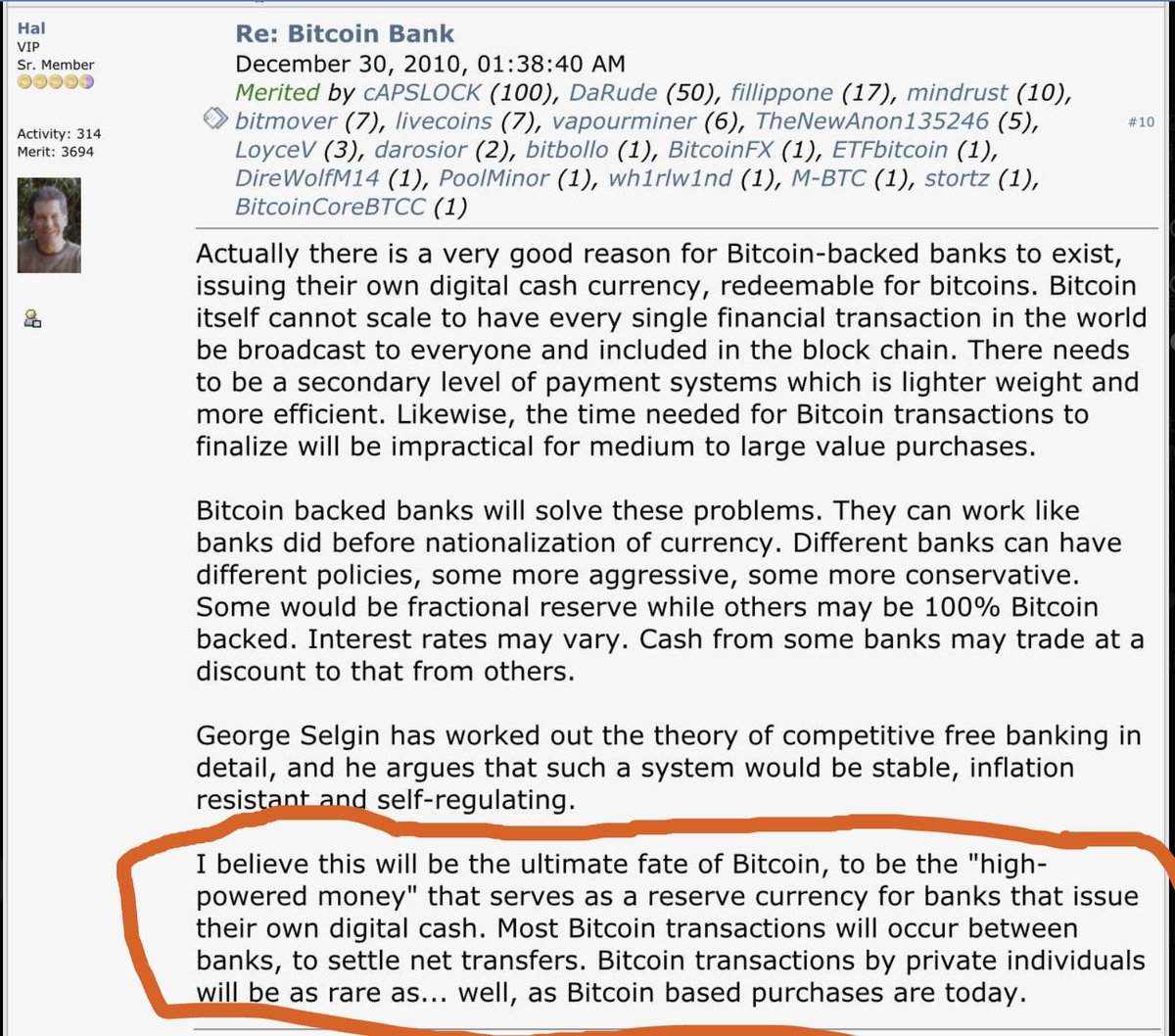
High-powered money.
Hal Finney entendió en 2010 lo que muchos todavía no entienden en 2026:
Bitcoin no tenía que procesar todos los pagos del mundo.
Tenía que convertirse en la capa final de liquidación.
El error de los críticos es medir Bitcoin como si fuera Visa. El error de los turistas es venderlo como si fuera PayPal. Bitcoin es otra cosa: es dinero de alta potencia.
La base monetaria. El colateral. El activo que no necesita prometer nada porque liquida todo.
Sobre el oro se construyeron bancos. Sobre los Treasuries se construyó el eurodólar. Sobre Bitcoin se va a construir crédito digital — como @AndresFelArias viene diciendo.
No porque Bitcoin "reemplace bancos" en el sentido infantil del meme. Sino porque los obliga a reorganizarse alrededor de un activo que no pueden imprimir.
Al final, la pregunta no es si vas a pagar el café on-chain.
La pregunta es: ¿qué activo va a respaldar el crédito cuando la gente deje de confiar en balances llenos de promesas estatales?
Hal no estaba imaginando un banco con logo naranja. Estaba describiendo el sistema financiero después de que el dinero base deja de ser deuda.
Bitcoin es high-powered money porque no es crédito. Es lo que queda cuando el crédito necesita arrodillarse frente a algo que no puede diluir.
El destino de Bitcoin no era reemplazar el banco. Era ser el activo que todo banco va a necesitar para sobrevivir.
Inference got a hundred times cheaper this year. The compute bill went up anyway.
If you understand why those two sentences are both true at the same time, you understand the most important thing happening in AI right now.
I work on inference for a living, at @nebiustf, where we run open-source managed inference at scale. Most of what follows is what I'm seeing from inside the bill.
12 months ago, the cost of 1M tokens of frontier-class reasoning was somewhere on the order of $60.
Today, an equivalent quality of output costs roughly $0.50.
Price /token of o1-level intelligence has dropped about a 128x in a year.
Price of GPT-4-level output has dropped roughly 100x since the original GPT-4 shipped.
By any normal reading of a technology cost curve, this should be deflationary. It should be saving customers money.
The opposite has happened. The total compute bill at every hyperscaler is going up, not down. Anthropic just signed multi-year capacity deals with both XAI and Amazon. Microsoft's Azure capex guide for 2026 starts with an eight. OpenAI is reportedly spending more on compute every quarter than it did in all of 2023. Nvidia paid roughly twenty billion dollars to acquire Groq, an inference-specialist company that did not exist as a serious commercial entity three years ago.
The cost curve and the demand curve crossed, and then the demand curve lapped the cost curve.
Here is what happened underneath.
A reasoning model burns roughly 10x the output tokens of a non-reasoning model on the same task, because it spends most of its tokens thinking out loud before answering. An agentic workflow chains roughly twenty times the requests of a single-shot completion, because it loops, calls tools, plans, retries, and synthesizes. A modern deep-research query (the kind a research analyst can fire off in fifteen seconds and then walk away from for ten minutes) costs more compute than 10 original GPT-4 queries combined. We made every individual token a hundred times cheaper, and then we built a generation of products that consume ten thousand times more tokens.
This is the Jevons paradox playing out at trillion-dollar scale, in compressed time, in front of everyone. Jevons noticed in 1865 that making coal-burning more efficient did not reduce coal consumption. It increased it, because efficiency unlocked uses that were previously uneconomic. Steam engines became more practical at smaller scales. Whole industries that could not afford coal at the old price suddenly could. Britain's coal consumption rose sharply, not despite the efficiency gains, but because of them.
The same thing is happening to AI compute right now and it is happening faster than any analogous historical cycle. Falling token prices did not contract demand. They unlocked agents, deep research, code-writing systems, multi-step reasoning, persistent memory, the entire next layer of AI products. Every product in that next layer consumes orders of magnitude more compute than the chat interfaces it is replacing.
The math at the aggregate level is brutal: 100x cheaper tokens times 10 000 more tokens equals a 100x larger total bill.
The implications stack quickly.
If you are running a hyperscaler, your 2026 capex guide is not a peak. It is a step on a curve. Inference is structurally always-on, twenty-four hours a day, in a way that training never was. Training is bursty. You spin up a cluster, run for weeks or months, and stop. Inference runs continuously, scales with usage, and the usage curve is exponential. Your power bill, your cooling bill, your transceiver count, your storage footprint, all of these were sized for a workload mix that no longer exists.
If you are running an AI software company built on top of someone else's closed API, you have a problem that did not exist a year ago. Your gross margins get worse as your customers get more value out of your product, because the more they use it, the more compute you pay for. The companies that win this are the ones that figured out vertical integration before the math caught them.
If you are watching this from a distance and trying to understand where the next bottlenecks form, the answer is everywhere downstream of "more inference compute, always-on, with massive memory state per session." The KV cache, the running memory state of a long conversation or an agent loop, is the silent monster of the inference era. It does not scale linearly with parameters. It scales linearly with context length and number of agent steps. A long agent session can hold tens of gigabytes of state per user, per session.
Multiply that by every concurrent user of every product, and you understand why $MU, $SNDK, $TOWCF, and the entire memory and packaging layer have re-rated the way they have.
The CPU-to-GPU ratio is evolving. Training is 1:8. Basic chat inference is 1:4. Agentic inference is 1:1, sometimes CPU-heavy. Google has split its TPU line in two, with a dedicated inference chip carrying tripled SRAM for KV cache. $INTC and $AMD just spent two earnings calls explaining that this shift is structural, not cyclical. The hardware map is redrawing in real time and the financial press is mostly still writing about training clusters.
The right framing of where we are right now is not that AI is hitting a wall. The framing a year ago that scaling was hitting a wall was the most expensive bad take of the cycle. The right framing is that AI got dramatically cheaper, dramatically more capable, and dramatically more useful, and the cost of running it at the new equilibrium of demand is much higher than the cost at the old equilibrium of demand, because the new equilibrium is enormous.
A meaningful share of what we actually do at Token Factory, day to day, is help customers stop their bills from running away from them. KV-cache management. Speculative decoding. Quantization. Routing. The kind of vertical integration that, eighteen months ago, every product team was happy to leave abstracted away behind a closed API. The reason this stack matters now is the same reason this whole essay matters: at the new equilibrium of inference demand, the cost of treating compute as a commodity is no longer survivable. The companies that figure out the layer beneath the API are the ones who keep their margins.
Cheaper tokens. More tokens.
Same coal as 1865.
You can just set up an auto DCA and walk away.
Watching charts, reading gossip about who's buying & selling... it's all high time preference dopamine inducing waste of time.
You can be confident that central banks will continue printing. Short term volatility is noise.
En 2022 BTC cayó de $65K a $15K.
¿Se vendió? No.
La tesis estaba escrita en una hojita de block amarillo.
Solana cayó de $249 a $8.
¿Se salió? No.
Se dobló la posición. Misma tesis. Mismo papel.
La diferencia con hoy es cómica:
en el último drawdown no había ETFs,
había muchos menos usuarios,
la SEC era abiertamente hostil,
y no existía ni rastro de regulación positiva.
El precio cae.
La tesis no.
Y cuando eso pasa, el error más caro no es aguantar:
es olvidar por qué se entró.
Ayer estaba escuhando el ultimo capitulo de @10ampro y de verdad:
"Tener una empresa en Colombia hoy es mas un acto de responsabilidad social que de generación de riqueza propiamente"
Dejo el substack con mi reflexión: https://t.co/BCqckio9Jo
This cycle is all about liquidity
1️⃣ Since 2021 the U.S. has been fueling markets with short-term T-Bills, not structural liquidity.
2️⃣ Private credit is expanding again.
3️⃣ The Fed is flat on QT, but we expect upcoming moves in rate cuts.
En un mundo en el que los gobiernos inyectan liquidez sin límite en el largo plazo, el mejor hedge son los activos escasos. Bitcoin con un suministro máximo definido y una inflación decreciente es el alpha! @davidso198
Adoption News: Middleman intermediary @PayPal introduces new rent seeking infrastructure to allow merchants to accept digital assets for payment across their network of merchants.
The spin.
PayPal will charge merchants a promotional fee of 0.99% on transactions for the first year and then up the charge to 1.5%, Frank Keller, an executive vice president, told @Fortune . Those fees are less than the 1.57% average rate that U.S. businesses paid to credit card companies in 2024, according to the Nilson Report.
The reality.
Adoption is hard, and this will get more merchants and customers to adopt crypto as a payment option which is the incoming payment rail, but understand, you dont need any intermediary to accept any crypto. You can swap any crypto for any other crypto or Stable Coin. Merchants can simply have a crypto wallet and accept direct peer to peer crypto payments. Paypal is placing a layer between merchants and the consumer and charging 1.5%. This is a first step but far from the end game for consumer payments.
Why not accept native crypto?
Bitcoin and Ethereum are slow and tedious to transact in at the retail level. This effort seems to use a centralized solution to this promlem once again mirroring Ethereum L2 behavior. Modern high speed L1s are designed to solve this problem without Paypal or any intermediary.
The saving in accepting crypto is the removal off ALL fees associated with accepting payments, this Paypal option reduces Visa Mastercard fees by half which are roughly 3% to 1.5% which is a step in the right direction, but not required. Merchants, accept native crypto and jump this intermediate step. You need no intermediary between your customers value and your merchant crypto wallet. 0 fees is the goal.
Summary
Although a step in the right direction for merchant awareness that crypto is available for payments and they should promote and accept crypto early because its the future of payments, I urge merchants to understand they dont need this. I applaud Paypal for their efforts and for finding a place in the supply chain, but we simply dont need any middlemen between customer and merchant, thats the while point of the blockchain.
https://t.co/mWgkHSvqVW