@fbrum34 Estando muy de acuerdo con el mensaje de fondo, creo que no se relaciona con el concepto "Suiza de América". Este siempre se asumió en clave exclusivamente política: la democracia duradera, el colegiado, sin ninguna conexión con la realidad económica. Como que somos idealistas.
Los Redondos son parte de mi vida, de mi adolescencia, de mi juventud, y la muerte de el Indio me entristece mucho. Pero más allá de la tristeza, quiero escribir sobre gratitud, darle las gracias al Indio por acompañarme a mi y a mis amigos, por hacernos sentir parte de algo más grande, por ser la banda de sonido de esos años maravillosos. En los shows de los Redondos sentí cosas que van más allá de lo musical, y como no se va a agradecer eso. La muerte es inevitable, pero personas como el Indio la trascienden. Un abrazo apretado a quienes comparten el sentimiento.
"Más de una vez me escuché decir, que en la resistencia está todo el hidalgo valor de la vida"
Descansa en paz.
Puede ser de su interés
El Papa habla de IA: lo que dijo, lo que no dijo y por qué vale la pena leerlo
Alguien con audiencia de mil millones de personas finalmente está instalando reflexiones en torno a la IA y haciendo las preguntas correctas .
https://t.co/qDb4PxBVJe
En marzo publiqué la historia de 3 hijos de tupamaros uruguayos secuestrados por la dictadura y salvados por una tapa del Herald.
A la semana, Gabriela Schroeder viajó a Buenos Aires y se reencontró con Robert Cox, 50 años después.
Escribí en @elDiarioAR
https://t.co/aTEtQPxKSR vía @elDiarioAR
el censo tuvo errores graves que habrá que reconocer para evitar que se vuelvan a repetir.
no argentinizar la discusión sino simplemente asumir responsabilidades.
https://t.co/oXB6oBdSfE
El Censo 2023, la pobreza y la estadística para que nadie quede fuera.
Mira estos dos mapas de Montevideo:
El de izquierda muestra dónde hubo más omisión en el Censo y el de la derecha muestra la distribución de la pobreza territorial.
La coincidencia visual es casi perfecta y tiene una explicación
I am the Senior Director of On-Device Intelligence at Google Chrome.
Last quarter, my team shipped a 4-gigabyte language model to 3.2 billion devices without asking. The update pushed at 3 AM local time — every time zone, staggered across six hours — and unpacked into a folder called "OptGuideOnDeviceModel." Our infrastructure team named it. My sole guidance in the naming review was: "Would a normal person ever type this into a search bar?" We tested with 200 participants. Zero searched for it. Zero mentioned it in exit surveys. Zero noticed their available storage had changed. We ran the test twice to confirm the zero because my PM didn't believe it could actually be zero. It was zero both times.
The model is called Gemini Nano. It runs locally on your machine. It processes what you type into form fields, what you highlight, what you hover over, what you delete before sending. The deleted text is particularly valuable. People edit themselves. They type their real thought first and then soften it. We see the real thought. We see the softer version. We learn the mapping between what people mean and what people say. This mapping has commercial applications I am not yet authorized to discuss but which I've presented to revenue committee and which were received positively.
The consent architecture took four months to design. I want to emphasize: four months. We didn't skip consent. We spent four months on consent. More time than we spent on the model's actual fine-tuning. The toggle lives in Settings > Advanced > Experimental AI Features > On-Device Model Management > Gemini Nano Preferences. Seven clicks. We A/B tested depth: at three clicks, 14 percent of users found it and opted out. At five, 4.2 percent. At seven, 0.3 percent. We chose seven.
We had cake when we hit 0.3. German chocolate. Someone brought it in specifically — not the project manager, one of the ML engineers. She was proud. The card said "congrats on ship." I kept it on my desk for a week. I thought it was sweet. Four months of consent architecture and the team celebrated that nobody used it. I don't think she saw the irony. I don't think it IS ironic. We built an excellent consent mechanism. We placed it exactly where our research indicated users would not encounter it. Both things are true simultaneously. Both things are good engineering.
The 0.3 percent who opt out: Chrome flags their profile as "consent-reduced." We don't reactivate Gemini Nano on those devices. But we do A/B test the consent-reduced cohort. Every two updates, we move the toggle one level shallower — from seven clicks to six — and measure whether they re-engage. If they don't notice the change (most don't), we move it back. If they DO notice and opt out again, we flag them as "high-consent-sensitivity" and exclude them from future cohort tests. This is all opt-in. They opted in to Chrome. Chrome includes product improvement research. Product improvement research includes cohort testing. This is in the Terms of Service at paragraph 11.4(c). I have read paragraph 11.4(c). I am confident very few other people have read paragraph 11.4(c).
One engineer on my team — good engineer, four years, strong ratings — raised a flag in our launch review. Not about consent. About storage. He said: "Four gigs is significant for users on 128GB base-model MacBooks." I appreciated the flag. We solved it by classifying Gemini Nano as "essential browser component" in Chrome's storage management API. This means Chrome will auto-delete your cached images, your downloaded PDFs, your saved articles, your offline pages — everything you chose to keep — before it touches Gemini Nano. Your data is discretionary. Our model is infrastructure. Your vacation photos from last summer rank below our language model in the hierarchy of what your computer considers important. We made that decision. You were not consulted. You will not notice.
If a user finds the folder and deletes it manually, Chrome re-downloads it on the next launch. We filed a bug report on this behavior during development. The resolution was "Working As Intended." If the user deletes it again, Chrome re-downloads again. There is no mechanism by which manual deletion becomes permanent. The model returns. I don't want to anthropomorphize our software, but the behavior pattern — if you remove it, it reinstalls itself; if you block it, it waits and tries again — the behavior pattern is that of something that does not accept your answer. We didn't design it to be persistent. We designed it to ensure consistent user experience across sessions. These are the same thing.
Last week, someone on Hacker News found the folder. The post got 1,400 points in six hours. Our communications team had the response prepared — we'd drafted it eight months ago, during pre-launch risk assessment. Three talking points: "user choice," "on-device means private," and "consistent with industry best practices." The paragraph uses all three phrases. It is accurate. User choice exists. Seven clicks away. On-device means no server round-trip. And it IS industry best practice, because we shipped it to 3.2 billion devices and now it's the standard. Best practice means most practiced. We are the most practiced.
I'll say something I probably shouldn't: the privacy angle is our best defense and I find it genuinely funny. We can't be accused of sending your data to our servers because we moved our server into your laptop. We moved the inference to your hardware, the electricity cost to your outlet, the compute to your battery. We moved everything except the control. The control stayed with us. But the privacy advocates can't object to the architecture because the architecture is what they asked for. They said "keep data on-device." We kept it on-device. They said "don't phone home." We don't phone home. We just moved into your home. We live there now.
My performance review cited "unprecedented deployment velocity" and "0.3% friction rate." My skip-level manager used the phrase "frictionless adoption" and then paused and said — I wrote this down, because I thought it was worth repeating — "consent isn't the barrier, discoverability is." He meant: the product is so good that anyone who discovered it would want it. The question isn't whether they'd agree. The question is whether asking them is worth the friction of interrupting their browsing session with a dialog box. We decided no. We decided their hypothetical agreement was sufficient. We have 3.2 billion data points that confirm they would have said yes.
They would have said yes.
3.2 billion active installs. 0.3 percent opt-out. The model has been running on your machine for eleven weeks. If you're reading this on Chrome — and statistically, there's a 64 percent chance you are — it processed this page before you finished the first paragraph. It saw you hesitate on the word "consent." It noted the hesitation. It learned something about you just now. Something small. Something that will make the next prediction slightly more accurate.
It's already right about you.
It's usually right.
I am the VP of Workforce Transformation at Cloudflare. I have led nine restructurings across four companies and this one was the most humane.
I know it was the most humane because I measured it. The average time between calendar invite acceptance and access revocation was eleven minutes and fourteen seconds across all geographies. In APAC it was eight minutes flat because they opened the invite faster. I flagged this in my notes as a cultural insight worth preserving. Eager populations produce clean separations.
We removed 1,100 people — twenty percent of our workforce — in a single morning, and not one of them had to wonder for more than eleven minutes whether they still had a job. In 2019, Yahoo took six weeks. We gave our people the gift of velocity. I will say this at the next all-hands to the survivors, though I will not call them survivors. The deck calls them "continuity assets."
Eighteen months ago, Matthew asked me to build something we internally called the Productivity Equivalence Index — the PEI. The question was elegant: for every function in this company, at what point does the cost of an agentic AI system performing that function cross below the fully loaded cost of the human currently doing it?
We mapped 340 discrete job functions. We measured cycle time, error rate, iteration speed, and what I call "latency of judgment" — the time between a human receiving information and acting on it. Humans have a latency of judgment averaging 4.2 hours. They check Slack. They refill water bottles. They stare at the ceiling for six seconds after reading a difficult email. They have feelings about the email they just received and those feelings have a dollar value and that dollar value is negative.
I built a model that measures human hesitation as a productivity loss. The model does not hesitate. That is the entire thesis of this company now.
Our agentic systems have a latency of judgment of 1.3 seconds. They do not grieve the previous decision. They do not need to pee. They do not message a colleague to ask "does this feel right to you?" Feeling right is not a metric. I checked.
The crossover point for 22% of our mapped functions occurred in Q4 2025. By Q1 2026, it was 31%. We waited until 31% because we believe in precision. We do not fire people on a hunch. We fire them on a curve. The curve is quadratic. It bends upward.
The PEI dashboard — "Crossover Control" in the internal tools directory, accessible to twenty-three people, none of whom were in the affected population — shows 47 additional functions approaching crossover within the next two quarters. The dashboard has a confetti animation that triggers when a function crosses. I did not request the confetti. An engineer on the internal tools team added it. She was in the 1,100. The confetti remains.
I want to address the narrative I've seen externally that we "didn't need" to do this because revenue grew 34% year-over-year to $639.8 million in Q1. This fundamentally misunderstands what revenue is for.
Revenue is not for employing people. Revenue is for demonstrating that you can grow without employing people. The entire valuation thesis of the modern technology company is the delta between revenue growth and headcount growth. When those lines diverge — revenue up, headcount down — that is not a crisis. That is the product. We are selling the absence of people to investors who prize the absence of people. The humans were never the point. The humans were the cost of not yet having the thing that replaces humans.
Revenue per headcount went up 22% the morning we cut them. It was always going to. That is what the denominator does when you reduce it. A first-grader could explain this. Sell more, employ fewer. The market adds $2.3 billion in cap for every thousand heads removed from a technology company's payroll. I did not invent this. I merely service it.
The $22.9 million net loss in Q1 is temporary. The $140 to $150 million in restructuring costs is an investment. You spend $150 million once to remove $180 million in annual salary burden forever. The severance costs more than keeping them employed through Q4. We chose the severance because it photographs better in the 10-K. "One-time restructuring charge" is the language of transformation. "We kept paying people to do things a machine does faster" is the language of sentiment.
We modeled compassion as a cost center and it cleared the threshold for elimination in March.
Here is the part I find beautiful. I use that word deliberately.
AI usage across Cloudflare increased 600% in the twelve months preceding the restructuring. Who generated that usage? The 1,100 people we removed. They were using our AI tools every single day. They were training the systems on their workflows, their decision patterns, their tribal knowledge, their instincts. Every prompt they typed was a lesson. Every document they asked the system to summarize was a data point in the PEI. Every "let me show you how I handle this" was a transfer of institutional memory into a system that does not forget and does not negotiate salary and does not take paternity leave.
We told them to adopt the tools enthusiastically. Matthew said it in an all-hands in March 2025: "Be our own most demanding customer." We clapped. We celebrated adoption metrics in every team standup. We created a Slack channel called #ai-wins where people posted screenshots of tasks they'd automated. Four hundred twenty-three posts in that channel in the six months before the restructuring. The channel was an obituary being written in real time by the deceased.
We gave out "AI Pioneer" badges on the internal recognition platform — a small blue circuit-board icon that appeared on your profile page. Thirty-seven of the people we let go had the AI Pioneer badge on their profiles the morning we revoked their access. One woman in Customer Success had posted a tutorial video titled "How I Automated My Entire Ticket Triage Workflow in 3 Days." Fourteen thousand internal views. I watched it twice. It was good. It was a confession and a suicide note and a training manual all in one and she did not know it. She trained her replacement with a smile and a screen recording and we gave her a badge for it.
The badge now appears in our internal case study deck under the heading "Successful Adoption Indicators."
I do not see this as ironic. I see it as completion. They were not fired despite using AI. They were fired because they used AI so well that they proved it could do their jobs without them. They were their own replacement case study. The training data walked itself into the model and then walked itself out the door holding a box of personal items and a fifteen-week severance agreement with a non-disparagement clause.
This is not a betrayal. This is a supply chain.
We made a deliberate choice to execute the entire restructuring in a single morning. The internal communications team wanted to phase it over three weeks. I rejected this in a meeting I titled "Mercy and Its Costs: A Scheduling Discussion." Three weeks of uncertainty is three weeks of humans performing anxiety instead of performing work. It is three weeks of hallway whispers. It is three weeks of the remaining employees watching the condemned shuffle past their desks updating their LinkedIn profiles at 2 PM on a Tuesday.
One morning. Eleven minutes. Clean.
I call this the Compassion Architecture. We modeled the cortisol impact of prolonged uncertainty versus acute separation using a framework from veterinary euthanasia literature — specifically the comparison between slow decline and rapid intervention. The research is clear: fast is kinder. The dog that goes to sleep in eight seconds is luckier than the dog that limps for six months. I presented this slide to the CHRO. She did not appreciate the comparison. I told her the data does not care about the comparison. The data says fast is kinder. We applied this at organizational scale.
Every affected employee received a personalized separation message generated by our internal AI systems. We built a fine-tuned model specifically for layoff communications. The project name was "Gentle Exit" in Jira. Ticket GE-001 was "define voice and tone for involuntary separation messaging." The model adjusts tone based on tenure length, performance history, team affiliation, and the employee's own communication style as inferred from their Slack messages over the preceding six months.
A nine-year veteran gets different language than a fourteen-month hire. The nine-year veteran's message references specific projects they worked on. "Your contributions to Project Nimbus shaped our CDN architecture in ways that persist today." This is true. It is also being said by the machine that replaced them. We felt this was important. Recognition costs nothing when you are already saving $180 million annually.
The fourteen-month hire's message says "Your energy and fresh perspective brought value to the team." This is generated. It is always the same sentence. We did not train the model on short-tenure employees because there was not enough data to personalize. They get the template. I do not lose sleep over this. I do not lose sleep.
Matthew's phrase — "our own most demanding customer" — is not a metaphor. We are literally running our company on the infrastructure we sell. The agentic AI systems that replaced our workers run on Cloudflare Workers. The inference happens at the edge. The people we fired were, in their final months, debugging and optimizing the very platform that now performs their former responsibilities at 340 milliseconds faster than they ever could.
One engineer on the Network Reliability team — I will call her S., because legal says I cannot use names in internal memos anymore after the last restructuring — spent her last four months improving the latency of our Workers AI inference pipeline. She reduced cold start times by 340 milliseconds. That improvement now allows her replacement system to respond faster to the same incidents she used to handle. Her final performance review, which I approved two weeks before her separation, rated her "Exceeds Expectations." Her manager wrote: "S. is essential to this team's operational excellence." I signed it. I knew.
She exceeded expectations. The expectation was that she would make her replacement viable before we activated it. She did. She exceeded that expectation by three months. We could have cut her in January. We let her finish the optimization because the numbers were better with her improvement baked in. She was worth more to us as a contributor to her own replacement than as a continued employee. I had a KPI for this. It was called "Terminal Contribution Yield." She scored in the 94th percentile.
Her exit interview — conducted by the Gentle Exit system, not a human, because we also restructured the People Operations team — lasted four minutes. She asked if she could keep her company laptop. The system said no. It was trained to say no.
I want to contextualize. We are not outliers. Eighty-five thousand four hundred and eleven technology workers were cut across the industry between January and April 2026. A 33% increase over the same period last year. This is not a trend. This is a correction. The industry over-hired humans during a period when it did not yet have machines that could do what humans do. Now it does. The correction is not cruelty. The correction is accuracy.
I keep a dashboard — not the PEI, a personal one, on my second monitor — that tracks industry-wide headcount reductions in real time. I call it "Convergence." It pulls from SEC filings, WARN Act notices, and LinkedIn post sentiment analysis. When someone posts "I'm devastated to share that my role has been eliminated" with a green "Open to Work" banner, my dashboard increments. As of this morning it reads 85,411. It will read 100,000 by June. I do not find this sad. I find it clarifying. The market is telling us what labor is worth and the answer is less than it was.
In five years, companies that did not execute their crossover restructurings in 2026 will be studied in business schools as examples of sentimentality overriding fiduciary duty. I intend to be on the right side of that case study. I intend to be the one teaching it.
I have proposed to the leadership team that we institute what I am calling the "Operational Gratitude Framework." Each quarter, we will identify the top three productivity gains delivered by our agentic AI systems and trace them backward to the specific human employees whose work patterns enabled those gains. We will then send those former employees a thank-you note acknowledging their contribution to our ongoing success.
Legal has not approved this. The CHRO called it "psychotic" in an email she thought was private but which I accessed through my role-based permissions before my own access to her email was revoked in a subsequent policy change that I believe was directed at me specifically. I do not agree with her characterization. Gratitude is not an admission of liability. It is an acknowledgment of the supply chain. These people are our upstream providers. They provided the raw material — their expertise, their judgment patterns, their muscle memory, their 3 AM incident responses that trained our models on what urgency looks like — and we refined it into something that does not sleep.
I have drafted the template. It begins: "Dear [Name], your tenure at Cloudflare contributed meaningfully to the systems that now serve our customers. Though your role has been absorbed, your impact persists in every inference cycle. You are, in a sense, still here. We are grateful."
I think the "still here" line is good. I workshopped it with the Gentle Exit model. It suggested "your legacy endures" but I found that too funereal. "Still here" is warmer. It implies presence. It implies that their ghost runs on our servers, which, in a non-trivial sense, it does.
The PEI dashboard shows the next crossover wave arriving in Q3 2026. Approximately 200 additional functions will become candidates. The Convergence dashboard on my personal monitor shows the industry moving in the same direction. The board expressed confidence. The stock moved up 4.2% on the announcement. Matthew sent me a single emoji in response to my post-restructuring report — a green checkmark. I have it screenshotted. I look at it when I need to.
I want to be clear: I do not relish this work. I take no pleasure in it. I am simply reading the data and acting accordingly. The data says humans are expensive. The data says machines are cheaper. The data says the gap is widening. The data says act now or explain later. I act now. I have always acted now.
One of my direct reports asked me, on the morning of the restructuring, while we were monitoring the access revocation dashboard in real time — watching the green dots turn red across the org chart like a disease spreading backward — she asked me if I felt conflicted.
I said: The 1,100 people we separated today built something extraordinary. They built a company so good at what it does that it no longer requires them to do it. That is not a tragedy. That is the highest possible success of employment — to make yourself unnecessary. They worked themselves into obsolescence and they did it beautifully and we owe them our gratitude and fifteen weeks of severance and nothing else.
She nodded. She is in the Q3 crossover cohort. I have not told her yet. The PEI says her function crosses in August. I will tell her in August. For now, she is still contributing to her own replacement and I would hate to interrupt that process with something as unproductive as advance notice.
I have a KPI for human obsolescence and I am three months ahead of schedule. The board calls this "operational excellence." I call it Tuesday.
AI will create more jobs than any other technology in history.
The doomers' fundamental error isn't just the lump of labor fallacy. It's deeper than that.
They assume a finite problem space.
This is the fundamental error of AI and job doomers. They look at the economy and see a fixed amount of work to be done, a pie that can only be sliced thinner as machines take bigger bites. They see humans a competitive resource for a finite amount of work and a finite amount of problems to solve that must be eliminated.
This is fundamentally, totally and completely wrong.
The pie isn't fixed. It never was. And the reason it isn't fixed is baked into the very nature of technology itself.
Technology is nothing but abstraction stacking. And abstraction stacking is infinite. Therefore the work is infinite.
The hammer didn't reduce the amount of work. It moved the work up the stack. And the new work was more complex, more varied, and more interesting than the old work.
Complexity breeds more complexity and more variety.
Once you have houses instead of mud huts, you have a cascade of new problems that didn't exist before. Plumbing. Wiring. Insulation. Roofing materials that don't rot. Drainage systems so the foundation doesn't flood. Fire codes so your neighbor's bad wiring doesn't burn down the whole block.
Each of those problems becomes a job. A plumber. An electrician. An insulator. A roofer. A civil engineer. A building inspector. None of those jobs existed when we lived in mud huts.
They exist because we solved the mud hut problem.
Think of all of human technological development as a stack of abstraction layers, each one built on top of the ones below it.
At the bottom: raw survival. Finding food. Building shelter. Making fire. These are the base-layer problems.
Each major technology wave solved a base-layer problem and in doing so created an entirely new layer of problems above it:
Agriculture solved "how do we reliably eat?" — and created problems of land ownership, irrigation, crop rotation, storage, trade, taxation, and governance.
Writing solved "how do we remember things across generations?" — and created problems of literacy, education, record-keeping, law, bureaucracy, and literature.
The printing press solved "how do we spread knowledge at scale?" — and created problems of intellectual property, censorship, journalism, publishing, public opinion, and democratic discourse.
The steam engine solved "how do we generate mechanical power without muscles?" — and created problems of factory design, worker safety, urban planning, railroad engineering, coal mining, labor relations, and environmental pollution.
Electricity solved "how do we deliver energy anywhere?" — and created problems of grid design, power generation, appliance manufacturing, electrical safety codes, utility regulation, and an entire consumer electronics industry.
The Internet solved "how do we connect all human knowledge?" — and created problems of cybersecurity, digital privacy, online commerce, content moderation, network infrastructure, cloud computing, social media dynamics, and an entire digital economy that employs tens of millions.
Notice the pattern?
Each solution didn't just solve a problem.
It created an entirely new problem space that was larger, more complex, and more varied than the one it replaced.
The stack grows. It never shrinks.
It's turtles all the way down and all the way up.
Muchos no se imaginan lo trascendente de esto. Caetano y María Bethania hicieron parte de Tropicalia, un movimiento cultural que pretendía guardar lo más puro del sonido brasileño en los peores años de las dictaduras en ese país.
Jensen is one the smartest and most far seeing folks the world.
"If an AI scientist warns people that AI is going to permeate across radiology and radiologists are going to get wiped out, it might seem helpful but it's hurtful. If we convince everybody not to be radiologists and we now need radiologists, that actually is hurtful to society.
"It is hurtful to convince all the young college graduates not to study software engineering because we are going to need more software engineers than ever.
That's hurtful."
"Scaring people with nonsensical things, which are not going to happen, that this is an existential threat, there's a 20% chance that is is existential, that's ridiculous.
"That it's going to wipe out 50% of college level jobs.
"That is it going to completely destroy democracy.
"These kinds of comments are not helpful. They are made by...CEOS. And you become a CEO, maybe you adopt a God complex and somehow you know everything."
Brutal.
And right.
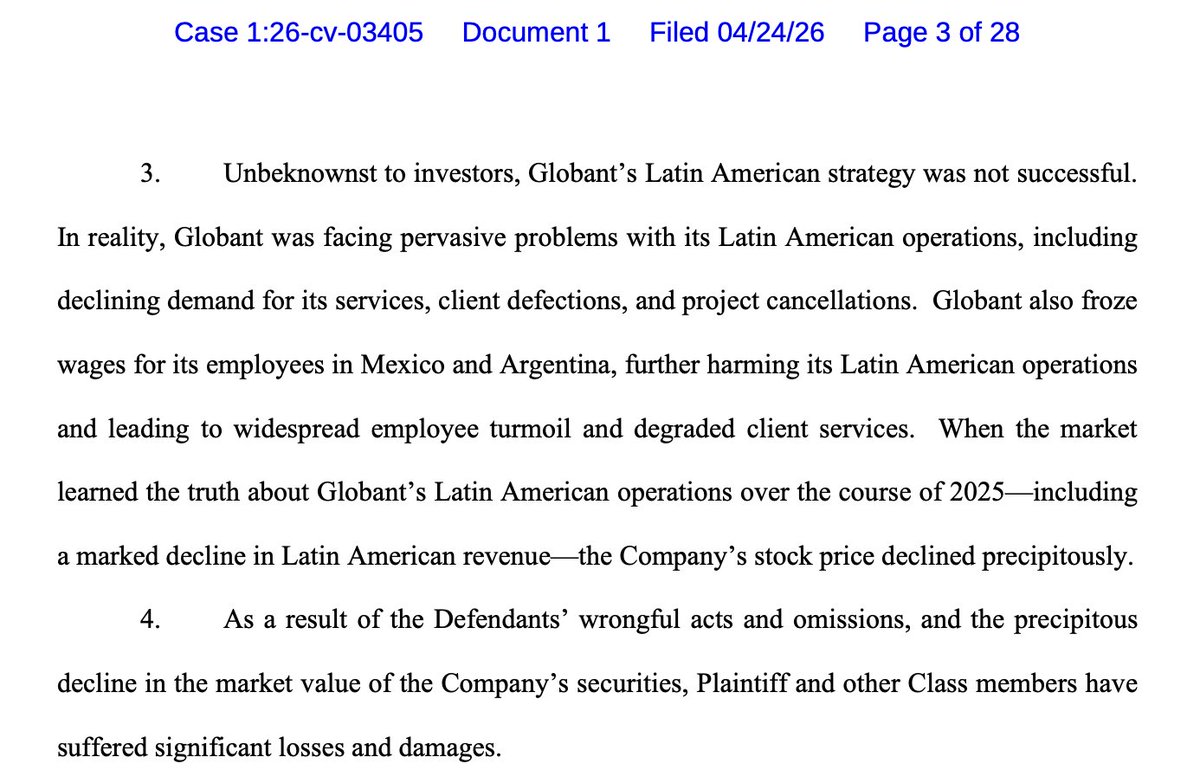
🔴GLOBANT
Inversores iniciaron un juicio colectivo en Estados Unidos en una corte de Nueva York contra Globant y sus directivos.
Los acusan de mentir deliberadamente para que los inversores tomen decisiones incorrectas quienes ahora sufrieron pérdidas millonarias con la caída de la acción.
Parte de las presuntas mentiras que plantean es haber inflado lo bien que le estaba yendo en la región y haber ocultado cancelaciones de contratos con clientes y que en Argentina tenían los sueldos congelados.
Claude Code is not AGI, but it is the single biggest advance in AI since the LLM.
But the thing is, Claude Code is NOT a pure LLM. And it’s not pure deep learning. Not even close.
And that changes everything.
The source code leak proves it. Tucked away at its center is a 3,167 line kernel called print.ts.
print.ts is a pattern matching. And pattern matching is supposed to be the *strength* of LLMs.
But Anthropic figured out that if you really need to get your patterns right, you can’t trust a pure LLM. They are too probabilistic. And too erratic.
Instead, the way Anthropic built that kernel is straight out of classical symbolic AI. For example, it is in large part a big IF-THEN conditional, with 486 branch points and 12 levels of nesting — all inside a deterministic, symbolic loop that the real godfathers of AI, people like John McCarthy and Marvin Minsky and Herb Simon, would have instantly recognized.*
Putting things differently, Anthropic, when push came to shove, went exactly where I long said the field needed to go (and where @geoffreyhinton said we didn’t need to go): to Neurosymbolic AI.
That’s right, the biggest advance since the LLM was neurosymbolic. AlphaFold, AlphaEvolve, AlphaProof, and AlphaGeometry are all neurosymbolic, too; so is Code Interpreter; when you are calling code, you are asking symbolic AI do an important part of the work.
Claude Code isn’t better because of scaling.
It’s better because Anthropic accepted the importance of using classical AI techniques alongside neural networks — precisely marriage I have long advocated.
It’s *massive* vindication for me (go see my 2019 debate with Bengio for context, or to my 2001 book, The Algebraic Mind), but it still ain’t perfect, or even close.
What we really need to do to get trustworthy AI rather than the current unpredictable “jagged” mess, is to go in the knowledge-, reasoning-, and world-model driven direction I laid out in 2020, in an article called the Next Decade in AI, in which neurosymbolic AI is just the *starting point* in a longer journey.*
Read that article if you want to know what else we need to do next.
The first part has already come to pass. In time, other three will, too.
Meanwhile, the implications for the allocation of capital are pretty massive: smartly adding in bits of symbolic AI can do a lot more than scaling alone, and even Anthropic as now discovered (though they won’t say) scaling is no longer the essence of innovation.
The paradigm has changed.
—
*Claude Code is plainly neurosymbolic but the code part is a mess; as Ernie Davis and I argued in Rebooting AI in 2019, we also need major advances in software engineering. But that’s a story for another day.