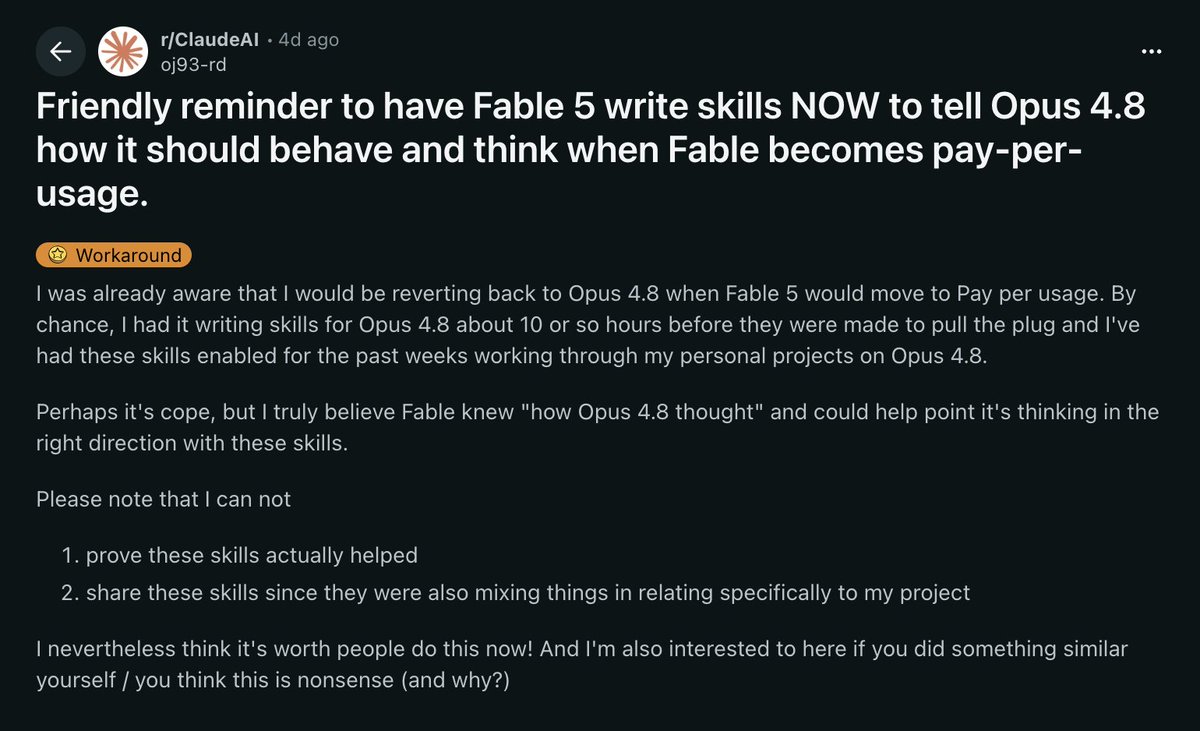
Fable 5 goes pay per use in 2 days. Make it train its replacement before it does.
Have Fable 5 write Skills for the models you'll actually keep using, so its judgment stays even after the model goes behind credits.
The best version from the thread: tell Fable it's "a retiring principal engineer" leaving a complete skill library behind for the team.
→ It audits your repo like an incoming senior engineer
→ Writes 10-16 SKILL files: debugging playbook, change rules, the failure stories that cost real time
→ Opus and Sonnet then run that playbook on cheaper sessions, at Fable's standard
Fair warning from the thread: the run can eat 30% of your weekly Fable usage. Still worth it.
Full prompt in comment 1, my Fable 5 playbook below. Bookmark this.
THIS IS HOW FABLE 5 MOVES WHEN YOUR VAULT IS BUILT RIGHT
direct path. zero wandering. hits the target on the first try.
without structure it's the opposite. 7 files opened. 2 minutes wasted. brief from 3 months ago still missing.
one index file per major folder. gives the agent a direct line to what it needs.
same task dropped from 2 minutes to 10 seconds. same model. nothing else changed.
build the path or watch it search in the dark.
full breakdown in the article below ↓
HE BUILT A $10,000-TIER ANIMATED SITE WITH CLAUDE CODE - FOR THE COST OF A SUBSCRIPTION
What's on screen isn't a landing page with a parallax background
It's a fully interactive, scroll-driven site with real-time 3D rendered in the browser
What's actually on the page:
> 3D product models rotating and reacting to scroll in real time via WebGL
> Smooth hover interactions and transitions - no hand-coded keyframes
> Cinematic minimal aesthetic that got featured on Awwwards
> Typography layering, editorial layouts, everything assembled in one session
What it normally takes:
> A 3D artist, a motion designer, and a frontend developer
> Weeks of handoffs - modelling, exporting, wiring animations, layout, copy
> Six separate systems integrated by hand
That pipeline was the moat. It's what justified the invoice
The price gap:
> Studio build at this level: $5,000-10,000+
> Your cost: a Claude subscription
Timeline:
weeks of production -> a single session
Full walkthrough in the article below
Karpathy method + Claude Code reading your whole Obsidian vault is the smartest second brain on earth.
The method is simple and brutal. If you can’t build a thing from scratch, you don’t know it. Tutorials are fake learning and your brain deletes them in 3 days.
Most people ignore this. They build a second brain that just sits there, folders of notes nobody reopens, dead text.
Point Claude Code at the vault and it wakes up. 5,000 notes, one mind. It reads all of it and answers in your own words and your own proofs, not a model’s guess.
Then the loop closes.
Want to understand neural nets? Skip the 3-hour video and ask Claude Code to build a tiny one. 200 lines from scratch. Watch it train, break a layer, watch it fail, fix it.
It clicks in 20 minutes instead of 3 weeks.
The second it lands the note gets written. One idea per file, linked to 10 others, dropped into the vault while the memory is still hot.
Now it compounds.
Month 1: is 60 notes. Month 6 is 900. Every new note pulls in old ones, so you ask anything and the answer comes from your brain, not the internet.
Before: 40 tabs, 6 half read PDF, 0 retained.
After: build it once, own it for life.
Setup takes 4 minutes. Plain text, no lock-in.
A second brain nobody reads is a graveyard.
Yours just started thinking.
stop telling Claude Code/Codex "read this file".
stop telling Claude Code/Codex "now read that one too".
stop telling Claude Code/Codex "grep the whole repo".
install codebase-memory. it indexes the Linux kernel, 28M lines, in 𝟯 𝗺𝗶𝗻𝘂𝘁𝗲𝘀. your repo takes seconds.
index once and the whole repo becomes 𝗼𝗻𝗲 𝗴𝗿𝗮𝗽𝗵 of every function, file and dependency. one query replaces dozens of grep and read cycles.
benchmarked across 31 real repos:
→ 10x fewer tokens on structural queries
→ 83% answer quality on complex tasks
→ 2.1x fewer tool calls
two prompts. send them straight to your agent 👇
You can build an AI second brain in 15 minutes.
No coding experience needed. no $1000 course
[Here is how you can do it in 5 mins:]
Step 1: Download Claude Desktop.
Step 2: Download Obsidian Desktop.
Step 3: Create a new vault and start dropping .MD files into it.
Step 4: Tell Claude Code to connect directly to your vault using Andrej Karpathy's prompt: https://t.co/2SJBZyjXDl
That is it.
Your entire knowledge base becomes searchable, connectable, and queryable by the most powerful AI model on earth.
Every note you have ever written.
Every idea you have ever captured.
Every resource you have ever saved.
Claude can now read all of it, find connections you missed, and surface insights from your own thinking that you forgot you had.
Most people are using Claude as a search engine.
The people building second brains with it are using it as an intelligence layer on top of everything they know.
The gap between those two use cases is the gap between asking Google a question and having a research partner who has read everything you have ever written.
Bookmark this.
Build it tonight.
I genuinely don't understand why everyone isn't using this yet.
Andrej Karpathy, OpenAI co-founder, posted a simple idea that went massively viral:
Stop using AI to write code.
Use it to build a second brain.
You point Claude Code at a folder. Drop in any source: an article, a transcript, a PDF.
Claude reads it, links it, files it into a living wiki of everything you know.
It compounds like interest. The more you feed it, the smarter it gets.
Here's the whole thing:
1) Install Obsidian
2) Create a vault
3) Open it in Claude Code
4) Paste Karpathy's wiki idea and tell Claude to build it
5) Claude makes three folders:
- raw (for sources)
- wiki (for its pages)
- CLAUDE. md (that runs it)
6) Drop any source into raw and say: "ingest this"
7) Ask questions across everything, forever
Five minutes to set up and you never start from a blank chat again.
Full step by step guide below.
We’ve added global orderbook metrics that aggregate every ticker across all major exchanges (spot & perp) and depths into a single view. 1000+ tickers across all major exchanges in one metric.
Instead of looking at BTC, ETH, SOL, or others in isolation, these indicators combine them all — giving you the aggregate order book of the entire crypto market. This lets you see supply and demand for the entire crypto market — not just one exchange or asset.
Track global books, bid/ask deltas, ratio shifts, and cumulative imbalances to see market-wide supply, demand, and sentiment in one place. Filter by all exchanges or any combination of exchanges including "spot only" or "perp only". Filter by depths such as global aggregation across just 2%-5% depth.
Here’s what you can track:
1. Global Combined Books – Total passive limit buys (bids) and passive limit sells (asks) orders across all exchanges and assets.
2. Global Bid-Ask Delta – Net difference between global bids and asks → market-wide limit buy vs limit sell pressure.
3. Global Bid-Ask Ratio Change – Shifts in the bid/ask imbalance across the full market.
4. Global Ask Change – Increase or decrease in all global asks (limit sell orders).
5. Global Bid Change – Increase or decrease in all global bids (limit buy orders).
6. Global Cumulative Delta – Running imbalance of global bids vs asks over time.
GM.
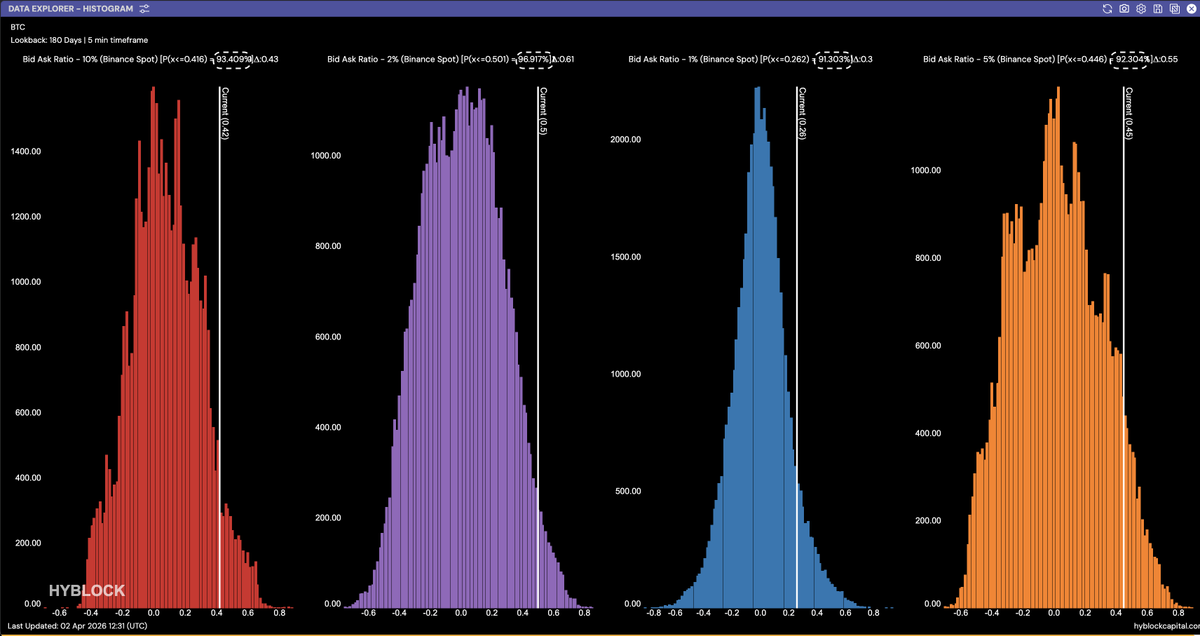
The orderbooks are back flashing outliers across the board. We are seeing bid imbalance on btc spot orderbooks across all four depths: 1%, 2%, 5%, 10% and all four are in the 90th percentile or higher.
The global orderbook bid ask ratio (which is the orderbook of 1000+ coins aggregated) is also showing a strong bid imbalance, indicating real demand across the entire crypto universe.
ANTHROPIC JUST QUIETLY SHIPPED A FEATURE THAT LETS CLAUDE SPAWN A WHOLE TEAM OF AGENTS THAT MESSAGE EACH OTHER AND REVIEW EACH OTHER'S WORK.
It's a Claude Code feature called agent teams. The team lead spawns multiple agents that share a task list and message each other directly, not subagents reporting back, actual peers. In the demo a QA agent caught three bugs, sent the work back to the front-end and back-end devs, they fixed it, app shipped in one pass.
How to run it:
1. Enable it. Needs Claude Code v2.1.32+. Add to settings.json: "env": { "CLAUDE_CODE_EXPERIMENTAL_AGENT_TEAMS": "1" }. Or paste that to Claude and say "add this to my settings." Restart.
2. Prompt in plain English. Start with a goal (agents wake with zero context), then "create a team of 3 using Sonnet," describe each role, its deliverable, and who it messages when done.
3. The rules: each agent owns its own files, define exact outputs, name who talks to who, keep it to 3-5 agents.
Use it for complex work with separate parts running in parallel. Skip it for simple or sequential tasks, teams cost 3-4x the tokens.
Bookmark this.
WE ARE SOOOOO BACK!
Someone leaked the Claude Fable 5 system prompt and ran it on an Opus 4.8
Output is like 90% of the real thing
Turns out half the magic was never the weights. It was the prompt the whole time
Repo down below:
THIS GUY CONNECTED CLAUDE TO TRADINGVIEW AND CUT 200+ HOURS OF MANUAL CHART WORK
40 trades a week used to mean the same loop: open the chart, check RSI, compare EMA, write notes and wait for the next setup
now Claude reads TradingView 24/7, tracks volume, indicators and price conditions while he is not even at the desk
this is not a $20k trading terminal and not a quant fund setup, just one laptop, one chart and one strategy written in plain English
the crazy part is not that Claude predicts the market, it is that a regular trader can remove the boring human loop from every setup ↓