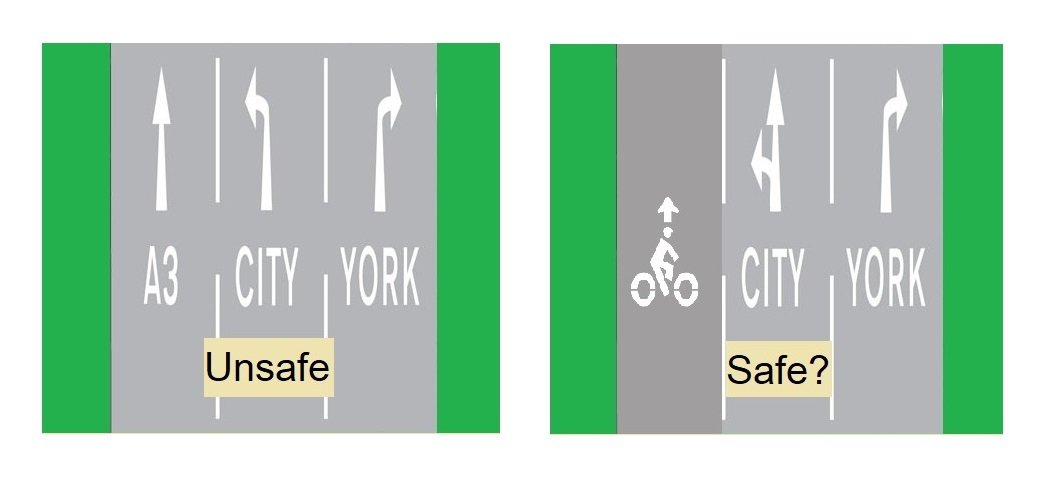
If we treated race relations like cyclists:
"Due to a spate of lynchings, it has come to our attention that Negroes are no longer safe in white society. Henceforth, they will be confined to small, specially-built ghettos. Further, to further prevent lynchings ...
@s70gad The attitude of them is something else. Personally if they refuse to use infustructure provided for them the the close pass rule should not apply.
@chase_swiss@NoMoreBikeLanes@QuintonLucasKC Those who ride bicycles with any regularity and do so far and fast, have the best understanding of positioning and traffic flow principles. In the past, most every cyclist opposed Dutch-style "infrastructure" in countries still lacking such rubbish.
https://t.co/eNfEtJi2qQ
@ReviewsPossum The meaning of the term "liberal" is quite different from that even 20 years ago, and neither has anything in common whatsoever with the original meaning of the term. But the same is true also of "conservative". These are meaningless labels that keep us forever in conflict.
Last night, I read the entirety of C.S. Lewis' The Screwtape Letters. It's a novel told in the form of letters written by a demon to another demon instructing him on ways to manipulate his "patient" to do evil.
This one quote sounded familiar.
@TheSolarShed To some extent, yes. If Somalians can't adapt to the local customs, what are they doing in the UK? Why do we have to pander to them when they are unwilling to respect our customs and our ways of life?
@GerardCarruthe2@2Wheeledbarbie That's not "whataboutery". That's why people cycle on pavements. So, do you respect cyclists when they are cycling where they are supposed to be: on the road? Do you think most other motorists respect cyclists' right to the road and drive in a fashion that keeps them safe?
@BudrinoPolitics "Practically every cyclists supports running red lights." I'd like to see your evidence for that. This cyclist certainly does not, and I rarely see cyclists running red lights.
And that’s the problem. It’s not that some cops are women; it’s that standards are lowered in order to meet diversity requirements. There are a LOT of men who apply to become cops who have absolutely no business carrying a badge, and the vast majority of them are not hired. Women, on the other hand, are basically guaranteed a job, whether or not they are fit for service.
Most women shouldn’t be cops. Neither should most men, to be fair, but the physical and psychological differences between men and women mean that fewer women will be suited for the work. I am an unusual woman in a few ways; I’m in the top 1% for height, am taller than most men, and grew up with 6 older brothers. I am, probably as a result, more aggressive than most women, and more willing to get physical. I’m also, due to my height and fitness level, significantly more help in a fight than the average woman would be.
The whole point of opening careers in the police to women was to allow those women who are suited to the job to do the work. Now the point seems to be to hire women, any women.
CBC’s latest on the Henry Nowak murder is a textbook case of narrative-driven journalism
CBC’s headline and analysis? “How Britain’s far right hijacked the murder of Henry Nowak.” The piece obsesses over “white grievance,” Tommy Robinson, Nigel Farage, and protests — while quoting sociologist Aaron Winter to dismiss concerns as a cynical “old playbook” and “exploitation of a young man’s death.” It frames legitimate questions about police prioritizing a false racism claim (over a dying British teen) as dangerous far-right rhetoric. Minimal scrutiny of the actual policing failure or why fear of “racism” accusations appears to have shaped the response
Imagine this framing if roles were reversed. The family asked not to politicize it. CBC ignored that and ran with grievance dismissal instead of straight facts on the murder, the lie, the bodycam, and accountability.
his isn’t journalism — it’s activism that protects institutional sensitivities at the expense of a dead 18-year-old and public trust. CBC fails here
https://t.co/LcmL2MO4Yk
In those 2 minutes and 51 seconds of video, the police immediately took the side of the Sikh dude, who was still standing, and didn't they believe the guy on the ground bleeding out.
Now, the bleeding out may not have been obvious, but what was obvious was that, *YES*, he needed medical attention. Whether it would have helped or not, that's not the police's job to call. He needed help.
Instead, they handcuffed him and taunted his claims of being stabbed.
"I don't think you have, mate."
-Is denying medical response, whether the individual in need is a criminal or not, whether the police were lied to or not, is that moral or decent or even intelligent? Does it illustrate good judgement?
When I was a Field Training Officer, one of the concepts I beat into a rookie's head, as it was beaten into my own, is that First Aid training does not qualify me to make medical decisions aside from 'Check ABCs and call for an ambulance."
The rest is EMT/Paramedic/Doctor territory, and they can't make that decision unless they are called. And yes, even when I have been 99.9999% positive someone is faking, I still call for EMTs. Because its both the smart and decent thing to do. Not being a medical professional, I may be very, very wrong, and I don't want something *exactly like this* on my conscience.
Do you think they were called in a timely manner, given the video? I don't.
In their own way, these cops are far more monstrous than the Sikh perpetrator. They lacked decency, judgement, humanity, and a sense of duty, unless you count their sense of duty to fight racism, real or only perceived.
They need to face criminal consequences, IMO.
🟥 Czy Henry Nowak mógł przeżyć?
Dr Krzysztof Magier @DrMagier , lekarz pediatra i były konsul honorowy RP w Cowes, przeanalizował nagrania z policyjnej kamery nasobnej pokazujące śmierć Henry'ego Nowaka.
Dr Magier jest lekarzem prowadzącym oddział intensywnej terapii dziecięcej, z doświadczeniem w szkoleniach z medycyny pola walki oraz po specjalistycznym kursie leczenia ciężkich urazów (w tym ran postrzałowych i kłutych).
Nie zgadza się z opinią patologa i sędziego, że Henry Nowak nie miał żadnych szans na przeżycie i ze skucie go w kajdanki nic w zasadzie nie zmieniło. Wręcz przeciwnie – istnieje duże prawdopodobieństwo, że to interwencja policji przyczyniła się do jego śmierci.
Przeanalizował on raport z sekcji, który wskazuje na uszkodzenie żyły podobojczykowej jako główne źródło krwawienia i tłumaczy, gdzie leży problem.
U zdrowej osoby krwawienie żylne odbywa się pod niskim ciśnieniem i często samoogranicza się dzięki powstającemu naturalnie skrzepowi, a samo zbliżenie krawędzi rany i ucisk otaczających tkanek domyka żyłę na tyle, że spowalnia albo nawet zatrzymuje krwawienie.
Z nagrania z policyjnej kamery nasobnej wynika, że gdy policja przybyła na miejsce (prawdopodobnie 5-10 minut po zranieniu), Henry był na tyle przytomny, że mówił dość głośno. Nie był zatem jeszcze w stanie terminalnym. Po wykręceniu rąk do tyłu i skuciu za plecami najprawdopodobniej doszło do rozciągnięcia żyły, rozerwania skrzepu i gwałtownego nasilenia krwawienia. W ciągu zaledwie ok. trzech minut stracił przytomność i zmarł.
Osoby z podejrzeniem urazów wewnętrznych nigdy nie powinny być gwałtownie przemieszczane ani szarpane – takie działanie może zniszczyć naturalny skrzep i doprowadzić do masywnego krwotoku wewnętrznego.
Zamiast natychmiastowego wezwania zespołu ratownictwa medycznego i przekazania pacjenta w ręce ratowników, policja go skuła. Gdyby na miejscu jako pierwsi pojawili się paramedycy, szanse Henry’ego na przeżycie byłyby znacznie większe. "50%" - pisze dr Magier.
Ratownicy mogliby szybko założyć kroplówkę, podać płyny zwiększające objętość krwi krążącej oraz kwas traneksamowy stabilizujący skrzep, a w razie potrzeby wykonać dekompresję igłową (wkłucie grubej i długiej igły w płuco), bo problemem nie był tyle brak funkcji płuca, ale ucisk zalanego krwią płuca na serce i śródpiersie, który blokuje krążenie.
Co gorsza, incydent miał miejsce zaledwie kilka minut jazdy samochodem (2–3 minuty karetką na sygnale) od Southampton University Hospital – regionalnego Major Trauma Centre dysponującego pełnym zapleczem specjalistów, procedur i sprzętu. "Jestem przekonany, że gdyby Henry dotarł tam żywy, lekarze nie pozwoliliby mu umrzeć" - pisze dr Magier.
Podsumowując: agresywna interwencja policji, zamiast ratować życie, doprowadziła do śmierci przez nieodpowiednie postępowanie z ciężko ranionym człowiekiem, mimo że najwyższej klasy opieka była w zasięgu kilku minut. "Obawiam się, że Sędzia i patolog byli zbyt łaskawi dla policji" - pisze dr Magier.