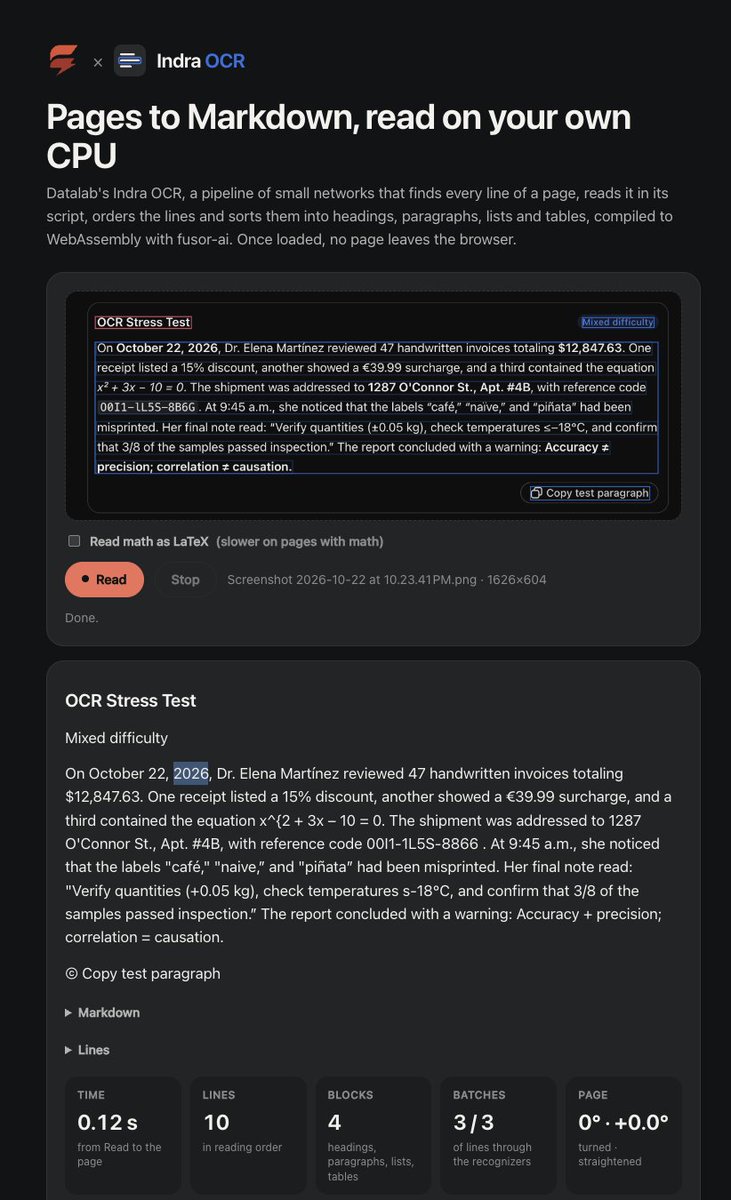
I think I just found the fastest OCR model I've ever tested.
Running OCR entirely in the browser with WebAssembly and Fusor AI (@fusor_rs).
Same benchmark. Wildly different results:
🐢 PaddleOCR (@PaddlePaddle): 20 seconds
⚡ OXR (@somarkai): 5 seconds
⚡ ⚡⚡⚡⚡⚡Indra OCR (@datalabto): 0.12 seconds
That's ~42x faster than OXR and ~167x faster than PaddleOCR.
All running on WASM.
This is insane.
Big data needs bigger infrastructure.
We've 2x Massive's New York data center capacity, with room to scale.
Shoutout to our platform engineering team for making it happen. 💙
@somarkai Hey! loved OXR, recently compiled it to WASM. really really fast running locally on the browser, just CPU. DM me, maybe we can collab on something!
WHAT THE ACTUAL FUCK?!
Anthropic just decided to go after OpenAI Dots and Grok Bot with Claude Duet, powered by the absolute MONSTER that is Opus 5.5.
We literally go to sleep, wake up, and somehow Anthropic has dropped ANOTHER product to take on its competitors.
LIKE HOW ARE THESE GUYS SHIPPING THIS FAST?!
THEY JUST CAN'T STOP WINNING.
What an absolutely LEGENDARY run. 😭
Two small open TTS models dropped this week: Ant Group's Ming-3.0-tts-0.5B and Gradium's Phonon-31M.
Within a day, @apirela_dev had both running locally in the browser on CPU. He used fusor-ai, a Rust toolkit he built that compiles models into WebAssembly programs.
His benchmarks on an M4 Pro:
- Phonon — 2.4x faster than Gradium's browser CPU runtime with 8 threads, with a 48.5 MB download vs. 69.4 MB.
- Ming — first audio in 0.3s vs. 14.3s for the non-streaming PyTorch reference, with quantized weights.
He also shares where his implementation loses: Gradium's native CPU runtime is 3.5x faster on a single thread.
"I'm all for privacy models running on CPU," he says.
Both implementations are open source and still at v0.1.
https://t.co/w1OV9oPp1C
https://t.co/gnVQkC59Om
#BackchannelSignals
@HowDevelop@GradiumAI@arduino@Alibaba_Qwen@ashwinexe@BhosalePratim would love if you could do the same with phonon-wasm! I recently created it to run Phonon with wasm optimizations (using something different from xn-ptts) so would love to see if there's any gain on a regular CPU!
Introducing Parakeet WASM: speech to text that runs entirely in your browser
116 s of audio -> 3 s. On your CPU. No server. No GPU. No API key. Your audio never leaves the tab.
Moondream's Parakeet Redux, built with fusor-ai for WASM compatability.
Try it now: https://t.co/aIjEaOEogV
it transcribes at real-time speed, and does not use GPU. It's great to embed in edge hardware, or frontends without having to pay a subscription.
This was made with love by @fusor_rs for @moondreamai
<3
@rustaceans_rs and even then, I’m annoyed at many in the rust ecosystem for hating on AI. It feels like math professors hating on calculators back in the 70s.
:/
Hey @GradiumAI, I ended up running phonon in the browser using Fusor AI toolkit instead of xn-ptts.
Here's a quick demo on hugging face: https://t.co/w6MNr6iBcN
Here's the repo: https://t.co/pVP3RZOsUA
it runs 2.5x faster across 8 threads, and about 1.3x faster across 1 thread.
It's very instant, the use cases for this are insane. Great job with Phonon, it feels instant already without any optimization. looking forward to doing more!