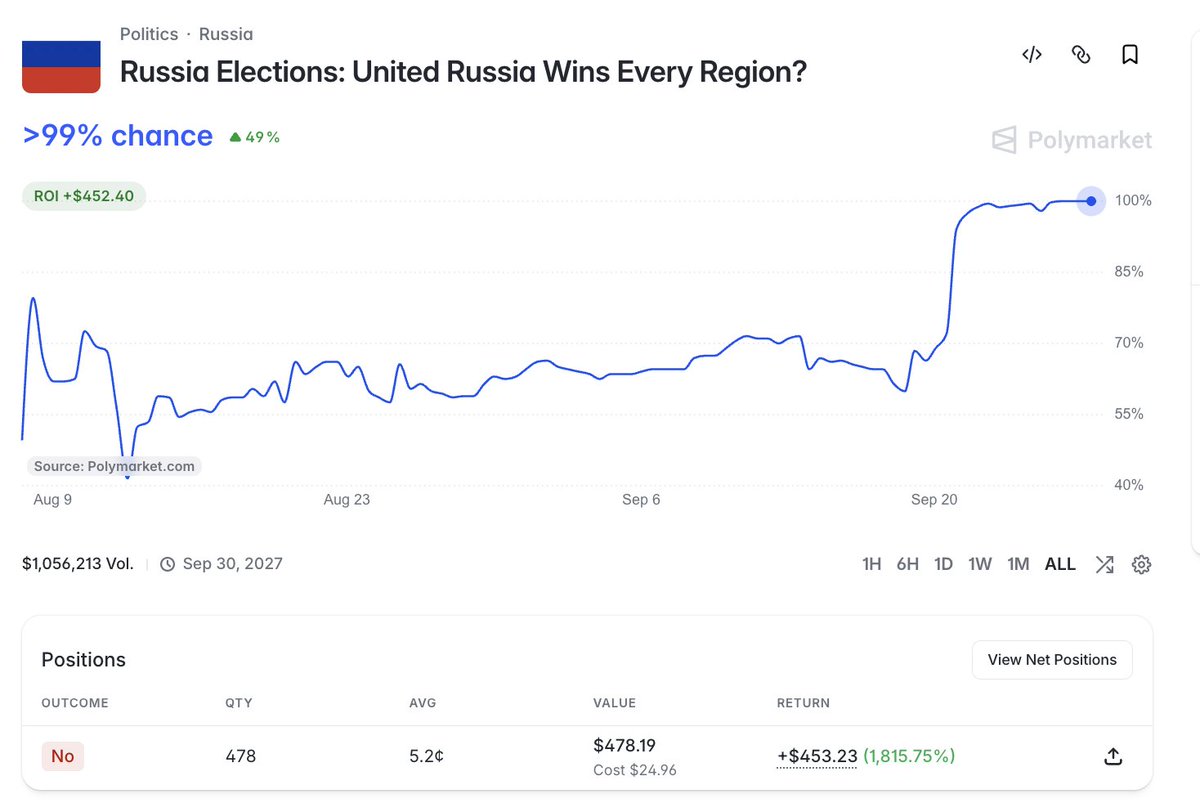
this month i bet Putin's party, United Russia, wouldn't win every single region in Russia's parliament election. opposition had to take at least 1 or 2, right?
wrong. they swept every region. a few days later, once the results were counted, the market settled YES. i lost, fair and square. the result was clear.
the Saylor market wasn't. "will Strategy sell any btc by May 31?" Strategy sold 32 btc between May 26 and 31. the filing dropped June 1.
Polymarket resolved it NO. around $80m was riding on it. people still argue whether the rule meant "sold by May 31" or "announced by May 31." that's the point. someone had to decide
that's the layer nobody prices in.
under every YES or NO, there's resolution (who decides what happened) and settlement (who moves the money). you can call it right and still get burned if that layer gets it wrong.
prediction markets are way too big to keep having resolution issues; that's why @PRDCTR_IO is building a settlement layer just for prediction markets, backed by 20k+ nodes.
on polymarket, disputes go to a UMA token vote, so the biggest wallets carry the most weight. on PRDCTR, the check is spread across 20k+ node operators working alongside a core validator set, and they earn $PRD plus gas fees for running the nodes.
no system is bias-proof. but 20k+ operators checking each result, with it all recorded onchain, is a lot harder to manipulate than a few big wallets.
calling it right should be enough to get paid and that's the part PRDCTR is fixing.
partnered with @PRDCTR_IO to break down how this actually gets fixed