You can't make this up.
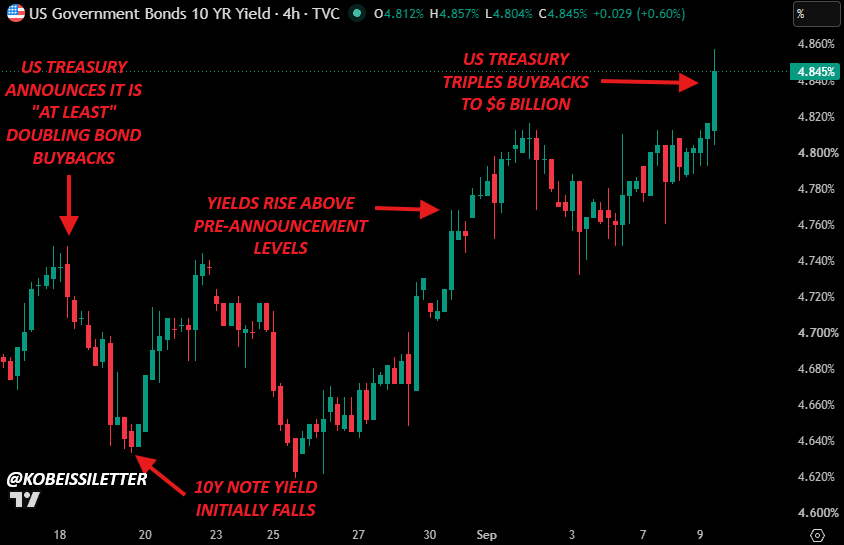
The US Treasury just announced it is tripling long-term buybacks to $6 billion and yields STILL rallied on the news.
That means the US Treasury went from doubling, to "at least doubling," to tripling long-term bond buybacks and yields are still rising.
This puts the 10Y Note Yield above 4.85% for the first time since November 2023, up +15 basis points from pre-announcement levels.
The bond market is quite literally fighting the US Treasury as the Iran War continues, with the 10Y Note Yield nearing a +100 basis point move since the war began.
Without an end to the Iran War, we are on track to see the 10Y Note Yield above 5.00% by next week.
American consumers, homebuyers, and borrowers are in for a rude awakening.
BREAKING: After falling -80% from its record high, Nike, $NKE, will be removed from the S&P 100 at the end of this month, ending a near 18-year run in the index.
The stock has now erased -$230 billion in market cap since its all time high.
A collapse for the history books.
Europe wrote the world's first stablecoin rulebook.
Two years later, euro stablecoins are 0.25% of the market.
To be fair, last month was a record. Euro stablecoins reached an all-time high of $776 million, up 6% for the month and 68% year over year. Circle's EURC passed €400 million for the first time. That is real growth, and it is accelerating.
The total stablecoin market is $311 billion.
USDT and USDC alone account for around $257 billion of it, or roughly 330 times the entire euro stablecoin market, combined.
The assumption behind MiCA optimism was that the constraint on euro stablecoins was legal. Nobody would build one while the rules were unclear, so write the rules and a market appears.
The rules have been in place since June 2024. The market did not appear.
Because the constraint was never legal.
A stablecoin is a claim denominated in a currency, and demand for the claim follows demand for the currency. Look at what people actually use stablecoins for:
👉 getting dollars where dollars are hard to get
👉 settling in dollars across borders without a correspondent bank
👉 posting dollars as collateral in crypto markets
👉 trading and market making in crypto markets
None of those is European problems.
Europeans already have frictionless euros. SEPA works. Instant transfers work. A euro stablecoin solves, for a European, a problem that was already solved.
This is worth a thought, because it generalises well beyond stablecoins.
Regulation is very good at deciding what may exist, but it has no mechanism whatsoever for deciding what people want.
Europe has built, by some distance, the best-regulated market in the world for a product with limited demand.
And then there is the detail from last month that says it more neatly than I can.
Revolut, Europe's flagship fintech, launched its euro stablecoin in August. It is issued by Bridge, which Stripe acquired last year.
Europe's regulatory achievement, denominated in euros, running on American infrastructure.
None of this is an argument against MiCA. Clear rules are better than unclear ones, and the firms operating under it are better off for the certainty.
It is an argument against a specific hope: that writing the rulebook first would make Europe the centre of this market.
The rulebook did exactly what a rulebook can do. It made euro stablecoins legal.
It was never going to make them necessary.
Scientists have created one of the most detailed 3D reconstructions of a human cell (eukaryotic cell) ever produced.
This groundbreaking model, often termed a "Cellular Landscape Cross-Section Through a Eukaryotic Cell," combines data from X-ray tomography, nuclear magnetic resonance (NMR), and cryo-electron microscopy to map molecular structures in extreme detail.
🚨 WE ARE NOW ENTERING THE HOTTEST PHASE
Every mid-term election year for 50 years has delivered a drawdown
1974 Ford: -35%
1978 Carter: -15%
1982 Reagan: -17%
1990 Bush: -20%
1994 Clinton: -8%
1998 Clinton: -22%
2002 Bush: -34%
2010 Obama: -17%
2018 Trump: -20%
2022 Biden: -27%
2026 Trump: ???
Ten mid-term years. Ten drawdowns. Not one skipped its turn. Average: roughly -21%.
And 2026 has more than the calendar working against it. A new Fed chair, eight weeks into the job. Across nine decades, every new chair was greeted with an equity drawdown in his first three months. Twelve chairs, twelve drawdowns, average roughly -12%. The market doesn't price a person. It prices a probability distribution. And it probes until the new chair reveals himself.
The last time both cycles overlapped: 2018. Powell takes the chair, Volmageddon hits within days, and after "a long way from neutral" the market pushes the S&P down 20% into Christmas Eve. Then Powell blinked. 2019 delivered over 30%. New chair, mid-term year, autumn washout, capitulation low, melt-up. That's the template.
Even fear has a calendar. The VIX troughs in early summer and peaks in September and October, and in mid-term years the crest runs higher. It sat in the mid-teens in early July, right at the seasonal trough. On Friday it jumped above 18. The market has started paying attention. It has not yet paid the full toll.
Meanwhile the shock absorbers are gone. Retail cash allocations at extreme lows seen only in 1998, 2000, 2018 and 2021. Put/call skew at a record low, nobody is hedging. Record IPO supply draining liquidity from the existing market.
And here's the flip: every single one of those ten mid-term drawdowns was a buying opportunity. Not most. All. Since 1934, the average rally off the mid-term low: roughly 47%. The market took out its prior high four times out of five. Bull markets don't die of drawdowns. They die of exhaustion. The mid-term correction is the maintenance schedule of the four-year cycle.
The playbook is not heroic. Hold your quality. Keep dry powder with a shopping list attached, decided at VIX 18, executed at VIX 28. Buy the fear in tranches.
The full map is out tomorrow, free for everyone. Twelve Fed chairs, ten mid-terms, the VIX season, the liquidity cycle, the 1998 rhyme. And the four tripwires that would prove it all wrong.
Greed is obvious. Fear is the edge.
When the cannons fire, buy.