Fomo vs PumpFun
What’s especially interesting right now is how PumpFun started moving the moment Fomo began taking a piece of its pie.
@fomo is essentially turning trading into a social network: connect your X account, get a public profile, PnL, leaderboards, followers and content. Trade well — people follow you. Post good takes — people follow you too. And for normies, the onboarding is ridiculously simple: Gmail to sign up and Apple Pay to deposit.
And apparently it works well enough that PumpFun has started literally paying people to come back: traders are being offered money to publicly delete their Fomo accounts and move to PumpFun. When you have to pay users to leave a competitor, that says quite a lot.
Meanwhile, @Pumpfun spent years sitting on top of the memecoin market without delivering the airdrop everyone has been waiting for. The community is still waiting for $PUMP, but the moment there was a real competitive threat, suddenly there was time for social features and aggressive efforts to win traders back.
But the most interesting part is that the market isn’t stopping there.
@trenches is coming next — a new Solana launchpad trying to combine the best parts of Fomo and PumpFun: launchpad + social layer + X integration, with launchpad-as-a-service for other products. And they already have tens of thousands of followers before even launching.
So I wouldn’t focus too much on who becomes the next “PumpFun killer.” The bigger trend is that crypto trading is becoming a social network, where PnL becomes content and traders become influencers.
Fomo understood the trend first. PumpFun understood it once it started losing market share. Trenches is trying to enter with both lessons already built in.
StonkBrokers continues to prove it was much more than a successful NFT mint.
Since my last post:
• the NFT floor has nearly doubled;
• the token $STONKBROKER briefly hit a $100M market cap and is now holding around $90M.
The most interesting part isn’t the numbers.
The team keeps expanding the ecosystem and shipping new products, and the market is gradually starting to price that in.
It feels like this story is only just getting started.
My biggest miss of the past few months @realstonkbroker
Free Mint → 7 ETH in two weeks on Robinhood.
The worst part isn't the 7 ETH.
The worst part is realizing the outcome was almost obvious... after the mint.
It turned out this wasn't just another anonymous Robinhood launch.
Behind it was:
• the former Head of DeFi at ApeChain;
• the founder of Clutch Markets;
• someone who had been building the product on Robinhood testnet for nearly six months before launch;
• someone who publicly demoed it at Arbitrum's Founder House in NYC;
• a builder whose previous NFT collection was even integrated into Otherside.
This is exactly the kind of information you usually discover after the floor has already gone vertical.
The deeper I dug, the more I realized people weren't just buying an NFT.
They were buying an ecosystem.
The NFT is simply the entry point.
The protocol is designed so that fees from the NFT AMM, lending markets, partner projects, and future launches flow back into the ecosystem.
A real flywheel.
The team has already launched its first partner project, with a DEX aggregator, options, VDEX, and a permissionless launchpad coming next. More importantly, every new product is designed to strengthen the existing ecosystem instead of existing in isolation.
I have no idea where the floor will be a month from now.
But now I understand why the market valued this project the way it did.
7 ETH was the consequence, not the reason.
The real signal was something else entirely: a public serial builder, six months of open development, a working product, and an ecosystem that kept shipping long after the hype started.
The most valuable signals almost always appear before the chart.
@theunipcs 57% market share is impressive, but the real signal is whether Pons can keep producing runners consistently. If that continues, the Robinhood + Pons narrative gets very hard to ignore
cash-cat:native finally woke up.
After a week of consolidation around a $40M market cap, it started gaining momentum — and has been accelerating throughout the entire week.
We’re already around $150M.
Personally, I think a new ATH for cash-cat:native is just a matter of time.
But what makes this story interesting to me isn’t just CASHCAT itself.
It’s Robinhood.
Over the past few weeks, Robinhood has had a massive impact on the memecoin market.
The launch of Robinhood Chain created a new playground for memes, liquidity, and retail attention.
And CASHCAT has become one of the biggest examples of this narrative.
We’ve already seen it climb above a $200M market cap, pull back, and then spend a week around $40M.
Now it’s back at $150M.
To me, this doesn’t look like a random pump.
It looks like interest in the entire Robinhood narrative is coming back.
And here’s my personal take:
When it comes to memecoins, I think Robinhood has, in some ways, already outperformed Solana.
Solana built one of the biggest memecoin ecosystems in crypto.
But Robinhood managed to create a new narrative around an entire chain much faster — while having a massive retail brand behind it.
If this trend continues, I wouldn’t be surprised to see cash-cat:native break its ATH soon.
For me, this is one of the main memecoins to watch on Robinhood Chain.
Just my thesis.
It feels like the market hasn’t fully realized what $REMUS actually is.
Back in December 2025, FOMO CEO Seyong officially named Remus the official mascot of FOMO. Somehow, we completely missed it — until his old post started gaining attention again.
And here’s what makes it really interesting: 100% of $REMUS fees are donated to the Lung Cancer Foundation — a charity Seyong personally supports after losing his grandfather to lung cancer.
So $REMUS isn’t just another memecoin. It’s the token of FOMO’s official mascot, from a platform that is currently bringing more and more new users into crypto.
FOMO → official mascot → Remus → $REMUS → charity.
I think this is something worth watching closely. 🐺
23e4CNuJxvBQ7RjNLc8Bh3yN3pQq6jeiTbyzJGXYPgme
🐸 TOAD — The Toad Pepe
Looks like Solana has found another meme that can explode overnight.
solana:A13oRB9FFaiUjfi6LdCg6p9ka1u8SfGkUFs4SKvPpump is a Solana memecoin built around El Sapo Pepe, an Argentine character from 1988 — long before Matt Furie’s Pepe the Frog.
But the lore isn’t the only interesting part.
Almost immediately after TOAD appeared, a community-driven CTO started forming around it. The creator, @slingoorio, said: “I will not run this coin”, essentially handing the initiative over to the community. What followed was a rapid increase in holders, massive trading volume, and attention from Mike Dudas (@mdudas), who became one of the most notable holders and publicly supported the narrative.
That’s when things really started accelerating: strong lore + CTO + attention from a major account + thousands of new buyers = the perfect setup for FOMO.
Within hours, TOAD went from a microcap to around $20M ATH, with tens of millions in trading volume.
At this point, the question isn’t whether the market has noticed TOAD — it clearly has. The real question is how far this narrative can go, and whether the community can turn another pump fun meme into a true cult memecoin.
🐸 Is TOAD the beginning of the next big meme movement, or just another beautiful overnight pump?
CA: A13oRB9FFaiUjfi6LdCg6p9ka1u8SfGkUFs4SKvPpump
DYOR. With coins like this, the chart can change your mind faster than a tweet.
What Is Really Happening With BONK?
The Upbit delisting is only the tip of the iceberg.
The past few weeks have been rough for $BONK: the BonkDAO attack, roughly $20M drained from the treasury, restrictions from several exchanges, and now the delisting from Upbit. But if you look at the situation only through the lens of the latest event, it’s easy to miss the bigger picture.
The real story started much earlier, and it’s not just about the @bonk_inu token itself. It’s about how BonkDAO governance was structured, how the attack happened, and how the project has handled the aftermath.
1. What happened to BonkDAO
On July 6, BonkDAO lost approximately 4.43 trillion BONK, worth around $20M at the time.
But it’s important to separate the facts from the headlines.
This was not a traditional hack of BONK, Solana, or users’ wallets. The attacker exploited the DAO’s own governance mechanism.
On June 30, proposal BIP #76 was created. On the surface, it looked like a normal governance initiative, but the proposal contained a transaction that would transfer treasury funds to the attacker’s wallet.
That’s where a fundamental weakness in BonkDAO’s governance became apparent.
2. How the attacker managed to take $20M
The proposal required only around 1% of voting power to pass.
The attacker recognized this and spent roughly $4.4M buying BONK, acquiring enough voting power to pass the proposal.
They then voted for their own proposal.
And it passed.
As a result, approximately 4.43 trillion BONK, or around $20M, was drained from the treasury.
Economically, the attack looked roughly like this:
$4.4M → buy voting power → control governance → $20M from the treasury.
And this, in my opinion, is much more important than the amount that was stolen.
The problem wasn’t some incredibly sophisticated vulnerability. It was the combination of several factors: an extremely low quorum, very low voting participation, the ability to cheaply acquire the required voting power, and the lack of a sufficient timelock between proposal approval and execution.
In other words, governance technically worked according to the rules — but the rules themselves were not sufficiently protected against an economic attack.
3. Why exchanges started reacting
After the attack, the story entered its second phase.
Several centralized exchanges restricted BONK operations, including Upbit, Kraken, and MEXC. Korean exchanges also started highlighting the risks surrounding the asset.
Upbit’s reaction is particularly interesting.
The exchange was not only looking at the security incident itself, but also at issues related to information disclosure.
So the question was no longer simply:
“$20M was stolen from the project.”
The bigger question for an exchange became:
“How well can this project manage the situation, and how transparently is it communicating with the market?”
That’s why I wouldn’t look at the Upbit delisting as an isolated event.
It is better understood as a consequence of the problem that started on July 6.
4. What the team is doing — and what remains unanswered
At the same time, it would be unfair to say that the team has done nothing.
After the attack, BonkDAO announced that an independent investigation firm had been engaged, that it was working with law enforcement, and that legal action was being prepared.
In its latest update, the team also said that the vulnerability has been closed and that recovering the funds remains the top priority.
That’s positive.
But weeks later, the market still has some very simple questions.
How much of the stolen funds has been recovered?
Where are the stolen tokens now?
What exactly has changed in the governance system?
Has the quorum been increased?
Has a proper timelock been implemented?
Who controls the treasury now?
Is there an emergency veto or another mechanism for stopping suspicious proposals?
When will the full post-mortem be published?
These are the questions I think the market needs answers to now.
Because after an incident like this, it’s not enough to say that the “vulnerability has been closed.”
The team needs to show exactly how it was closed and why the same type of attack can no longer happen.
5. BONK is still building — and that matters
There is another side of the story that shouldn’t be ignored.
While the market is discussing the $20M loss and the Upbit delisting, the BONK ecosystem continues to operate and expand.
In its latest update, the team highlighted the following figures:
BONKTrade — $425M+ in volume in June
https://t.co/zQWcyg8oru — $17M+ in volume in July
BONKbot — around $1M in volume every 24 hours
BONKPLAY — $1.2M in volume during its first three days
The team also claims 1M+ unique wallet holders.
If these numbers are accurate, then saying that “BONK is dead” would simply be wrong.
The project still has users, products, liquidity, and an active ecosystem.
And that’s probably the strongest argument that this story is far from over.
But there is an important distinction.
Product volume does not fix governance.
$425M in trading volume does not answer why $20M could be drained from the treasury through the official governance system.
One million wallets don’t automatically make governance secure.
And launching a new product does not replace a proper post-mortem.
6. The biggest problem right now is trust
That’s why I believe BONK is currently facing more of a trust crisis than a product crisis.
The token itself was not hacked.
The ecosystem continues to operate.
New products are being launched.
But investors are now asking a very different question:
“Can I trust the system responsible for managing BONK’s treasury?”
And that is much harder to fix.
You can patch a technical vulnerability.
You can change the quorum.
You can add a timelock.
But rebuilding market trust requires actions and transparency.
I also wouldn’t jump to conclusions that the attack was necessarily an inside job. There are already plenty of theories in the community about an insider attack or an intentional rug, but until the investigation is complete, those remain theories.
What we do know is that the attacker was able to acquire enough voting power, pass a malicious proposal, and drain a significant portion of the treasury by exploiting weaknesses in the existing governance system.
7. My take
I do not think BONK is dead.
The project still has a strong position within the Solana ecosystem, a large user base, real products, and significant activity.
But pretending that nothing serious happened would also be a mistake.
BONK took a very serious hit to its credibility.
And now the key question isn’t whether the team can launch another product or execute another burn.
The real question is:
Can the team prove that $20M can never leave the treasury this way again?
If we see a full post-mortem, a transparent investigation, concrete governance changes, a higher quorum, a timelock, emergency controls, and a clear treasury protection mechanism, this could eventually be viewed as a very expensive lesson that ultimately made BONK stronger.
But if all we get is:
“BONK continues to build”
followed by new products and impressive volume numbers, without clear answers to the security questions, then for me it remains a serious red flag.
So I wouldn’t write BONK off.
But I also wouldn’t blindly trust the project again yet.
The Upbit delisting is not the end of the BONK story.
It is a signal that the market is now demanding proof.
And for me, the biggest bullish catalyst for $BONK right now isn’t another listing, another burn, or another product.
It’s rebuilding trust.
We want to address the recent BonkDAO incident directly and share the actions taken since.
$BONK and BonkDAO are two distinct entities. BonkDAO is a community governed treasury that BONK funded and handed over to its community. The recent attack targeted that treasury alone. While other BONK operations, products and funds remain fully intact, the loss landed on the community, and that makes recovery our utmost priority.
Immediately following the attack, an independent investigations firm was engaged. Law enforcement continues to be engaged, legal action is in preparation and the vulnerability has been closed.
Through all of it, BONK and its community remain standing and continue to grow. The data across our ecosystem speaks for itself:
BONKTrade: $425M+ in volume in June 2026
BONKPLAY: $1.2M in volume in the first 3 days
BONKbot: $1M in volume every 24 hours
https://t.co/UcwtKpR4Yb: $17M+ in volume in July 2026
$BONK: 1M+ unique wallet holders
We are committed to transparency with our community, our partners and the exchanges that support BONK, and we will keep communicating openly at every step.
BONK will never stop building.
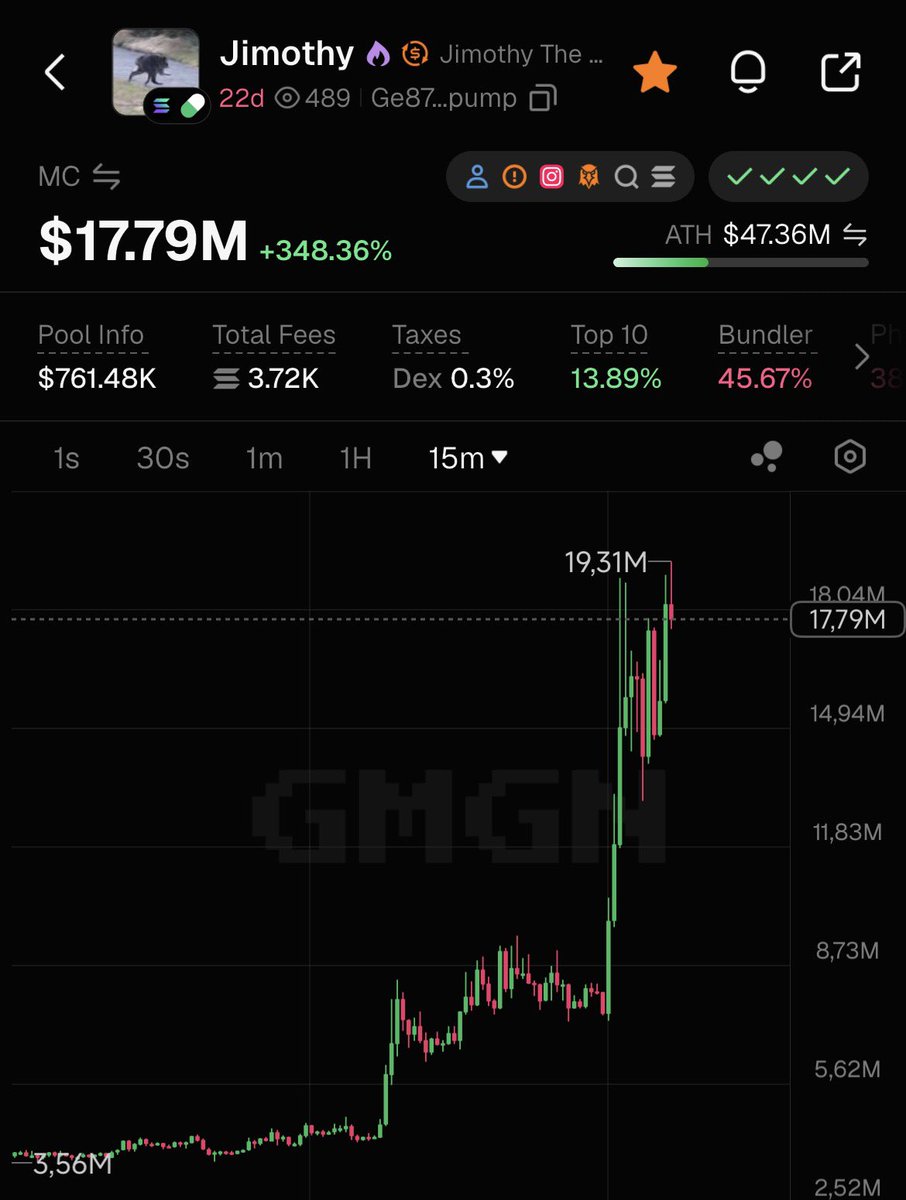
What happened with $JIMOTHY is absolutely insane.
Elon Musk posted a raccoon. No ticker. No token mention. Just a raccoon.
The token that literally is that raccoon went from a $3M market cap to $19M within hours.
This is exactly why memecoins remain the craziest market in crypto. Sometimes, a single post changes everything.
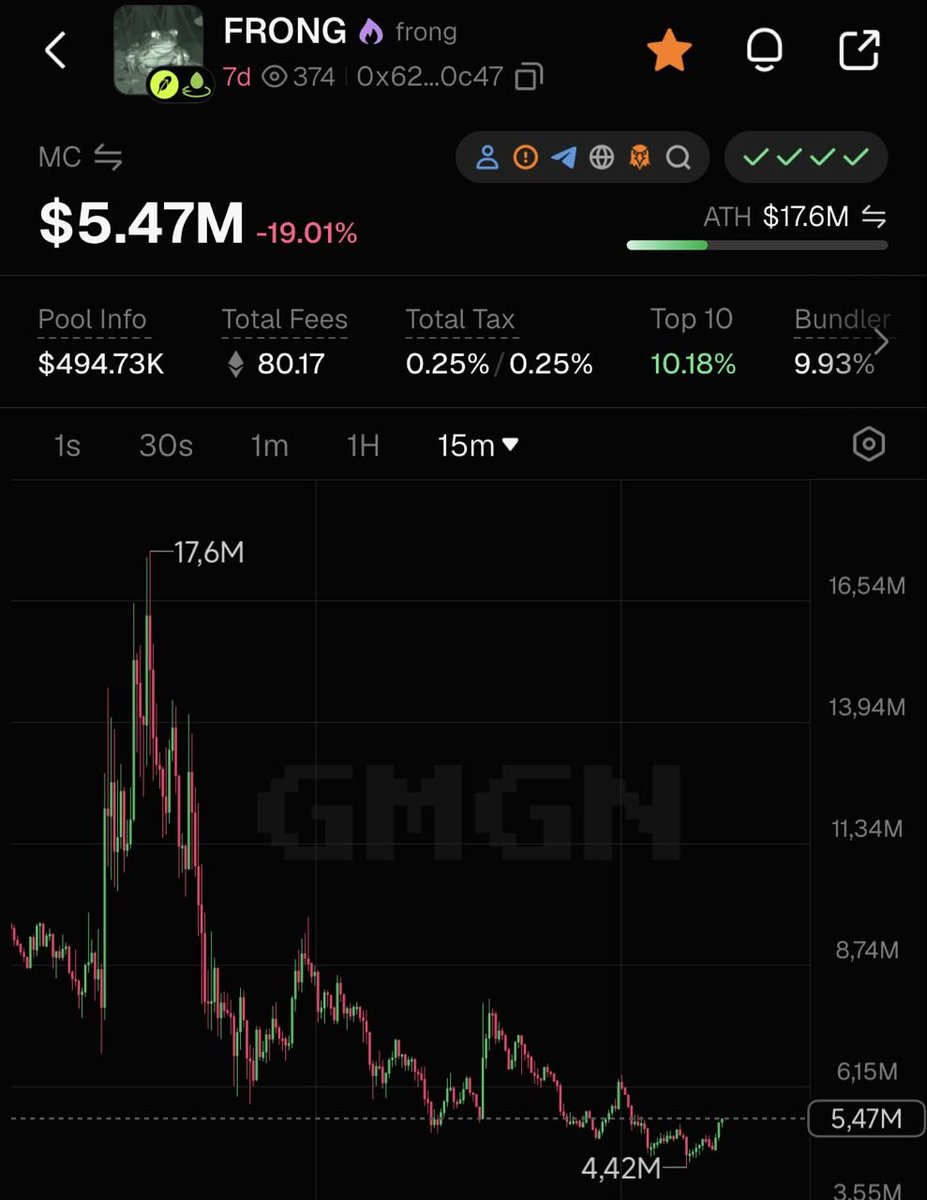
frong:native has cooled off quite a bit.
After reaching a $15M market cap, it's now pulled back to around $5M . For meme coins, that's a completely normal move - strong rallies are usually followed by a cooldown.
But in my opinion, this is where things get interesting. This could be the calm before the storm, with smart money quietly accumulating while the crowd has already moved on to the next shiny token.
And don't forget one of the most interesting parts of the lore.
frong:native was deployed by @zacklabadie, the Product Design lead at Uniswap. Even more interesting, he left his real identity and ENS in the token's metadata. That's not something you see every day with a random meme coin.
Of course, none of this guarantees anything. But stories like this are often what fuel the next wave of attention.
We'll see if $5M turns out to be the accumulation zone before the next leg up. 👀
Same story every single time.
Under $1M: "Who would buy this trash?"
At $15M: "Damn, why didn't I buy?"
The market never changes. Only the numbers on the chart do.
$FRONG proved it once again.
0x6245e67affa44a23077f0ea7f981a8dc743a0c47
🚨FOMO has officially flipped Axiom in 24-hour revenue.
This is a really bullish sign. @fomo keeps gaining more and more momentum, and I honestly think this is just the beginning.
In my opinion, FOMO's app has much broader appeal to mainstream users who aren't deeply involved in crypto. It's a far more accessible entry point.
@AxiomExchange on the other hand, feels like a platform built mainly for crypto veterans and advanced traders.
If FOMO continues growing at this pace, it could become one of the biggest onboarding tools for bringing new users on-chain.
What do you think? Can FOMO keep up this momentum? 👀
Funny to think…
$BONK was actually the first memecoin I ever bought.
And I actually made some good money on it.
Now seeing it get delisted by Upbit…
Time really flies. 🥲