Function & cytoarchitecture don't overlap ... they're orthogonal. Prefrontal cortex is tiled with chains of functional patches mostly known from face processing. Multi-modal parcellations are wrong ... & other insights hidden by group-averaging fMRI data: https://t.co/WEo2Cf9N26
Diffusion MRI (dMRI) is a powerful tool to study white matter maturation. In our new preprint, we process and distribute a new resource of >24,000 ABCD dMRI scans using open source tools! We then evaluate how methods shape inferences about development.
🔗 https://t.co/XzEFQQj6i9
First *complete* view of the mouse hippocampus with in-vivo 2p imaging + ex-vivo MERSCOPE spatial transcriptomics!
*🔊sound on
Amazing collaboration led @jason_hc_yong at @attila_losonczy 's lab.
Preprint: https://t.co/LA0RUzQkHX
Interactive website: https://t.co/9ko9zqf2fe
Some blog posts I liked on techniques for long-context learning...
- DroPE: dropping positional embeddings https://t.co/XSdBsndW6Q
-RePo: context repositioning https://t.co/CMJBFtofsf
- RLMs: recursive language models https://t.co/XlPIGTxSP8
Many people think of the genome as a string of "letters." The human genome, say, has 3.2 billion base pairs of DNA organized across 23 pairs of chromosomes.
But the genome is a 3D object. Genes located on entirely different chromosomes might be clustered together. Mutations in these "distant" genes can lead to disease in surprising ways.
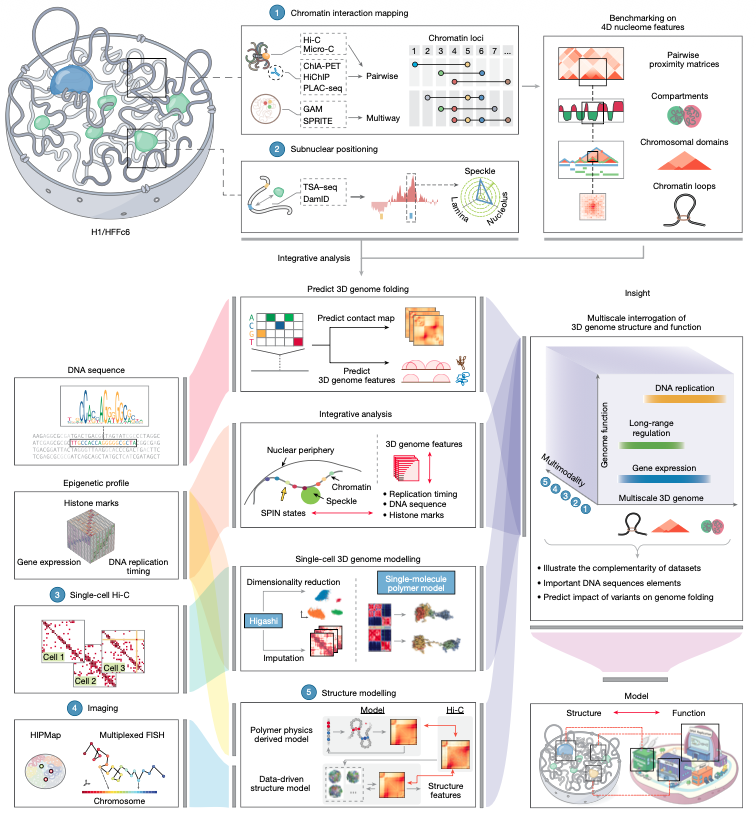
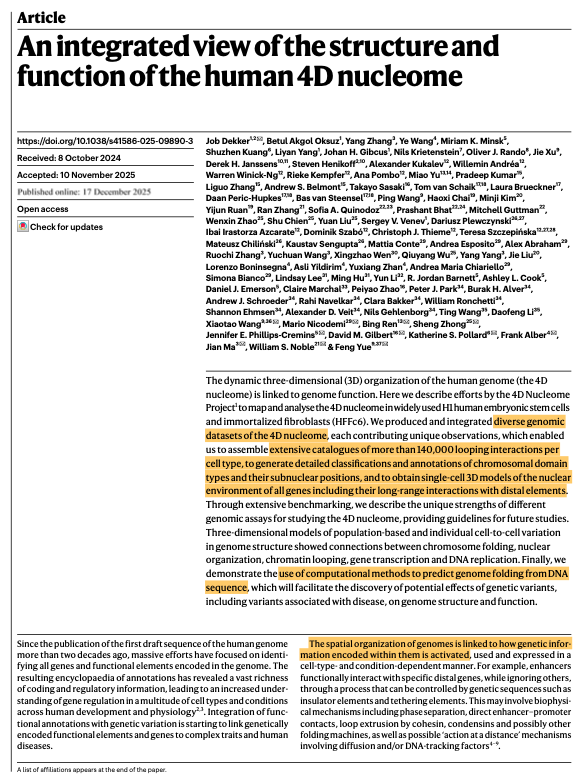
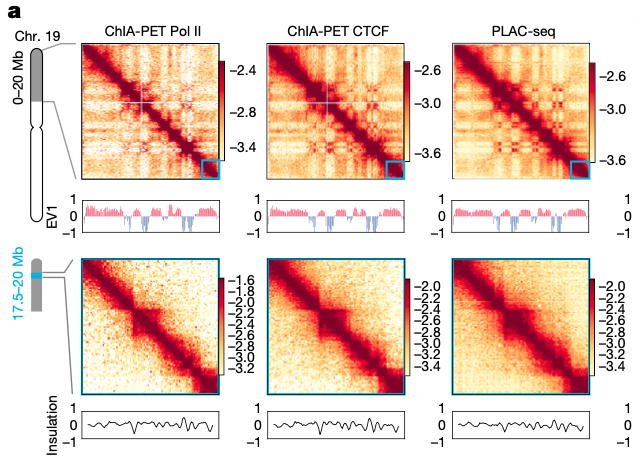
For a new paper in @Nature, researchers released several "maps" of human genomes from two types of cells: embryonic stem cells and fibroblasts. They compared methods to see which ones are least biased, and found many long-range interactions between genes.
The article does a good job explaining how “the genome is organized at different scales”:
> On a single chromosome, histones control which parts of the DNA sequence are accessible and expressed.
> At the scale of hundreds of thousands of bases, “chromatin loops in a dynamic manner,” the authors write, bringing distant genes closer together. > Across chromosomes, sequences "cluster together in space to form subnuclear compartments."
Examples abound. Enhancers, for example, are short DNA sequences that regulate the expression of far away genes. They do this by *physically* touching the genes they control; a protein called cohesin grabs the DNA and tugs it into big loops.
Even promoters, which are thought of as being associated with one gene or operon, can cluster together across many genes! A protein, Ronin, grabs promoters and pulls them together. This is apparently done mostly for genes that tend to be "on," as it helps enzymes find genes faster/not have to diffuse far away to find targets. (This also happens with genes that tend to be "off;" so-called polycomb proteins grab onto promoters, cluster them up, and silence all of them at once. It's a way for the cell to conserve energy.)
One consequence of this spooky "action-at-a-distance" is that diseases might arise from mutations in unexpected locations. Editing these regulatory sequences, in other words, might in turn affect a gene located on an entirely different chromosome that *is* associated with that disease.
Genetic mutations linked to autism, for example, are known to disrupt the 3D organization of the genome. A single deletion at a gene, TAL1, also affects its ability to form long-range chromatin interactions with other genes, leading to leukemia. There are probably many other, as-yet-undiscovered, instances of this.
Good morning San Diego! My lab will be presenting two posters today at #neurips2025:
Thursday Poster Session 3, 11 am-2 pm
--Poster #2204--
--Poster #2114--
Please come by to learn about the work led by my two talented PhD students...
🧵
Excited to be presenting our recently accepted paper, ‘Predicting Functional Brain Connectivity with Context-Aware Deep Neural Networks’ at NeurIPS tomorrow 12/04 from 11 am to 2 pm, https://t.co/pfAx2RrHvy! Feel free to stop by to talk deep modeling for neurogenomic data
A small-molecule drug proves its mettle in the treatment of spinal muscular atrophy, a disease amenable to intervention at the pre-mRNA level.
Learn more in the editorial “Presymptomatic Treatment of a Genetic Disease with a Small-Molecule Drug” by Charlotte J. Sumner, MD, from @HopkinsMedicine: https://t.co/Am6KsgyJnb
Applying new tools to entire brains, starting with C. elegans, offers the opportunity to uncover how molecules work together to generate neural physiology, and how neurons generate behavior, write @eboyden3 and @koerding.
https://t.co/TMjnGwbAPh
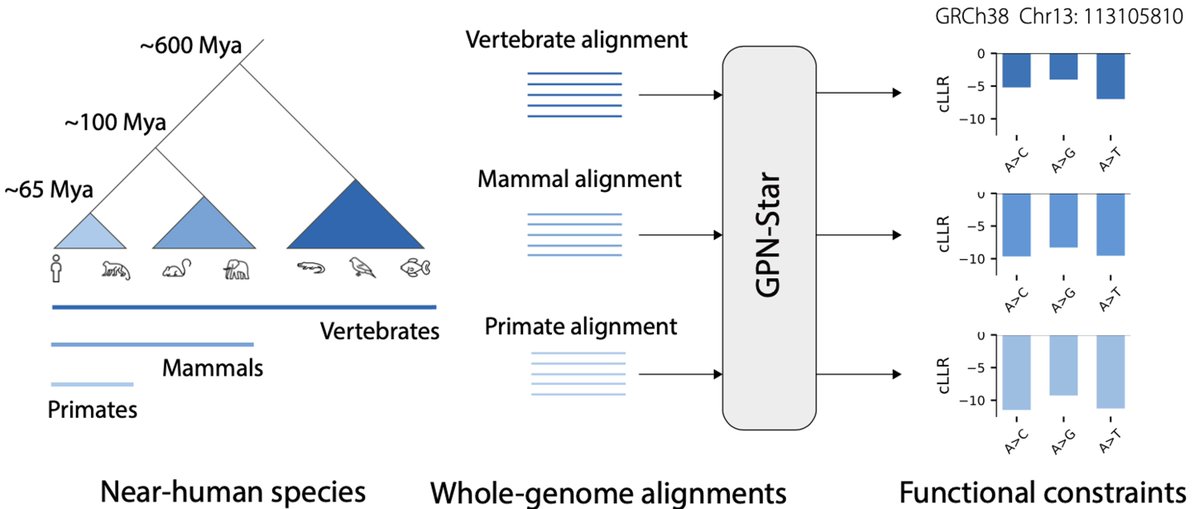
We are excited to share GPN-Star, a cost-effective, biologically grounded genomic language modeling framework that achieves state-of-the-art performance across a wide range of variant effect prediction tasks relevant to human genetics.
https://t.co/FTm3byYp67
(1/n)
New paper in Imaging Neuroscience by Vincent Bazinet, Zhen-Qi Liu and Bratislav Misic:
The effect of spherical projection on spin tests for brain maps
https://t.co/t1yzHPYoQH
Really enjoyed this paper integrating the theory of latent dynamical systems+RNNs with experimental neural firing data.
'Disentangling the Roles of Distinct Cell Classes with Cell-Type Dynamical Systems' https://t.co/vplTjLWYGK
This award is very hard to respond to. I have received many hundred congratulatory notes, from former students, post-docs, Princeton University juniors and seniors, funding agencies and foundations, authors, signature collectors, amateurs, elementary school neural network followers, and on and on. An astonishing fraction of them has found their way into useful and interesting Neural Network careers by a casual interaction in class, at a meeting, hearing what I had to say about their ideas, learning from thinking about how I worked with a class, or from being my teaching assistants... There are some whom I remember well, and others for whom my reaction is “are they certain that our interaction sparked a single usable thought?” Yet they go on and comment “you changed my life” and follow on to explain that they heard me lecture when they were 15, and have been a member of the Neural Network brigade of the research army ever afterward.
I cannot make detailed comments to most of my letter writers. In sum I can only say that I tremendously enjoyed the interactions that the Neural Network community provided me with; that the mutual interactions have given me much pleasure over the years; that the community interested both in brain and in artificial brain has proved a good way for science to develop even if institutions have not always been sympathetic. Often these institutions found the enthusiasm infectious, after a period of doubt. In short, we often have won--. No, perhaps all we know is that we have not yet lost. I still believe that finding mind lodged in biological matter is the most profound question that physics can pose. And that the breadth of physics is a good base from which to begin.