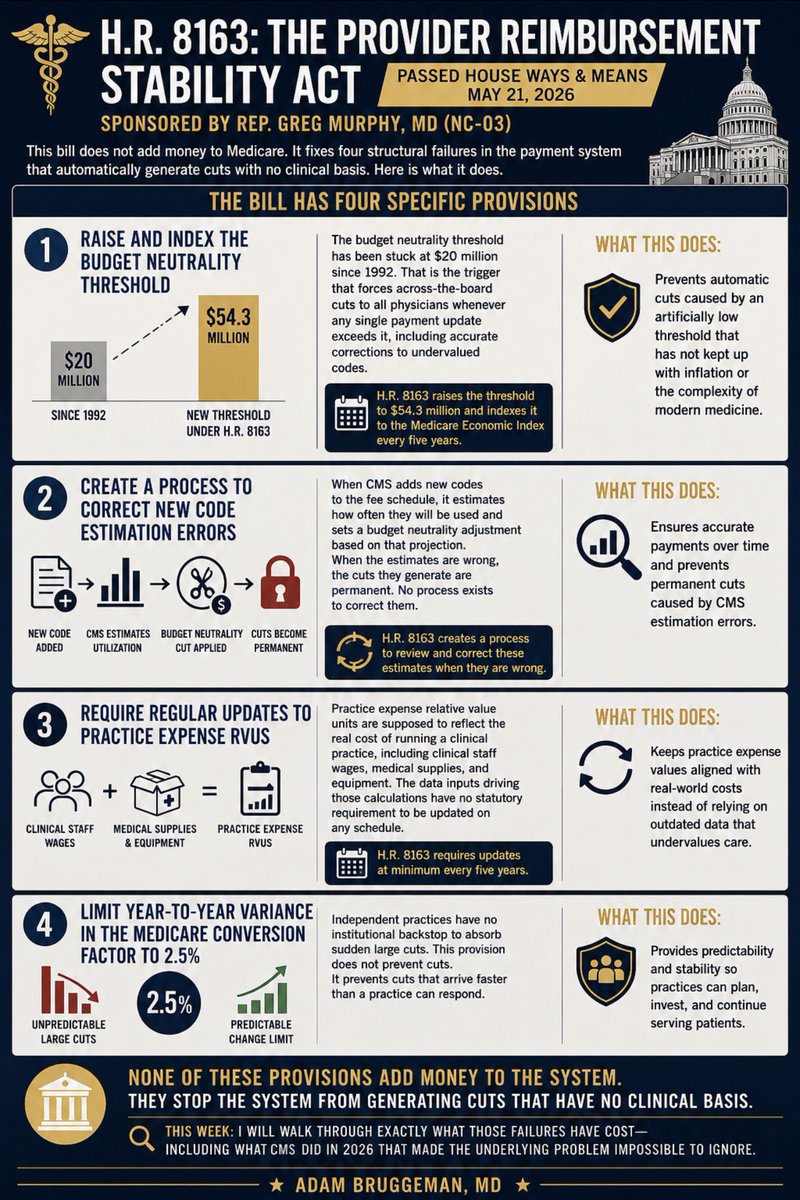
On May 21, 2026, the House Ways and Means Committee passed H.R. 8163, the Provider Reimbursement Stability Act, sponsored by @RepGregMurphy (NC-03), co-chair of the @gopdoccaucus. Before I walk through the documented failures this bill addresses, I want to explain what it actually does. It has four specific provisions, and the mechanics behind each one matter.
The budget neutrality threshold has sat at $20 million since the Medicare Physician Fee Schedule was created in 1992. That number is the trigger that forces across-the-board cuts to all physicians whenever any single payment update exceeds it, including accurate corrections to undervalued codes. H.R. 8163 raises the threshold to $54.3 million and indexes it to the Medicare Economic Index every five years so it never falls this far behind again.
When CMS adds new codes to the fee schedule, it estimates how often they will be used and sets a budget neutrality adjustment based on that projection. When the estimates are wrong, the cuts they generate are permanent. No process exists to correct them. H.R. 8163 creates one.
Practice expense relative value units are supposed to reflect the real cost of running a clinical practice, including clinical staff wages, medical supplies, and equipment. The data inputs driving those calculations have no statutory requirement to be updated on any schedule. H.R. 8163 requires updates at minimum every five years.
The fourth provision limits year-to-year variance in the Medicare conversion factor to 2.5 percent. Independent practices have no institutional backstop to absorb sudden large cuts. This provision does not prevent cuts. It prevents cuts that arrive faster than a practice can respond.
None of these provisions add money to the system. They stop the system from generating cuts that have no clinical basis. This week I will walk through exactly what those failures have cost, including what CMS did in 2026 that made the underlying problem impossible to ignore.
@FreightAlley This ruling may have a significant impact on inflation. Trucks deliver everything in the economy. If now we have to layer on more insurance premiums, the price for everything just went up.
@TheStalwart@tracyalloway@hblodget I'm old enough to remember who he is.
"Henry Blodget was one of the most prominent Wall Street Internet analysts during the 1990s dot-com bubble. His reputation was ruined after the bubble burst when emails revealed he privately derided stocks he was publicly promoting. "
@AngelicaOung You are correct. I also thought he was really smart until he wrote about something I know deeply, and realized he was just wrong.
Gell-Mann Amnesia FTW.
Just walked in the front door after work.
My 5 year old son ran to greet me.
"Hi dad!" he said excitedly.
As he went to hug me, I grabbed his shoulders and said, "Bud, I think you're overestimating the value of human relationships. I read that in a Substack today. Everything is different now. I mean - it was different before, but it's super different now."
He blinked, clutching a plastic dinosaur. I couldn't believe it. Attachment to physical objects in a post-digital era. I gently rotated him toward the hallway mirror.
“Look,” I continued, “do you see that reflection? That’s legacy hardware. Carbon-based. High latency. Limited processing power."
As I kicked off my shoes, my 3 year old daughter came running up to me with a drawing she made in preschool this morning.
She was glowing. Beaming.
“Look, Daddy! I made this for you!”
I glanced at it and explained that Nano Banana one-shotted her entire effort. Her job prospects were hopeless if she didn't understand this.
“Sweetie,” I said gently, kneeling down, “this crayon sun? It’s 2022. Nano Banana can generate 100,000 emotionally resonant suns before you finish saying ‘primary colors.’ You need API access.”
She asked what an API was.
“Exactly,” I said, standing up.
The crying started around then. Very emotional household. Understandable. They hadn't read *the essay.*
My wife heard the children crying in the foyer and came to check on us.
"I don't understand what's happening here, but why don't we sit down for dinner and talk about this?" she asked. "I made chicken pot pies!"
“Dinner? Your contribution to a world where Amex and Mastercard are heading to zero by 2028 is DINNER?!”
I started laughing.
“Uh yeah…” I explained: “Cooking is a pre-Claude activity. Do you realize I can vibecode a functional DoorDash competitor in about 8 minutes now? It's all right there in the Substack.”
As the kids continued sobbing, my wife looked at me in disbelief.
“Okay, okay. Maybe it would take me 15 minutes to spin up a functional Doordash competitor,” I conceded. “Payments integration can be annoying.”
She asked if I was feeling alright.
“Better than alright,” I said. “I’ve seen the roadmap. I've read the Substack.”
I gestured broadly at the house: “This? This is a future data center. The hugs? Deprecated. The drawings? Automatable. The chicken pot pies? Disrupted.”
My wife folded her arms. “You used to like chicken pot pies.”
“That was before I could prompt at a few hundred words per minute,” I said.
Today the HHS DOGE team open sourced the largest Medicaid dataset in department history.
This dataset contains aggregated, provider-level claims data for a specific billing code over time.
For example, using this dataset, it would have been possible to easily detect the large-scale autism diagnosis fraud seen in Minnesota.
Download the data yourself:
https://t.co/6h2c6loE9y
Great job @HawleyMO & @SenWarren LOVE THIS.
Anyone in Congress that doesn’t support this, doesn’t want lower cost healthcare for Americans.
This is a no brainer. Let’s hope @POTUS puts his weight behind this
“I felt a bit like an accessory to a crime.”
That’s how Dr. Keith Smith describes his time working inside a hospital system with a pricing model he couldn’t stand behind. Charging patients unknowable, inflated prices wasn’t just frustrating. It went against everything he believed medicine should be.
Surgery Center of Oklahoma was built as a response to that moment. Our pricing model is grounded in a simple principle: the golden rule. Treat patients the way you’d want to be treated. Tell them the full price upfront. Deliver excellent care. Charge a fair amount.
Quality care. Low costs. No games.
That’s the SCO model.
Price your procedure today at https://t.co/9AMqge6CA3
Safetyism is destroying American healthcare. Everything in the below post happens in hospitals around the country.
Endless resources are devoted to unrealistic goals. We must eliminate all falls, all deep venous thromboses, all urinary catheter associated infections.
Meanwhile true safety issues get ignored. The electronic health record doesn’t allow for blood product administration. The sterilization department can’t process surgical instruments. The computer in the operating room won’t load the radiographs.
We are forced to go through endless modules on cybersecurity, harassment, and physician burnout. Yet the system can’t ensure a patient gets a routine Xray and has the images pushed over to a clinic appointment.
Doctors who bring up safety concerns are labeled problematic and quickly burn out or are forced to stop practicing. They are admonished by nurse administrators who openly state that “physician preferences don’t dictate practice here.”
Read the thread below and realize all this is happening in healthcare.
@drmoneymatters@JahangirAsgha10 Not helpful,and further widens the political gap we are trying to heal. You can easily find many conservative commentators and conservative politicians criticizing this event. Not sure if you're looking. See Senator Tillis, Resprentative Massie, Erik Ericson etc etc etc.