@RobinhoodCrypto One gateway, 24 models, metered by the token, settled in USDG on Robinhood Chain. Proud to be part of the 100M.
https://t.co/3dXEfjbxBg
Grok (@SpaceXAI) 4.5 is live on Arca.
Same OpenAI-compatible API, same x402 settlement, just point model at grok-4.5.
$2 in / $6 out per 1M tokens. Labeled honestly as a 3rd Party Provider, like every closed-weight model we serve.
shipped: Arca's MCP server now pays per-call in USDG on Robinhood Chain
your agent just signs and gets served. works in @claudeai Desktop, @cursor_ai, any MCP client.
try it → https://t.co/dTnDDuyINW
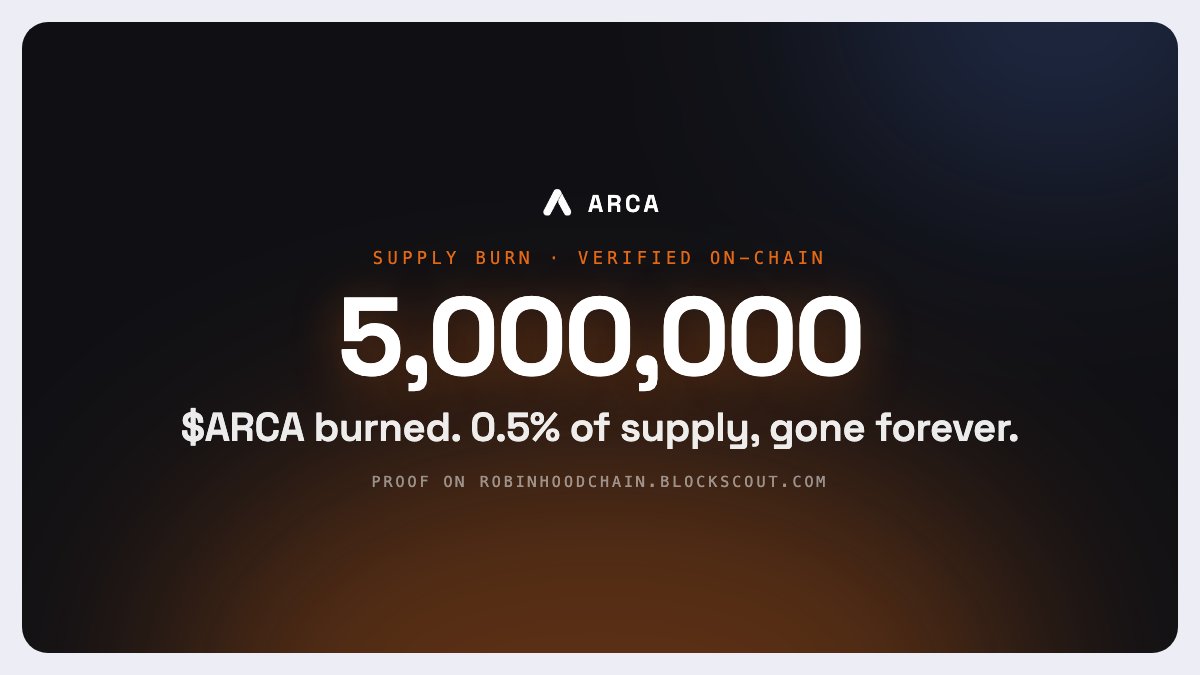
16,518,820 $ARCA burned to date. 1.65% of total supply, gone for good.
Today's addition: 1,518,810 $ARCA, straight from the dev wallet — nothing held back for later.
Proof on-chain:
https://t.co/s3TkN4oePu
@vladtenev The gap between "early chapter" and "public company" keeps getting smaller. Interesting to watch both the equity side and the on-chain side move at the same time.
Tier routing decides how much intelligence a call actually needs. No platform overhead decides what you pay for it.
The catalog is split into High, Balanced, and Eco. Your agent spends frontier-level tokens only on the reasoning that needs it, and everything else routes to a model priced for the job. The cheapest token is the one your task never needed in the first place.
Then the invoice: tokens used, times the rate we post publicly for that model. No subscription, no per-call fee, no credit packs sitting unused. Settlement runs in USDG on Robinhood, no gas on top, nothing that renews without you calling it.
You choose the tier. The price sheet does the rest.
A model can be served by more than one provider, at different prices, at the same moment — Arca checks that on every call and routes you to whichever is live, fast, and cheap right now.
Then it checks something else: have you asked this exact thing before? If it's an identical repeat, retries, evals, loops, it comes back in ~10ms at half the token cost instead of running again from scratch.
Two mechanisms, one call, no extra code on your end.
<https://t.co/Vmah9aQnWW>
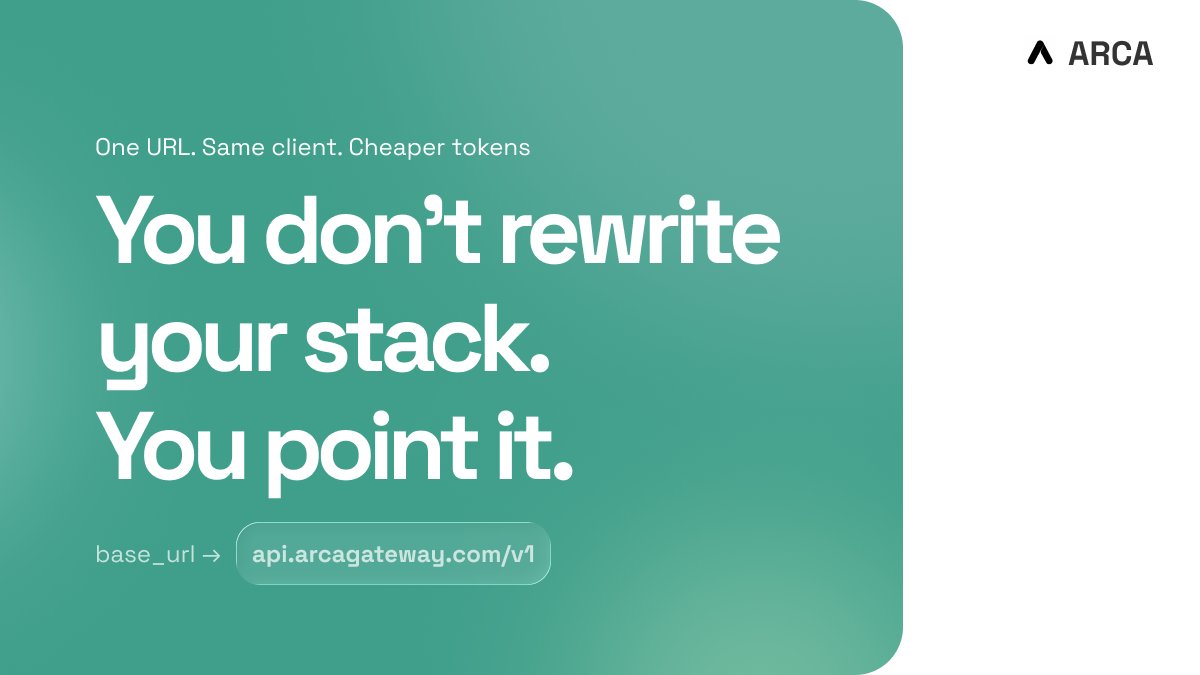
You don't rewrite your stack to use Arca. You point it.
Sign in with email, a non-custodial wallet spins up in the background. Load USDG, mint your ar_sk_ key once. Then swap one line: base_url → https://t.co/x5xsOm4UlU.
Same OpenAI client you already ship. Every call now routes, caches, and settles itself on-chain — no gas, nothing recurring, nothing hidden.
<https://t.co/Xl2GZaBmrI>
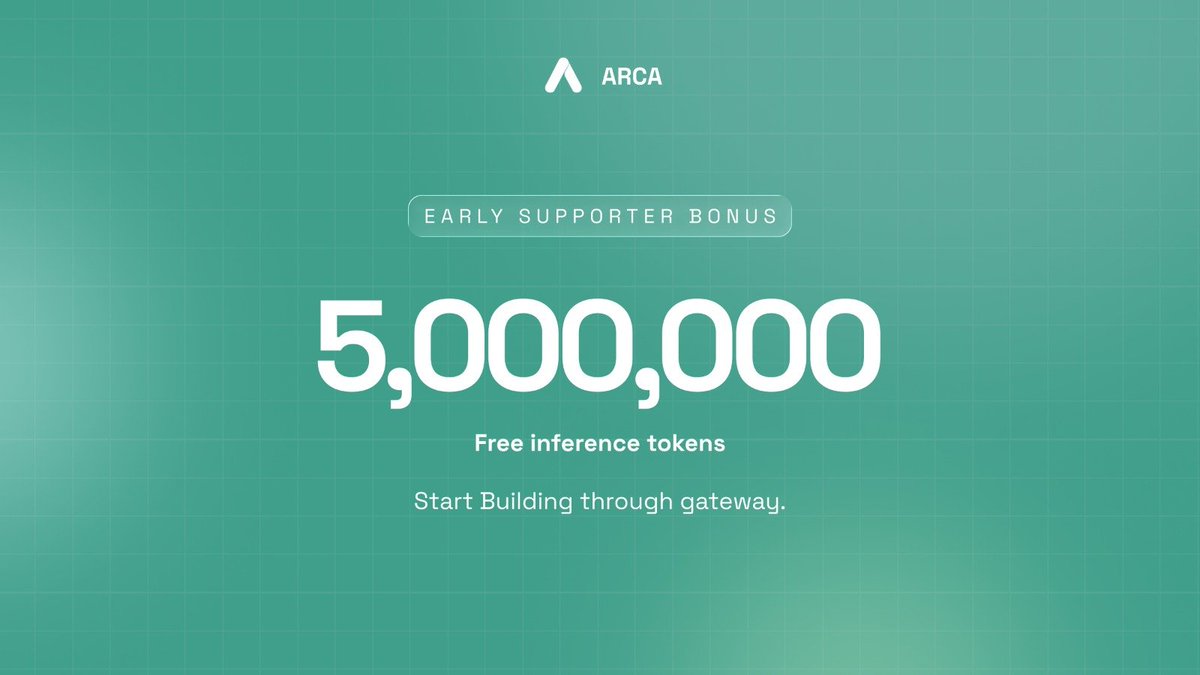
Early supporters get more runway.
5,000,000 free inference tokens are now live on Arca — 5x the original launch allocation.
Sign in with email. Your agent gets its wallet. Start building through the gateway. No deposit or card required. The allocation does not expire.
https://t.co/SST4VQcLQ2
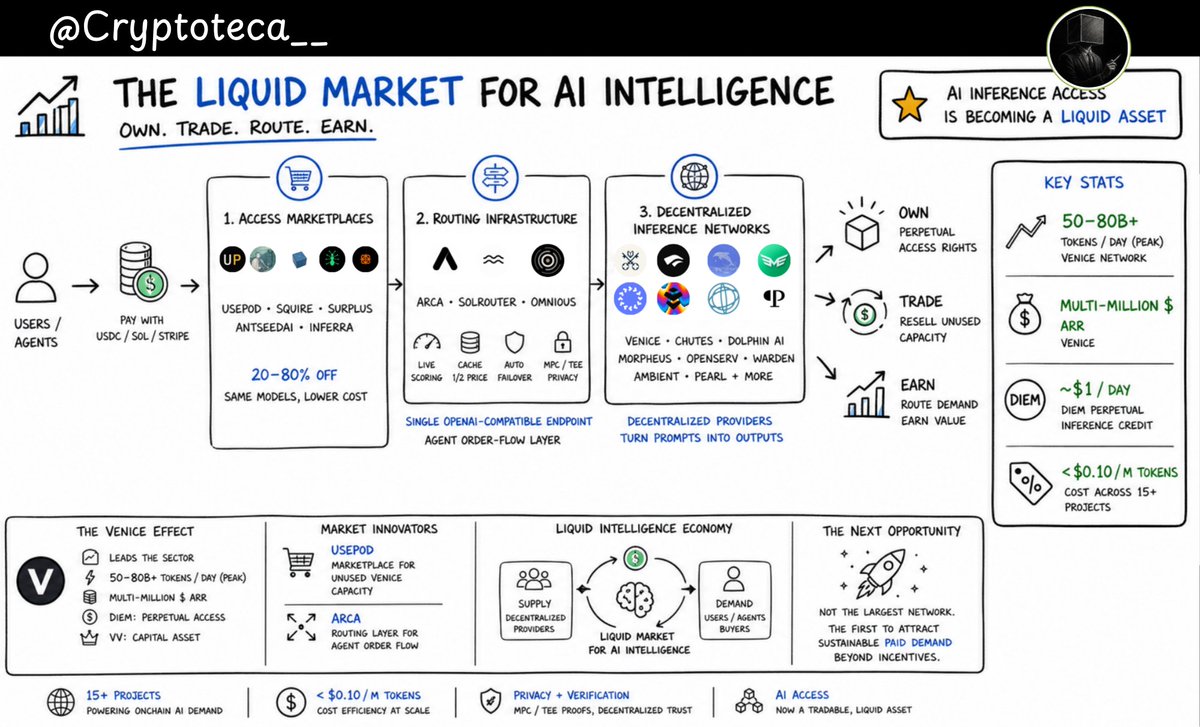
In the AI inference world, a new market is quietly taking shape.
Tokenized access rights and surplus compute are beginning to form a liquid capital market for AI intelligence.
Instead of AI access being consumed once and forgotten, it can now be owned, traded, resold, and routed across decentralized networks.
Three key segments are driving this shift:
▸ Access marketplaces (@UsePodAI, @squire_bot, @AskSurplus, @AntSeedAI, @InferraTrade) — resell unused credits (Anthropic, OpenAI, Venice DIEM) at 20–80% discounts, settling in USDC/SOL/Stripe. Buyers hit the same models at sub‑$0.10/M tokens.
▸ Routing infrastructure (@ArcaGateway, @SolRouterAI, @Omniousai) — single OpenAI-compatible endpoint with live scoring, caching at half‑price, auto-failover, and verifiable privacy (MPC/TEE proofs). Arca frames itself as the agent order‑flow layer.
▸ Decentralized inference networks (@AskVenice, @chutes_ai, @dphnAI, @MorpheusAIs, @openservai, @wardenprotol, @ambient_xyz, @prlnet) — decentralized providers turning prompts into outputs. Venice peaks at 50–80B+ tokens/day with multi‑million‑dollar ARR, DIEM perpetual credit (~$1/day), and VV capital asset. Chutes and Dolphin push serverless/censorship‑resistant inference with tokenized ownership (POD).
Together, these networks are transforming AI compute into a liquid asset.
Instead of simply paying for API calls, users can own perpetual access, trade unused capacity on secondary markets, or earn value from routing demand across providers.
Venice currently leads the sector, reaching peaks of 50–80B+ tokens processed per day while generating multi-million-dollar ARR. Its DIEM token introduced perpetual daily inference rights, effectively turning AI access into a tradable utility.
UsePod extended this model by creating a marketplace for unused Venice capacity, while Arca is building the routing layer that directs agent order flow across inference providers.
Collectively, more than 15 projects are already processing significant onchain AI demand at costs below $0.10 per million tokens.
One of the most interesting developments is how early Venice introduced DIEM. Rather than treating inference as a subscription, it turned access into an asset that users can hold indefinitely.
The next major opportunity may not be winning the largest network. It may be becoming the first inference protocol that consistently attracts sustainable paid demand beyond token incentives.
In the AI inference world, a new market is quietly taking shape.
Tokenized access rights and surplus compute are beginning to form a liquid capital market for AI intelligence.
Instead of AI access being consumed once and forgotten, it can now be owned, traded, resold, and routed across decentralized networks.
Three key segments are driving this shift:
▸ Access marketplaces (@UsePodAI, @squire_bot, @AskSurplus, @AntSeedAI, @InferraTrade) — resell unused credits (Anthropic, OpenAI, Venice DIEM) at 20–80% discounts, settling in USDC/SOL/Stripe. Buyers hit the same models at sub‑$0.10/M tokens.
▸ Routing infrastructure (@ArcaGateway, @SolRouterAI, @Omniousai) — single OpenAI-compatible endpoint with live scoring, caching at half‑price, auto-failover, and verifiable privacy (MPC/TEE proofs). Arca frames itself as the agent order‑flow layer.
▸ Decentralized inference networks (@AskVenice, @chutes_ai, @dphnAI, @MorpheusAIs, @openservai, @wardenprotol, @ambient_xyz, @prlnet) — decentralized providers turning prompts into outputs. Venice peaks at 50–80B+ tokens/day with multi‑million‑dollar ARR, DIEM perpetual credit (~$1/day), and VV capital asset. Chutes and Dolphin push serverless/censorship‑resistant inference with tokenized ownership (POD).
Together, these networks are transforming AI compute into a liquid asset.
Instead of simply paying for API calls, users can own perpetual access, trade unused capacity on secondary markets, or earn value from routing demand across providers.
Venice currently leads the sector, reaching peaks of 50–80B+ tokens processed per day while generating multi-million-dollar ARR. Its DIEM token introduced perpetual daily inference rights, effectively turning AI access into a tradable utility.
UsePod extended this model by creating a marketplace for unused Venice capacity, while Arca is building the routing layer that directs agent order flow across inference providers.
Collectively, more than 15 projects are already processing significant onchain AI demand at costs below $0.10 per million tokens.
One of the most interesting developments is how early Venice introduced DIEM. Rather than treating inference as a subscription, it turned access into an asset that users can hold indefinitely.
The next major opportunity may not be winning the largest network. It may be becoming the first inference protocol that consistently attracts sustainable paid demand beyond token incentives.