"they literally deplatformed me from the largest video sharing platform in the world because some shitty pencil pushing blue-haired person in san francisco doesn't like my politics"
@PalmerLuckey on google nuking @anduriltech's youtube channel
BREAKING: US Treasury hit by cyberattack, taking multiple FinCEN systems offline, per a Treasury disclosure.
This comes just hours after the CIA and ODNI were hacked in a cyberattack.
The entire global economy is being held by a single thread of people forgetting to cancel auto-renewing subscriptions and people being too lazy to move their cash to higher yielding money market accounts.
If every human ran a prompt for an agent to do it for them, the banking system would collapse and the world would explode.
JUST IN: Over 50 government, AI, and cybersecurity leaders warn cyberattacks on businesses and critical infrastructure will become constant and highly disruptive over the next 18 months.
I think the Fed is about to make another mistake on December 9th. Financial conditions have tightened massively. For example, @SpaceX, an investment grade company, just raised secured debt financing at an 8.259% interest rate versus below 6% for its unsecured bond offering at the time of its IPO.
The cost of equity capital has also increased materially with the recent substantial decline in the stock market.
The Fed’s 2% inflation ambition is misguided. Geopolitical risk and the required investment in global military spending, de globalization and tariffs, and the massive AI infrastructure and related energy investment are features of the world that did not exist when the 2% target was set. 3% inflation is a more realistic ambition in the new world.
The Fed will put the U.S. and world in recession if it continues to raise rates in a failed attempt to drive inflation to 2%.
Tell me why I am wrong.
Buy when there is blood in the streets!
Extreme fear is setting up the next leg higher
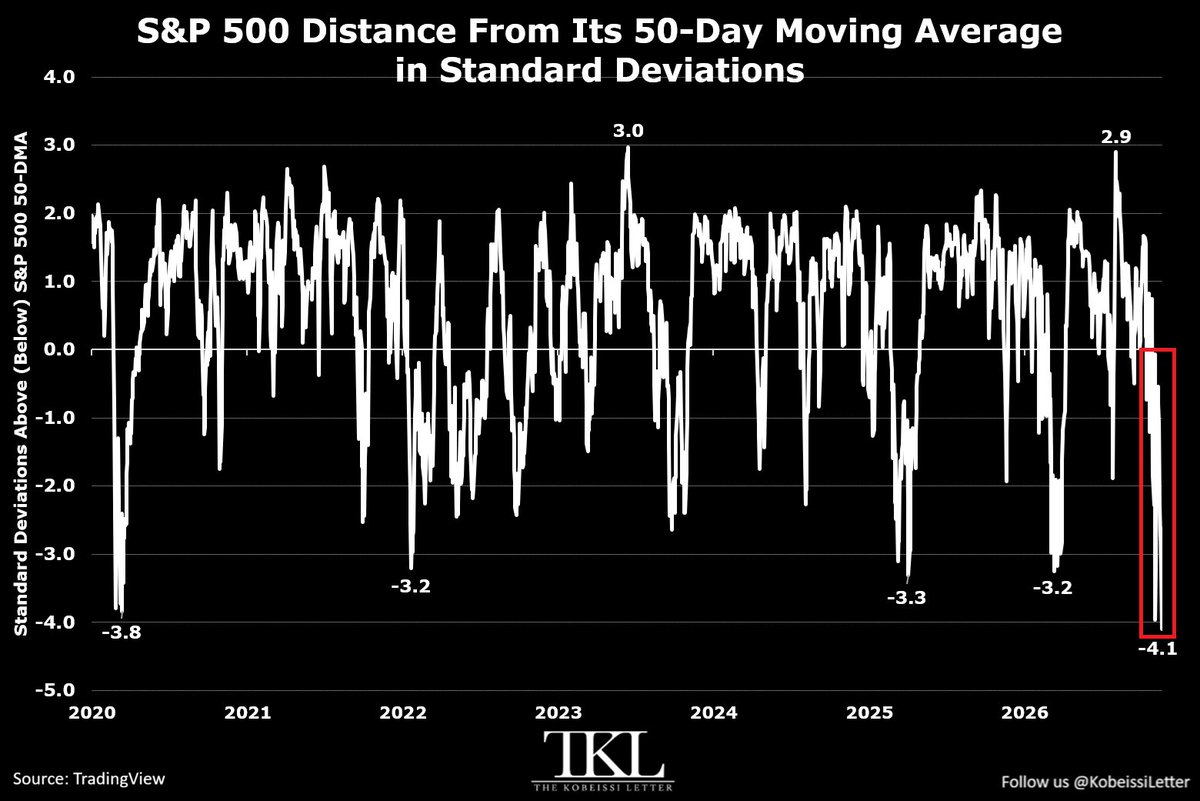
The S&P 500 has fallen 11.6% from its October high in seven straight sessions. Friday’s close sat 4.1 standard deviations below the 50-day average, the most oversold reading since August 2015. The Arms Index posted back-to-back capitulation readings. This is what extreme fear looks like, and extreme fear has historically marked buying opportunities, not the start of bear markets.
The market closed the week at 6,910, right on 6,900, the key Fibonacci support level of this year’s rally. Fast V-shaped recoveries form within days of capitulation, and corrections that hold support don’t become bear markets. From 6,900, the strongest past fast-V recoveries delivered 12-month gains of up to 38%, which puts 9,500 within reach. The timing adds to the case.
The market is entering the sweet spot of the four-year presidential cycle, and the S&P has been higher a year after every midterm election since 1950.
Add a Fed pivot, and 10,000 is still in play. S&P 500 earnings will reach $450 in 2027, so the only argument is over the multiple. With the energy crisis passing, the 10-year Treasury yield will head to 4%, and the Greenspan Fed model then implies a multiple of 25.
Even 22 times earnings gets the index to 10,000. Nothing has changed except the level of fear. There is no recession and no financial crisis, and investors will come to see AI not as a three-year buildout but as something like the railroads.
Fear flips to greed, as it did in 1998. After the Asian currency crisis and the Russia and LTCM shock, the S&P 500 fell 19% from its July peak. The Fed cut three times, the index regained its high by late November, and a year after the October low it was up 39%. When the Fed has eased after a no-recession sell-off, as in 1998, 2019 and 2025, the median 12-month gain has been 33.7%.
Many cite the 1990s to argue that the supply of AI capacity is outstripping demand. That’s wrong. The real lesson of the 1990s is the one Alan Greenspan drew: productivity gains let an economy run hot without stoking inflation. In 1995, after the Fed pivoted from hiking to easing with no recession, the S&P 500 gained 34.1%, the best pre-election year since 1950.
Leveraged products now amplify every swing between fear and greed, and this week’s selling was fear at full volume. The old saying is to buy when there is blood in the streets. Today there is no recession and no financial crisis, the energy shock is ending, and productivity and earnings are growing strongly. A Fed pivot is coming, and the market is cheap.
That’s the time to buy.
US stocks have rarely been this oversold:
The S&P 500 closed the week 4.1 standard deviations below its 50-day moving average, its widest deviation since August 2015.
This also marks its 3rd-largest deviation in at least 20 years.
By comparison, during the 2008 Financial Crisis, the index’s largest deviation from its 50-DMA was 3.6 standard deviations.
Not even the 2020 Pandemic crash saw such extreme oversold conditions, with the S&P 500 falling 3.8 standard deviations below its 50-day moving average in February.
During the 2022 bear market and the April 2025 post-"Liberation Day" selloff, the S&P 500 fell 3.2 and 3.3 standard deviations below its 50-day moving average, respectively.
This has been one of the sharpest market sell-offs in history.
Imagine waking up to a bank balance of zero, and the fix you're offered is money the government can switch off. Bret Weinstein says that's the scenario to watch for.
He isn't claiming it has happened. His warning is about how it could be sold to the public.
Bret Weinstein: "If, for example, people watched their bank balances go to zero and they were told that the reason that that had happened was that there was a cyber attack with AI, that that would in one move allow them to be marshaled into a central bank digital currency."
And the rescue would sound reassuring:
Bret Weinstein: "They could be told, don't worry, your money is safe, but we're giving it back to you in this form of programmable money."
This is the part he says people miss:
Bret Weinstein: "There is no longer a need for a process to eliminate your speech rights. You can simply be rendered poor. Your money can become unspendable because you've displeased the regime."
Nobody would need to censor you if they could just stop you paying for things.
His conclusion:
Bret Weinstein: "What may look like an attack from far away is actually an attack from close quarters designed to get us to embrace measures that we would not do if we had not been frightened into it."
This isn't purely hypothetical. In 2022, Canada used emergency powers to freeze the bank accounts of people linked to the trucker protests, without a court order. In 2024, a federal judge ruled that the use of those powers was unreasonable.
Here's where digital money stands now. In the EU, the digital euro is in final negotiations, with the ECB aiming for a first issuance in 2029. The ECB says it would not be programmable money and that holdings would be capped. In the US, a January 2025 executive order bans federal agencies from creating a CBDC, but Congress hasn't made that ban law.
How it's built matters, and so does how it's introduced. People should get to choose it calmly, not in a panic.
This is f*cking insane.
Everyone is talking about Trump asking Nvidia to give Jensen Huang a "second chance"
Almost nobody is talking about what Jensen told Lex Fridman about TSMC:
"Three decades. I don't know how many tens, hundreds of billions of dollars of business we've done through them.
And we don't have a contract"
In 3 minutes, he explains how Nvidia's supply chain runs on trust instead of paper, and why he turned down the chance to run TSMC in 2013
Today the WSJ called his handshake deals a danger for Nvidia
When a founder leaves, most people count his shares.
Jensen is describing the asset that doesn't transfer:
Promise → delivery → trust → billions in capex on his word
Old way: lawyers sign the contract, then the partner builds
New way: the founder explains it from first principles, and partners commit "several billion dollars of capital investments each"
The board can hire a new CEO. It can't hire 30 years of trust
This 3-minute clip explains Nvidia's next problem better than any analyst note
Palmer Luckey at NYT DealBook explains why he believes Elon Musk shouldn’t have to risk the entire Starlink network for Ukraine when the U.S. government isn’t willing to take the same risk with Starshield
Starshield is the military system, not Starlink. Palmer Luckey nailed it: stop expecting SpaceX to weaponize a commercial network for a government that won't even hold elections for "democracy."
via BusinessBlurb
#elonmusk #ukraine #russia #usa #billionaire