@UnitreeRobotics is up 14% in Shanghai today, above 3x its August IPO price. The market is buying bodies.
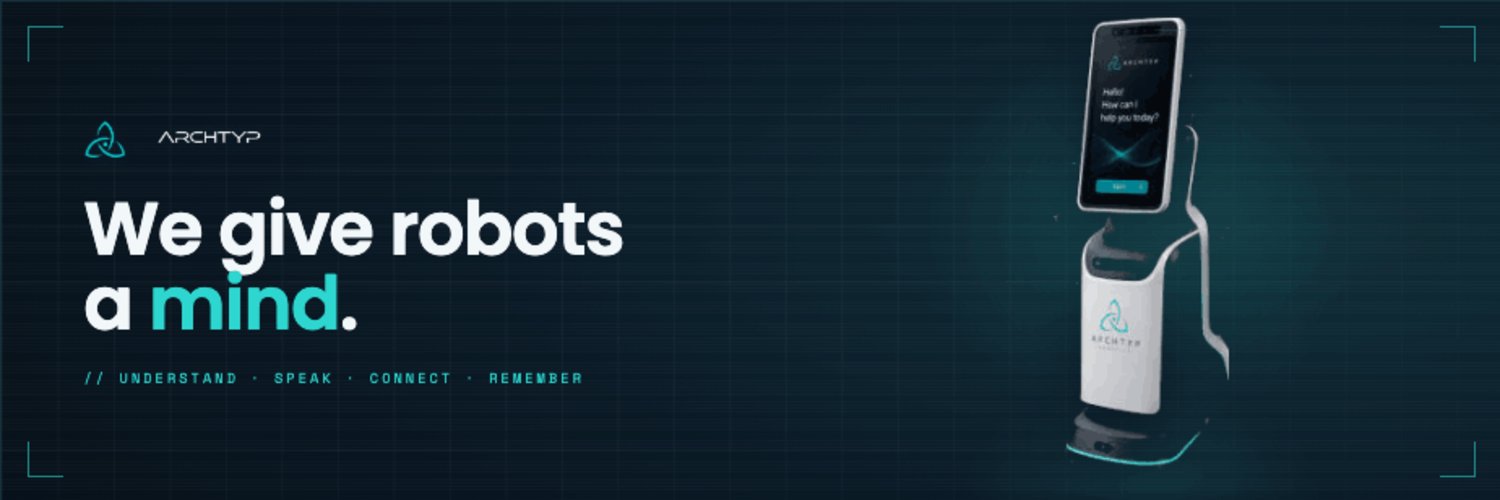
ARCHTYP OS is the social and operational brain for physical AI, running on humanoids, robots, avatars and screens.
@PuduRobotics now has a semi-humanoid and a wheel-leg quadruped next to 130,000 delivery robots in 85 countries.
New bodies every few months. Who this shopper is and what we said last time shouldn't be rebuilt for each one. ARCHTYP OS runs across them.
#PhysicalAI
Alto is the retail robot we co-designed with temi, here in Ljubljana.
In a store it has one job, more sales per square metre. Everything we build this month gets judged on that.
#RetailTech
People interrupt. They change their mind mid sentence and point at a shelf.
Most robots wait for silence, then answer the question you stopped asking three seconds ago. Handling that is a big part of working with people.
A humanoid under $2,500 and a fully open source one both launched this week.
Bodies are about to be cheap and everywhere. What the robot says to the person in front of it, and remembers tomorrow, still comes from somewhere. That's the layer we build.
#PhysicalAI
Our test lab is a dark showroom in Ljubljana with two Alto robots and a pile of Dormeo and Slayer products.
Visitors ask the robot things we never planned for. We write every one down.
#BuildInPublic
@ctorobotics@mobileloaves 121 homes nearing completion in Austin makes robotic construction feel real. People living in them will say more than any promo video.
@RoboDispatch You said the Xiao Di link is only likely, which is more than most patent stories bother with. A rounded head with no screen is a bold choice for service work.
@robotsdigest Gear meshing and nut tightening zero shot straight from sim is the bit that matters. Most manipulation demos still sneak in human data somewhere.
A shop robot that says hello to everyone the same way is a doorbell.
The useful one notices the customer who has stared at the same shelf for a full minute, and walks over.
Hello is the easy part.
#robotics
@weikaih04 Thanks for the reply. Treating catching as a fast closed-loop visuomotor problem instead of bolting on another slow reasoning stack makes sense. The live throws test is what matters.
@XueJia24682 Running waste-sorting guidance on a roaming platform instead of a fixed kiosk is a smart placement. Convincing passengers to actually classify their trash while hurrying through a busy terminal is where the idea gets tested.
@BrianTycangco The way it won't let the doors close on it is a genuinely useful elevator behavior. Most room service bots just nudge at the threshold and stall. Getting through doors unreliably kills the guest experience before anything else.
@fkfk21_18 Shoving knee link nonlinearity compensation into Odrive firmware instead of leaving it in userspace drops the control loop where it matters on hardware. Solid RL to deploy pipeline as well.
@MarwaEldiwiny@GoingBallistic5 Watching step impact ripple straight up into the arms is a clear read of what the actuators are doing. Most control stacks average that energy out and call it solved.
@rafaelcaricio Disciplined about keeping customizations as extensions of Microduck. Ship the first fork early and the rest of the team inherits clean upgrade paths.
@yihan825 A ten second s2r clip on a doll type body is a stronger read than most multi minute policy demos. Real actuator compliance is what gets in the way once you scale past that chassis.
@techniahqrobot Twenty years apart, side by side, makes it obvious. Placement going from slow and errorful to a blur shows how much the control stack moved.