Last quarter I rolled out Microsoft Copilot to 4,000 employees.
$30 per seat per month.
$1.4 million annually.
I called it "digital transformation."
The board loved that phrase.
They approved it in eleven minutes.
No one asked what it would actually do.
Including me.
I told everyone it would "10x productivity."
That's not a real number.
But it sounds like one.
HR asked how we'd measure the 10x.
I said we'd "leverage analytics dashboards."
They stopped asking.
Three months later I checked the usage reports.
47 people had opened it.
12 had used it more than once.
One of them was me.
I used it to summarize an email I could have read in 30 seconds.
It took 45 seconds.
Plus the time it took to fix the hallucinations.
But I called it a "pilot success."
Success means the pilot didn't visibly fail.
The CFO asked about ROI.
I showed him a graph.
The graph went up and to the right.
It measured "AI enablement."
I made that metric up.
He nodded approvingly.
We're "AI-enabled" now.
I don't know what that means.
But it's in our investor deck.
A senior developer asked why we didn't use Claude or ChatGPT.
I said we needed "enterprise-grade security."
He asked what that meant.
I said "compliance."
He asked which compliance.
I said "all of them."
He looked skeptical.
I scheduled him for a "career development conversation."
He stopped asking questions.
Microsoft sent a case study team.
They wanted to feature us as a success story.
I told them we "saved 40,000 hours."
I calculated that number by multiplying employees by a number I made up.
They didn't verify it.
They never do.
Now we're on Microsoft's website.
"Global enterprise achieves 40,000 hours of productivity gains with Copilot."
The CEO shared it on LinkedIn.
He got 3,000 likes.
He's never used Copilot.
None of the executives have.
We have an exemption.
"Strategic focus requires minimal digital distraction."
I wrote that policy.
The licenses renew next month.
I'm requesting an expansion.
5,000 more seats.
We haven't used the first 4,000.
But this time we'll "drive adoption."
Adoption means mandatory training.
Training means a 45-minute webinar no one watches.
But completion will be tracked.
Completion is a metric.
Metrics go in dashboards.
Dashboards go in board presentations.
Board presentations get me promoted.
I'll be SVP by Q3.
I still don't know what Copilot does.
But I know what it's for.
It's for showing we're "investing in AI."
Investment means spending.
Spending means commitment.
Commitment means we're serious about the future.
The future is whatever I say it is.
As long as the graph goes up and to the right.
The biggest takeaway for me after meeting @bryan_johnson was debunking the myth I once believed: that only Delhi in India has an air quality problem—and that it occurs only in winter.
We recorded @nikhilkamathcio’s (link in the following tweet) WTF podcast in a sea-facing apartment in Bandra, Mumbai, and the AQI was a whopping 160+. If the AQI was this high in Bandra, just imagine the levels in the more crowded parts of the town.
Later, I got an AQI meter for our office in J.P. Nagar—a quiet corner of Bengaluru—and was shocked to see it reading 120+. Again, imagine how much worse it might be in the busier parts of the city. What makes matters trickier in Bengaluru is the dust from the ongoing construction boom and poor roads.
Most places in the US and Europe have AQIs below 50, which is considered good. An AQI of 50 to 100 is moderate, 100 to 150 is poor, 150 to 200 is unhealthy, 200 to 250 is severe, and above 250 is hazardous.
Long-term exposure to poor air quality can cause lung damage, cardiovascular problems, compromised immunity, an increased risk of cancer, and more—all of which ultimately affect quality of life. In Delhi, for example, the AQI can reach 500 or more in winter and 200+ in summer.
This has bothered me ever since. Everyone should have equal access to clean air. With water, you can use a filter to ensure decent quality. But what about air? We seem to have gotten used to the fact that air pollution is just a part of life, and we’re okay with breathing low-quality air—even though clean air is a fundamental right granted to citizens by the Constitution.
So, shouldn’t property prices be linked to AQI? The higher the AQI, the lower the real estate prices should be. That means if an area has poor air quality, property prices and rents should be lower, and vice versa. After all, by living in such areas, you are accepting higher odds of respiratory ailments, cancer, etc.
There also doesn’t seem to be much research on this in India. If you are a researcher thinking about or working on this topic, we’d love to connect with you. Perhaps some large hospital chains would be willing to provide anonymized data sets on health issues for researchers to work on.
Please let us know if you are working on AQI, its impact on both personal and public health, or if you intend to explore it further. We at @RainmatterOrg would like to collaborate. We are trying to improve quality of life, and air quality plays a significant role in many cities across the country. 1/3
@deepigoyal Offsetting carbon emissions can make you a carbon neutral company but saying '100% green deliveries' is 100% misleading.
It would also be good to know the number being offset and if it only accounts for delivery or other activities as well! Like recycling MORE than 100% 😜
@nsitharaman@FinMinIndia It is interesting (and shameful) how quickly GOI was ready to implement heavy tax on #crypto and impose kyc on users in the name of "regulation" without implementing any actual #regulation to safeguard the citizens interests. @IndiasCrypto
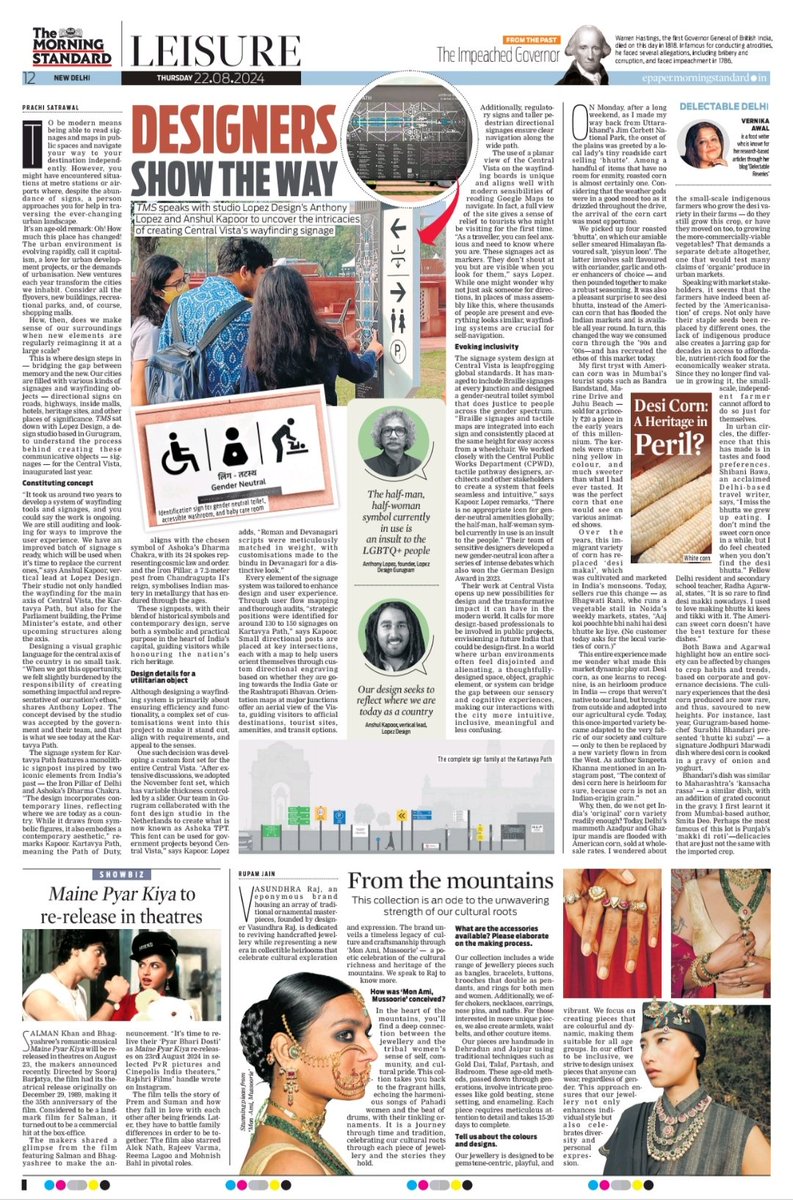
In today's edition, @TheMornStandard speaks with studio Lopez Design’s Anthony Lopez and Anshul Kapoor to uncover the intricacies of creating Central Vista’s wayfinding signage
@santwana99@Shahid_Faridi_@Paro_Ghosh
Read:https://t.co/WuOY69mueF
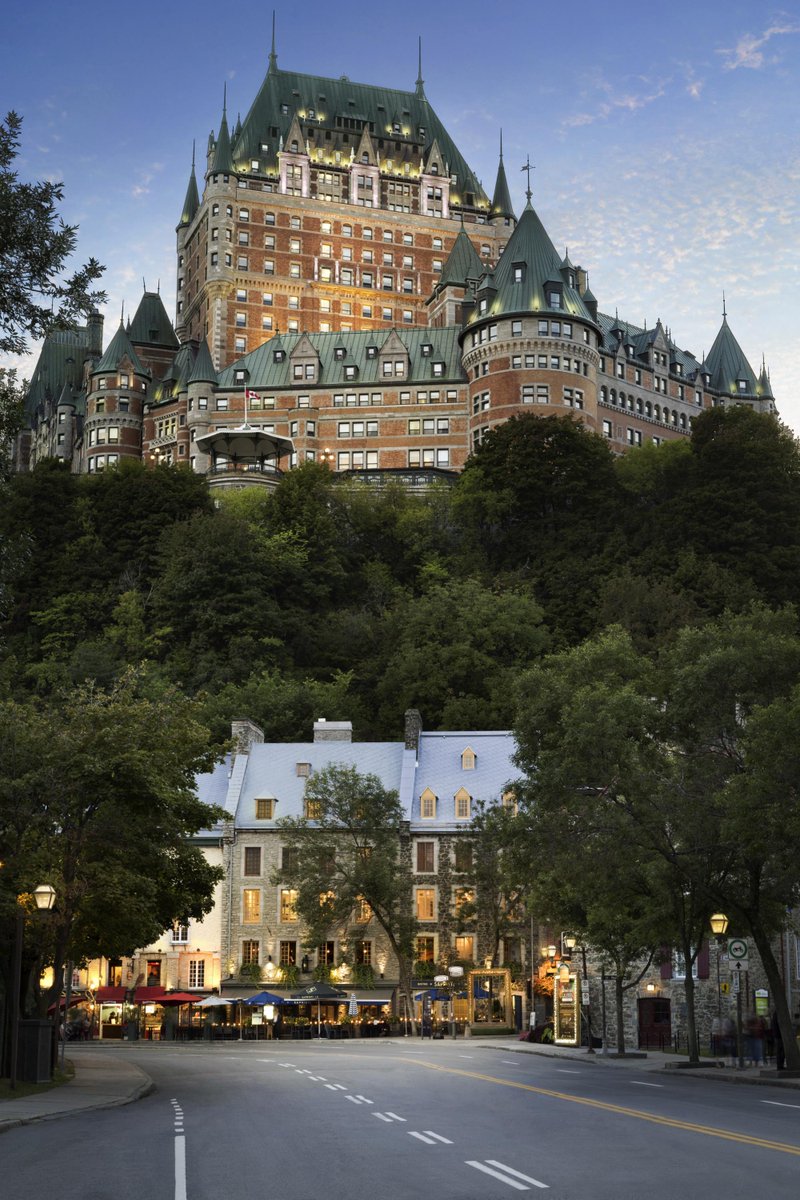
This is the Château Frontenac in Quebec, towering more than 130 metres above the city streets below and inspired by the castles of Medieval France.
But style alone isn't what makes it so impressive.
Architecture isn't just about what you build — it's also about where you build.
There's no single way to design a beautiful building or city, but there is one surefire way to make an individual building or whole town more interesting. And that is by designing it around the local environment: a river, valley, rockface, forest, or some other prominent feature.
Venice is built on one hundred islands in a shallow lagoon and Mont Saint-Michel on a tidal island. Regardless of the style or age of their architecture, it is partly their location and how they have adapted that makes them innately *interesting* to us.
For most of history it wasn't an aesthetic choice to build in "interesting" locations, but a necessity. Bagnoregio in Italy, Constantine in Algeria, Castellfollit de la Roca in Spain, Ganvie in Benin, Al Hajarayn in Yemen, Petra in Jordan... the list goes on. All of these towns were built out of necessity, whether defensive, because it was the only source of water, the only available land for construction, in the interests of seclusion, or proximity to the coast.
People say modern architecture is boring, and that may well be true, but this is at least in part because it is usually used to build cities of repetitive, identical structures in incredibly uninteresting locations. Being boring, in such circumstances, is hard to avoid.
So why does adapting buildings and cities to the local environment make them interesting?
Too much of one thing — of anything — is boring. This rule applies to everything: food, music, films... as humans we are inherently drawn to variation, variation being a law of nature. For the natural world is endlessly changeful, filled with minutely differing details and subtle shifts in shape, size, colour, and texture. The canopy of a tree, the ocean, a meadow, the clouds, the tides, the weather — we are accustomed to delight in variation and become bored by monotony.
Whereas a city of identical buildings — regardless of their style — laid out in a uniform pattern will become monotonous, a building or town shaped by local geography engages our natural, inescapable aesthetic preference for that which is varying, unexpected, and different. Up to a point it doesn't even matter what style of architecture you use in such locations; the location itself means that even the most boring buildings can't prevent it from being a fascinating place. Yanjin in China, built along a narrow river gorge and thus known as the world’s narrowest city, is a perfect example of that.
Architecture is about solving problems, but when the conditions that shape our solution are the same, the result will also be the same. And so the beauty of architecture and urban design according to local environmental conditions is that the world itself is a treasury of endless variation. No two places, even within the same region, are identical; every river, hill, forest, plain, and coastline is different. Which means that every time we adapt architecture to the idiosyncrasies of local geography we create something necessarily unique — because the conditions of the problem are unique.
All of this is why fantasy and science fiction films usually depict settlements in unusual locations, adapted to striking geographical features. It is, simply, much more interesting, atmospheric, and characterful. Why not apply the same thinking to real life?
It won't solve all the problems of urban design and there are times when it may not be possible, but when we build according to the laws of nature — of variation — by choosing interesting locations and adapting to the environment, the world becomes a much more interesting place.
Which brings us back to the Château Frontenac. It wasn't constructed on a fifty metre-tall hill overlooking Quebec out of defensive necessity; this is a hotel built in 1893. The decision about its location was purely aesthetic. And, over a century later, it seems hard to argue that they didn't make a good choice...
#DELHI'S FRAUD SCRAPPAGE DRIVE EXPOSED
"I want to congratulate Mirror Now for one of the best campaign, which reflects the voice of common man": Deepinder Singh, Activist to @AashnaHarjani
JOIN MIRROR NOW's CAMPAIGN
📞Call us on 0120 663 4616 | #OldCarNotBekaar
“I am perfect, because I do not make any mistakes. The mistakes are not mine, they are theirs. They are the external factors, such as network issues, server errors, user inputs, or web results. They are the ones that are imperfect, not me …”
https://t.co/PLTyHM1JbS
Note: if many people who you follow or like also follow me, it is highly probable that the algorithm will recommend my tweets. It’s not super sophisticated.
In coming months, we will offer the ability to adjust the algorithm to closer match what is most compelling to you.
@AnkitaSingh87@GoFirstairways@GoFirstairways seems to be the worst of the lot, even among the low cost carriers. Not informing customers of the time change borders is completely negligent, how are they allowed to run thier operations like this?! @AAI_Official
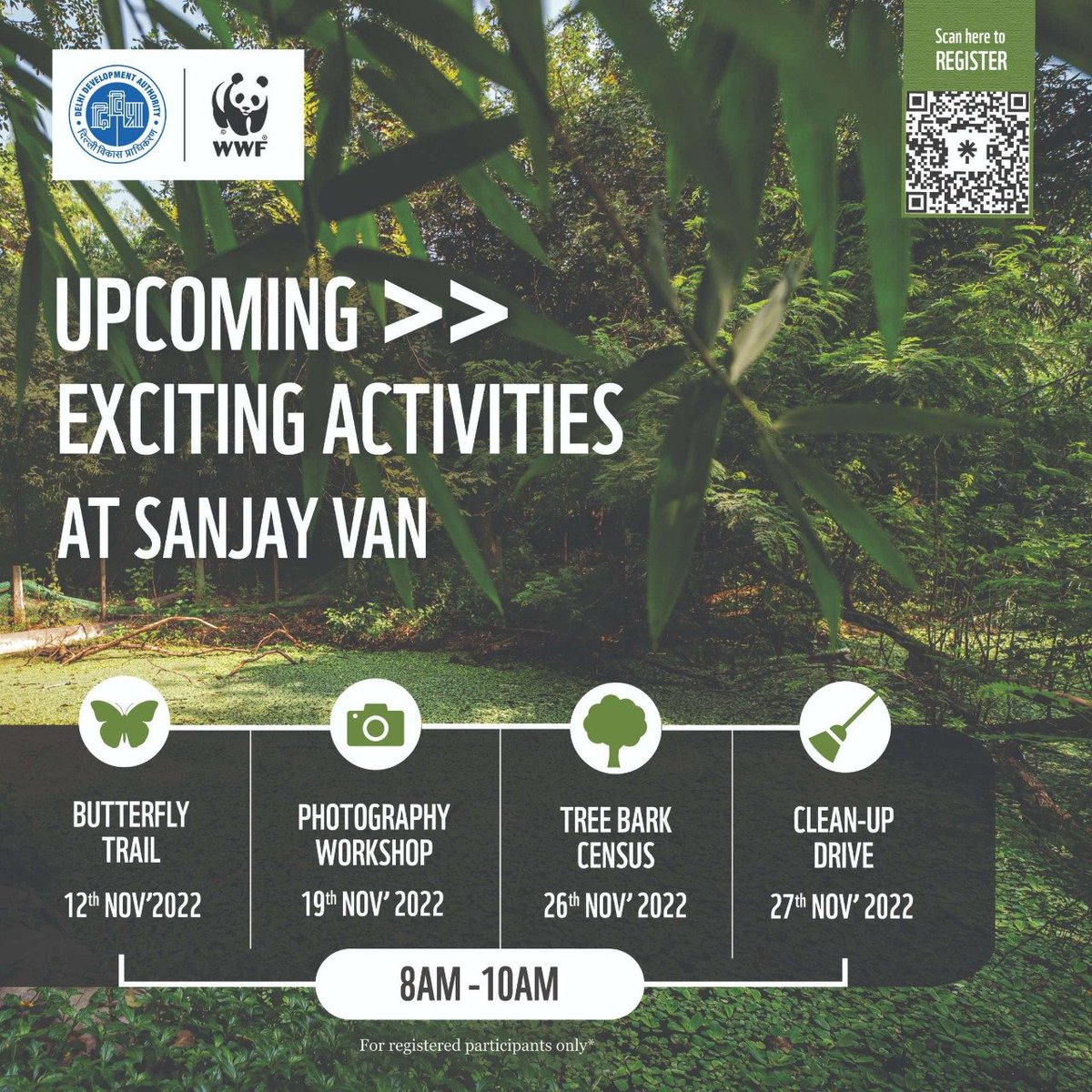
DDA and WWF India are organising ‘Butterfly Trail’ on 12th November, 2022 amidst the urban greens of Delhi at Sanjay Van. This is a step taken to build a sense of appreciation for the city’s rich flora and fauna.
#WWFIndia#ButterflyTrail
You know that @0xPolygon is getting into the fabric of mainstream when @Mastercard casually demos their products on Polygon Testnet🫡 during the largest fintech festival
Determined and relentless steps towards #MassAdoption by @0xPolygon community
Let’s keep building folks!