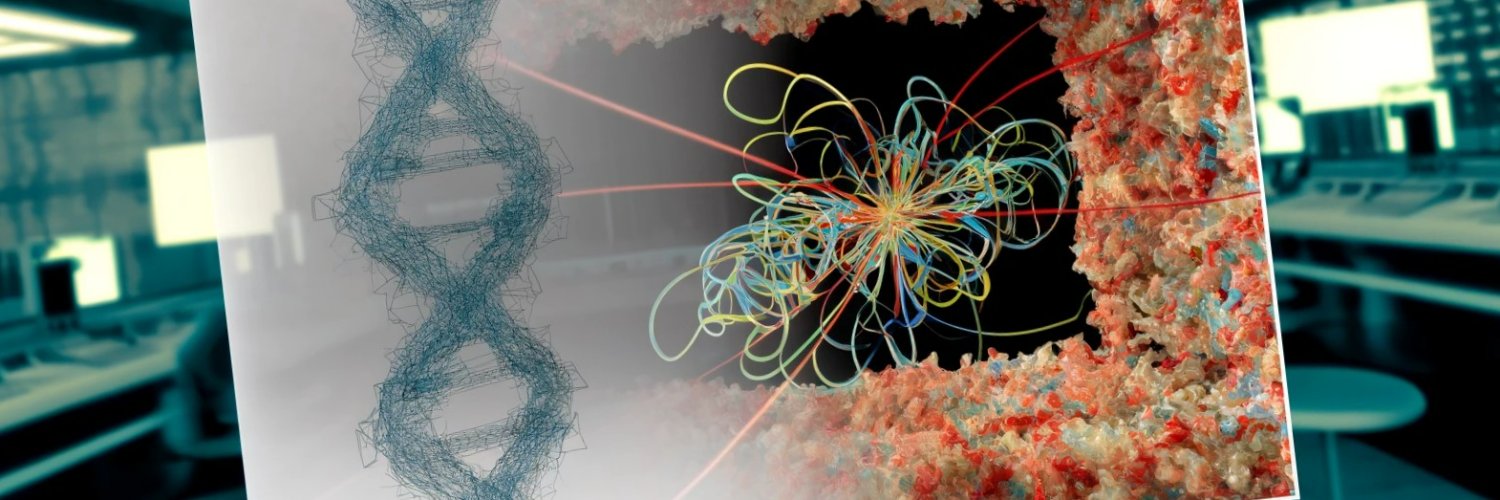
If you’re attending #BioIT conference at Boston, I’ll be happy to exchange ideas about computational protein engineering, immunoinformatics, and machine learning-based biomolecular design! #BioITExpo
I am pleased to inform you about the publication of my recent article entitled "Unexplored power of CRISPR-Cas9 in neuroscience, a multi-OMICs review". Here is the link to its full text "https://t.co/DB2SWIpNRR" I would like to especially thank @Ardavan_Abiri for this project.
Excited to attend & present at #RECOMB, #MIT, thanks to #YaleUniversity's PEB award! 🎉 Exploring the intersection of transformers & #vaccine_design, we've made significant strides in quantifying antigenicity. Can't wait for stimulating discussions with brilliant minds! #Vaccine
Three years ago, I started working on an easy-to-use tool for interpretable machine learning in science. I wanted it to do for symbolic regression what Theano did for deep learning.
Today, I am beyond excited to share with you the paper describing it!
https://t.co/be2cVdukPy
1.
Some perspective for scientists who may be asked to review computational methods: Computational methods are indeed innovated by taking existing mathematical and algorithmic atoms and putting them together in a novel way. Second, small changes in the steps can have a large effect on the outcome! Examples below:
The classic ISOMAP method could be considered a combination of shortest paths on graphs + MDS. Neither of these was novel but ISOMAP was one of the first breakthrough manifold learning algorithms.
Spectral clustering is just using graph Laplacian eigenvectors and K-means, again the combo is what makes this able to detect arbitrarily shaped clusters.
The difference between SNE and t-SNE was just the "t" (student t-distribution) but look at how much one is used over the other :).
The difference between a GAN and a conditional GAN is just a conditioning input signal.
Please do comment on anyone's paper that because the atoms they used are not novel, or the change doesn't seem vast, that the entire method is not novel. This is completely unfair and ignores how computational innovation proceeds...
@tegmark Just more convinced that, indeed, this amazing hero is trying to dispel irrational fear that exists in this rapidly evolving area. It's "inevitable" and you cannot halt the progression of science & technology!
Re: Replacing Google Search with ChatGPT
If Google Search used Chat-GPT, Google would probably be bankrupt in a month or so given that there are 8.5 billion search queries a day.
Using LLMs in/for Google Search makes sense though. They already started doing that years ago.
It seems that a dearth of data for sequences with low homology is the main impediment in successfully predicting new structures! In short, the models are memorizing not learning :-(
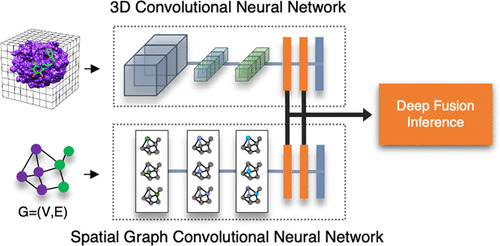
"On large-scale inhouse Kinome-data .. found that the prediction accuracy of the single-task graph neural network (GNN) model was generally lower than that of the non-deep learning model (LightGBM), but the multitask GNN, outperformed LightGBM." https://t.co/CbUKZaRtGu
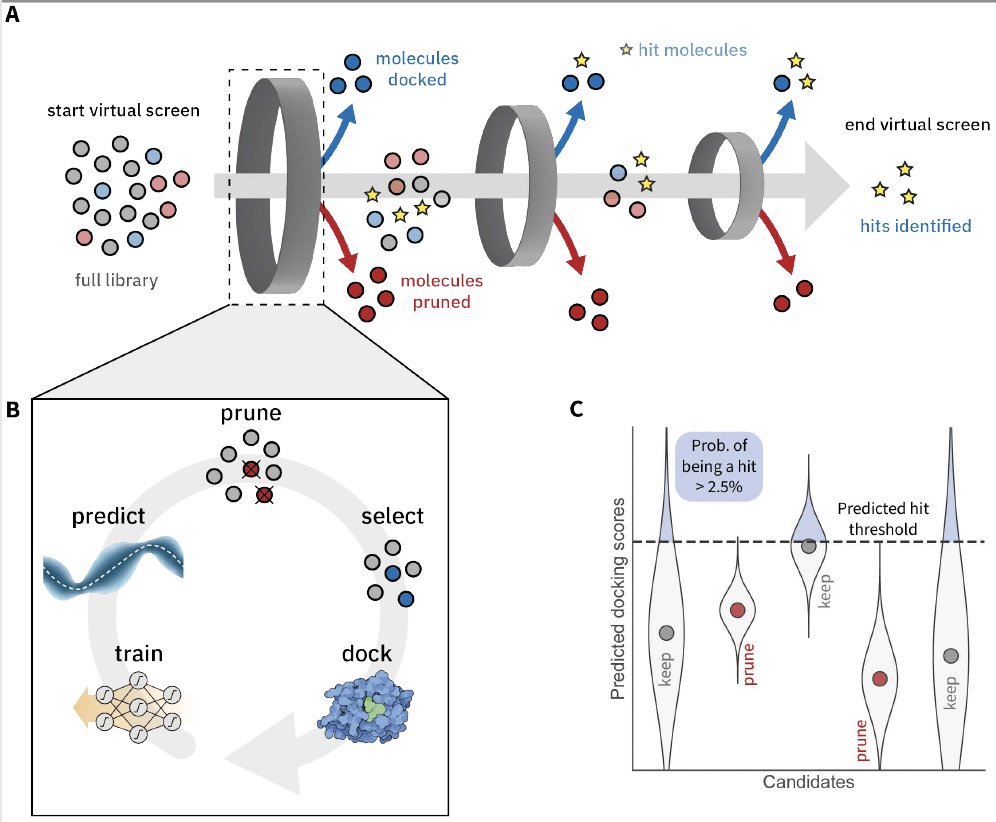
1/ We've preprinted a follow-up to our work applying Bayesian optimization to high-throughput virtual screening: "design space pruning": https://t.co/7zjiJKKi1Z | led by David Graff and @matteo_aldeghi + @ed_pyzerknapp and others at IBM
Learn #neuralnetworks not (only) because they are ineffably interesting and will promisingly change the world, but because you learn how to deal with sophisticated problems in real life which require you to factor in so many unrelated components in the final #decisionmaking 🧐.
@egbert_castro Great work 🌺. The finding that attention maps of ReLSO and AE have some discrepancies was one of the most mesmerizing parts! I am thinking about the possibility of the dynamic nature of protein conformations, lending credence to distinct attention maps🤔.
@AndrewPlested @UniCologne There seems an inverse relationship between the hatred of a person of IF and the number of their published papers in top journals (Nature, Cell, Science). IF undeniably does correlate with the significance of a scientific work; so maybe a bit distant from totally "nonsense".
@gonenlab The same applies to PhD interviews/assessments and items that are present in CVs. They are either impossible (bluffing!?) or obvious (cliché and ubiquitous!!) in the eyes of examiners. So, in the same analogy, the assessment committee for graduate studies is antiquated.
The more I apply to #PhD#positions, the more I come to the realization that the scientific community desperately needs more #machinelearning implementation in graduate admission process, #decisionmaking, and selection criteria, not in bioinformatics or drug design. #bias
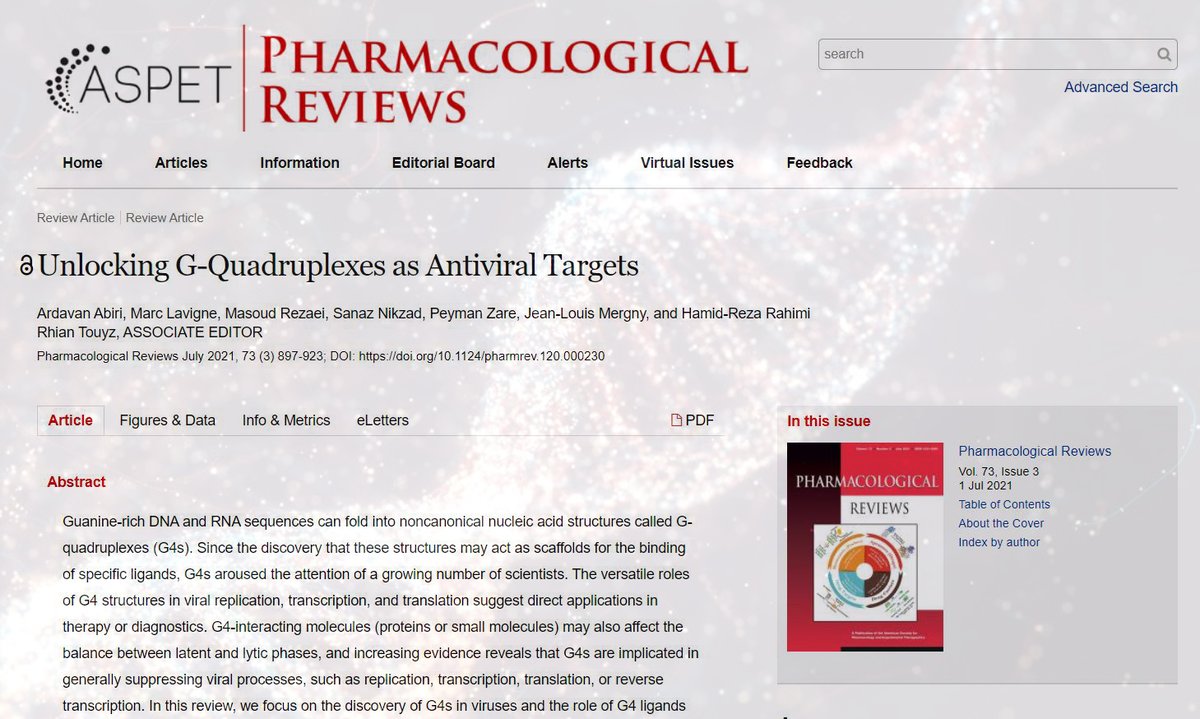
Are you a fan of drug discovery by targeting nucleic acids? Then, check out our paper in Pharmacological Reviews, one of the best journals in pharmacology (IF = 24.7).
https://t.co/XMin1rNzhh
#DNA#RNA#drugdiscovery#drugdesign#antiviral
@SusannaLHarris There is a concealed form of bias in the pool from which the answers are being sampled. Those who left academia (and now express loathing) are a substratum that haven’t enjoyed and loved academia, for any reason. Otherwise, why should someone leave it? :-)
@fabian_theis In the second case, the discussion section can be argued in a case-to-case investigation. Regarding the discussion/conclusion usually there are more peer-reviewed data that can be replaced and other citations can be specifically discussed.
@fabian_theis In the majority of cases, such citations are directed to either methodology or discussion. As most of the ML works currently accomplished are roughly “black-box” at heart, the evaluation criteria fall into the hand of accuracy, sensitivity, etc. and criticism becomes irrelevant.