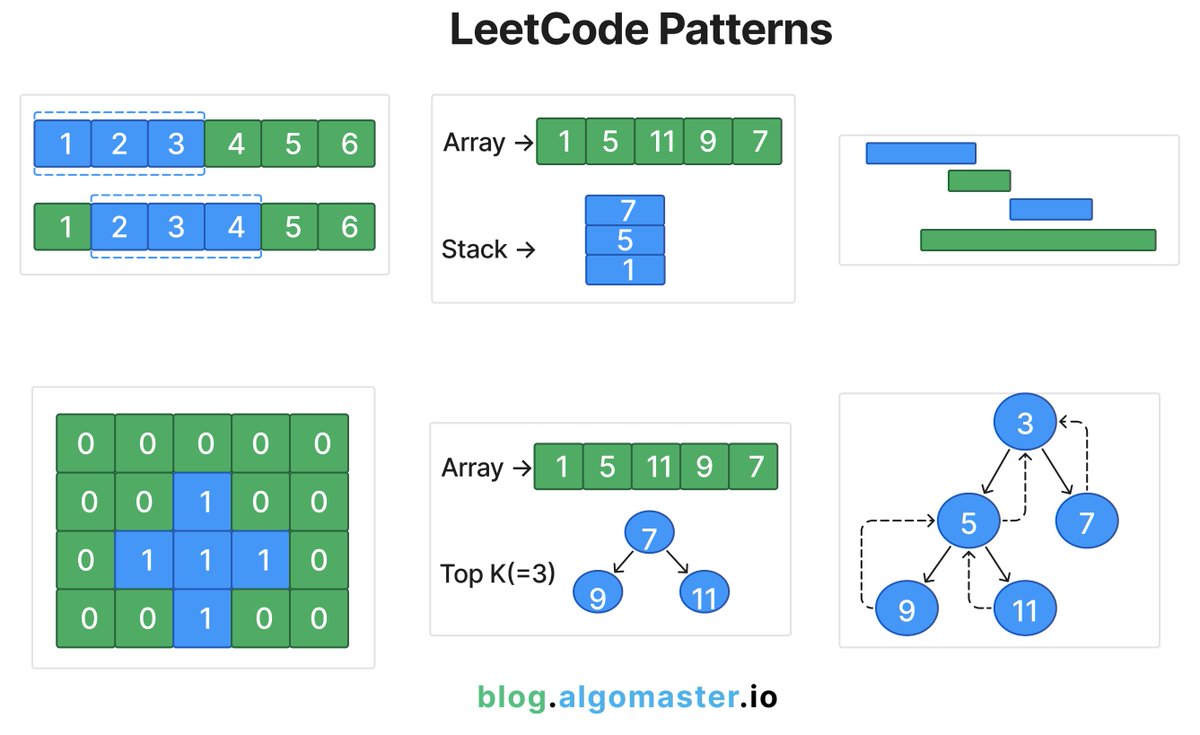
LeetCode was HARD until I Learned these 15 Patterns:
1. Prefix Sum
2. Two Pointers
3. Sliding Window
4. Fast & Slow Pointers
5. LinkedList In-place Reversal
6. Monotonic Stack
7. Top ‘K’ Elements
8. Overlapping Intervals
9. Modified Binary Search
10. Binary Tree Traversal
11. Depth-First Search (DFS)
12. Breadth-First Search (BFS)
13. Matrix Traversal
14. Backtracking
15. Dynamic Programming Patterns
I wrote a detailed article on these patterns and provide links to leetcode problems you can practice to learn them better.
Check it out here: https://t.co/dFv9UPKFUB
Subscribe for more such articles every week.
A strong foundation in Mathematics can help you excel in the field of Data Science!
Here are some of the top FREE resources on Maths for ML, covering:
- Linear Algebra
- Calculus
- Prob/Stats
- Applied Bayesian Modeling
- Probabilistic Machine Learning
Let's go! 🚀
Microsoft launched the best course on Generative AI!
The free 18 lesson course is available on Github and will teach you everything you need to know to start building Generative AI applications.
Top 5 Kafka use cases
Kafka was originally built for massive log processing. It retains messages until expiration and lets consumers pull messages at their own pace.
Let’s review the popular Kafka use cases.
- Log processing and analysis
- Data streaming in recommendations
- System monitoring and alerting
- CDC (Change data capture)
- System migration
Over to you: Do you have any other Kafka use cases to share?
--
Subscribe to our weekly newsletter to get a Free System Design PDF (158 pages): https://t.co/uc5M7CdXXC
Advanced prompting techniques: function calling
Function calling is a very powerful technique, and it can be used to go far beyond making API calls. Let's learn how it works!
#DEVCommunity#Ruby
https://t.co/kLquPTQ6Aw
हामिहरुले स्याङ्जा, वालिङ १ खहरे मा स्व. सुर्य प्रसाद रेग्मी द्वारा स्थापित "जनता पुस्तकाल��" लाई पुन सञ्चालन गर्नको लागि किताब संकलन गरिरहेका छौँ। यदि हजुरहरु संग पनि पुरानानयाँ किताबहरु छन र कसैलाइ दिने बिचारमा हुनुहुन्छ भने हामिलाइ त्यो किताब दिएर सहयोग गर्न सक्नुहुन्छ। #RT
I've interviewed hundreds of engineers and written a bestseller on system design interviews. My actionable tips to help you succeed:
1. Ask clarifying questions
We can’t afford to be unfocused. Asking clarifying questions helps us and the interviewer focus on the right things.
From the interviewer’s perspective, not asking clarifying questions is often a no-hire signal.
Here are a few pointers to consider when asking questions. The primary goal of these questions is to eliminate misunderstanding, confusion, and ambiguity.
Use the questions to pin down the functional and non-functional requirements. Use them as a tool to keep the requirements simple and manageable. Leverage them to get a solid idea of the scale and performance constraints.
2. Focus on the core design
There is little time to cover components unrelated to the core design. Skip common components not unique to the problem.
For example, it is not necessary to include a DNS server in the high-level design, nor to discuss the inner workings of a load balancer in the deep dive. Reserve the bandwidth for the core pieces agreed upon during requirement gathering.
Resist the urge to show off our breadth. Don’t get distracted by non-core features.
Focus on demonstrating our ability to deliver a quality design under tight time constraints. Give the interviewers plenty to brag about on our behalf.
3. Don't optimize prematurely
It is a red flag to get carried away early in the session with premature optimizations.
Optimizations are complicated and expensive. They require solid justifications for the added complexity. The added complexity distracts the interviewer and prevents them from understanding the high-level design.
Focus on the task at hand. If you find yourself getting distracted by optimization ideas, table them. Make a list of ideas to revisit in the deep dive section.
4. Tackling deep dive
Deep dive is where we shine. Use this opportunity to demonstrate our ability to identify problems and develop solutions with well-justified trade-offs.
By the time we reach the deep dive section, we should have accumulated a list of potential deep dive topics discovered during high-level design.
From the list, rank the topics by importance. The more critical the issue, the better it is for a deeper dive.
Here are some suggestions on how to tackle each one.
- Clearly articulate why it is a problem and why it is important to solve.
- Propose solutions. In an interview setting, two are usually enough.
- Discuss trade-offs.
- Pick a solution and defend our decision with strong technical reasoning. Engage the interviewer and resolve any disagreement.
–
Subscribe to our weekly newsletter to get a Free System Design PDF (158 pages): https://t.co/kNfv0DVDdf
संसदीय विकास कोषको विरोध गरौ, हामीले सदनमा गरेका छौं, तपाईको पालो तपाईको सांसद, तपाईको पार्टीलाई कल गर्ने - भन्नुहोस् कि तपाईं यो कोषसँग असहमत हुनुहुन्छ। https://t.co/wfA3M8KPLK फोन नम्बरहरूको लागि
रोचक घटना र न्यायालयको (अ)न्याय
—————————
- एउटा २५ वर्षको बाइक चालक
- लाइसेन्स पनि नभएको
- एकाबिहानै बाइक कुदाएर गएको
- पेसेन्जर पनि रहेको दाबी (शंकास्पद)
- जेब्रा क्रसिंगमा एक पैदलयात्रुलाई ठोक्छ
- मुचुल्का उठाउदा बाइक र पैदलयात्रु उल्लेख
- चालक बारे मुचुल्का मौन
If anyone knows if companies hiring remote workers for Rails or React please reach out, my company had to lay off 5 incredibly talented individuals this week.
केही बर्ष अघि सरकारले अनुसन्धान एवं प्राज्ञिक शोधको प्रवद्र्धन गर्न विश्वबिद्यालय अनुदान आयोग मार्फत बिभिन्न सात शीर्षकमा दिने रकम तत्कालिन आवको कुल बजेटको ०.००३ % थियो। यो अपुग छ भन्ने आसयको मेरो तत्कालिन लेख 👇
नगण्य अनुसन्धान, तैपनि समृद्धिको सपना
https://t.co/Cfsn5VLldv