In the new article from Issue 009, @juliasteinberg dissects the real meaning of California's Proposition 40.
Read and subscribe: https://t.co/DrUUvoX5eP
Can you vote for or against technological progress? In most elections, it’s not that simple. But this November, Californians will have as close an opportunity as any group of voters has ever had to do so. That opportunity comes in the form of a ballot initiative proposing a wealth tax on the state’s billionaires.
Prop 40, sponsored by SEIU-United Healthcare Workers West, one of California’s largest labor unions, is summarized as follows: “billionaires who were residents of California on January 1, 2026 would have to pay a one-time state tax equal to 5 percent of their net worth. The tax would be due in 2027.”
You may be asking yourself whether anyone — for or against it — could actually believe that, if passed, the wealth tax would be a “one-time” measure rather than the first of many. California has no plans to slow its rate of spending, trending to almost $400 billion annually. The measure’s official summary tells voters that “Ninety percent of the money would have to be spent on health care services for the public. The rest would have to be spent on education, food assistance, and administration of the wealth tax.”
California is infamous for its high taxes, but young people head west anyway, because that’s where the gold is. These two economic facts have coexisted for decades. Because California has supported so much of American technocapitalism in the last half century, it would have been hard to imagine a measure as extreme as a confiscatory wealth tax gaining serious traction.
But Prop 40 has a real chance of passing in a few months. Something has changed in how the public views technology and the wealthy. That something is AI. And so, while Prop 40 presents itself as a tax on the ultrarich to prop up healthcare and education spending in California, it really should be thought of as a referendum on AI.
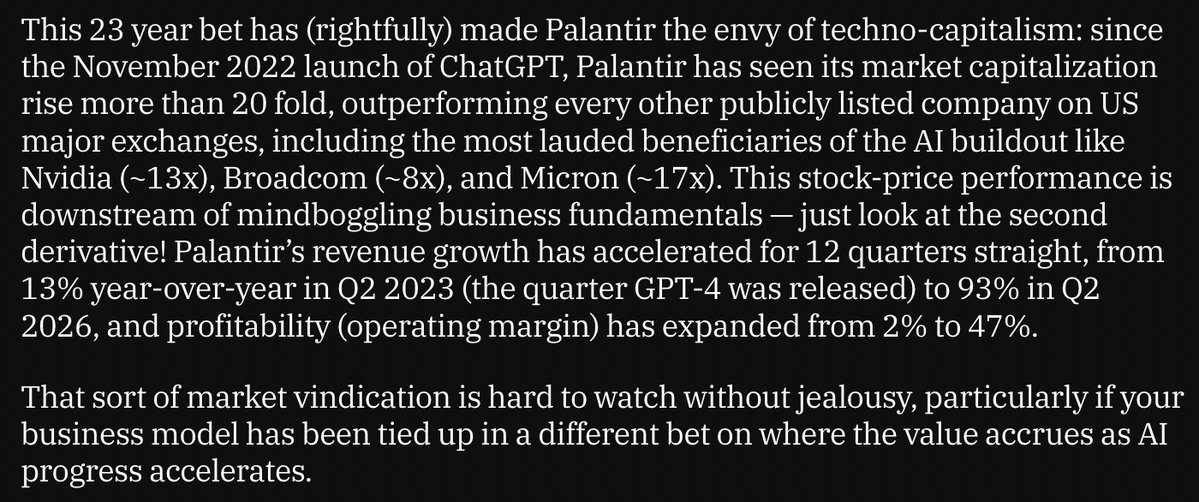
I will be returning to @MTSlive at 10am PT today with @ByrneHobart to discuss our @arenamag piece on Palantir, the Forward Deployed Model, institutional fitness in an age of accelerating machine intelligence, the bottleneck in converting tokens into economic value, and lab positioning in this world. Looking forward to it!
I spent the better part of this morning making my way through Wandering America
It's hard to express in words the feeling of looking at modern day American landscapes and especially city scapes captured on film photography and printed on larger-than-life pages.
Great way to reminisce on roads already traveled and those yet to be taken in this beautiful and bountiful country we call home.
This is exceptionally good. Well worth a read.
"Institutions are generators of economic and civilizational reward functions. The reward functions that drive progress are the ones that reinforce actions that improve our collective understanding of the universe — giving us dopamine from productive curiosity, for improving our ideas — and that translate that understanding into useful solutions to human problems. Reward functions that reinforce essentially anything else (particularly sensory novelty at the expense of epistemic novelty, or certainly anything that creates fear), will probably lead to stagnation. And stagnation almost always reinforces zero-sum behaviors that tend toward civilizational collapse."
We're in Arena with a look at Palantir! Very fun collaboration—we were working backwards from how Palantir has been doing AI differently to how they're thinking about it, and the world, differently.
The @arenamag homepage design is sort of inspired by software documentation.
With the current issue and articles especially, it's looking very dialed. More fun than most magazine sites!
Your weekend read, from the new issue of Arena Magazine. The best thing I have ever read on why Palantir is doing so well with AI -- and how the frontier labs are paying attention and reacting.
By @lefttailguy@ByrneHobart
https://t.co/nfijzQdUSs
Progress in technology is all about breaking false tradeoffs. Palantir, has been forged, from the beginning, to help critical institutions leverage the accelerating power of digital computation without sacrificing their sovereignty or the sovereignty of their constituents. This was prescient and is more important than ever. As, today, some in Silicon Valley believe "commoditizing your complement" means commoditizing institutions and humanity itself.
In some sense, the effective accelerationists of Silicon Valley believe technology is God and the effective altruists believe they are God. The former believe that sufficiently powerful technology will automatically organize society in the way that threads the needle between the Antichrist and Armageddon, and the latter believe they are the only ones capable of creating technology and organizing society in a way that threads that needle—convienently, according to their own utility function! The AI successionists don’t even care whether we thread that needle at all.
Palantir gives us a different option: technology as an unapologetic accelerant of human curiosity and agency, yes, but also of institutional fitness. In this view, we don't have to surrender our economic sovereignty to an all-knowing model, nor cede our moral authority to the unelected engineers in SF and the well-meaning, but generally histrionic “philosophers” in Berkeley who built it. Instead, we can use ever-more powerful computation to make the pro-human institutions we select (through free markets and the democratic process), and therefore our society, radically more capable and resilient.
Forward Deployed by @lefttailguy and @ByrneHobart. Only in Arena 009: Hello, World.
For nearly 25 years, Palantir has built a unique business that few understand, inside or outside of Silicon Valley. Now, the Frontier Labs want a piece of the action. In the race to bring artificial intelligence into the real world, everyone wants to be Forward Deployed.