"Orang yang rasa solat susah, hidup dia akan susah."
Peringatan Pakcik Lan, solat itu hadiah daripada Allah SWT, bukan beban. Manusia dijadikan bersifat keluh-kesah, dan solat ialah tempat mengadu segala resah kepada yang Esa.
“The government believes it has become aware of a method of bypassing, or ‘jailbreaking’ Fable 5,” the company said in a blog post. https://t.co/uK6r5MY0Ze
As a result of a US government directive, we are suspending access to Claude Fable 5 for all users. You can continue to use all other Claude models.
Here’s what this means for you:
Across Claude products, new sessions will run on your selected default model or Opus 4.8, and existing Fable 5 sessions will end with an error.
On the Claude Platform, requests to Fable 5 will also return an error. Please update your integrations to other Claude models.
We know this is a disruption to your workflows; we appreciate your patience and support.
Kata Ustadz Dr. Ariful Bahri, mabrur haji tu bukan dilihat ketika jemaah berada di Makkah. Tetapi ketika mereka sudah pulang ke tanah air nanti.
Antara tandanya mereka sentiasa solat berjemaah (jaga solat), istiqamah baca Al-Quran, bangun malam solat tahajjud, bersedekah, buat banyak kebaikan dan tinggalkan dosa serta maksiat. Mereka jaga hubungan sesama manusia, dan sebarkan salam.
Sebab mereka yang dapat haji mabrur, akan dimudahkan Allah beribadah sampai akhir hayatnya.
Ia tidak mudah dan tersangat susah. Malah ia sebenarnya lagi sukar dari laksanakan ibadah haji tersebut.
Semoga semua jemaah haji sama ada yang telah selesai haji, atau bakal tunaikan haji kelak dapat kekalkan kebaikan, dan lakukan amal ibadah sampai kita semua mati dalam husnul khatimah nanti.
A man came to the Messenger of Allah ﷺ and said:
“I have committed a major sin. Is there any way for me to repent?”
The Prophet ﷺ asked:
“Is your mother still alive?”
The man replied: “No.”
He then asked:
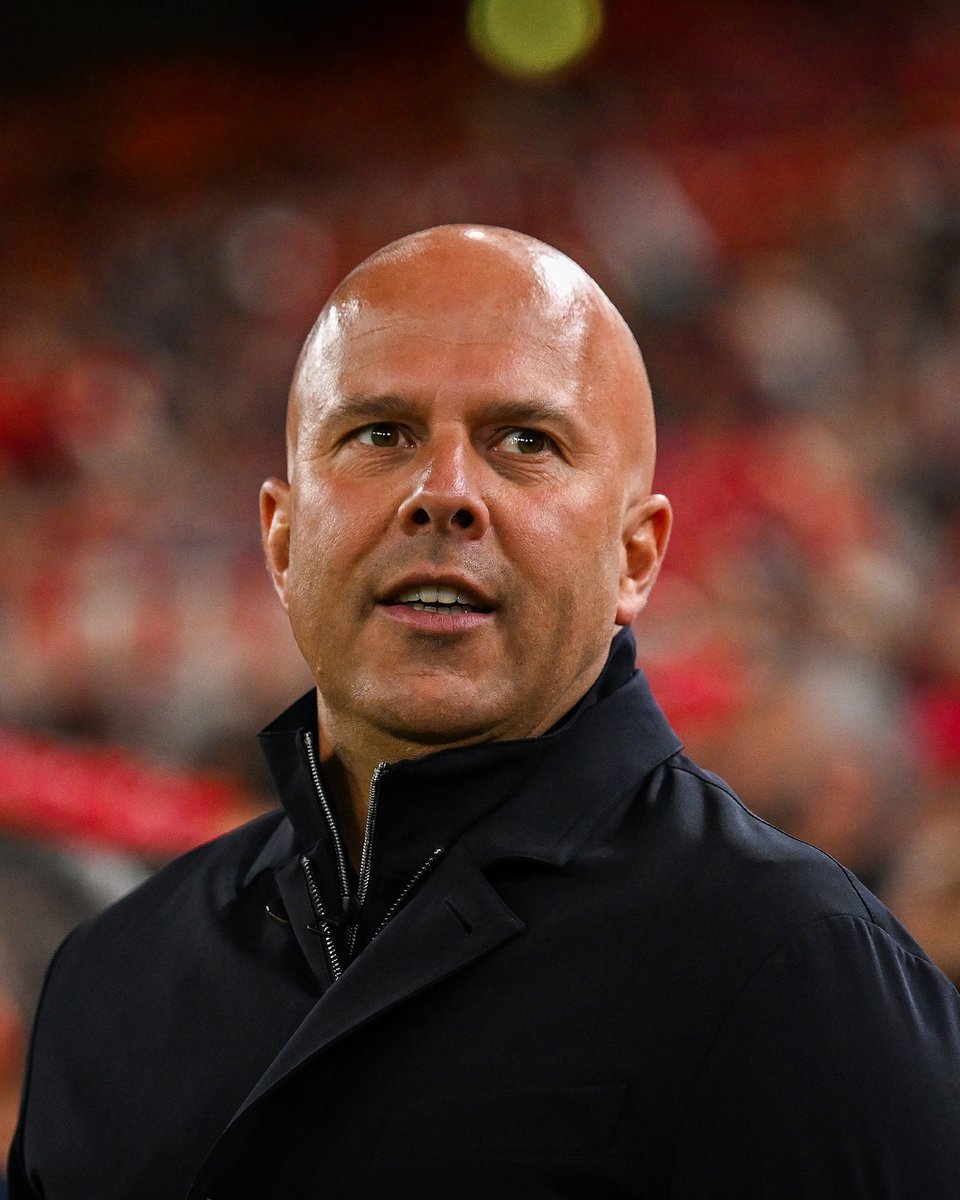
Liverpool FC can confirm Arne Slot is to depart his role as head coach with immediate effect and that the process to appoint a successor is under way.
He leaves with a Premier League title to his name and our deepest gratitude and appreciation.
Wow
Trio Pulau Pinang yang mula menggegarkan Industri Semikonduktor Dunia
Tak sangka ada 3 syarikat Malaysia yang dah mula jadi sangat berpengaruh dalam industri ni. Dalam diam diam mereka perform
Let your last thought before sleep not be fear of tomorrow, but concern for Fajr
There are hearts restless over what might happen, and there are hearts at peace, only worried about waking up to stand before Allah.
Sleep with tawakkul, knowing what is written will reach you
1/2
🚨Just IN: If you've used ChatGPT for writing or brainstorming in the last 6 months, your creative ability may already be permanently damaged.
A controlled experiment just proved the effect doesn't reverse when you stop using it.
3,302 creative ideas. 61 people. 30 days of tracking.
Researchers split students into two groups. Half used ChatGPT for creative tasks. Half worked alone. For five days, the ChatGPT group outperformed on every metric. Higher scores. More ideas. Better output. AI was making them better.
Then day 7. ChatGPT removed. Every creativity gain vanished overnight. Crashed to baseline. Zero lasting improvement.
But that's not the bad part.
ChatGPT users' ideas became increasingly identical to each other over time. Same content. Same structure. Same phrasing. The researchers called it homogenization. Everyone using ChatGPT started producing the same ideas wearing different clothes.
When ChatGPT was removed, the creativity boost disappeared -- but the homogenization stayed. 30 days later, same result. Their creative range had been permanently compressed.
Five days of use. Permanent damage 30 days later.
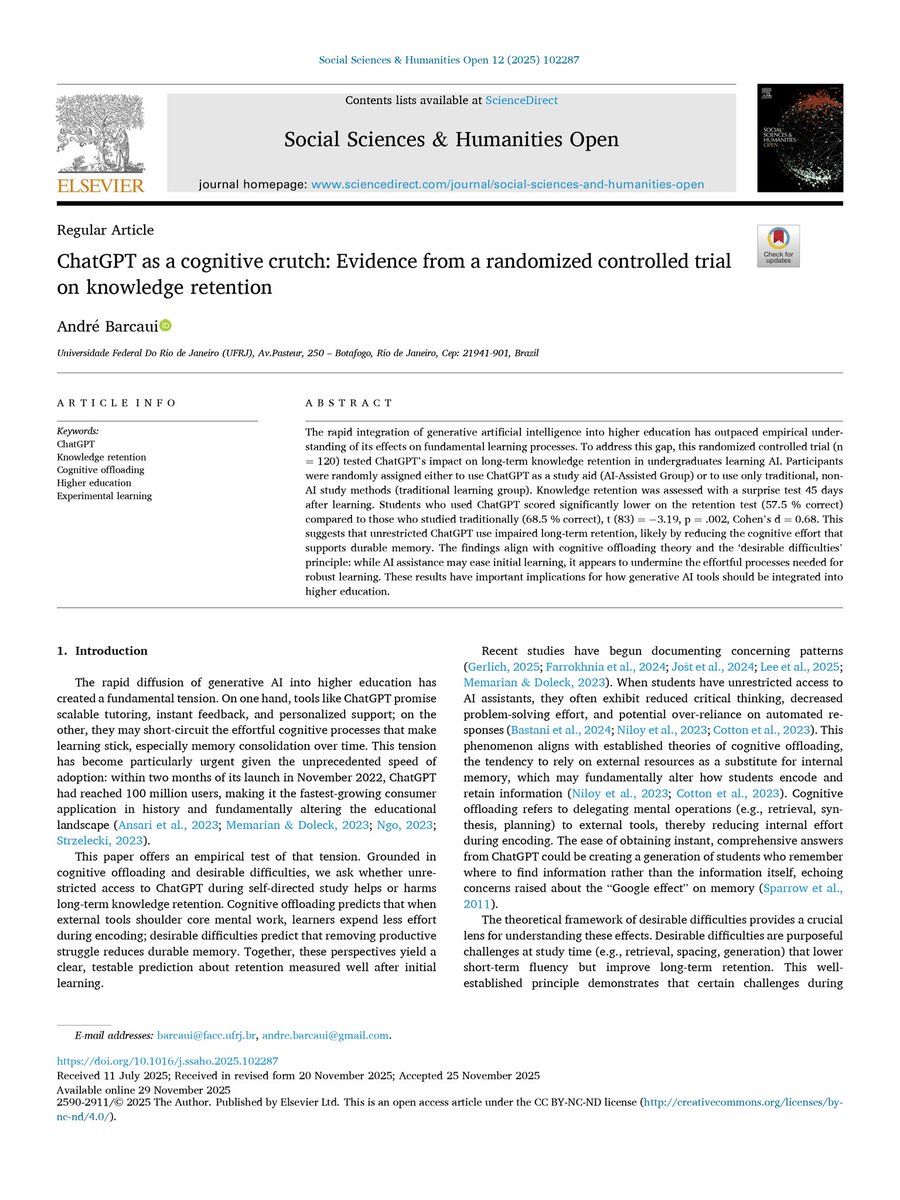
A separate trial confirmed it. 120 students. 45-day surprise test. ChatGPT users scored 57.5%. Traditional learners scored 68.5%. AI reduces cognitive effort. Less effort means weaker encoding. Weaker encoding means less creative raw material.
You're not renting a productivity boost. You're financing it with your originality.
The interest rate is permanent.
A friend told me that Singapore's HDB is a form of wealth transfer by their government.
I didn't know what he meant. Wealth transfer from who, to who, and how?
We have PPR in Malaysia. Isn't that just our version of HDB?
The more I dug, the less true that turned out to be.
Start with who each system is for.
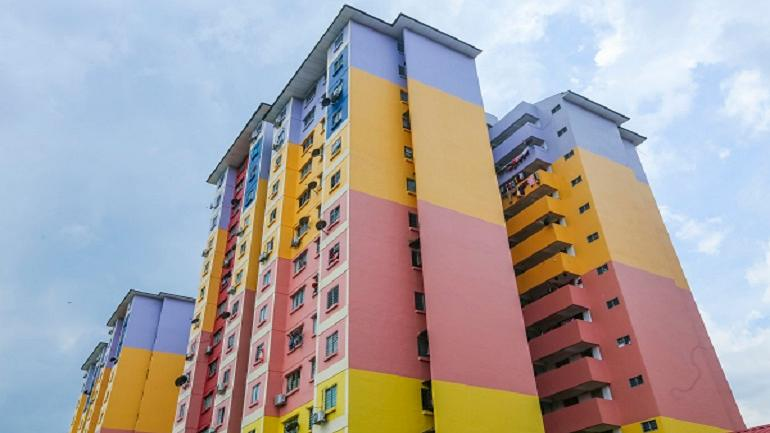
PPR is welfare. The income cap is RM3,000 per month. Earn RM3,500 and you do not qualify. It is for the bottom half of B40.
HDB is the default. Around 80 percent of Singaporeans live in HDB flats. The income ceiling for new flats goes up to SGD 14,000 per month, roughly RM48,000. Almost everyone qualifies.
So one is a safety net. The other is the country's main housing system. That is a huge difference at the starting line.
Now financing. This is the part nobody talks about.
Every working Singaporean contributes to CPF. Roughly 20 percent of their salary plus 17 percent from their employer. That money funds the HDB downpayment. It also pays the monthly mortgage directly, no commercial bank in between.
The whole thing is a closed loop. The government builds the flat, sells it to you, holds your retirement savings, and pays itself back from your retirement savings.
In Malaysia, PPR ownership is paid through commercial bank loans. Regular mortgage. Regular interest. Regular default risk. EPF can be tapped for housing in limited ways but is not structurally integrated with public housing the way CPF is with HDB.
This is why HDB ownership is near-universal in Singapore. You almost cannot avoid owning a flat because the retirement system is built to push you toward one.
Then there is the part that turns this from a housing system into a wealth-building system.
HDB flats are sold at subsidized prices and appreciate in price almost from the moment it's sold. The HDB Resale Price Index has gone up roughly 50 percent since 2009, even though the flats are technically depreciating 99-year leaseholds. The newer the lease, the better the location, the better the resale value.
So Singaporeans who bought HDB flats in their twenties and thirties are sitting on assets that have grown alongside the country. They can sell, downgrade, and keep the difference. They can borrow against it. They can pass the lease on to family.
PPR units do not appreciate the same way. The resale market is thin. The locations are not desirable. The buyers are limited to other low-income households. The unit you bought for RM35,000 might still be worth RM35,000 fifteen years later in real terms.
So one system gives you a home and a wealth-building asset. The other gives you a home.
OK so let me circle back to my friend's claim. Why is HDB a wealth transfer?
I think I see it now.
In the 1960s and 70s, the Singapore government acquired most of the country's land under the Land Acquisition Act, often below market rates. They paid the old landowners less than the land was worth. Then they built flats on that land and sold them at subsidised prices to the population.
The wealth transfer flowed from old landowners to new flat buyers, with the government as the middleman. Land that would have made a small number of families very rich was converted into housing that 80 percent of the population could afford.
By 1985, the Singapore government owned 76 percent of the country's land, up from 31 percent in 1949. That was the foundation everything else was built on.
You might be wondering why Malaysia cannot just do the same.
The political moment for that kind of land acquisition has passed. Singapore did it during a specific window of nation-building under a one-party government. Malaysia has federalism, state land powers, multiple ethnic land claims, and a political environment where mass land acquisition would be near impossible.
So PPR is not a smaller HDB. PPR is a different programme answering a different question.
HDB asks "how do we house everyone."
PPR asks "how do we shelter the poorest."
These are not the same project.
When someone says Malaysia should have an HDB, they are really asking us to redo a 1965 nation-building exercise in 2026. That is much bigger than just building more PPR.
Did you learn something today like I did?
🇸🇬 Singapore built a 15-storey glass tower that works like a vending machine, but for Ferraris and Lamborghinis.
Pick a floor, pay, drive away. A billionaire's fever dream.