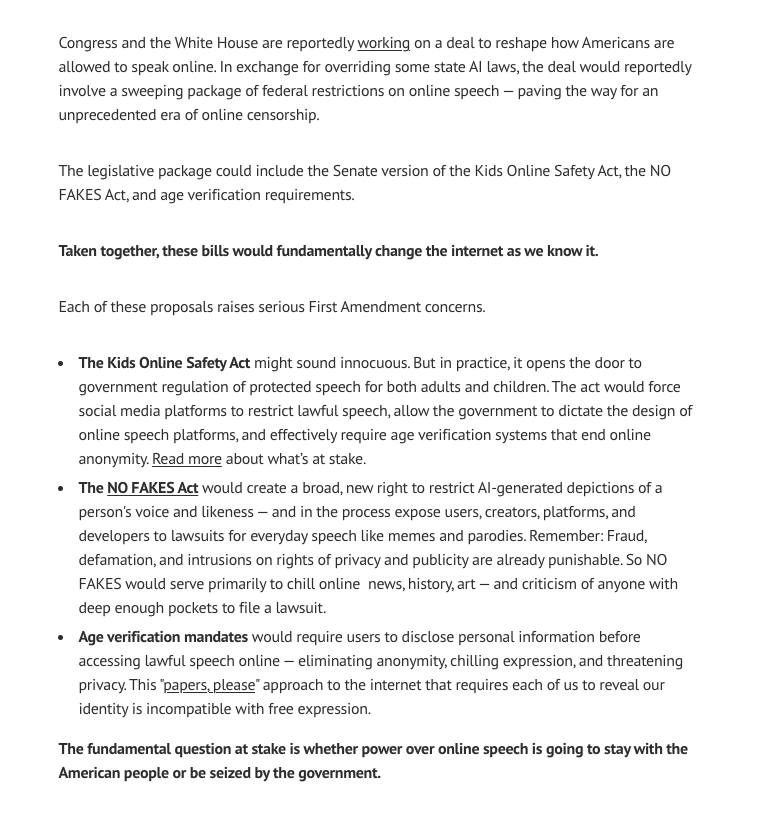
We’re one bad deal away from the era of online government censorship. The White House and Congress are negotiating away your rights as we speak.
FIRE urges lawmakers to reject any deal that includes the Kids Online Safety Act, the NO FAKES Act, and age verification requirements.
Our statement on the UK government’s demand that all content on all devices sold or used in the country be scanned, on the presumption of nudity, using a dystopian combination of age verification and content scanning. This proposal will not safeguard children. It endangers us all.
https://t.co/VdWe9uhi8p
When I first heard it the "data centers in space" idea seemed kind of crazy but seeing it more concretely it actually seems like it could plausibly work
Quick napkin math
Vera Rubin rack is $8 million
SpaceX AI1 satellite weighs 2 tons
Launch cost $200K
All in, including solar etc, about $10M to put a Vera Rubin rack in space, vs roughly $12M per rack on the ground with cooling and other infra.
Free electricity saves more than $100,000/year on 120 kW.
A French engineer who lives quietly in Paris has spent 30 years writing software that the entire internet now runs on without knowing his name.
He wrote the code that streams every YouTube video, every Netflix show, every TikTok clip. He wrote the code that runs the virtual servers underneath AWS, Google Cloud, and Microsoft Azure. He calculated more digits of pi than anyone in history. He has no Twitter. He has no marketing. He just keeps shipping.
His name is Fabrice Bellard.
Here is the story, because almost nobody outside the systems programming world knows what one man has built.
Fabrice was born in 1972 in Grenoble, France. He studied at École Polytechnique, the top French engineering school. He never went to Silicon Valley. He never built a startup empire. He just wrote code.
In 2000 he started a project called FFmpeg, an open-source multimedia framework for encoding, decoding, and streaming video. He was 28. The project did one thing nobody else had done well. It handled every video and audio format that existed, in one library, on every operating system. He led it himself for years.
Today FFmpeg is the invisible engine of the internet. YouTube uses it. Netflix uses it. VLC uses it. Chrome and Firefox use parts of it. Every Android phone, every iPhone, every smart TV, every video editing tool you have ever touched runs FFmpeg somewhere underneath. If you have watched a video on a screen in the last 20 years, Fabrice's code processed it.
He was not done.
In 2003 he started QEMU, a machine emulator and virtualizer. He wrote it solo until version 0.7.1 in 2005. QEMU lets you run any operating system on any other operating system. It became the foundation of modern virtualization. KVM, the Linux kernel hypervisor, runs on top of QEMU. Every major cloud provider, AWS, Google Cloud, Microsoft Azure, IBM Cloud, runs virtual machines on infrastructure built around it. The Quick Emulator is the most cited piece of cloud infrastructure code on Earth.
He kept going.
In 2001 he won the International Obfuscated C Code Contest with a small C compiler that grew into TCC, the Tiny C Compiler. TCC can compile and boot a Linux kernel from source in under 15 seconds. In 2004 he calculated the most digits of pi ever computed at the time, using a personal desktop computer and an algorithm he derived himself called Bellard's formula. In 2011 he wrote a complete PC emulator in pure JavaScript that runs Linux in your browser, a project called JSLinux that engineers still cannot believe is real.
In 2019 he released QuickJS, a small but complete JavaScript engine that fits where V8 cannot. In 2021 he released NNCP, a neural network based lossless data compressor that immediately took the lead on the Large Text Compression Benchmark.
Then he turned his attention to large language models. He built TextSynth Server, a web server with a REST API for running LLMs locally. He released ts_zip and ts_sms, compression utilities that use language models to compress text and short messages at ratios traditional algorithms cannot reach. He released TSAC, a very low bitrate audio compression system. In December 2025 he released Micro QuickJS, a new JavaScript engine for microcontrollers, separate from QuickJS, designed for environments with almost no memory.
Fabrice co-founded a telecom company called Amarisoft in 2012, where he serves as CTO. Amarisoft builds 4G and 5G base station software used by carriers and labs around the world. He has been running it for over a decade while continuing to ship personal projects from his own home page at bellard dot org
He has no Twitter. He has no Instagram. He gives almost no interviews. His personal website is a flat list of projects with no styling, no fonts, no marketing copy. Just titles and links.
A quiet French engineer who never moved to Silicon Valley wrote the code that quietly runs the internet.
He is still shipping.
SpaceX has just officially unveiled its AI1 satellite, the first generation of its AI satellite.
Overall Specs:
• 150 kW peak compute payload
• 120 kW average compute payload
• 70 kW per ton
• Compute provider interchangeable
Dimensions:
• Wingspan: 70 meters
• Deployed height: 20 meters
Thermal System:
• 110 m² deployable liquid radiator
• Redundant pumping loops
• Integrated micrometeoroid shielding
• Deployable liquid radiators
Solar Power System:
• 150 kW solar array
• 250 W/m²
• SpaceX-manufactured solar technology from Bastrop, Texas
Architecture:
• Centralized compute module
• Large deployable solar arrays
• Deployable liquid-radiator thermal management system
• AI-focused compute satellite design ("AI1 satellite")
Elon: "The AI satellite is much simpler than a Starlink satellite. The AI satellite is essentially a lot of solar cells, you still need some laser links, but you don't have all of the super complex antennas that you have on a Starlink satellite. The easier one to design for is the AI satellite. It's bigger. A lot of this is technology we've already made with the Starlink V3 satellites."
If you struggle with deer eating your garden, I can't recommend a "3D" fence enough.
Since they're eyes are on the sides of their heads, they can't see depth vs. height as we do.
So you space out two rows of cheap electrified polywire, and they're too afraid to jump it.
I think SpaceX not being included in the S&P right after IPO is probably a good thing. It's fine that it'll be in the NASDAQ though because NASDAQ investors signed up for high risk/reward tech stocks.
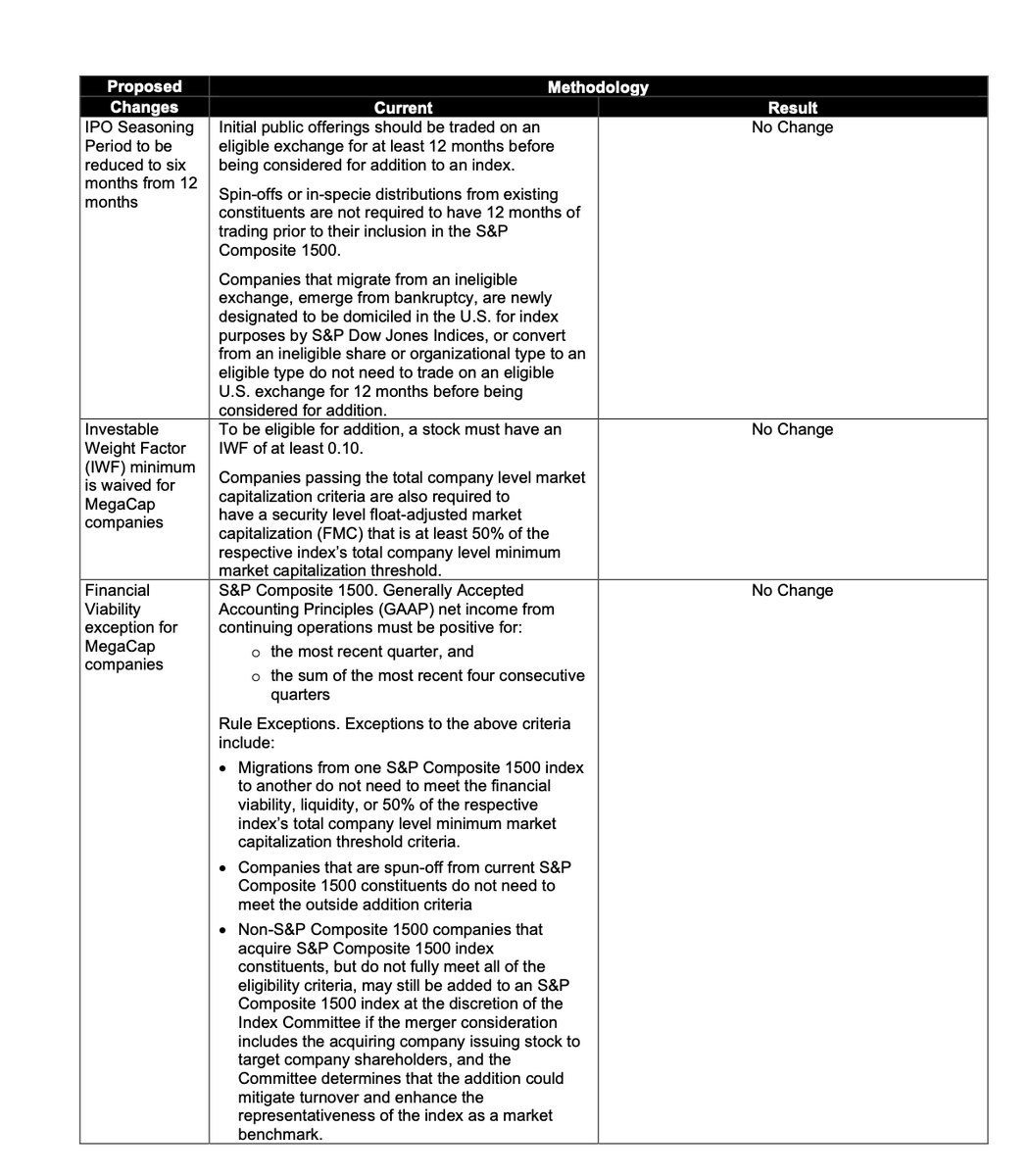
Wow, the S&P Dow Jones Indices has just officially announced that they will NOT be changing their inclusion rules to make it easier for “MegaCap” companies (such as @SpaceX) to be fast-tracked into the S&P 500.
Their reasoning:
"S&P DJI determined that exceptions to the financial viability, seasoning, and IWF requirements should not be granted solely based on market capitalization. The decision not to adopt the proposed exceptions preserves core index principles by maintaining consistent application of these key requirements. Although there may be trade-offs between strict adherence to these eligibility requirements and broad representativeness, the current methodology provides substantial market coverage and sector balance. As a result, the indices can continue to meet their stated objectives while preserving their role as representative and investable benchmarks for the U.S. equity market.
No changes will be made to the eligibility criteria including financial viability screens, seasoning period, or minimum IWF, for the S&P 500, S&P MidCap 400, or S&P SmallCap 600 as a result of the S&P Dow Jones Indices consultation on the treatment of MegaCap companies. Accordingly, there will be no changes to existing methodology for this index family."
This means that the earliest @SpaceX could be eligible to be added to the S&P 500 would now be June 2027.
The requirements that will now remain in place are:
• No changes to S&P 500 eligibility rules for mega-cap companies.
• Mega-cap companies will still need to wait 12 months after their IPO before being considered for S&P 500 inclusion.
• S&P will not waive profitability requirements for mega-cap companies. The company must have positive GAAP net income in the most recent quarter, and the sum of the most recent four consecutive quarters.
• S&P will not waive minimum public float requirements for mega-cap companies. At least 10% of a company's shares must be publicly tradable ("free float").
The S&P rejected proposals that would have:
• Reduced the IPO seasoning period from 12 months to 6 months
• Waived profitability requirements
• Waived minimum public float requirements
Anecdotally from looking at software engineering job listings the job market seems to have gotten meaningful better for software engineering job seekers since 2024
BREAKING: The US economy adds 172,000 jobs in May, crushing expectations of 85,000.
The unemployment rate was 4.3%, in-line with expectations of 4.3%.
April's jobs number was also revised UP by +64,000 jobs.
This marks the second strongest US jobs report in 13 months.
BREAKING.: Biggest privacy token $ZEC crashed over -50% in the last 24 hours and wiped out $5 Billion from its market cap.
The flaw was hidden inside Zcash's Orchard privacy pool since May 2022 and remained undetected for nearly 4 years despite multiple security audits.
Security researcher Taylor Hornby reportedly used Claude Opus 4.8 AI model to build a working proof-of-concept that successfully generated counterfeit ZEC in local testing on May 29.
Although the bug has now been patched on June 2, The issue is that Zcash's privacy design makes it impossible to know if any fake ZEC was minted before the fix. Unlike Bitcoin, where anyone can verify the supply, Zcash's privacy design makes it impossible to audit whether fake coins were secretly minted before the fix.
The team denies any fake ZEC was minted, but traders are selling on the fear alone. Imagine someone secretly adding extra chips to a casino, but because of the way the system works, neither the casino nor the players could tell which chips were real and which were fake.
Shielded Labs is exploring a proposed Network Upgrade to allow anyone to verify the integrity of Zcash supply.