We’re hiring for multiple positions at @Nabeh_sa for our #Baseer AI Team 🚀
Nabeh is a pure ai products company with multiple AI solutions already deployed at big clients. We’re building the future of Computer Vision, LLMs & STT.
Many people think any given ML project is 99% training.
In reality, it’s 50% evaluation, 40% data cleaning, 8% integration, and 2% training.
The first two set the noise floor for learning. No ML magic matters; the model cannot lower the noise floor, as that’s the optimal bound of Shannon encoding of your data.
Thus, not a single day goes by without me thinking about ontology. Even the old labels have to be constantly reviewed.
OpenAI just published dozens of real-world workflows showing how teams are using it to automate work.
> Manage your inbox and draft replies in your voice
> Review GitHub pull requests before human review
> Turn Figma designs into production-ready code
> Understand large codebases in minutes
> Automate bug triage and QA workflows
> Query spreadsheets and datasets using natural language
> Deploy apps and websites directly from prompts
> Build Mac and iOS applications faster
> Create slide decks automatically
> Turn Slack threads into coding tasks
> Use your computer through AI-powered actions
From software engineering and design to data analysis and operations, Codex is becoming an AI teammate instead of just an AI assistant.
Explore all use cases:
https://t.co/N6PbSjCTrT
CEOs are uniquely prone to AI psychosis because they’re sufficiently distant from the last mile of work that still has to happen to generate most value with AI.
So when they play with AI, they see the happy path results, often not considering the next 10 or 20 things that have to happen to get sustainable results from agents.
“Look I made this awesome product prototype”. Yes but you didn’t have to review the code before it went into production and fix a bunch of issues.
“Look I generated a contract”. Yes but you didn’t verify all the terms before it goes out to the counterparty and didn’t have to wire up all the past contracts to work with.
The best thing you can do as a CEO is to use AI a *ton* to figure out the real implications of agents in the enterprise, and come out the other side with an appreciation for both the upside and the real work that goes into them.
My colleagues wrote up a great post on using Goals in Codex.
They go through when to use them, what changes when a Goal is active, and how to write Goals that give Codex a clear outcome, constraints and verification criteria.
Also how we designed Goals at the architecture level if you’re curious.
https://t.co/QQfjW2EbPO
I strongly believe there are entire companies right now under heavy AI psychosis and its impossible to have rational conversations about it with them. I can't name any specific people because they include personal friends I deeply respect, but I worry about how this plays out.
I lived through the great MTBF vs MTTR (mean-time-between-failure vs. mean-time-to-recovery) reckoning of infrastructure during the transition to cloud and cloud automation. All those arguments are rearing their ugly heads again but now its... the whole software development industry (maybe the whole world, really).
It's frightening, because the psychosis folks operate under an almost absolute "MTTR is all you need" mentality: "its fine to ship bugs because the agents will fix them so quickly and at a scale humans can't do!" We learned in infrastructure that MTTR is great but you can't yeet resilient systems entirely.
The main issue is I don't even know how to bring this up to people I know personally, because bringing this topic up leads to immediately dismissals like "no no, it has full test coverage" or "bug reports are going down" or something, which just don't paint the whole picture.
We already learned this lesson once in infrastructure: you can automate yourself into a very resilient catastrophe machine. Systems can appear healthy by local metrics while globally becoming incomprehensible. Bug reports can go down while latent risk explodes. Test coverage can rise while semantic understanding falls. Changes happens so fast that nobody notices the underlying architecture decaying.
I worry.
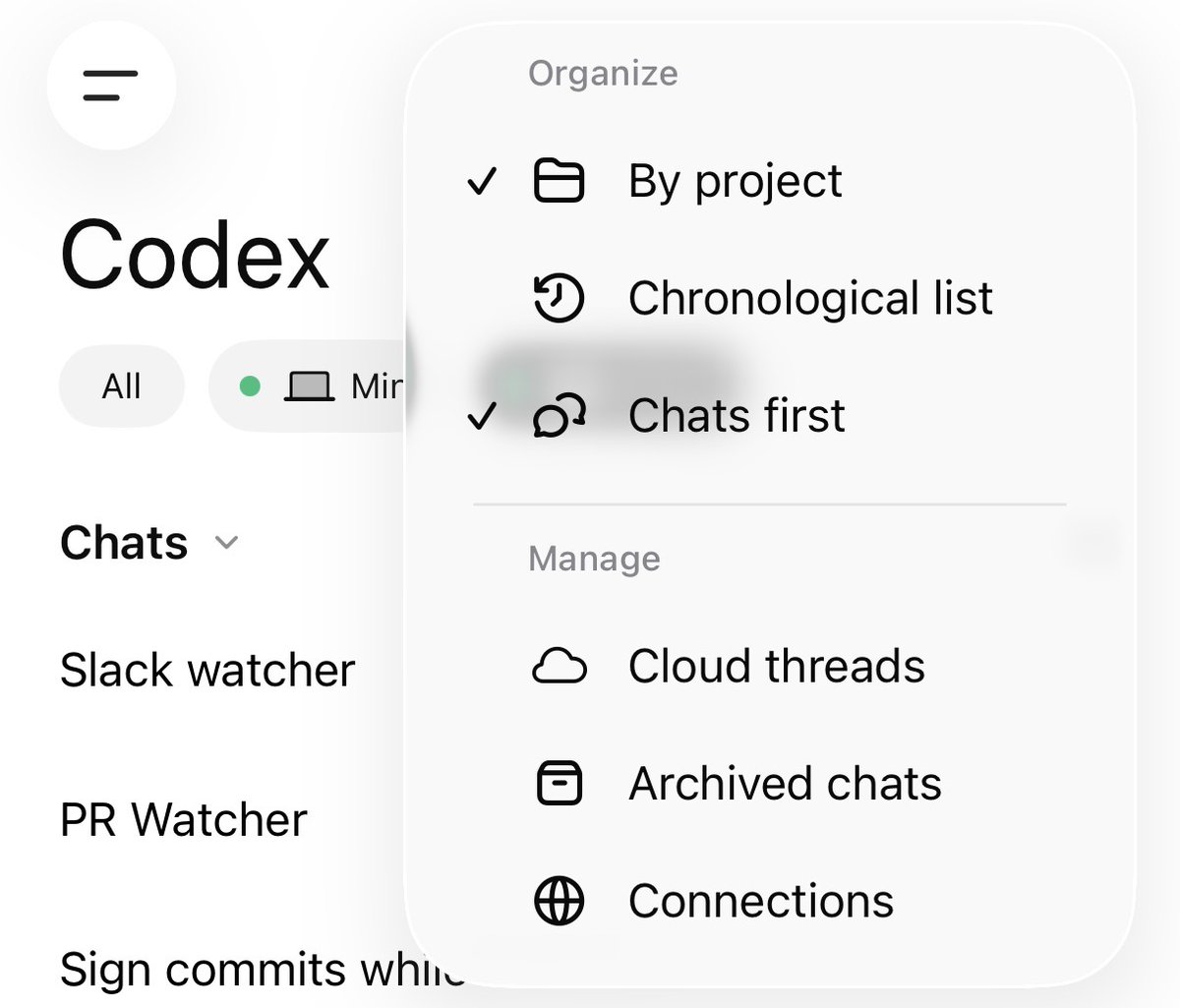
Now that Codex in the ChatGPT mobile app is out, it's time for some pro tips on how to use it best!
We tried to make it as familiar as possible with the Codex desktop app, so you should find your recent threads and projects, alongside our usual sorting options!
Today, we launched browser use inside Codex to further close the build & verify loop for local development!
Now, you can ask Codex to build your front end, and test it like a user would by clicking through the app.
Codex sees everything a user sees through vision & checks the network/console logs to help debug & fix any issues that it finds.
This change brings us closer to fully autonomous coding agents that delivers high quality and tested changes.
Watch Codex test my app in the browser, catch & fix a real bug, and doing that loop again with a brand new feature.
🚀 DeepSeek-V4 Preview is officially live & open-sourced! Welcome to the era of cost-effective 1M context length.
🔹 DeepSeek-V4-Pro: 1.6T total / 49B active params. Performance rivaling the world's top closed-source models.
🔹 DeepSeek-V4-Flash: 284B total / 13B active params. Your fast, efficient, and economical choice.
Try it now at https://t.co/GCdiMzk1Dl via Expert Mode / Instant Mode. API is updated & available today!
📄 Tech Report: https://t.co/drlDrxkYtp
🤗 Open Weights: https://t.co/T13Y8i7SDM
1/n
Introducing GPT-5.5
A new class of intelligence for real work and powering agents, built to understand complex goals, use tools, check its work, and carry more tasks through to completion. It marks a new way of getting computer work done.
Now available in ChatGPT and Codex.
Introducing Claude Design by Anthropic Labs: make prototypes, slides, and one-pagers by talking to Claude.
Powered by Claude Opus 4.7, our most capable vision model. Available in research preview on the Pro, Max, Team, and Enterprise plans, rolling out throughout the day.