In 1970, India produced 21 mill tonnes of milk. Today, India produces 155 mill tonnes, the most by any country in the world. Next best is USA @ 95 mill tonnes. Initiatives of @DOAHDF and @Amul_Coop#NDDB commendable. Yet #Livestock quality is deplorable.
After a dispute within the late Ustaad’s family, a member bulldozed a portion of the property. Apparently to construct a museum. So move on, Sherlock, and dig in for your next tale and regale us.
Ustad Bismillah Khan holds the rare distinction of having been honoured with all three Padma awards - Padma Shri, Padma Bhushan and Padma Vibhushan - as well as the Bharat Ratna, India's highest civilian honour.
Yet, even this extraordinary legacy could not save his ancestral house in Varanasi from being bulldozed.
Bismillah Sahab’s house was never just a house. It was a living piece of our national heritage, a repository of memories and a part of our shared cultural inheritance.
The walls that held history and deserved to be preserved as a national treasure have instead been reduced to rubble.
Ustad Bismillah Khan gave India a musical legacy that will endure for generations. His home deserved to be treated with the same reverence.
A hundred salutations to Bismillah Sahab. To the BJP, shame.
Shit this is, Sherlock ! After a dispute within the late Ustaad’s family, a member bulldozed a portion of the property. Apparently to construct a museum. So move on, and feed another sensation.
जिनके लिए शहनाई नहीं बजी, उनसे और क्या उम्मीद करना?
भाजपा और उनके संकीर्ण सोच के संगी-साथी ‘कला और कलाकारों’ के हमेशा ख़िलाफ़ रहते हैं क्योंकि इन पुरातनपंथी-रूढ़िवादियों की ये संकरी मानसिकता होती है कि रचनात्मक लोग ही समाज म��ं परिवर्तन की भूमि और भूमिका बनाते हैं। सकारात्मक कला सहृदयता को जन्म देती है और सहनशीलता को भी। इसीलिए कला के हर रूप को ये अपने एजेंडे के रास्ते में रोड़ा मानते हैं ��ा फिर कला को अपने एजेंडे के लिए इस्तेमाल करके उसको नकारात्मक बना देना चाहते हैं।
जिनके आगे ‘भारत रत्न’ लगा हो उनकी मिलीजुली विरासत को ध्वस्त करना, उनके मान-सम्मान के साथ-साथ ‘भारत’ के मान को भी ध्वस्त करने के समान है।
भाजपा नफ़रत की आग में जलकर देश को नुक़सान पहुँचा रही है।
सरकार में आने पर हम ‘भारत रत्न बिस्मिल्लाह ख़ान’ जी की सांगीतिक धरोहर को बचाने के लिए ‘श्रवण-संग्रहालय’ बनाएंगे
��ोर निंदनीय!
The Roman Empire reached its financial and economic strength and peak during the height of the Paxa Romana. This was during the reigns of Five Good Emperors of Trajan and Hadrian. A period, when the empire produced 25-30% of global economic output.
Socrates : The decline of society begins when,
1. The stupid are louder than the wise
2. Those who have none, preach morality
3. The unscrupulous are respected more than the honest
4. When madness is glorified as normal
5. Politicians live not for the people, but off the people
Kashmir is honor of Ummah…
Once again, President Recep Tayyip Erdoğan raised the Kashmir issue at the United Nations General Assembly and gave a powerful voice to the people of Kashmir who have long yearned for justice, dignity and lasting peace.
For Pakistan and the people of Kashmir, this is more than a diplomatic statement. It is the voice of a true brother standing beside his brother in his hour of need.
Türkiye and Pakistan are two nations bound by an unbreakable bond of brotherhood. We will continue to stand together for justice, peace and the legitimate aspirations of the people of Kashmir.
Türkiye-Pakistan Dosti Zindabad! 🇹🇷🇵🇰
Kashmir Zindabad! 🇵🇰
@RTErdogan@CMShehbaz@GovtofPakistan@ForeignOfficePk@PakinTurkiye
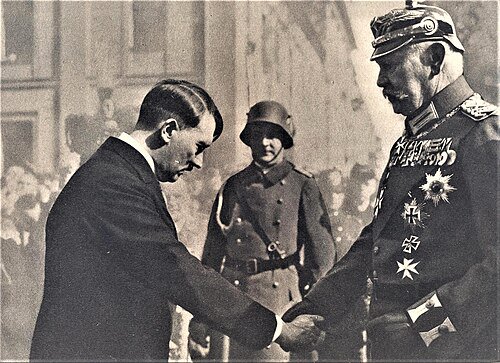
Hindenburg viewed Hitler as an unrefined low class rabble rouser. Under pressure from conservative allies and his own son Oskar, Hindenburg reluctantly appointed Hitler as chancellor. Despite dislike, he shared Hitler’s opposition to democracy & political left.
Chancellor Adolf Hitler greeting Reich President Paul von Hindenburg in Potsdam on March 21, 1933...
Hindenburg had appointed Hitler as Chancellor weeks prior on January 30, 1933. The meeting was staged to link the new Nazi regime with the traditional Prussian military elite, making Hitler appear deferential and non-threatening to conservatives and the established order.
“The Third Reich, which was born on January 30, 1933, Hitler boasted, would endure for a thousand years, and in Nazi parlance it was often referred to as the “Thousand-Year Reich.” It lasted twelve years and four months, but in that flicker of time, as history goes, it caused an eruption on this earth more violent and shattering than any previously experienced, raising the German people to heights of power they had not known in more than a millennium, making them at one time the masters of Europe from the Atlantic to the Volga, from the North Cape to the Mediterranean, and then plunging them to the depths of destruction and desolation at the end of a world war which their nation had cold-bloodedly provoked and during which it instituted a reign of terror over the conquered peoples which, in its calculated butchery of human life and the human spirit, out-did all the savage oppressions of the previous ages.”
One of the countless atrocities uncovered during the Nuremberg trials has stuck with me for its total lack of humanity on the part of the S.S. officers:
“An eyewitness report by a German of how a comparatively minor mass execution was carried out in the Ukraine brought a hush of horror over the Nuremberg courtroom when it was read by the chief British prosecutor, Sir Hartley Shawcross. It was a sworn affidavit by Hermann Graebe, the manager and engineer of a branch office in the Ukraine of a German construction firm. On October 5, 1942, he witnessed the Einsatz commandos, supported by Ukrainian militia, in action at the execution pits at Dubno in the Ukraine. It was a matter, he reported, of liquidating the town’s 5,000 Jews.
. . . My foreman and I went directly to the pits. I heard rifle shots in quick succession from behind one of the earth mounds. The people who had got off the trucks - men, women and children of all ages - had to undress upon the order of an S.S. man, who carried a riding or dog whip. They had to put down their clothes in fixed places, sorted according to shoes, top clothing and underclothing. I saw a heap of shoes of about 800 to 1,000 pairs, great piles of under-linen and clothing.
Without screaming or weeping these people undressed, stood around in family groups, kissed each other, said farewells and waited for a sign from another S.S. man, who stood near the pit, also with a whip in his hand. During the fifteen minutes that I stood near the pit I heard no complaint or plea for mercy . . . An old woman with snow-white hair was holding a one-year-old child in her arms and singing to it and tickling it. The child was cooing with delight. The parents were looking on with tears in their eyes. The father was holding the hand of a boy about 10 years old and speaking to him softly; the boy was fighting his tears. The father pointed to the sky, stroked his head and seemed to explain something to him.
At that moment the S.S. man at the pit shouted something to his comrade. The latter counted off about twenty persons and instructed them to go behind the earth mound . . . I well remember a girl, slim and with black hair, who, as she passed close to me, pointed to herself and said: “twenty-three years old.”
- William L. Shirer
The Rise and Fall of the Third Reich (p5-6, 961-962)
#archaeohistories
The “Brown Eminence” was secretly an accomplice to a political murder, long before becoming the most feared in the Thord Reich. Murder of his former teacher whom he suspected of betraying nationalist saboteur Albert Schlageter to the French.
The night of May 1, 1945. Hitler has been dead for a day and a half. The Red Army is a few hundred yards from the bunker.
Martin Bormann, the man who controlled who could see Hitler, what papers crossed his desk, and who rose or fell in the Nazi Party, walks up the bunker stairs into a burning Berlin.
He was never seen alive again. Probably.
Bormann was the most powerful Nazi most people had never heard of. Insiders called him the Brown Eminence. He was Hitler's private secretary, ran the Party Chancellery, and in Hitler's final will he was named Party Minister. He witnessed that will himself.
Then he tried to escape.
He went out with a breakout group that included Hitler Youth leader Artur Axmann and an SS doctor named Ludwig Stumpfegger. They tried to cross the Spree at the Weidendammer Bridge behind German armor under Soviet fire. They got split up. Bormann and Stumpfegger started following the railway tracks toward the Lehrter station.
Axmann later swore he found both of them lying near a bridge by the station, not moving. He didn't stop to check. He assumed they were dead and kept running.
That was it. That was the only eyewitness.
And for the next 27 years, nobody believed him.
At Nuremberg, Bormann became the only defendant tried in absentia. He got a court appointed lawyer, a trial, and a death sentence in October 1946. The court had no idea whether it was sentencing a living man or a corpse.
Then the sightings started. Argentina. Paraguay. Brazil. Chile. A monastery in Italy. When Israeli agents grabbed Adolf Eichmann off a street in Buenos Aires in 1960, it seemed to prove the point. Nazis really were hiding in South America. Why not Bormann?
It got stranger. In 1971, Reinhard Gehlen, the former head of West German intelligence, published memoirs claiming Bormann had been a Soviet agent all along and was living comfortably in Moscow.
A few years later a bestselling book claimed Bormann was alive in Argentina and the author had nearly tracked him down.
Meanwhile, back in Berlin, there was a detail almost nobody paid attention to. In 1945 a postal worker said the Soviets ordered him to bury bodies found near the Lehrter station. One of them carried papers belonging to an SS doctor. Stumpfegger.
In 1965, West German authorities dug near the station looking for Bormann. They found nothing and gave up.
In December 1972, construction workers laying cable in the same area hit bones. Two skeletons, close to where the 1965 search had come up empty.
Both had fragments of glass in their jaws. Crushed cyanide capsules.
One skeleton was tall, matching Stumpfegger. The other matched Bormann's dental chart, which had been drawn from memory after the war. West Germany officially declared Bormann dead in 1973.
The doubters still weren't finished. Some pointed to red clay on the skull and claimed it wasn't Berlin soil, that the body had been buried somewhere else and brought back. Paraguay was the favorite theory.
So in 1998, German investigators ran DNA from the skull against one of Bormann's elderly relatives.
It matched.
The man hunted across two continents, sentenced to death at Nuremberg, and "spotted" in half of South America had been lying under a Berlin street the whole time. He made it maybe a mile from the bunker before he bit down on the capsule.
In 1999 his remains were cremated and scattered in the Baltic Sea, so no grave could ever become a shrine.
One last detail. Bormann's eldest son, Martin Jr., was Hitler's godson. He grew up to become a Catholic priest and spent much of his life speaking out against everything his father stood for.
Wishing you success in steering India to a better future and may Heavens bestow all Its blessings for a long healthy life. I am fortunate to share the same birth date with you. Pranam Sir !
@narendramodi
Ha ha…when you successfully return the tupperware, the neighbour left at your house. The trade agreement where the currency is pure nostalgia and extra green chillies. Move over cricket, Hilsa is the new diplomacy !!!
WHAT A SHAMEFUL IRONY.
A country that once sent its world-famous Hilsa to India for Durga Puja is now buying Hilsa from India in the same festive season.
Sit with that.
Bangladesh Hilsa is a GI-tagged national treasure. For years it travelled the other way—especially to India before Puja—as both trade and pride. That flow has flipped. In two months, about 500 tonnes of Indian Hilsa have crossed into Bangladeshi markets through Benapole and Howrah. Some of it is even being sold as “Padma Hilsa.”
The irony does not stop at the crate.
The same climate that abused India over Hilsa exports—and went to the High Court to stop them—now depends on Indian fish because domestic supply cannot hold the price or the plate. Fisheries Adviser Farida Akhter objected to sending Hilsa out. The markets are taking Hilsa in.
This is not a seasonal glitch. It is what happens when breeding grounds and sanctuaries are neglected, jatka is scooped early, and a GI product becomes a slogan instead of a stock.
The same slide is visible in garments. Orders have shifted. Vietnam has pushed Bangladesh back to third. A country that sold the world its fish and its shirts is watching both brands thin out.
This is not only about Hilsa.
It is about a government that inherited pride and is managing shortage.
From exporting Hilsa to importing Hilsa. That is not diplomacy. That is decline.
Those who turned a national fish into an anti-India slogan now eat the consequence.
Video 1: The fight to stop Hilsa going to India.
Video 2: Indian Hilsa arriving in Bangladesh.
On the eve of Ganesh Chaturthi, we make a new beginning in Goa’s politics.
‘Goa First’ - an alliance between Aam Aadmi Party and Goa Forward Party - to be an alternative to the BJP-Congress collusion that has destroyed the state of Goa.
If the reports are true, this is not a courtesy call. It is a signal.
Confidential diplomatic sources claim Vladimir Putin spoke with Sheikh Hasina for nearly 20 minutes during the BRICS summit in India — and that India’s NSA Ajit Doval was in the room.
A Kremlin-to-exile conversation is already unusual. One conducted with India’s most powerful security official present is something else. It would mean Moscow was not merely checking on a former partner. It would mean Moscow was talking through New Delhi.
The reports say Putin expressed appreciation and assured Hasina of Russia’s support on Bangladesh’s political situation. No transcript. No readout. No confirmation from Moscow, Delhi, or Hasina’s circle. Treat it as a claim until it is proven. Do not treat it as small.
The money trail is not rumor. Under Hasina, Bangladesh built Rooppur with Rosatom — about $12 billion. After her government fell, the project stalled. Payments snarled. Sanctions boxed the dollar out. Russia is now pushing settlement in Indian rupees.
A nuclear plant. An unpaid bill. A currency workaround that runs through India. And, if these reports are accurate, a phone line from Putin to Hasina with Doval listening in.
Bangladesh’s post-Hasina politics is no longer only a domestic fight. It sits at three hard interests: Russia’s need to get paid, India’s need to manage an exile it cannot easily discard, and Dhaka’s need to decide whether Rooppur is a national asset or a political hostage.
If the call happened, the message is blunt: Hasina is not finished business in Moscow’s ledger. If it did not, the fact that the story is circulating at all tells you how combustible the triangle has become.
Unverified. High-stakes. Impossible to ignore.
(File photo 1: Hasina–Putin, earlier meeting. Photo 2: Ajit Doval.)
#BRICS #Rooppur
FDI to GDP ratio for the missing years…
20092.65%
20101.64%
20112.0%
20121.31%
20131.32%
20141.70%
Historical annual figures generally hover in the range of 1 to 3%. Net FDI remains lower due to profit repatriation and out outward remittances
Foreign direct investment as % of GDP into India was:
3.6 in 2008
2.1 in 2015
1.5 in 2022
1.0 in 2025
India has a lot of talent & global confidence in India used to be high. We must ask what’s causing the decline & take corrective action.
India focuses on practical economic cooperation and strategic autonomy. China , if not Russia, view the bloc as a geopolitical tool and challenge the Western influence. India refuses to let BRICS become an anti-western coalition.
Without India, BRICS could become exactly what Beijing wants: an anti-Western bloc dominated by China, Russia, and Iran.
Imran Khurshid argues New Delhi’s challenge is to lead the Global South without allowing China to define it.
https://t.co/85oFQRGLsX
A sight worth waiting 12 years for! 💜 The rare Neelakurinji is blooming again across the hills near Munnar, turning the Western Ghats into a spectacular carpet of purple. The last mass bloom was in 2014; the next is expected only in 2038.
Incredible India! 🇮🇳
@LetsTalk_FPL Gibbs White a must. His next four fixture teams all are the table bottom. The four have a combined total of 20 conceded and a solitary scored.
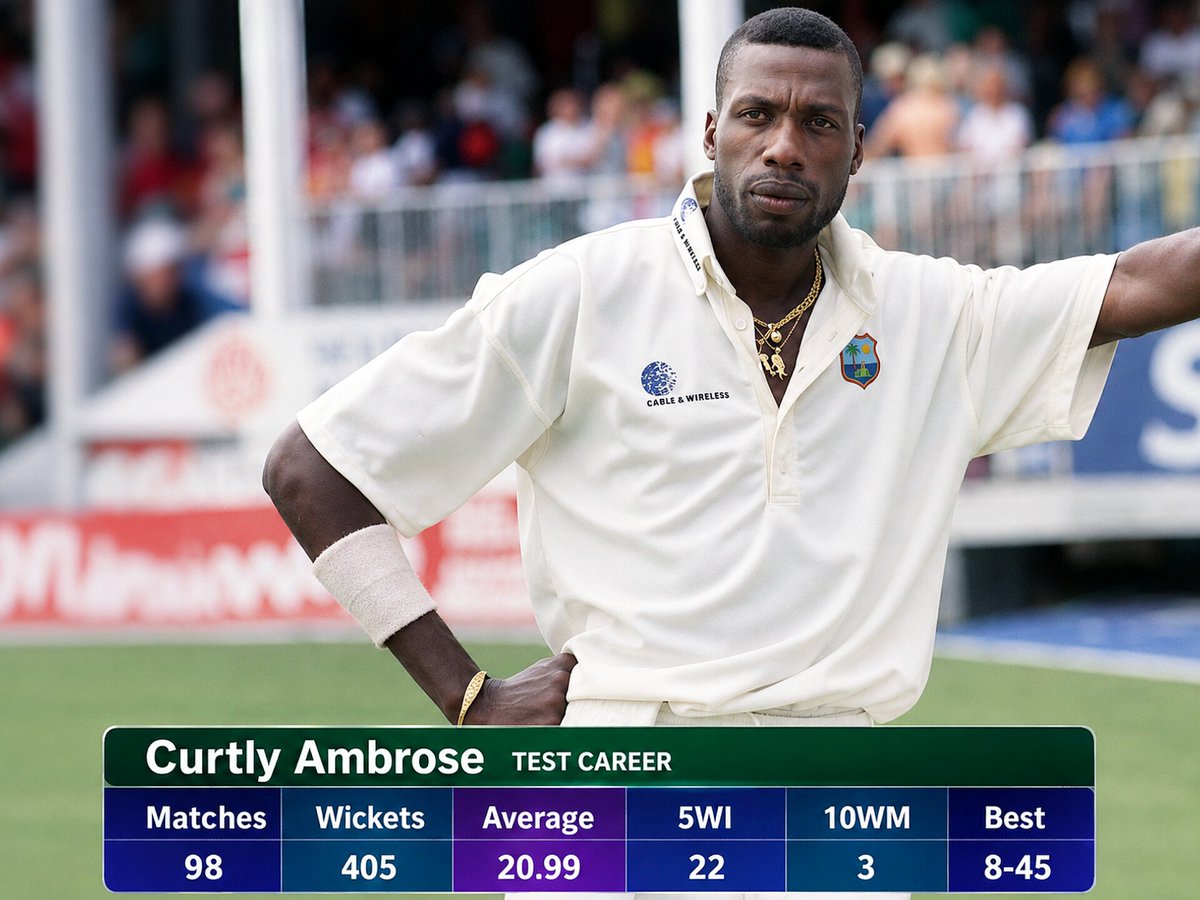
His mother rang a bell outside the house every time he took a Test wicket. She rang it 405 times. Halfway up the pavilion steps at The Oval, Curtly Ambrose removed his famous white armbands, knowing his legs would never have to pound in again. He was the fifth bowler in history to reach 400 Test wickets, and he had only picked up the game at 21, because his mother made him. Four years later he was destroying Test teams. On this day in 2000, his final Test began, ending one of the great eras of domination, and the story behind it is one for the history books.
Because he was never supposed to be a cricketer at all. Ambrose grew up in the village of Swetes in Antigua preferring basketball, and only started playing club cricket in 1984, at 21, largely because his mother Hellie pushed him into it. Within four years he was playing for the West Indies, and in his debut year of 1988 he took 49 wickets alongside Malcolm Marshall and Courtney Walsh. And this is the part that sounds almost too good to be true: every single time Curtly took a Test wicket, anywhere in the world, Hellie would run out of the house in Swetes and ring a bell. Day or night. (That bell rang 405 times.)
How about the career? Firstly, let us throw one myth out. Cricket lore files Ambrose away as a beneficiary of fast, bouncy West Indian and Australian tracks, one more name in the general 1980s and 90s era of pace dominance. But the great Ambrose spells were not accumulation, they were demolition. At the WACA on 30 January 1993, he took 7 for 1 from 32 balls and Australia went from 85 for 2 to 119 all out. Now the freakish part is that he did it again the following year in completely different conditions: Port of Spain, March 1994, second innings, 6 for 24, England all out for 46. Two of the most famous collapses in modern Test history, both engineered by the same man in the same way, without a single wasted delivery.
And Ambrose was skilful as hell, though the skill was never the flashy kind. At 6 foot 7 he was getting bounce from a length nobody else could, but the real weapon was that he simply never gave you anything: a career economy rate that rarely broke 2.5 an over, the same seam position ball after ball, hour after hour, until a Test batsman played a shot he knew he should not have played. He did not beat people. He starved them.
Then the manner of the going, which was entirely in character. He announced at the start of that 2000 summer, with no histrionics, that the England series would be his last, and then said almost nothing else about it, giving exactly one interview, to his old friend Michael Holding, which finally ruined the line that Curtly talks to no one. When he walked out to bat in his final innings at The Oval, the England team lined up and applauded him all the way to the wicket. He and Courtney Walsh left the field arm in arm, and as Mike Atherton wrote in the Guardian, one sensed close to tears, before Ambrose removed those white armbands halfway up the pavilion steps.
A career average of 20.99 across 405 wickets in 98 Tests, built on an economy rate that rarely broke 2.5 an over, from a man who had never wanted to play the sport in the first place.
Thank you, Curtly. Nobody has been that quiet and that frightening since.