I am a refractive surgeon and this is one of the most common reasons patients come to see me. The eyes age like any other part of the human body, and presbyopia, much like a receding hairline or starting to go gray, is often the first sign of mortality that many experience.
Friends! I’m looking to rejuvenate my eyes. Seems like I have some presbyopia — my phone, small fonts on supplement bottles, etc. are getting blurry. Aside from glasses, have you found any treatments (exercises, eye drops like pilocarpine, surgeries, others) to be worth it?
Taking a moment to show my respect to folks who have worn glasses their entire lives. I’m a couple years in and it is truly disturbing how exhausting I find it to keep them clean throughout the day. Random flakes, oily edges, accidental fingerprints — save me from this hell.
The drop mentioned works using small aperture optics - by reducing pupil size, a pinhole effect is induced which can increase depth of focus. This temporarily restores near vision for some individuals.
It can sometimes also sharpen distance vision as unfocused peripheral light rays entering the eye are blocked by the resulting smaller pupil and only focused and straight light rays reach the retina.
As a consequence of less light reaching the retina, some patients experience a dimming effect in their vision.
There are several other drops that also do this and each have their own side effect profile.
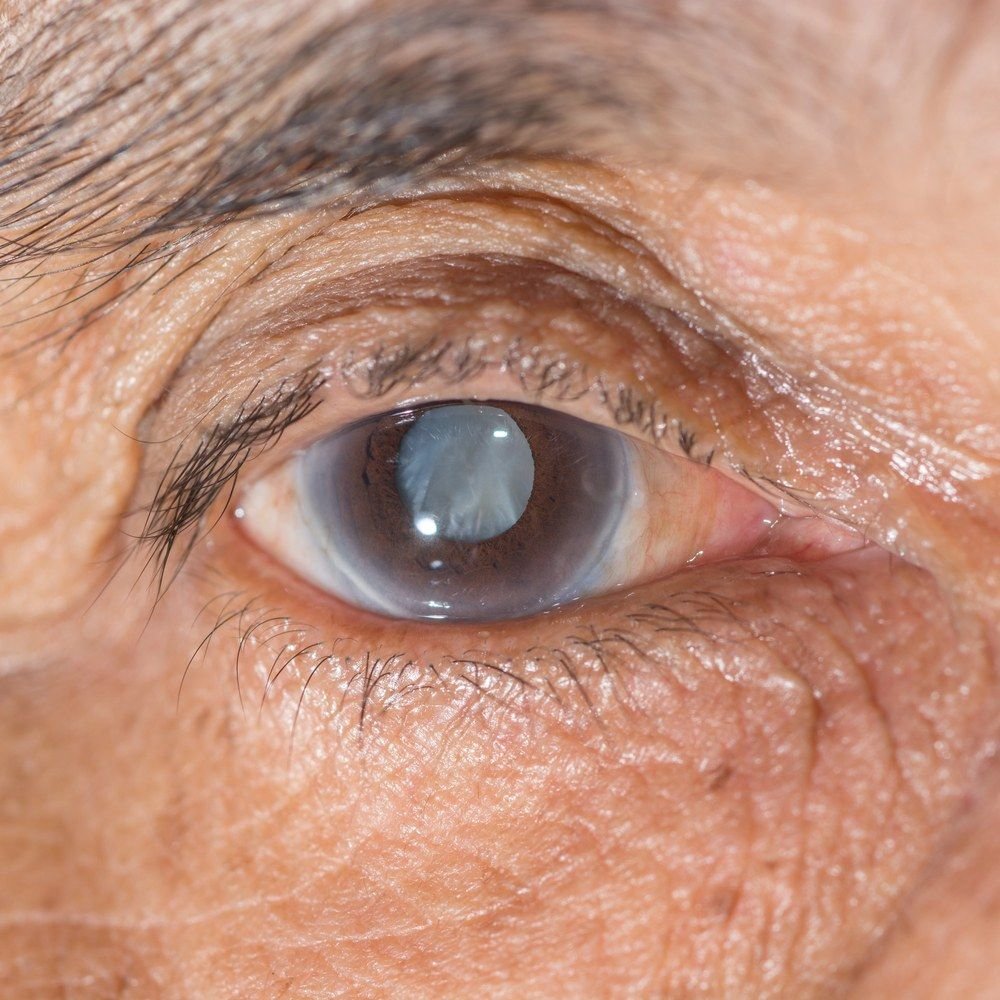
Due to the way small aperture optics work, any central opacity like corneal scarring or dense vitreous floaters along the central optical pathway from the front of the eye to the retina, can make one’s vision worse. The second image shown is a very dense cataract with a cortical component through the visual axis. The cataract is essentially blocking the entire optical pathway. There is already a decrease in light reaching the retina. By reducing pupil size in someone who has a dense cataract, the vision will likely get worse, not better. This category of drops works best for presbyopic patients who have not yet developed cataracts.
The flip side of the “advantage” described is that the moderate myope often can’t comfortably drive, watch TV, recognize faces across a room, travel, play sports, swim, wake up and see the clock, have a normal conversation, etc. without glasses or contact lenses. The examples are endless.
Yes, uncorrected nearsightedness can aid near tasks. But selectively isolating one occupational advantage ignores the other 95% of life.
If given the choice, most people don’t optimize their vision around a few inches from their face. They optimize it around living.
Glasses are the highest-bandwidth vision tool ever made for someone whose job is examining eyes from inches away. LASIK and contacts are both downgrades for this specific career.
A myopic eye doctor lifting glasses to peer into your retina is using the eye as a built-in magnifier with infinite battery. Half-second on, half-second off. No alternative matches that switching speed.
Contacts sit on the cornea drying out under slit-lamp light for 10-hour clinic days. They blur with debris, shift mid-exam, and chronic wear produces the exact dry eye disease the doctor is treating in patients. Contacts also lock you into one focal distance per insertion. A clinician who needs distance for the patient walking in and high near magnification for the retinal scan cannot switch on demand.
LASIK is the bigger trap. It reshapes the cornea, never the lens behind it. The lens stiffens with age regardless, and presbyopia hits everyone around 45. A 35-year-old who gets LASIK gets ten clean years, then reading glasses for the next 30 years of their career. The myopic ophthalmologist who kept glasses just slides them up at 45 and has built-in reading vision through retirement.
Plenty of eye surgeons do get LASIK. The ones who keep glasses are running a different calculation: 30 years of close-range work plus an aging lens that LASIK cannot touch.
A jeweler with -3 diopters has the same advantage. So does a watchmaker. So does a microsurgeon. The trade looks lopsided only when you forget what these people do all day.
I am a refractive surgeon and this is one of the most common reasons patients come to see me. The eyes age like any other part of the human body, and presbyopia, much like a receding hairline or starting to go gray, is often the first sign of mortality that many experience.
@morganhousel@udivaks I tell patients if they are happy in glasses and contact lenses, to stick with them. For the right candidate, vision correction surgery would allow one to wake up and experience what you describe when wearing contact lenses, without them.
@_linakiedis My whole career was spent in ophthalmology (37 years) with 20 of those years in vision correction surgery. I’ve had it done, my daughter and several in-laws. It is a safe, wonderful procedure that is life changing!
I love celebrating my post-op day one patients and their new vision with them! The joy never gets old. This morning was a mix of EVO ICL and RLE, and most were 20/15 less than 24 hours after surgery which is incredible. One is even headed to graduation today! Truly life changing.
@peanutchippit@ze_rusty Not true. Vision correction surgeons are far more likely than the general population to have it done themselves. https://t.co/htfmKmk6Ew