🔥 New #ICML2026 Paper accepted 🔥 by Arjun Rao with Tessa Ooms, Ruth Castro, @kklmmr@david_rolnick
Paper: https://t.co/jT1P2bYDPY
Code: https://t.co/Zls9c8nSZo
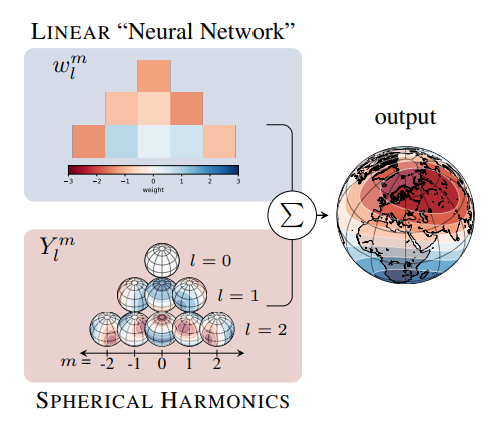
TL;DR: We propose Slepian functions as localized, spatially concentrated basis functions for regional location encoding. Building on spherical harmonics, Slepians allow location encoders to allocate higher resolution where it is most needed — for example, in regions with denser observations or where the underlying geospatial field varies at finer spatial scales, such as land compared to oceans.
This work connects geospatial AI, implicit neural representations, and functional modeling of Earth system data fields.
New paper out on localized location encoders with Slepian functions! 🤖🌍🌐
Lead by @arjun_arao & w/ @david_rolnick, @MarcCoru & others.
📰Paper: https://t.co/Jbb6j4VkYl
💻Code: https://t.co/gUu5AYAnJm
Learn more 👇
1/4
New paper on the intrinsic dimensions of Earth embeddings, led by @arjun_arao & w/ @rolf_comma_e and @MarcCoru.
Models like DeepMind's AEF have a fixed embedding space; but how many dimensions do they actually use?
Find out:
📰https://t.co/GeTEuKECCY
💻https://t.co/0ooz0Yamvu
30 years ago, Carol Casey joined what was then called the SURF Office. She arrived as an Administrative Assistant, rising steadily and working very hard to become Associate Director. For all that time, Carol and undergraduate research at @Caltech have been inextricably linked.
Weight averaging and model merging for LLMs seem to be the most interesting themes in 2024 so far. What are the benefits? Combining multiple models (or checkpoints) into a single one can improve training convergence, overall performance, and also robustness.
I will probably do a deeper dive in the upcoming weeks, but here are at least 3 interesting papers. To get started, here's a selection of papers on this learning trajectory (no pun intended).
📢 New #ICLR2024 paper on robustness: We propose an efficient and effective method to overcome catastrophic overfitting in single-step adversarial training.
See you in Vienna!
Paper: https://t.co/Qaj1JY9qIr
Code: https://t.co/43XDEYUIhe
1/2
New preprint out on geographic location encoding using spherical harmonics and sinusoidal representations! 🌐➡️🌏
Work led by @MarcCoru and w/ @rolf_comma_e, Robin Zbinden and @devistuia.
📄Paper: https://t.co/Gz4aQDdacv
💻Code: https://t.co/hR7KDesaoX
🧵Thread: 👇
1/11
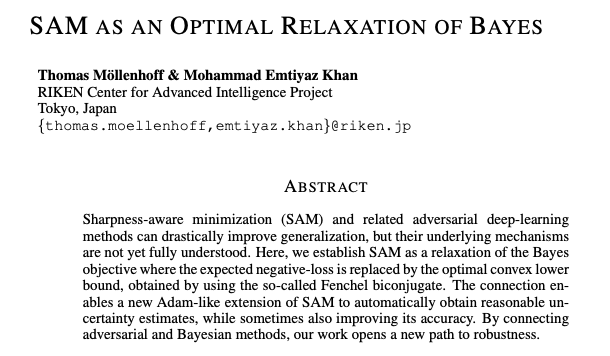
New work with @tmoellenhoff showing that SAM's max-loss is the *best* convex upper bound to Bayes' expected-loss. This is then used to derive an Adam-style extension of SAM to estimate uncertainty for free.
https://t.co/oGBotfMK9W
The work took 2 yrs, and it's my favorite! 1/13
One view of ML history is that we started out with MLPs and evolved towards more specialized architectures like CNNs for vision, LSTMs for sequences, etc. But actually, the exact opposite is true! 🚨🧵1/6
Mila is proud to welcome the Quebec-based startup @horomaAI as an industrial partner. This new partnership will help optimize remote sensing and earth observation technologies.
https://t.co/G9AIWeiRs9
New @ #ICML2021: When a trained model fits clean (training) data well but randomly labeled (training) data (added in) poorly, its generalization (to the population) is guaranteed!
Paper: https://t.co/zc7cPpaf9m
by ACMI PhD @saurabh_garg67, Siva B, @zicokolter, & @zacharylipton
On ImageNet, a random guess has 0.1% accuracy, but ResNet50 gets about 80% with any stable optimizer. The difference between SGD, Adam, and BFGS is about 1%. Batch size 64K “only” gets 75%. There’s no evidence that optimizer choice plays a fundamental role in generalization.
Introducing SAM: An easy-to-use algorithm derived by connecting PAC Bayesian bounds and geometry of the loss landscape. Achieves SOTA on benchmark image tasks (0.3% error on CIFAR10, 3.9% on CIFAR100) and drastically improves label noise robustness.
https://t.co/aONWVTPZsT
Ever wondered if FGSM training now really works? Actually, it does, but only for small eps. Catastrophic overfitting is *still a problem* for many recently proposed methods, but this can be fixed with GradAlign.
Paper: https://t.co/1w2vYTpnIH
Code: https://t.co/cIN4powE5U
(1/9)
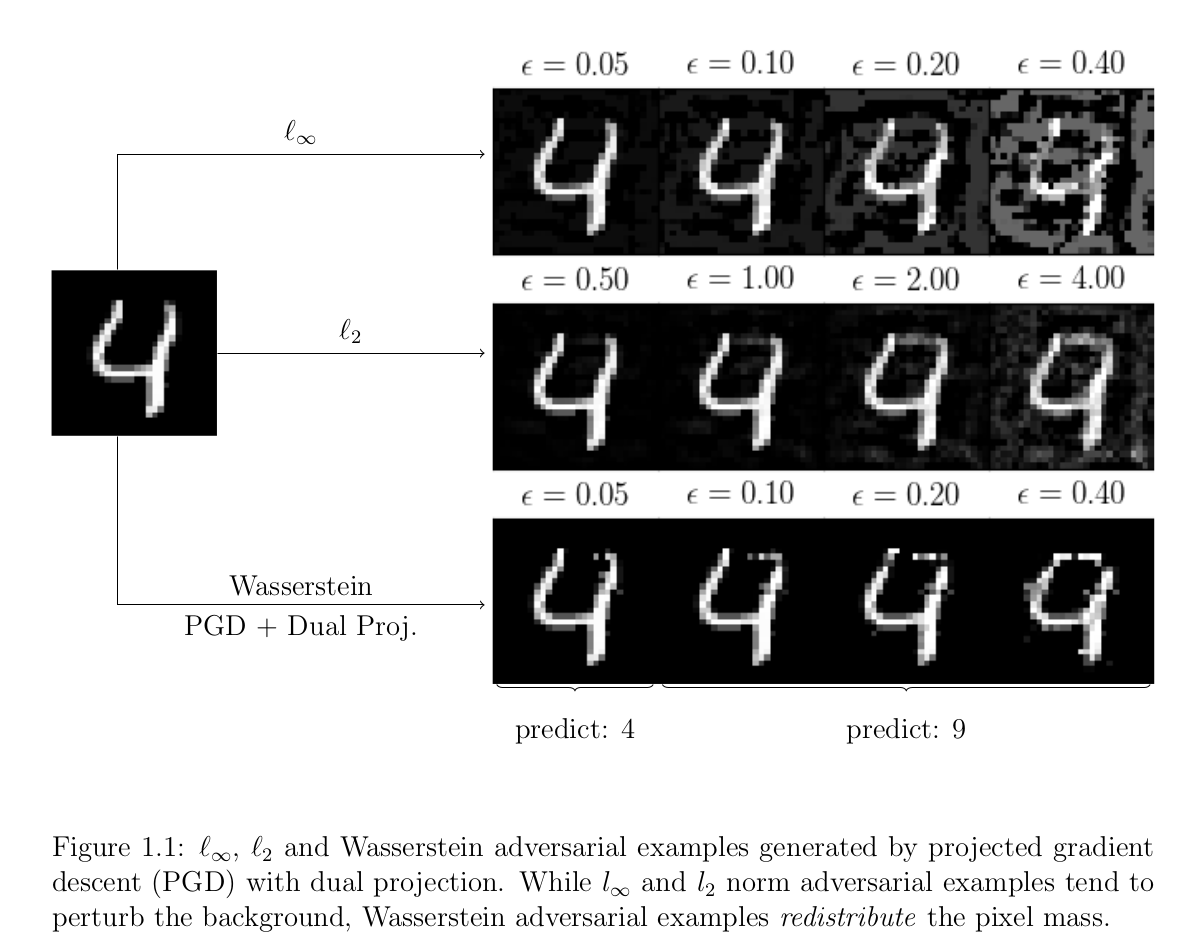
Just saw a great Master's thesis presentation by Kaiwen Wu (@kaiwenwuwu), about his #ICML2020 with on Wasserstein Adversarial Attacks (with Allen Wang (@AllenHW0) and my colleague Yaoliang Yu). Strong results in a comparatively underexplored area! https://t.co/OhRndIkvK0
Training a neural network (NN) can suffer from bad local minima. But as the NN gets wider, its optimization landscape in *function space* converges & becomes convex; when width=∞, this convex landscape is described by Neural Tangent Kernel. https://t.co/v1b6kndqCk
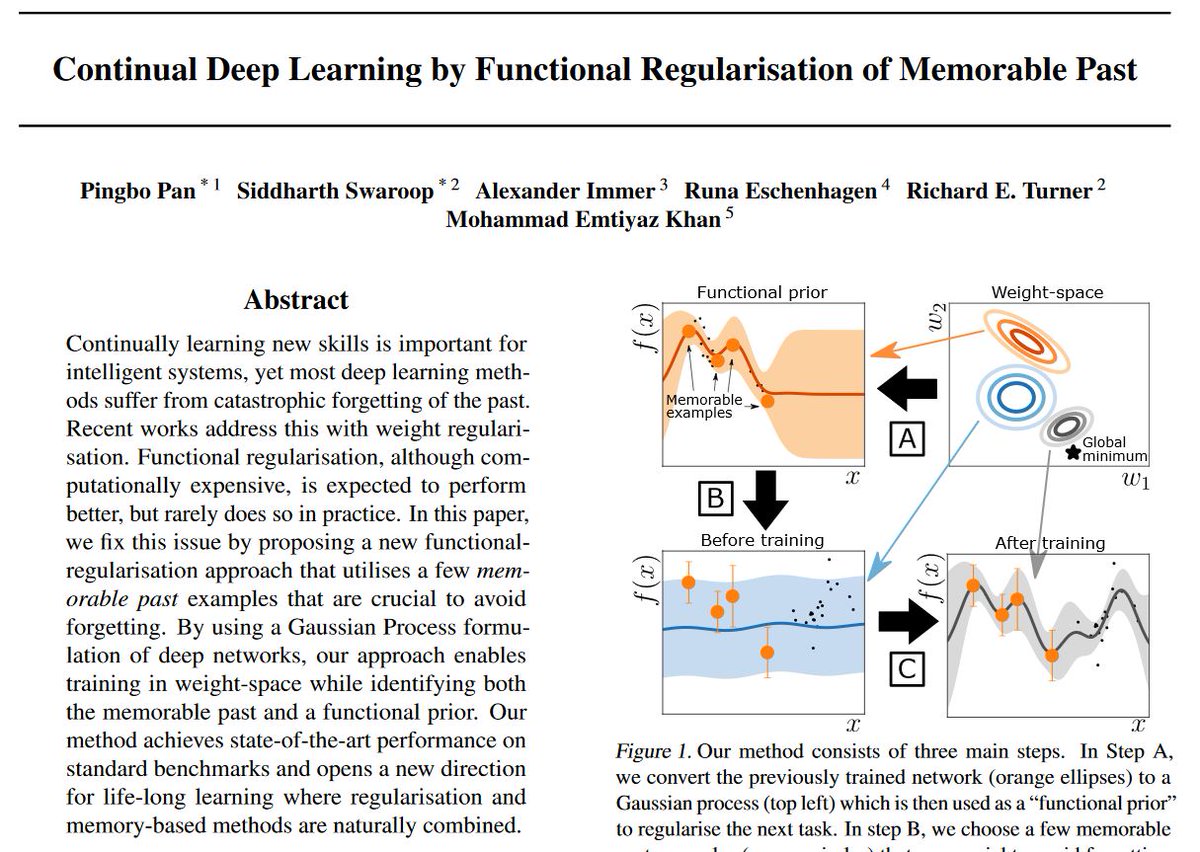
Recent work on functional regularisation for continual learning with @EmtiyazKhan and others. Since network outputs depend on weights in a complex way, function-regularisation may be better than previous weight-regularisation. https://t.co/cvUvrU6kDp 1/7
New book by Nisheeth Vishnoi (@NisheethVishnoi)! "Algorithms for Convex Optimization" -- looks like a great resource for people entering the field. And of course the draft is free, check it out here: https://t.co/mO4EaQV1R7
Interested in black-box Lp adversarial examples?
We'll have a virtual poster tomorrow (Monday) about our Square Attack (https://t.co/bpwt2JLqVJ) at #ECCV2020 at 7am & 3pm CET (with @fra__31)
SOTA query efficiency with an extremely simple algo (just put squares here and there)!