The Slaying of Henry Nowak — How the West's Accommodation of Khalistanis Led to the Tragedy
Henry Nowak was eighteen years old, a first-year accountancy student at the University of Southampton, a footballer who had grown up in Essex, the son of Polish-British parents. He was, by every account, an unremarkable and thoroughly likeable young man, out on a December evening with football teammates.
Vickrum Digwa was twenty-three, a baptised Sikh. Shortly before eleven-thirty that night, on Belmont Road in Southampton, Digwa and Nowak became embroiled in a verbal altercation. Digwa maintained at his trial that Nowak had made racist remarks and that he had acted in self-defense. The jury rejected this account comprehensively.
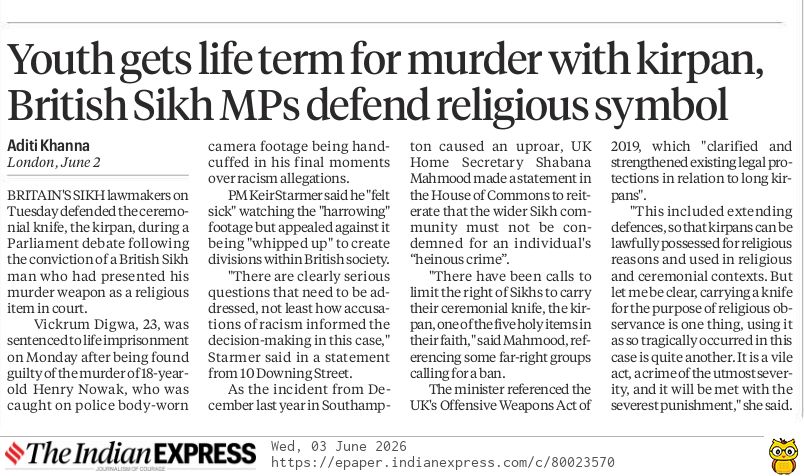
What is not contested is what Digwa did: he stabbed and cut Henry Nowak five times with a knife described in court as "a large Sikh dagger" — a kirpan measuring twenty-one centimetres. When police arrived, Digwa pointed to Nowak as his assailant. Officers handcuffed the dying teenager. Nowak died shortly after receiving first aid.
Digwa was convicted of murder on May 28, 2026, and sentenced to life imprisonment with a minimum of twenty-one years. His mother, Kiran Kaur, was found guilty of assisting an offender.
The prosecution told the jury that while Digwa was entitled to wear a small kirpan under his clothing around his neck, he also chose to carry the much larger knife that killed Nowak. It was this second, larger blade — carried for religious reasons as per Digwa — that ended an eighteen-year-old's life.
The case provoked an immediate and predictable controversy about the kirpan exemption. The National Secular Society wrote to the government urging a review of religious exemptions to knife laws. Cabinet Office minister Nick Thomas-Symonds acknowledged that the Criminal Justice Act 1988 sets out "an exception in terms of carrying bladed articles in public places for particular religious and ceremonial reasons." Social unrest followed in Southampton after bodycam footage of Nowak's arrest was released.
One need not be hostile to Sikhism, or to the genuine religious significance of the kirpan, to observe that an exemption designed to accommodate a symbolic article of faith had, in this instance, provided legal cover for carrying a weapon that killed a teenager. The question of whether a twenty-one-centimetre blade serves a religious purpose meaningfully distinct from a much smaller, blunted version is one that the British Parliament has conspicuously declined to address. The NSS argued precisely this point: "accommodating religious practices need not require exemptions from safety laws which should apply equally to all." The Henry Nowak case is ultimately a story about institutional failure.
The Five Eyes of Indulgence
Britain's permissiveness toward the Khalistan movement is not, of course, uniquely British. Across the Anglosphere — in Canada, the United States, Australia, and New Zealand — Western governments have, at varying speeds and with varying degrees of discomfort, extended to Khalistani organisations the protections and freedoms of liberal democracy while declining to apply to those organisations the scrutiny that genuine security threats ordinarily attract.
The Canadian chapter of this story is the most dramatic. Canada hosts the world’s largest Sikh diaspora outside Punjab, heavily concentrated in the Toronto and Vancouver suburbs. Khalistani politics have long influenced Canadian electoral politics, especially within the Liberal Party. The assassination of Hardeep Singh Nijjar — an individual designated a terrorist by India’s National Investigation Agency and wanted in multiple criminal cases — outside a Surrey, British Columbia gurdwara in June 2023 triggered a major diplomatic crisis. Prime Minister Justin Trudeau publicly accused the Indian government of involvement based on “credible allegations,” prompting a strong denial from India and the mutual expulsion of diplomats.
The episode exploded into one of the most serious diplomatic crises between the two countries in decades, culminating in the mutual expulsion of diplomats. The Canadian government's willingness to allow a man India regarded as a terrorist operative to operate freely on its territory — and then to shield his network with the language of Canadian sovereignty after his death — illustrated the depth of the problem.
The United States has its own ecosystem of Khalistan support. In 1984, at the height of the troubles, one of the accused at the Air India bombing trial put it in his speech at the founding convention of the World Sikh Organization, New York: “Until we kill 50,000 Hindus we will not rest.”
In recent years, the extremist group Sikhs for Justice, which has organised so-called "referendums" on Khalistan in major Western cities, is based in Washington, D.C. Its founder, the comical yet devious Gurpatwant Singh Pannun, has repeatedly issued threats against India, its institutions, and public events in support of the Khalistan movement. These threats have included calls to disrupt national celebrations, warnings directed at Indian aviation, and appeals for separatist activities aimed at establishing an independent Khalistan state.
Australia has seen its own chapter: Khalistani protesters and activists have vandalised Indian diplomatic missions in Sydney and Melbourne, often in coordinated actions timed with attacks in London and North America.
New Zealand's experience, while smaller in scale, is particularly illuminating for what it reveals about how Western governments rationalise inaction. In a 2025 interview with Indian journalist Palki Sharma, Prime Minister Christopher Luxon stated he had no plans to act against Khalistani extremists, despite their increasingly violent attacks on Indians. He defended this position using the “free speech” argument and emphasized that New Zealand operates strictly within its own laws and democratic framework. Luxon also declined to commit to sharing intelligence on Khalistanis with India.
The stance highlighted a fundamental gap: activities that Indian security services view as serious threats are treated as legally protected expressions in New Zealand, allowing the Khalistan movement to find safe haven across much of the Western world.
The Snakes in the Backyard
In October 2011, Secretary of State Hillary Clinton visited Islamabad and, at a joint press conference, delivered one of the more blunt assessments in the history of American diplomacy. "You can't keep snakes in your backyard and expect them only to bite your neighbours," Clinton told her hosts. She was speaking about Pakistan's support for the Haqqani network. "Eventually those snakes are going to turn on whoever has them in the backyard."
It is an analogy that travels with uncomfortable ease from Pakistan to the United Kingdom. Britain and its Five Eyes partners have, for decades, kept a version of their own serpents — not with the active intent of weaponising them against India, necessarily, but through a combination of Cold War calculation, electoral politics, multicultural squeamishness, and plain institutional inertia. The snakes were allowed to grow. The networks were allowed to deepen. The ideology was allowed to radicalise. And the implicit bargain — that the violence would be directed elsewhere, at Indian diplomats and Indian army generals and Indian Hindus, and therefore was not quite Britain's problem — held, more or less, until it didn't.
General Brar's slashed throat on Old Quebec Street was a warning. The vandalism at Aldwych was a warning. The coordinated assaults on Indian missions across the Anglosphere in March 2023 were a warning. And Henry Nowak — eighteen years old, out for a December evening with his football mates — received the bill that had been accumulating, in ways large and small, across five decades of accommodation.
The question of whether his death was "caused" by the kirpan exemption or by Khalistani radicalisation or by Britain's long leniency toward separatist networks admits no simple answer. Social and legal failure rarely has a single cause. But the exemption made it possible for Digwa to walk a Southampton street with a twenty-one-centimetre blade under the colour of religious obligation. The decades of leniency created the ecosystem in which extreme interpretations of religious and political identity flourish. And the combination — a permissive legal carve-out meeting an ideology that the state had declined to confront — produced a result that was, in the most painful sense, entirely foreseeable.
The Democratic Alibi
Western governments, when pressed about their tolerance of Khalistani activities, reach instinctively for the language of democratic rights. Free assembly. Free speech. Due process. The rule of law. These are not trivial values; they are, in many respects, what distinguishes liberal democracies from the alternatives. But they have also become, in this context, a sophisticated alibi for inaction that serves domestic electoral interests while externalising the costs of that inaction onto India and, increasingly, onto the Western countries' own citizens.
The alibi works, in part, because the Khalistan movement has always been adept at wearing the costume of civil society. Referendums sound democratic. Community organisations sound benign. Religious exemptions sound like tolerance. The language of self-determination sounds — if one does not look too closely at the methods employed to advance it — like the language of freedom movements everywhere.
But the pattern of activity across British soil over the past fifty years — from Chauhan's government-in-exile to the Brar assassination attempt to the recurring violence at India House to the Southampton killing — does not describe a civil society movement. It describes a transnational infrastructure of radicalisation that has operated, with considerable effectiveness, in the gaps that Western democracies have left open for it.
India has paid the largest price. But as Clinton might have observed: the snakes don't stay in their lane. They never do.
A Reckoning Deferred
In the days after Henry Nowak's murder, there were the usual expressions of grief and political determination. The NSS wrote its letter. Ministers gave their statements. The police bodycam footage circulated on social media, provoking the particular kind of outrage that comes from watching an institution protect its own processes rather than the dying teenager in front of it. Digwa was convicted and sentenced. The machinery of justice, in the end, worked.
What has not yet happened — and what the Nowak case makes urgently necessary — is a genuine audit of the accumulated decisions, exemptions, accommodations, and indulgences that created the conditions for this outcome. The kirpan exemption, untethered from any requirement that the blade be symbolic in size or incapable of causing serious harm, is the most obvious point of revision. But it is the surface of a much deeper problem.
That deeper problem is this: Britain and its allies made a series of choices, over many decades, to treat the Khalistan movement as a tolerable presence on their soil — a loud but essentially harmless community of agitators whose grievances were Indian problems to manage. They were wrong. The movement has shown itself willing and able to pursue assassination attempts against individuals on British streets, to organise coordinated attacks on diplomatic premises, to radicalise young men in British cities, and to create legal and social environments in which the carrying of weapons becomes, by an incremental drift of accommodation, normalised.
The bill for those choices is now arriving. Henry Nowak is the most recent entry on it. He will not be the last, unless something changes.
Secretary Clinton's snakes, one should note, had a particular quality. They did not simply wait in the backyard. They moved, over time, into the house.
@palepurshankar The vile and stupid comments are coming from people who have never spent a day in uniform nor have ever lived in a military environment. It's amazing how so many have self-decided what's good for the armed forces.
The discussion highlighted the intersection of security, diplomacy, and regional cooperation at a critical moment for West Asia.
Watch the full conversation here: https://t.co/X66zpvXqQX
@manjarisingh_ME@BakstHadas@arjunhardas#GWAFI#WestAsia
By all means run a bulldozer over Delhi Gymkhana. But don’t give the bullshit of exclusivity or privilege or tax payer money. If thats the standard we are living by then shut down Constitution Club; demolish the CSOI where govt land was given at throw away price to babus; shut down DSOI; take back all newspaper properties on BSZ Marg; Take back all lands given to NGOs which are profit centres; demolish IIC and Habitat Centre; stop subsidised food in parliament. MPs get paid so why should their food be subsidised? if they cant afford it, step down from parliament and do something that pays you enough. Shut down the Air Force and Army Golf Clubs, Santushti Centre, Race Club, and the Delhi Flying Club where no one flies anything. The DGC is being targeted because someone has an axe to grind and didnt get membership. Now its being made an elite vs non-elite fight which it isn't. But since we all want to play Bolshevik commies or are inspired by CCP and Khmer Rouge to demolish everything nice, decent, genteel, lets do a comprehensive job of it. Make it all a animal shelter which would warm the cockles of Pol Pot's heart. But please don’t give the BS of security because that is total hogwash. Thank you for your attention to this matter.
Dear Honoruable Shri @rajnathsingh Ji,
Namaskaar !
You are much aware of the case of disgruntled indisciplined defaulters from Army, who were invited and misused as props by two disgraceful MPs @SanjayAzadSln & @manojkjhadu, in their attempt to demean our Armed Forces through a Press Conference held at @PCITweets Premise, on 21 May 2026 at around 5 PM to 5.45 PM IST, at New Delhi.
We seek your personal indulgence to move a Case File seeking approval of Honoruable Rashtrapati Ji @rashtrapatibhvn to grant waiver for prosecuting these two MPs while @adgpi moves Court to take due legal action.
As Veterans and also with millions of Citizens, we will stand witness in the Case, which needs to be done for greater good of Bharat and our future.
While Suo Moto looks unlikely by the legal dispensation, unless your good offices seek the intervention of Honourable Chief Justice of Bharat (CJI), we will proceed with the FIR already filed in the matter.
We beseech your good offices to apprise the Honourable Prime Minister Shri @narendramodi Ji, who as the Executive Head may discuss this with the Honourable Rashtrapati and Vice President @VPIndia who presides over Rajya Sabha.
Soliciting your support and guidance to take this to its logical legal conclusion and restoration of respect of our Armed Forces that has been assaulted by these disgraceful MPs and Defaulters from Army.
Best wishes and warm regards,
JAI HIND 🇮🇳
Cc @PMOIndia@HQ_IDS_India@adgpi
Fully agree. The west is arrogant, condescending, sinking and blind. Just a question of time. There will either be a civil war or a complete surrender esp in Europe.
Context: Dutch #PM’s remarks about press and religious freedom during #Indian PM’s visit to #Netherlands the #MEA’s response
I’ve followed press freedom issues in #India & #Europe for decades. I have also followed minority rights issues in my country and #Europe. Despite the rough and tumble and difficulties we face in India, I’m proud to say our media space is one of the freest in the world. We raise all our issues directly with the government. We @thenewsminute & @newslaundry question compromised media regularly.
Minority rights is an issue, but it’s not any country’s business to tell us how to solve it. We have enough agency in 🇮🇳 to raise it as our media & NGOs do regularly.
I wish the #MEA would not have gone on the defensive and simple told the #Dutch we take note of the issue or even gone further to say we do not appreciate their interfering in our domestic affairs. Perhaps the #MEA has its rules.
I did not like our diplomats going around the western world mostly to explain our problems during #OperationSindoor. Why on earth do we seek western approval for our issues. In this case it was national defense. Our lawmakers made fools of themselves. The result was the #west especially the very powerful 🇺🇸 is closer to #Pakistan
It’s not a tit for tat issue, but it’s about time 🇮🇳 occupies its place in geopolitics with responsibility and pride.The sooner we do it, the better for us.
Recent years have shown us how compromised #NATO and #Eorupean media is. Their one sided reporting on the war in #Iran and absence of knowledge about #WestAsia is jarring. They do not allow @GUnderground_TV to broadcast in 🇪🇺 - it’s one of the best news networks in the world and I urge you to follow them and @RT_India_news
You’ll never hear western media report on how we have lifted millions of people out of absolute poverty. The #UNDP puts the figure at 415 million between 2005 - 2021 and the #WorldBank says 171 million people moved up between 2022 - 2023.
We’re growing at the fastest rate in the world. Indians argue about the figure 6.5 or 8 percent but that’s what makes us a true democracy. In fact there’s nothing Indians don’t argue about and that’s an excellent thing. You’ll never see such diversity of views in #Europe because they are comfortable in their arrogance. Europe is in full decline. It has no plan B for anything. It’s needs India’s markets to restart and grow. Netherlands is part of a struggling Europe. I’ll skip how the #Dutch pillaged countries in Africa to enrich themselves. I’m also not going into how Europe treats minorities especially the #Gypsies and others
Why am I saying all this? It’s because there’s envy about us as a developing nation. Over 800 million people - more than the 🇺🇸 and 🇪🇺 combined vote in the world’s largest democratic process peacefully. Saying nasty things is easy. Appreciating our differences & difficulties is true diplomacy
In recent years I’ve notices how everyone in #India has aspirations. We should #manufacture in India for Indians as we are potentially the world’s largest market. The other issue is unemployment. We must create 12 million jobs YOY - an employed people is a peaceful people. I saw this while covering the #Bosnian war where unemployment stirred religious disputes and finally led to the partition of former #Yugoslavia. #NATO played a dirty that monumental this tragedy. Families were separated from each other, hundreds and thousands of people died. #India did not ask any questions.
I believe time has come for us to raise issues internationally within the purview of our power and ambitions. There are serious voices saying India may soon become a permanent member of the United Nations Security Council (UNSC). What are we waiting for.
Thank you for reading. #Geopolitics is area I follow closely. Keen to hear your views. 🙏🏼