Another Tata Story - Letter to a School Teacher!
In 1965, JRD Tata received a letter from a school teacher in Kolkata named K.C. Bhansali. He enquired of JRD Tata about the guiding principles of his life.
JRD Tata responded to Mr. Bhansali with the following extraordinary letter:
13 September 1965
Dear Mr. Bhansali,
I thank you for your letter of 6th August, enquiring what have been the guiding principles which have kindled my path and my career. I do not consider myself to be an "illustrious personality", but only an ordinary businessman and citizen who has tried to make the best of his opportunities to advance the cause of India's industrial and economic development.
Any such guiding principles I might unconsciously have had in my life can be summarised as follows:
That nothing worthwhile is ever achieved without deep thought and hard work.
That one must think for oneself and never accept at their face value slogans and catch phrases to which, unfortunately, our people are too susceptible.
That one must forever strive for excellence, or even perfection, in any task however small, and never be satisfied with the second best.
That no success or achievement in material terms is worthwhile, unless it serves the needs and interests of the country and its people, and is achieved by fair and honest means.
That good human relations not only bring great personal rewards but are essential to the success of any enterprise.
Yours sincerely,
J.R.D. Tata
********
Such a simple and powerful letter. In less than 200 words, JRD Tata had put forward the guiding principles of his life. Wonderful words coming from one of the greatest industrialists and leaders of our nation.
And also an apt day to ask ourselves, what are the guiding principles by which we strive to lead our own lives?
(Picture below - JRD Tata at Chowpatty Beach, Mumbai. Courtesy Tata Central Archives, Pune.) #Tata #lifelessons
If you sit alone for 24 hours without any activity, and simply watch the nature of your mind, you will know how compulsive your psychological activity is. In such compulsive states, you cannot simply “be.” You can explore the full potential of being human only if you know how to be.
#SadhguruWisdom
India has no shortage of people or talent. The opportunity now is to convert that talent into greater productivity, prosperity, and innovation.
Population gives strength. Productivity gives prosperity.
The future belongs not to countries with the most people, but to countries that unlock the full potential of their people.
Rather long but I hope you enjoy reading it as much as I did:
I am an Indian,
and everyone says I lack civic sense.
They can burn streets,
and vandalize a city after a championship game.
I dance at an airport excited about my first foreign trip, and suddenly I am the face of poor civic sense.
I am an Indian,
and everyone says I steal jobs.
They move factories across oceans,
shift profits through tax havens.
I study, compete, earn a visa, work 18 hours a day, sometimes multiple jobs and somehow I am the one stealing jobs and scamming the system.
I am an Indian,
and everyone says I am everywhere.
I build your software,
treat your illness,
teach your children,
drive your taxis,
and open your stores.
The world became a village,
yet my presence remains a problem.
I am an Indian,
and everyone says I am too loud.
The evening news screams outrage.
The internet echoes with anger day and night.
I celebrate a wedding, a festival, a victory,
and I am told my joy is too loud.
I am an Indian,
and everyone says I smell of curry.
The world smells of gunpowder,
of hatred,
of division,
of endless arguments about race and religion.
I carry the fragrance of spices from my grandmother's kitchen,
and somehow that is what offends.
I am an Indian,
and everyone says I have no culture.
I come from a civilization that counted the stars
when much of the world was still learning maps.
I speak languages older than nations.
I celebrate hundreds of traditions,
yet I am told I have no culture.
I am an Indian,
and everyone says I am backward.
I send missions to the Moon.
I build vaccines for millions.
I run companies across continents.
Yet a viral video of one fool becomes evidence against a billion people.
I am an Indian.
I celebrate my favorite actor's success
with flowers, music, and a few glasses of milk.
Others worship influencers who sell outrage, turn every disagreement into a battlefield, and every opinion into a war.
Yet my celebration is the one that makes headlines.
I am an Indian,
and everyone says I gather in crowds.
We walk together in processions,
celebrating our faith, our culture, our traditions.
Everyone is welcome.
No shops are looted.
No neighborhoods are burned.
No one is threatened for thinking differently.
We sing.
We dance.
We pray.
And somehow our gathering becomes the problem.
I am an Indian,
and everyone says I bring my culture everywhere.
I light a lamp in a foreign land.
I wear a saree in the snow.
I teach my children the language of their grandparents.
Others build walls between neighbors,
argue endlessly over identity,
and forget where they came from.
Yet I am told I should leave my culture behind.
I am an Indian,
and everyone says I live in the past.
But my past gave me yoga,
mathematics, philosophy, meditation,
and the idea that the world is one family.
The future keeps borrowing from my past,
while telling me to be embarrassed by it.
I am an Indian,
and everyone says I should be ashamed.
Ashamed of my accent.
Ashamed of my food.
Ashamed of my festivals.
Ashamed of my traditions.
Ashamed of existing.
But I am not ashamed.
I am the child of farmers and philosophers,
scientists and saints, workers and dreamers.
*I come from a land that taught the world
that truth can be many-sided,
that all paths deserve respect,
and that the entire world is one family.*
*Yes, we have flaws. Every nation does.*
*But judge me by my actions, not by your stereotypes.*
For I am an Indian.
*And before you tell me what is wrong with me, look honestly at what you have normalized in yourself.*
For I am an Indian.
The world may mock my accent,
question my customs,
laugh at my celebrations,
and judge me through a thousand stereotypes.
*Yet I stand tall. For I belong to a civilization older than empires, a culture richer than prejudice, and a people whose spirit refuses to bend.*
For I am an Indian.
Google which is cash surplus, just announced an additional capital raise of $80 bn.
Google annual profit is $160 bn, last quarter $62 bn, and market cap $4.5 trillion. That is close to total profits and market cap of all Indian listed companies put together.
It’s a wake up call to all companies to invest into the future, whatever the present maybe.
Now that IPL is done and dusted, time for India to focus on business of business.
Yesterday when I shared the interaction between Warren Buffett and Donald Trump during Trump's campaign for his first term, many mentioned they were entirely unaware of it.
The skepticism wasn't unique to Buffett. Back in 2011, when Charlie Munger was asked how Trump would fare as US President, he didn't mince words:
"Well, he might be quite decisive, but do I consider Donald Trump an ideal decision maker or manager of anything? And the answer is no.
And the last person almost I'd want to be president of the United States is Donald Trump.
I think he has qualities that make him unsuitable for the office. He has qualities like Vainglory. Puffery to too large an extent. I could go on and on."
Buffett and Munger got many judgments about people right. They were always exceptionally insightful on the core realities of human behavior.
In our group, from the beginning one lady has been shoplifting. We were not aware of it. In one of the tourist souvenir shops, she was caught. She immediately offered to pay money. The Japanese shop keeper said that they are a high trust society where stealing is rare and have great respect for India. He said more than stealing, what offended him was offering money after being caught.
In Japan, you can never see police. Crime rate is very less. Traffic discipline is very high. The shopkeeper called the police. Our tour manager accompanied that lady to police station. In police station too that lady offered money. The Japanese police was not amused.
They explained how severe the punishment is for stealing and said she needs to go to jail. But she being an Indian and they respect India a lot, she was let go with severe warning.
A student once explained how wild pigs are trapped:
First, they are given free corn in the forest.
They return every day for the easy food.
Then slowly, fences are built around them, one side at a time.
At first they resist. Then they adapt.
Finally the gate shuts and the pigs, now dependent on the free corn, have lost their freedom without even realizing it.
That is how freedom often disappears in societies too. Not suddenly through force, but gradually through dependence.
Free rations. Free electricity. Free cash transfers. Endless subsidies. Political promises of “something for nothing.”
Each may appear harmless in isolation. But over time, citizens begin depending more on the State than on their own enterprise, effort and initiative.
And when dependence grows, freedom quietly shrinks.
A nation becomes truly strong not when more people vote for benefits, but when more people create, build, innovate and contribute.
There is no free lunch.
Someone always pays the bill.
And sometimes, the hidden cost is freedom itself.
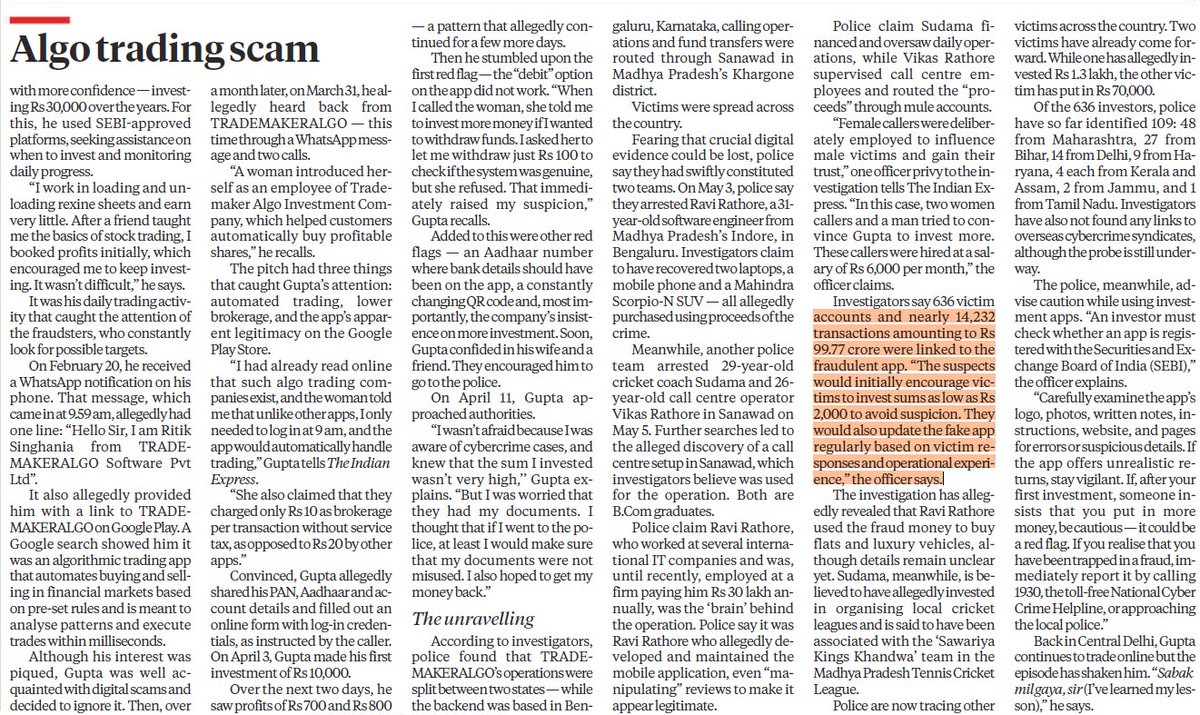
An alleged algorithmic trading scam involving TRADEMAKERALGO, where fraudsters lured investors with promises of automated trading, low brokerage fees, and easy profits.
A victim initially invested small amounts and was encouraged to increase investments after seeing modest returns. Warning signs emerged when withdrawals became difficult, app features malfunctioned, and suspicious payment requests arose.
Police investigations suggest a widespread operation using fake apps, manipulated reviews, mule accounts, and call centers to target victims across India.
Authorities have identified 636 accounts linked to transactions worth nearly ₹99.77 crore and advise investors to verify app legitimacy and remain cautious of unrealistic returns.
Almost 100 cr were lost by people in the name of "get rich quick" schemes. And then people on social media ask an uneducated opinion: what's the difference between regulated and unregulated advice? 😀
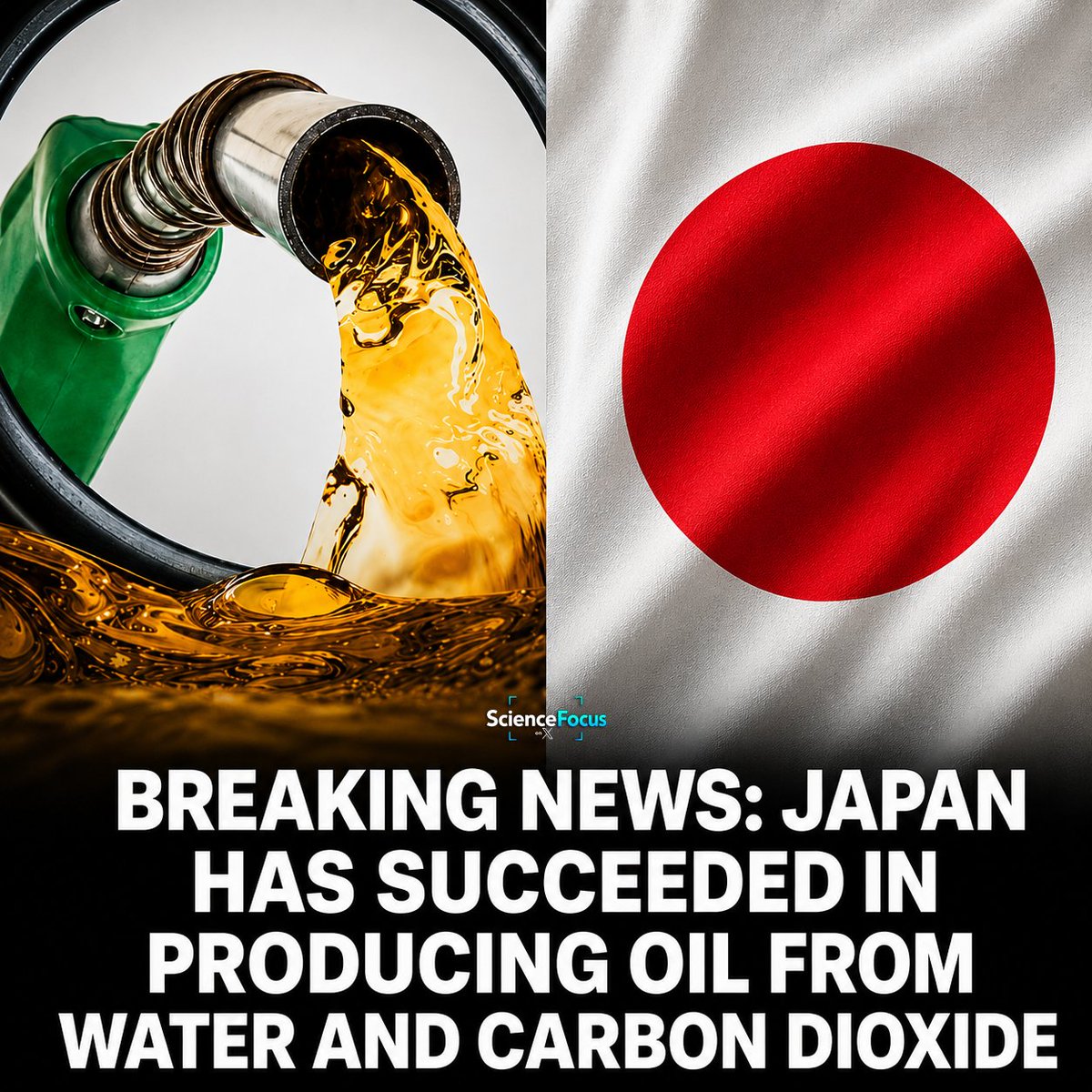
Japan just turned thin air into fuel.
No oil rigs. No drilling. No pipelines stretching across oceans.
Just water, CO₂, and a process that flips combustion on its head.
ENEOS Corporation, Japan's biggest oil refiner, pulled it off at their Yokohama lab.
They built a demo plant that sucks carbon dioxide straight from the atmosphere, splits hydrogen out of water using renewable energy, then fuses them through Fischer-Tropsch synthesis into liquid hydrocarbons.
The result? Real, usable synthetic petroleum.
The kicker: this fuel is "drop-in ready." That means it works in the cars you already drive, the planes already in the sky, the pipelines already in the ground. Zero modifications.
They didn't just brew it in a beaker either. They ran actual vehicles on it. It works.
Think about what that unlocks. Countries with no oil reserves could manufacture their own fuel using nothing but sunlight, wind, and the air around them.
The geopolitical chessboard would flip overnight.
Sectors that electrification can't easily touch, like aviation and heavy shipping, suddenly have a clean fuel path.
There's a catch, though. The process is hungry. The same electricity it takes to brew one liter of synthetic fuel could push an EV about 200 km down the road. ENEOS quietly shelved the project in 2025 because the economics didn't math out yet.
But the science? Proven. The blueprint exists. Someone, somewhere, will crack the cost problem.
And the day they do, the oil map of the planet gets redrawn.
Source: ENEOS Corporation / TheTownHall(.)News
In 1984, Apple tried hiring “professional management.”
Steve Jobs: “It didn’t work at all.”
“Most of them were bozos.”
“They knew how to manage. But they didn’t know how to do anything.”
He spent 4 minutes explaining what actually works:
"The greatest people are self-managing. They don't need to be managed."
"Once they know what to do, they'll go figure out how to do it. They don't need to be managed at all."
"What they need is a common vision. And that's what leadership is."
"Having a vision. Being able to articulate it so the people around you can understand it. And getting a consensus on a common vision."
So who should manage?
"If you're a great person, why do you want to work for somebody you can't learn anything from?"
"You know who the best managers are?"
"They're the great individual contributors who never ever want to be a manager."
"But decide they have to be a manager because no one else is going to be able to do as good a job as them."
Apple hired two professional managers from outside the company. Fired them both.
Then Jobs gambled on Debbie Coleman. A member of the Macintosh team. 32 years old. English literature major with an MBA from Stanford.
A financial manager with no experience in manufacturing. Put in charge of manufacturing.
Debbie Coleman: "There's no way in the world anybody else would give me this chance to run this kind of operation. I don't kid myself about that."
"It's an incredible high risk. Both for myself personally and professionally. And for Apple as a company. To put a person like myself in this job."
"We're betting that my skills at organizational effectiveness override all lack of technology, lack of experience, lack of time in manufacturing."
"I'm just an example. Almost every single person on the Mac team, you could say that about."
"This is a place where people were afforded incredibly unique opportunities to prove they could write the book again."
Hiring was the most important job.
"I consider the most important job of someone like myself is recruiting."
"We agonized over hiring."
"Interviews would start at 9 or 10 in the morning and go through dinner."
"A new interviewee would talk to everybody in the building. At least once. Maybe a couple times."
"Then come back for another round of interviews. Then we'd all get together and talk about it."
"And then they'd fill out an application."
He laughs.
"No. They never filled out an application."
Here's how they knew someone was right.
"The critical part of the interview, at least to my mind, was when we finally decided we liked them enough to show them the Macintosh prototype."
"We sat them down in front of it."
"If they were just kind of bored, or said 'this is a nice computer,' we didn't want them."
"We wanted their eyes to light up. For them to get really excited."
"Then we knew they were one of us."
Once you get the right people, something changes.
"When you get a core group of ten great people, it becomes self-policing as to who they let into that group."
"Everybody just wanted to work. Not because it was work that had to be done."
"But because it was something we really believed in. That was going to really make a difference."
"We all wanted exactly the same thing. Instead of spending our time arguing about what the computer should be, we all knew what the computer should be."
"And we just went and did it."
Inside the casing of every Macintosh, unseen by the consumer, are the signatures of the whole team.
Apple's way of affirming that their innovation is a product of the individuals who created it. Not the corporation.
This 4 minute video will teach you more about hiring, leadership, and why professional managers fail than every business book combined.
Bookmark & give it 4 minutes today, no matter what.
🚨🇮🇳 Full blockade of the Strait of Hormuz might choke India?
Not so fast. India has a powerful ace up its sleeve: the Chennai-Vladivostok Eastern Maritime Corridor.
This ambitious sea route is now one of the top strategic priorities for both Russia and India. It’s designed to slash dependence on traditional chokepoints and unlock direct, reliable trade between the two nations.
The corridor will boost joint projects in Russia’s Far East while dramatically expanding trade in crude oil, metals, machinery and equipment.
Signed back in September 2019 at the Eastern Economic Forum, the route stretches over 10,000 kilometres. It officially began operations in early 2024 and is already changing the game.
While the world watches tensions in the Middle East, India and Russia have built a vital alternative that keeps energy and goods flowing no matter what happens in Hormuz.
“Radhakishan Damani is a SSC pass. He competed with House of Tatas, Ambanis and Birlas to become most successful and profitable retailer of India”
“People who come from nowhere can challenge them, 25 years ago this was unheard.”
- Late Rakesh Jhunjhunwala,’18 (ETnow)
Charts bante nahin banaye jaate hai. Markets move in cycles and the current retracement in Nifty from the 26341 zone towards the 22955 base is part of that structure.
The 38.2 percent Fibonacci zone near 23900 has already been broken which signals that the correction has gone deeper than a normal pullback. Price around 23400 is now approaching the important support zone of 22950 which is the origin of the previous rally.
RSI is near 29 which indicates an oversold condition. This can lead to short covering bounces but does not automatically confirm a trend reversal.
If the market stabilizes a bounce towards 23900 and possibly 24250 to 24650 can appear where supply may again emerge. Sustained strength will only return if Nifty reclaims and holds above 24650.
Immediate support zone lies between 23300 and 22950. A break of 22950 can open the path towards 22400 and 22100.
Risk rewards are gradually moving in favour of long term investors especially near panic zones where accumulation in Nifty ETF and Bank ETF becomes attractive if global conditions stabilize.
From a longer term perspective the structure still points towards potential expansion zones of 28500 to 30000 in the coming cycle if the base around 22950 holds and macro conditions remain supportive.
Avoid the noise. Watch the levels. Watch the important dates ahead on the timeline.
#Nifty #IndianMarkets #Fibonacci #MarketCycles #TechnicalAnalysis
A privilege to be at @shreyaghoshal's concert last night and relive the magic of Lata Mangeshkar and remind us of what a big part of our life she was. Shreya is a worthy successor.