Introducing NEO’s 25 Degrees of Freedom, tendon-driven hands — nearing or surpassing human-level dexterity, strength, speed, and reliability.
For seventy years, robotics worked around the hand problem. The humanoid bet is the reverse: it lives or dies at the fingertips.
It was fun to be on the Human by Design podcast with @Arjunjain (unbiased former co-worker of LeCun). We talked about everything including the roots of today's AI boom in 1991 in Munich. Link in the reply!
At 15, he decided to build a machine smarter than himself - so he could retire. Fifty years later, he is still at it. "I am saying the same things I told my mom back then. The only difference is that more people are listening."
That was five decades ago. Jürgen Schmidhuber (@SchmidhuberAI), one of the pioneers of modern AI, is still at it. Munich, 1991, an underfunded lab, ideas written for compute that would not exist for twenty years. He published anyway.
Now a trillion-dollar industry runs on scaled-up versions of that work. And he says the race has barely started.
Why today’s AI is not the finish line. Jürgen Schmidhuber on Human by Design, Monday, July 6.
Watch this space.
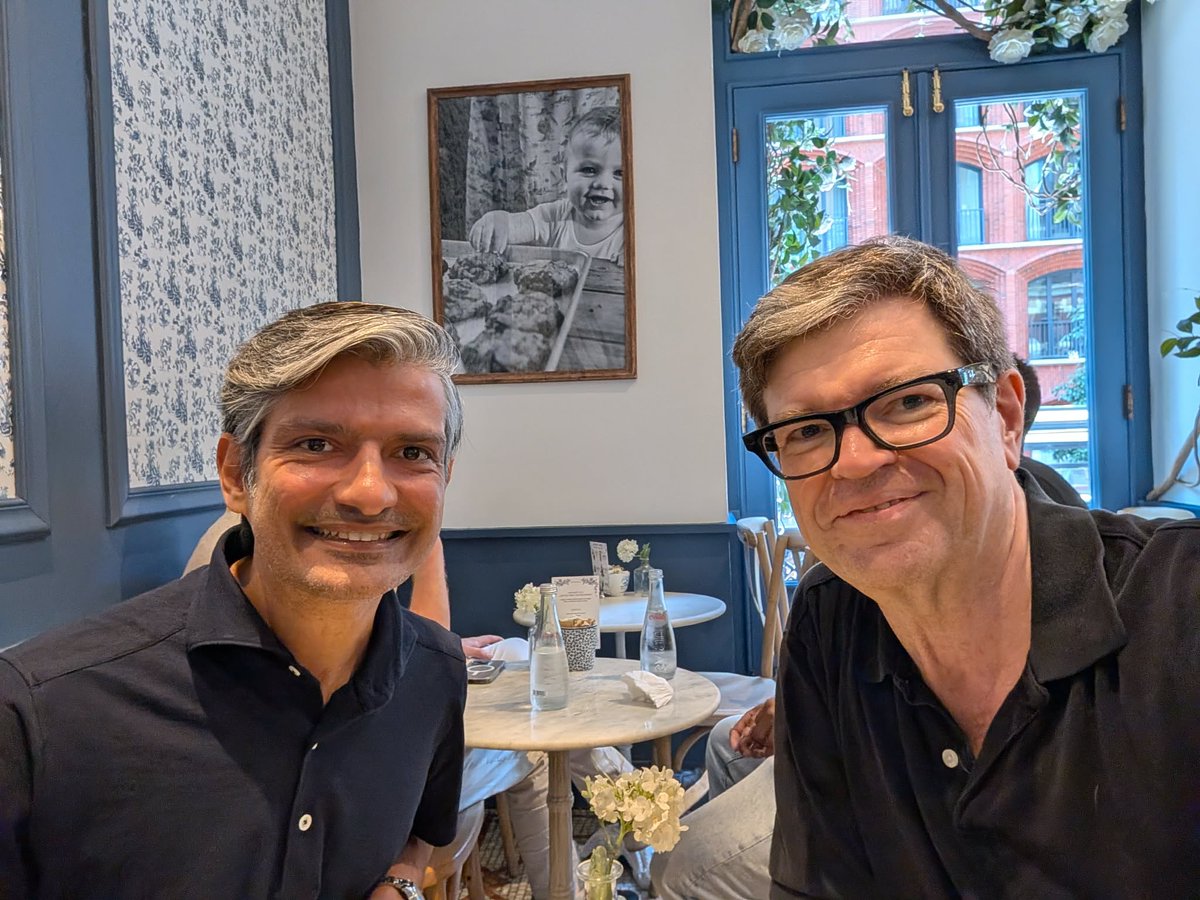
Today. Maman, a small café near NYU, on the hottest day of the summer so far.
Across the table: Yann LeCun.
Thirteen years ago, I landed a postdoc at NYU - an office next to his, the year after AlexNet. I did not fully understand my luck.
He gave me half an hour, a few blocks from that office. We talked about world models - and I was a postdoc again, taking notes.
Here is the idea.
You are about to change lanes on a highway. Before you move, your head has already played it forward: the gap closes, the truck brakes, you make it - or you do not. You never touch the wheel until the future looks safe.
Notice what your brain just did. It took the world as it is, took an action you were considering, and predicted what happens next. Not once - for every option you had. Then it chose the one that ends well.
And notice what it did not do: play a movie. There is no 4K in your head. You tracked three things - gap, speed, truck - and threw the rest away.
𝗧𝗵𝗮𝘁 𝗶𝘀 𝗮 𝘄𝗼𝗿𝗹𝗱 𝗺𝗼𝗱𝗲𝗹. Yann's JEPA line of work makes it precise. First, the machine learns its own compressed representation of the world: an embedding that keeps what matters and drops the rest. Then the world model is a single function: current embedding, plus an action, predicts the next embedding. Chain it forward and the futures branch out; planning is picking the best path through them. No pixels anywhere in the loop. It is not a video generator.
Yann's one-line version: 𝘁𝗿𝗮𝗶𝗻𝗲𝗱 𝘄𝗼𝗿𝗹𝗱 𝗺𝗼𝗱𝗲𝗹 + 𝗼𝗽𝘁𝗶𝗺𝗮𝗹 𝗰𝗼𝗻𝘁𝗿𝗼𝗹 = 𝗶𝗻𝘁𝗲𝗹𝗹𝗶𝗴𝗲𝗻𝗰𝗲.
Most AI for the physical world still does not work this way. It maps what it sees straight to an action. 𝗔 𝗿𝗲𝗳𝗹𝗲𝘅, 𝗻𝗼𝘁 𝗮 𝗽𝗹𝗮𝗻.
That gap matters most in the places we build for - a plant, a grid, a pipeline. You do not get to discover consequences by trial there. Knowing what happens next is not a research question. It is the whole job.
And Yann is far from done. His new lab, AMI, raised a billion dollars to chase exactly this. The part I loved most: they plan to do it in the open - publishing the research, open sourcing a lot of the code. Frontiers move faster when they are shared.
Thirteen years ago I got lucky: the office next to his, at exactly the right moment.
Today, I got to say thank you.
The true measure of a software engineer isn't their ability to write clever code. It's their ability to ruthlessly protect the codebase from unnecessary cleverness.
"If AI can write the code, what is left for us to do?"
For 70 yrs we got better at telling computers HOW. The next era is about telling them WHAT.
That sounds small. It is not.
When a machine can build whatever you describe, the whole game becomes the description. Not typing speed. Not syntax. The ability to state the problem precisely - and to ask the right question. That was always the rarest skill. Now it is the entire job.
But there is a second half, and I think it matters even more.
If AI writes the code, how do you know it is right?
Today, the honest answer is: we test it, and we hope.
So the real frontier is not getting AI to write code. It is getting AI to prove its own work - to verify, in a foolproof way, that the solution matches the problem. Not "passed the tests we wrote." Correct by construction, for every case.
Get the WHAT right. Make the machine prove the HOW.
@scottdwitt Yes, empathizing with the customer is the most important, but also the hardest imho. Also, sometimes they do not know what they want and so we have to figure that out together.
At @FastCodeAI, we built one of our projects on GPT-4.1. Microsoft is retiring it this October.
So right now we are redoing a large part of our testing loop. Every prompt, every eval, every guardrail re-checked - because a new model behaves differently, and you cannot trust an output until you prove it again.
And we got off easy. We had months of notice.
A government ban gives you none. One day the model your product runs on is simply gone - for good.
A consumer app shrugs. A power grid, a bank, a national oil company does not.
So the case for 𝘀𝗼𝘃𝗲𝗿𝗲𝗶𝗴𝗻𝘁𝘆 isn't fear. It's 𝗳𝗿𝗲𝗲𝗱𝗼𝗺.
Run your models and your data inside your own walls, and you get three things back: the freedom to choose what you run, the control to change it on your own terms, and the clarity of always knowing exactly what is inside.
𝗙𝗿𝗲𝗲𝗱𝗼𝗺. 𝗖𝗼𝗻𝘁𝗿𝗼𝗹. 𝗖𝗹𝗮𝗿𝗶𝘁𝘆. The only way to build without asking permission.
I started writing these posts for the most unglamorous reason there is.
Sales.
@FastCodeAI needed to be known. So I did the thing I least wanted to do: I put myself out there. Conferences. Hallways. A Twitter feed I used to just scroll past.
None of it came naturally. I am a private person. Standing up in a room, or writing about myself to strangers, cost me something every time.
I did it because the business needed it - and because that is what entrepreneurship quietly does to you. It does not promise money, or fame, or any of the things people imagine. But it backs you into becoming a version of yourself you would never have volunteered to be.
And the business part worked. The posts brought real opportunities - clients, conversations, rooms I would not otherwise have been in.
But that is not the part I think about.
Somewhere along the way I stopped writing about the company and started writing about the kid. The boarding school. The rejections. The nights I was sure I had run out of road. The stuck moments I had spent thirty years not talking about.
Those are the posts strangers reply to.
Not "great insight." Something quieter. "I thought it was just me."
One man wrote to me about his father's debt - the same kind I grew up with, the knock at the door you learn to dread. He is the first in his family to go for a PhD. He told me he had never said out loud what it cost until he read one of mine.
I did not plan for that. I came for the business. I stayed for those messages.
If you have been sitting on a story because it feels too small, or too private, or too much - that is probably the one someone needs to read.
Thank you for reading mine.
Everyone's racing to scale voice AI up. More parameters, more compute.
We bet the opposite direction.
Our 30B voice agent now sits with frontier models 20x its size, matching ~600B-param systems on third-party benchmarks.
Our co-founder @kamath_sutra, lead researcher Sameer Khurana, and @Arjunjain (Fast Code AI) broke down how at our latest session:
→ Why voice is harder than text (audio carries tone, emotion, intent while text throws it away)
→ Why today's voice agents are "synchronous": listen → think → speak, one at a time
→ Voice 4.0: an asynchronous architecture that listens, thinks, speaks, and calls tools simultaneously like humans actually do
→ A conversational world model that predicts where a conversation is going, not just the next 80ms of audio
The bet: structure beats scale.
🎥 Full talk ↓ link to full video in thread
The best off-the-shelf OCR system reads zero line numbers correctly. Zero.
We are digitizing P&ID sheets for a leading international oil and gas client. The dense piping diagrams an engineer traces by hand for a risk assessment. Our pipeline could already find the symbols, instruments, and lines. The last mile was reading the tiny line-number tags printed beside them, like 30"-P-14860-1CS1P03.
That last mile breaks things. Always does. Stock OCR confused 0 with O, 9 with g, 2 with Z. On ordinary text you would never notice. On a pipeline tag, one swapped character points to a different line in a different system, and that feeds a safety calculation.
So Shubham Kumar built a pipeline instead of trusting one model. Split each sheet into overlapping patches so edge tags are not cut off. Process rotated copies to catch vertical tags. EasyOCR finds the text regions. A regex layer checks each read against the format a real tag is allowed to take, so the system stops guessing and starts validating. A vision model handles the hard character calls.
A bake-off ranked the stock options first: LLaVA-Next around 0.41 F1, off-the-shelf TrOCR around 0.71. The version that shipped was trained on line numbers cropped from the sheets themselves, with the hard cases augmented to strengthen the training set. It reached roughly 99% recognition accuracy.
The #ICRA 2026 Best Paper in Robot Learning went to "Know Your Camera" - Tianchong Jiang and the RIPL team. Worth your time.
Their robot policies looked viewpoint-invariant. Then they built a benchmark that stopped letting the background leak the camera's pose, and the invariance collapsed. The policies hadn't learned 3D. They had learned a shortcut.
We meet this every time we ship a vision model into a real plant or a real vehicle: the demo generalizes, the field breaks it - because the model learned the benchmark, not the geometry.
Their fix is unfashionable and correct: don't make the network guess 3D from pixels. Hand it the camera geometry directly. It holds across ACT, Diffusion Policy, and SmolVLA, in sim and on real robots.
Geometry isn't a detail you abstract away. It's the part that survives contact with reality.
Congratulations to the team.
Sunday afternoon. West Village. The red Village banners hang on every lamppost down here - including the one outside our window. THE VILLAGE, they say. And under it, smaller: NYU.
NYU was the place that took me when no one else would.
I was thirty, just out of my PhD, and I wanted to build graphics for a living. Valve said no. Disney, no. ILM, no. Fine - a postdoc. Stanford, no. UW, no. NYU was the last name on the list. The last resort. I walked in a little ashamed of how I had gotten there.
I arrived in August 2013. A SIGGRAPH deadline a few months out. Most nights, a walk home in the dark, sure I had run out of road.
What I did not grasp yet: the autumn before I arrived, a network called AlexNet had won ImageNet and split the field into before and after. And NYU - the last-resort lab that took me when no one else would - was one of the rooms where the after was being built. Yann LeCun's office was next to mine.
The seven doors that slammed in my face had pushed me, by accident, into the exact place the next ten years were coming from.
The last resort turned out to be the only door that mattered.
Thirteen years later, we are back for the summer. We just had lunch, and my wife, Priyanka, took the kids out to Washington Square Park - the square I crossed a hundred times that year, unsure, on my way to the lab.
The company I built is half a world away - and a part of me is already itching to check that it is still standing without me. That part never really rests.
But this afternoon I let it wait. I stand at the window, a little undone, looking at the name of the place that said yes when everyone else said no.
I used to think those rejections were the worst thing that happened to me.
They were the best thing that ever did.
If you are walking through a door you are ashamed to be walking through - the last one on your list, the one you settled for - look again. It might be the only one that ever mattered.