Today I’m joining 30+ colleagues in taking an unusual step: calling for a halt to a line of research I was excited about, the long-term effort to build “mirror life”.
We’re sharing our findings in a @ScienceMagazine paper:
https://t.co/B4eXp46K84
1/6
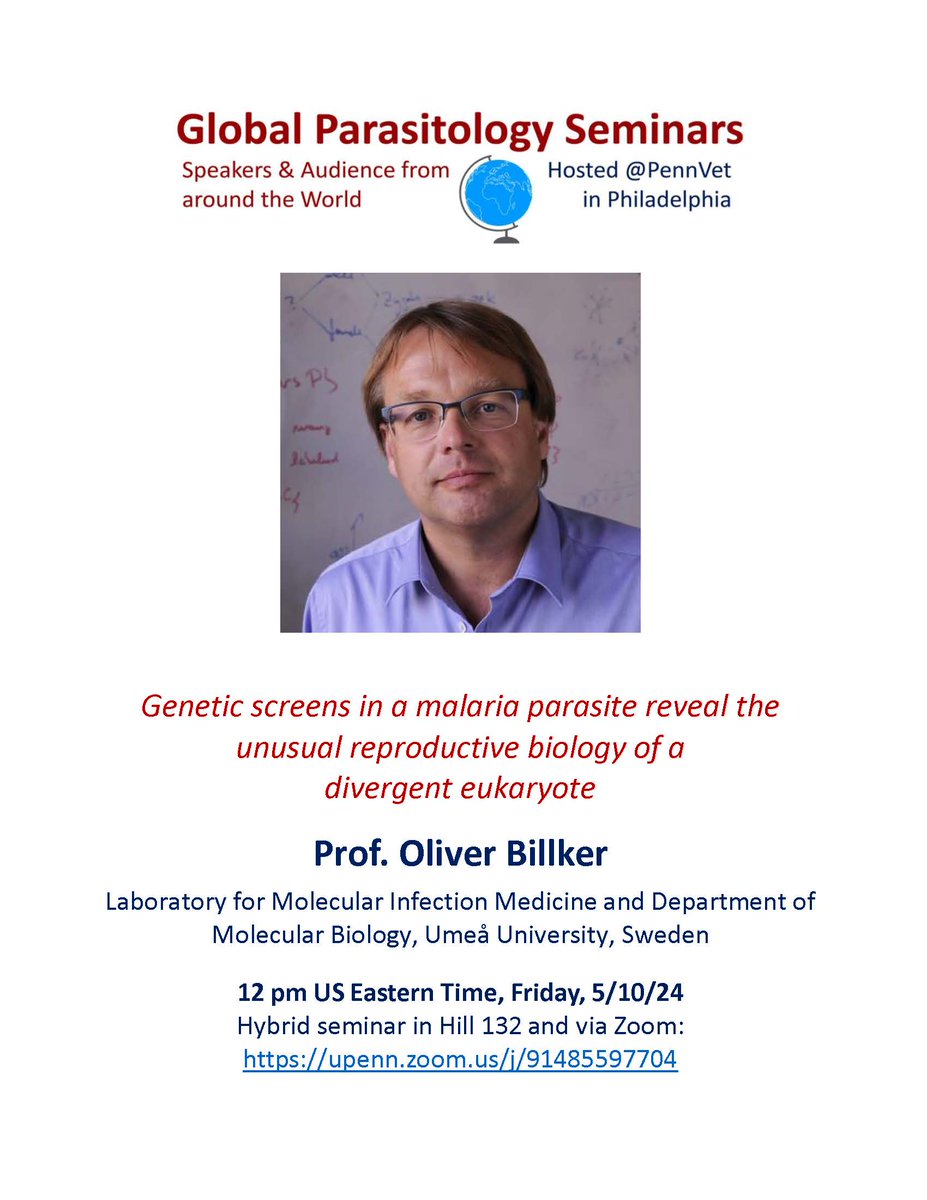
Published! Screens for fertility genes in malaria parasites reveal conserved aspects of eukaryotic sex and a nuclear protein complex essential for male gametes. Big thanks to all involved and everyone who has supported me along the way ❤️ https://t.co/LMzgP4dhdP
"Can you name the journal in which microbiologist Alexander Fleming first reported on the antibacterial properties of penicillin?"
https://t.co/kppSs3zoYF.
This is a major turning point for anyone doing research on parasites, vector biology, or fungal pathogens that is going to rock our community! For now, we should give thanks to all the @veupathdb team for everything they have done to support our research for so many years!!
A CRISPR homing screen finds a chloroquine resistance transporter-like protein of the Plasmodium oocyst essential for mosquito transmission of malaria https://t.co/moLqTUWSyb @biorxivpreprint
FINALLY ONLINE 🥳 In our @Marti_Paoletta pre-print (https://t.co/R2j1B46gQ0) we present a scalable CRISPR system in Plasmodium berghei called PbHiT, providing detailed protocols and construct designs for anyone to use! 🧵@Bushell_Lab@umeauniversity@mims_umea@womeninmalaria
That amazing paper you spent years on? That amazing breakthrough you had? Very likely you built this following the work of others (very few exceptions), just as others will build off yours. Science is a continuum. Want to leave a lasting legacy in science? Be generous & be kind.
MIMS Director Oliver Billker at @umeauniversity is awarded the Medicine Doctor Axel Hirsch prize 2024 by @karolinskainst for his outstanding research in the field of malaria. Congratulations!
In English: https://t.co/9ifhFKUbNB, in Swedish: https://t.co/Ss8scVx3GO
@billker_lab
“Ten years ago I was kicked out and forced to retire.”
Our new medicine laureate Katalin Karikó (@kkariko) told us how much it means to be awarded the Nobel Prize after a scientific career that has been full of challenges.
Ten years ago, Karikó was still doing all her experiments by hand but today she has been awarded the medicine prize for her research on mRNA, which led to the development of COVID-19 vaccines.
Listen now:
Chandrayaan-3 Mission:
'India🇮🇳,
I reached my destination
and you too!'
: Chandrayaan-3
Chandrayaan-3 has successfully
soft-landed on the moon 🌖!.
Congratulations, India🇮🇳!
#Chandrayaan_3#Ch3
"Disappointed with the situation at #EmiratesFlight EK158. It's chaos resembling a disaster relief camp rather than a paid service. People stranded without seats, unaware of stepping on small children. @emirates and @ArlandaAirport, please improve the experience.
I can’t describe how important it is to establish roles, responsibilities and a general ethos for research labs. Especially in academia where so many labs turn dysfunctional due to internal competition and lack of structure. https://t.co/nvqGZddAK2
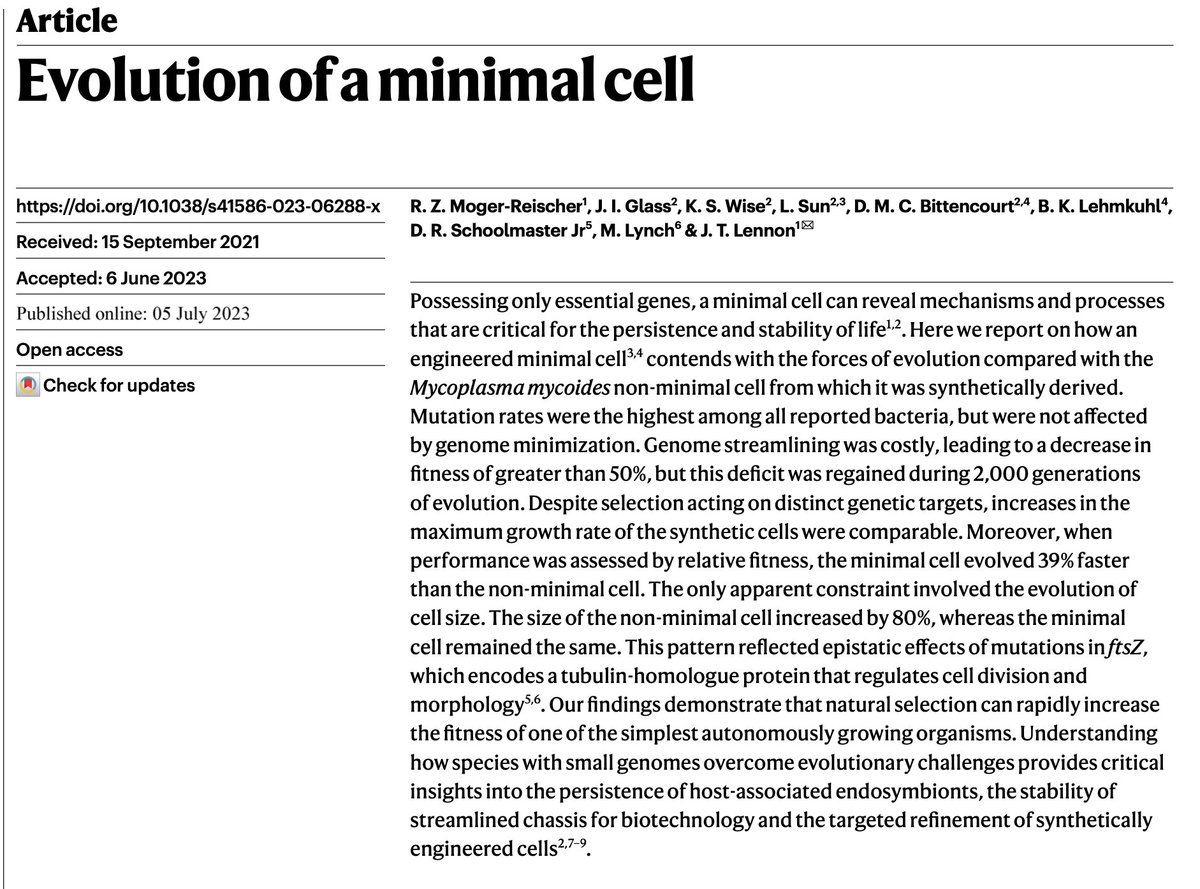
A mind-blowing paper has come out today in @Nature
In 2016, JC Venter Institute scientists trimmed a bacterial genome to its barest minimum required for life to synthesize what they called a "minimal genome" (https://t.co/Rk8oZJ0bUj).
Today, a group of scientists from Indiana University reports how that minimal genome evolved over 2000 generations in comparison to the non-minimal genome.
The authors found that even when you reduce a bacterial genome to its absolute minimum where every nucleotide matters, the genome undergoes mutational events generation after generation as much as the non-minimal genome. One simply cannot stop the evolution.
Just over 300 days of evolution (equivalent to 40,000 years in humans) the minimal cell has gained everything it lacked in fitness on day one in comparison to the non-minimal cell.
When comparing the evolved traits between the minimal and non-minimal cells, the scientists found something striking. The evolutionary process increased the cell size of non-minimal cells but not that of the minimal cell. But that is not the striking part.
The scientists were able to identify the key mutation that resulted in cell size evolution. And it turned out that the mutation that helped the non-minimal cells to grow bigger is the same that helped the minimal cells to stay smaller. Growing bigger had a survival advantage for non-minimal cells and not growing bigger had a survival advantage for minimal cells. So, the mutation had a context-dependent effect. This just demonstrates that the evolutionary effects on traits have no absolute direction. All that matter is what is beneficial for the organism's survival.
The conclusion of the paper is metaphorically a quote from the Jurassic Park movie:
“Listen, if there’s one thing the history of evolution has taught us is that life will not be contained. Life breaks free. It expands to new territories, and it crashes through barriers painfully, maybe even dangerously, but . . . life finds a way". (https://t.co/UlxRlb86CT)
https://t.co/zA9OAqSoAu
IISc has been ranked #1 in India in both the overall and academic categories of the 2023 Nature Index Annual Tables!
The rankings recognise high-quality research contributions in diverse disciplines.
👉https://t.co/wKzSRRLUBn
👉https://t.co/V3s1lmkbLi
@EduMinOfIndia