Everyone prepares their Shopify store for BFCM traffic.
I think the more interesting question is:
What breaks when the traffic actually arrives?
A product goes viral → inventory doesn't sync fast enough.
Orders spike → checkout slows down.
Customers abandon → recovery flow doesn't fire.
Orders go up → support gets overwhelmed.
Ad platforms report something different → nobody knows which number to trust.
The store didn't necessarily have a traffic problem.
It had a systems problem.
BFCM is basically a stress test for the entire ecommerce stack.
Curious - what broke for you last BFCM?
Ads used to interrupt the buying journey.
Now they might become part of it.
OpenAI is testing Sponsored Agents inside ChatGPT — click an ad, start a conversation with the brand's AI agent, ask questions, compare, then decide.
Shopify is now integrating product catalog + commerce data directly into ChatGPT Ads.
We're moving from:
Ad → Click
to:
Ad → Conversation → Decision
That's a very different advertising model.
And I think D2C marketers are going to have to rethink what "performance" actually means.
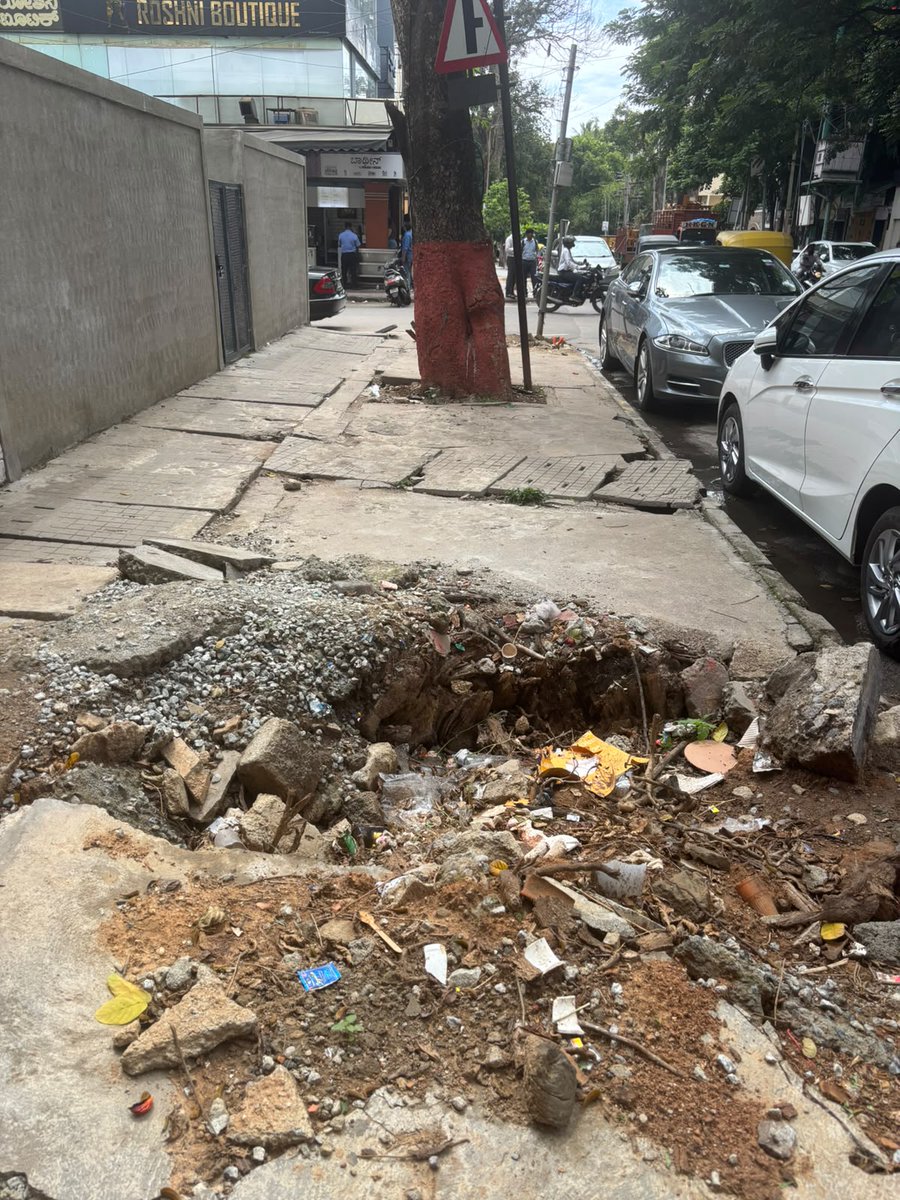
Indiranagar is a prime hub in Bangalore, but the pedestrian paths are basically gone.
It's slabs that are either half open and hence unsafe to walk on.
Bikes and cars are parked right on the road, squeezing traffic into half the space it should have.
This makes the congestion worse and unsafe for pedestrians. And to make it worse, there's waste being thrown onto the streets in the early mornings or late nights.
This is a daily activity once the shops shuts/opens. The streets are filled with rats.
This is not the image any neighborhood should give, especially a prime neighborhood.
Can the local corporation please look into basic walkability and waste management?
@GBA_office@krishnabgowda@GBAChiefComm@bbmpcommr
Indiranagar is a prime hub in Bangalore, but the pedestrian paths are basically gone.
It's slabs that are either half open and hence unsafe to walk on.
Bikes and cars are parked right on the road, squeezing traffic into half the space it should have.
This makes the congestion worse and unsafe for pedestrians. And to make it worse, there's waste being thrown onto the streets in the early mornings or late nights.
This is a daily activity once the shops shuts/opens. The streets are filled with rats.
This is not the image any neighborhood should give, especially a prime neighborhood.
Can the local corporation please look into basic walkability and waste management?
@GBA_office@krishnabgowda@GBAChiefComm@bbmpcommr
Exactly. The interface changes, but the fundamentals don't.
Whether it's a human looking at a PDP or an agent evaluating the product, the merchant still has to get the basics right: Trust. Accurate price. Real availability. Reliable fulfillment.
Maybe that's the interesting evolution of CRO - we're not replacing the old funnel, we're adding another decision maker into it.
It is going to be crucial to ensure the product information be trustworthy for both humans and agents
Indiranagar is a prime hub in Bangalore, but the pedestrian paths are basically gone.
It's slabs that are either half open and hence unsafe to walk on.
Bikes and cars are parked right on the road, squeezing traffic into half the space it should have.
This makes the congestion worse and unsafe for pedestrians. And to make it worse, there's waste being thrown onto the streets in the early mornings or late nights.
This is a daily activity once the shops shuts/opens. The streets are filled with rats.
This is not the image any neighborhood should give, especially a prime neighborhood.
Can the local corporation please look into basic walkability and waste management?
@GBA_office@krishnabgowda@GBAChiefComm@bbmpcommr
When you say “the buyer is software,” do you mean the AI agent acting on behalf of the human?
If so, I think there are actually two CRO flows emerging:
Human buys: PDP, UX, trust, reviews, content → checkout
Agent buys: catalog data, attributes, inventory, pricing, policies → transaction
But I don't think PDP becomes irrelevant. There will probably be a hybrid too: AI makes the shortlist, then the human visits the PDP to validate the recommendation.
So maybe the bigger shift isn't “PDP doesn't matter.”
It's that CRO now has to work for both the human and the agent.
What do you think?
The calculation itself is mathematically correct, but the conclusion is misleading.
₹15,000 + 18% GST = ₹17,700.
0.4% of ₹17,700 = ₹70.80 MDR.
18% GST on that MDR = ₹12.74.
So yes, the arithmetic gives ₹17,783.54.
But MDR is not supposed to be added to the customer's bill.
Under the current UPI framework, MDR is a charge within the merchant/payment ecosystem. The Ministry of Finance has explicitly clarified that customers will not pay MDR and merchants should not pass the MDR on to customers.
So if the invoice is ₹17,700, the customer's UPI payment should be ₹17,700 - not ₹17,783.54.
The ₹70.80 + ₹12.74 is a payment-processing cost associated with the merchant/payment ecosystem, not an additional GST/UPI tax payable by the customer.
Also, calling this “GST on GST” is confusing. The ₹12.74 is 18% GST on the payment-processing/MDR service, not GST being charged on the original ₹2,700 GST.
So the right question isn't whether ₹70.80 × 18% can be calculated - it can.
The question is who is legally/regulatorily supposed to bear that cost. And on that point, the consumer isn't supposed to be the one paying it.
@Shopify just made it much easier to advertise inside @ChatGPT.
And I don't think D2C brands should think about this as "another ad channel."
Meta asks:
Who should see my ad?
Google asks:
What are you searching for?
ChatGPT knows something different:
What are you actually trying to decide?
That's a pretty big difference.
Someone isn't necessarily asking:
"Buy me a running shoe."
They're asking:
"What's the best running shoe under ₹8,000 for someone running 5km three times a week?"
The ad isn't just competing for attention anymore.
It's competing to become part of the answer.
Shopify connecting product catalogs + commerce data directly into ChatGPT Ads makes this even more interesting.
I think we're going to have to rethink what "performance marketing" means in an AI-native shopping journey.
The next battleground might not be:
Who gets the click?
It might be:
Who gets considered?
@Shopify just made WhatsApp a little more interesting for D2C brands.
You can now collect WhatsApp marketing consent directly at checkout.
And this comes after Shopify adding WhatsApp consent to customer profiles, Forms and its APIs.
I think the bigger story isn't the checkbox.
It's what happens after it.
For years brands have treated WhatsApp as another messaging channel.
But if Shopify is making WhatsApp part of the customer record, it starts looking more like a customer lifecycle channel.
Purchase → WhatsApp → repeat purchase → referral → loyalty → win-back.
The question for brands won't be:
"How many WhatsApp subscribers do we have?"
It'll be:
"Are we actually creating more value from the customers who opted in?"
That feels like a much more interesting problem.
16/17
The AI Layoff Trap is therefore worth paying attention to.
Not because it proves AI will destroy capitalism.
It doesn't.
It's useful because it exposes a question most AI discussions ignore:
When machines become dramatically more productive than humans,
how does purchasing power get distributed across the economy?
That question may matter more than the number of jobs AI eliminates.
17/17
The “AI Layoff Trap” argument is fascinating.
But the viral version leaves out the most important part of the economic equation.
It says:
AI replaces a worker → worker loses income → demand falls → every company suffers → AI destroys the economy.
That sounds inevitable.
It isn't.
Here's the missing piece 🧵
1/17
Imagine a company has 1,000 employees.
Average salary: ₹10 lakh.
Total wage bill: ₹100 crore.
AI allows the company to do the same work with 700 people.
300 people lose their jobs.
That's ₹30 crore of annual wages that disappear.
So far, so good.
Two economists mathematically proved that AI will destroy the economy.
Researchers from Wharton and Boston University published a terryfiying paper called "The AI Layoff Trap."
They mapped out the economic end-game of the AI transition, and it exposes a fatal flaw in competitive capitalism.
When a company replaces a worker with AI, it captures 100% of the wage savings.
But that displaced worker is also a consumer. When they lose their job, they stop buying things.
The company gets all the savings, but the loss of consumer demand is spread across the entire economy.
If there are 20 competitors in a market, a CEO only absorbs 1/20th of the economic damage their layoffs just created.
So every single rational CEO has a mathematical incentive to automate as fast as possible.
They can literally see the cliff approaching, and they still step on the gas.
It triggers an unavoidable Prisoner’s Dilemma. If you don't automate, your competitors will, and they will crush you on price.
It doesn't just hurt workers. It destroys the businesses, too.
The economy gets trapped in an automation arms race. Companies fire their workforce to stay competitive, until the entire consumer base is completely hollowed out.
At the limit, the paper concludes: “Firms automate their way to boundless productivity and zero demand.”
And the scariest part?
The researchers mathematically tested every popular fix.
Universal Basic Income? Fails. It raises the living standard but doesn't change the corporate incentive to cut jobs. Retraining? Fails. Worker equity? Fails.
The paper proves that more competition actually makes the collapse happen faster. And "better" AI makes the damage worse.
The only thing that mathematically stops the collapse is a targeted automation tax, forcing companies to pay for the purchasing power they destroy before they automate the job.
15/17
So the scariest conclusion isn't:
“AI will inevitably create zero demand.”
That's too strong.
The more defensible conclusion is:
AI could create an economy where production becomes incredibly cheap and abundant while purchasing power becomes increasingly concentrated.
That's a distribution problem.
And potentially a coordination problem.