$AVGO CEO on an interview 3 months ago was asked about future M&A his response:
He was also asked about photonics companies and called them a “shiny object” a subtle way of suggesting they may be overvalued, or even in bubble territory, if you ask me.
Yes, Appreciate the clarification Nick, you're right on this point. I might’ve overstated what those docs establish.
As you said, MAX does expose certain data that Ad Quality can receive, so $U having access to it isn't evidence of anything bad.
I should've pointed to the broader dispute instead, where $APP alleges $U went beyond that and collected additional MAX data, like creatives, engagement and auction info, that it says was protected and outside $U authorization.
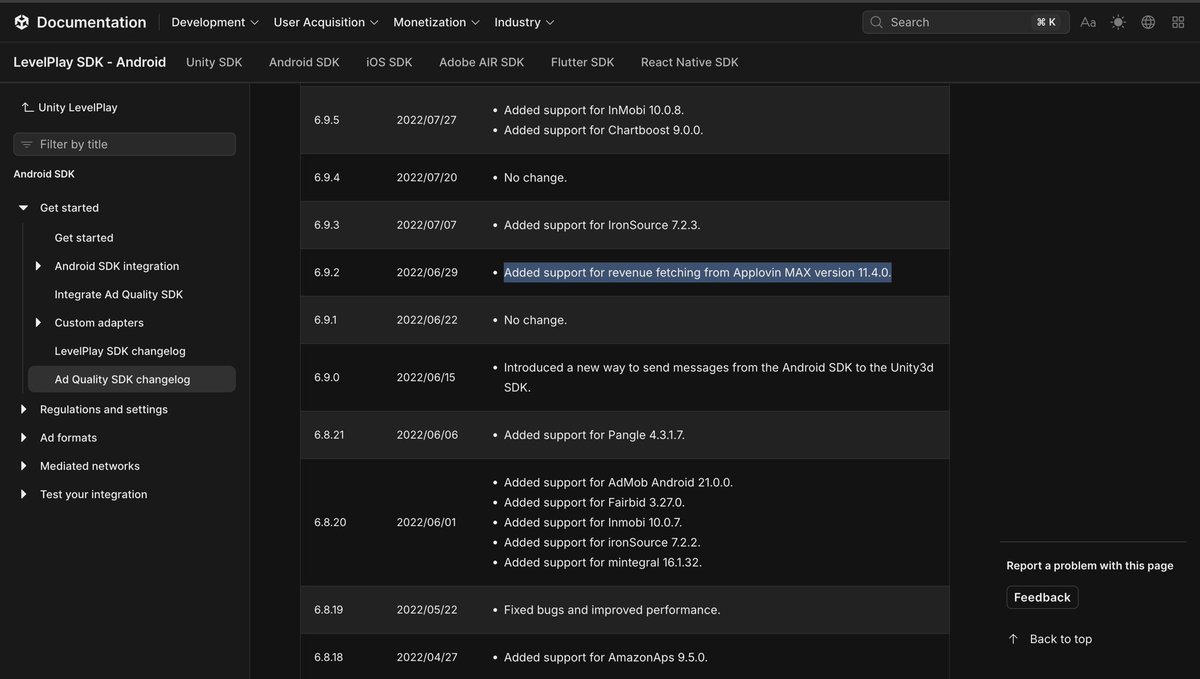
If you don’t believe me, here is $U own documentation explicitly referencing accessing to $APP data.
“Added support for revenue fetching from Applovin MAX version 11.4.0”
That’s $U basically saying that Ad Quality SDK was capable of fetching revenue data from Applovin MAX.
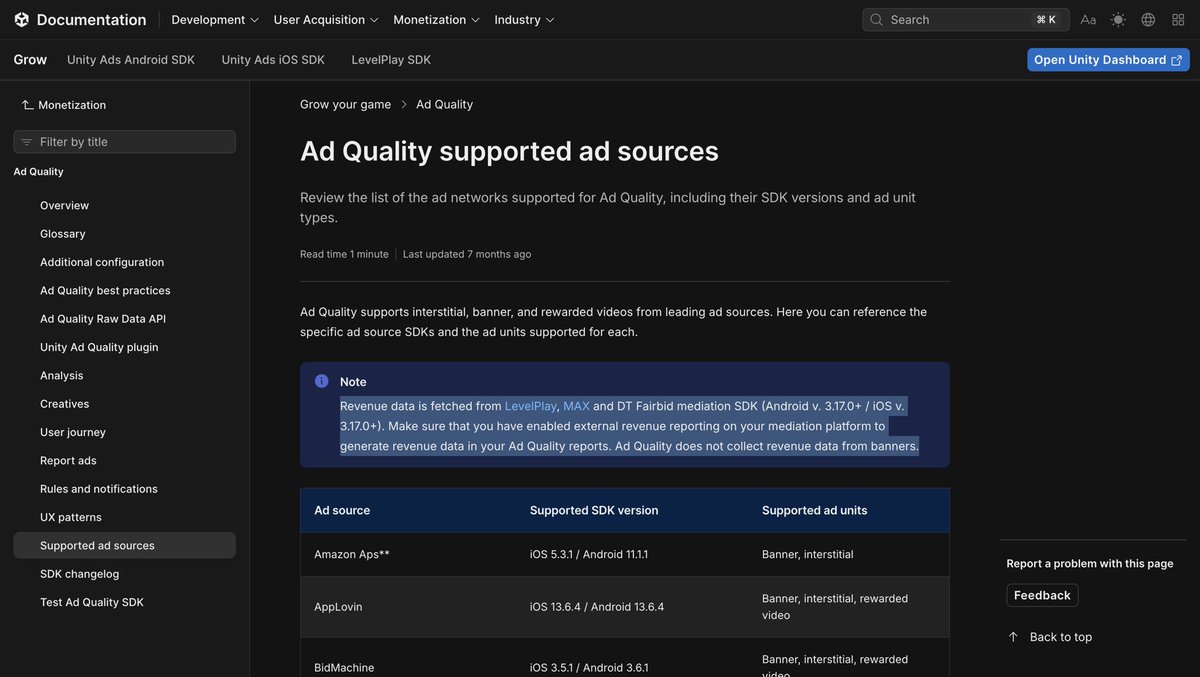
More proof, in the second image:
“Revenue data is fetched from LevelPlay, MAX and DT Fairbid mediation SDK”
So yeah, pretty sure $U was able to look at some interesting $APP data.
$APP vs $U legal fight explained:
What Applovin claims is that $U had a software called “Ad Quality” inside many mobile games that was originally designed to “help” game developers monitor bad or inappropriate ads.
But $APP alleges that the software wasn’t just monitoring the ads, it was also collecting more information (confidential information) about the ads, like auctions, performance, revenue, etc.
The response that $U gave $APP was basically:
“The game devs installed our software and gave us permission to collect that information.”
The thing is, those game devs couldn’t give permission to take information that doesn’t BELONG to them and they are contractually required by $APP to keep confidential.
The second part of the allegation is much more serious. $APP is claiming that $U may have used that confidential data to train their own ML models like Vector, which competes directly with AXON from $APP.
This is very problematic since training data is EXTREMELY valuable for ML models, and if you are familiar with $APP you know that basically the entire business is very dependent on AXON and their model being so good that it has virtually 0 competition.
So if it’s proven that $U actually stole their data to build their own ML algo “Vector “ this will turn into a very ugly situation.
As of today, we only know that the first part is true: $U “Ad Quality” software was looking at data it wasn’t supposed to. But we don’t have a verdict yet on whether they trained their own models using that data.
$APP vs $U legal fight explained:
What Applovin claims is that $U had a software called “Ad Quality” inside many mobile games that was originally designed to “help” game developers monitor bad or inappropriate ads.
But $APP alleges that the software wasn’t just monitoring the ads, it was also collecting more information (confidential information) about the ads, like auctions, performance, revenue, etc.
The response that $U gave $APP was basically:
“The game devs installed our software and gave us permission to collect that information.”
The thing is, those game devs couldn’t give permission to take information that doesn’t BELONG to them and they are contractually required by $APP to keep confidential.
The second part of the allegation is much more serious. $APP is claiming that $U may have used that confidential data to train their own ML models like Vector, which competes directly with AXON from $APP.
This is very problematic since training data is EXTREMELY valuable for ML models, and if you are familiar with $APP you know that basically the entire business is very dependent on AXON and their model being so good that it has virtually 0 competition.
So if it’s proven that $U actually stole their data to build their own ML algo “Vector “ this will turn into a very ugly situation.
As of today, we only know that the first part is true: $U “Ad Quality” software was looking at data it wasn’t supposed to. But we don’t have a verdict yet on whether they trained their own models using that data.
Updated on $U vs $APP legal case:
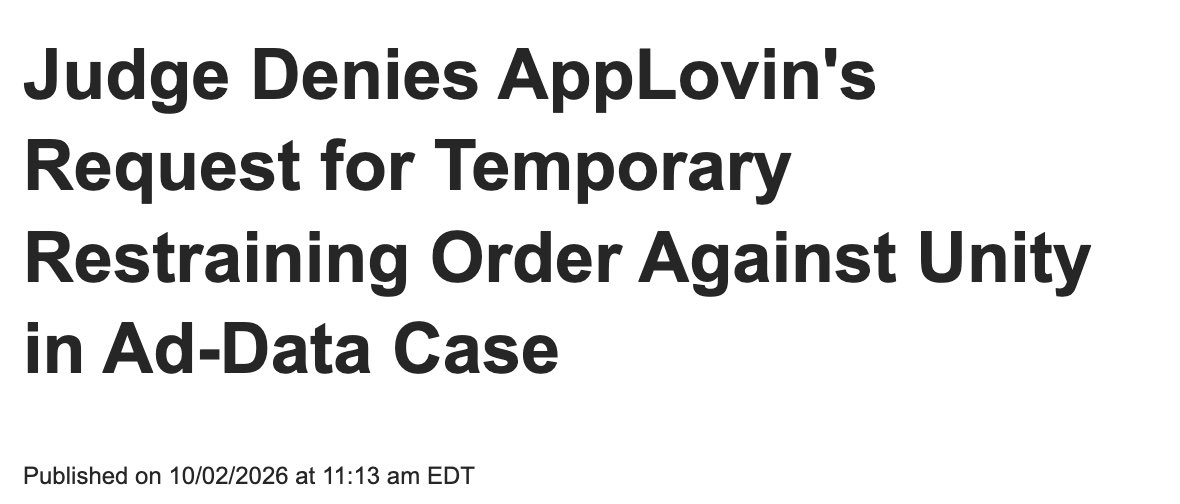
“$APP lost the emergency TRO 🚨”
The San Francisco Superior Court denied $APP request for temporary restraining order against $U.
What this means is that $APP asked the judge that while the arbitration is happening force $U to stop collecting/using disputed data. And the judge said no, at least for the moment.
Links to the official pages of $U if anyone feels like verifying:
https://t.co/f5HqjgfwRk](https://t.co/f5HqjgfwRk)
https://t.co/ZdNDD7u6lY](https://t.co/ZdNDD7u6lY)
@hammersoy I mean it’s pretty obvious for many reasons, first by the response $U gave them, and second $U own documentation support cross network collection data.
@DrewCohenMoney I mean at some point you can only push prices so far in a certain amount of time before customers start resenting you.
Because tbh jacking prices 16x simply because you can with no real justification, would definitely piss me off if I were a client.
Warren Buffett didn’t talked much about “P/E or FCF yield”. His approach was more direct:
“How much cash can this business produce for its owners?”
“How much capital does it need to produce/grow that cash?”
“What price am I paying for those future cash flows?”
Next time you plan on investing in a company, make sure to ask yourself those questions.