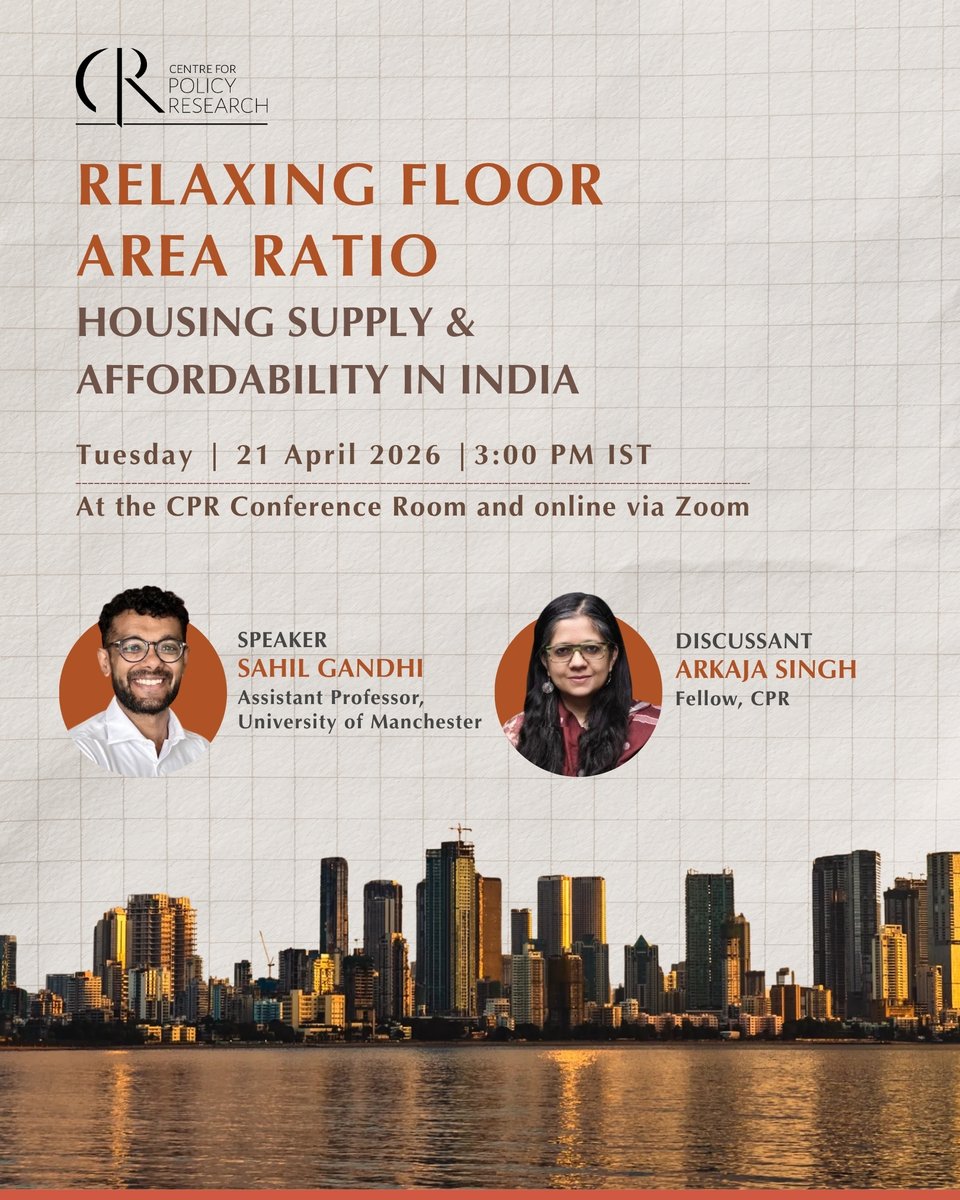
Does relaxing zoning regulations increase affordable housing or simply trigger the construction of new, larger units?
Join us on Tuesday, 21st April, at 3:00 PM IST for a talk by @gandhisahil (Assistant Professor, @OfficialUoM) as he discusses how a relaxation of the regulatory cap on building height and floorspace affects housing supply, drawing on a case study of Mumbai. @arkajasingh (Fellow, CPR) will join the session as a discussant.
This talk will be held in a hybrid mode at the CPR Conference Room and online via Zoom.
Register to attend: https://t.co/h2CjqntReb
@Warriormomsin@iitdelhi@gupta_rekha@mssirsa What are the new policy implications of these findings? Doesn’t it mean lots of local actions across north India? It’s still dependent on local action, and on things that were anyway worth doing? What changes with this new study?
@AnkurBisen1 The money needs to be spent intelligently. India is spending a lot of money on urban infrastructure, but it’s not necessarily thought through. Sewage lines pass by irregular settlements and don’t connect them. Different sections of a drain don’t meet at the right level.
@MuktaNaik@SarikaPanda Truely. I was thinking today that the widest roads of the are the most flood-risk, mostly likely to be crazily gridlocked with every downpour.
Thank you for saying this. The EOL policy makes little environmental sense, penalises car owners and rewards car companies. There should be a right to repair, maintain and upgrade. And surely governments can spend a little more money to have credible fitness tests.
Delhi's End-of-Life (EOL) vehicle policy has gone off track. Owners are being forced to junk perfectly running cars due to fear, not facts. Moms have been connecting many stories to the media and authorities.
A well maintained 10 year old car emits less than a neglected new one, yet no scope for fitness checks?
Delhi has 62 lakh EOL vehicles, yet even low mileage, BS IV cars with valid emissions are being scrapped. In 2024, 39000+ impounded, with no fitness tests allowed.
Why not adopt conditional extensions, as other states do?
We need cleaner air and smarter policy.
And policy that curbs pollution,
not punish prudence!
https://t.co/9YrJkOjVQu via @ishita_jairath@timesofindia@CPCB_OFFICIAL@CAQM_Official@PrinSciAdvGoI@LtGovDelhi@CMODelhi
Why do people think it’s netas and babus? They may be part of the roadwidening problem, but engineers and the entire technical community of urban development are much more to blame. There’s an east-west problem also in the imagination of trees.
In a Hot and Humid country like INDIA, this is exactly how our cities should look, full of trees and shade.
But our Netas and Babus would probably get a heart attack seeing this much Greenery. 🙏🤷🏻♂️
@tajmahalfoxtrot You’re right of course, but there’s also a problem of trashiness, when quaint and culturally-specific places become mass produced, I suppose when they start to get investors and need to scale up. No car rules might help slow this down, but only up to a point.
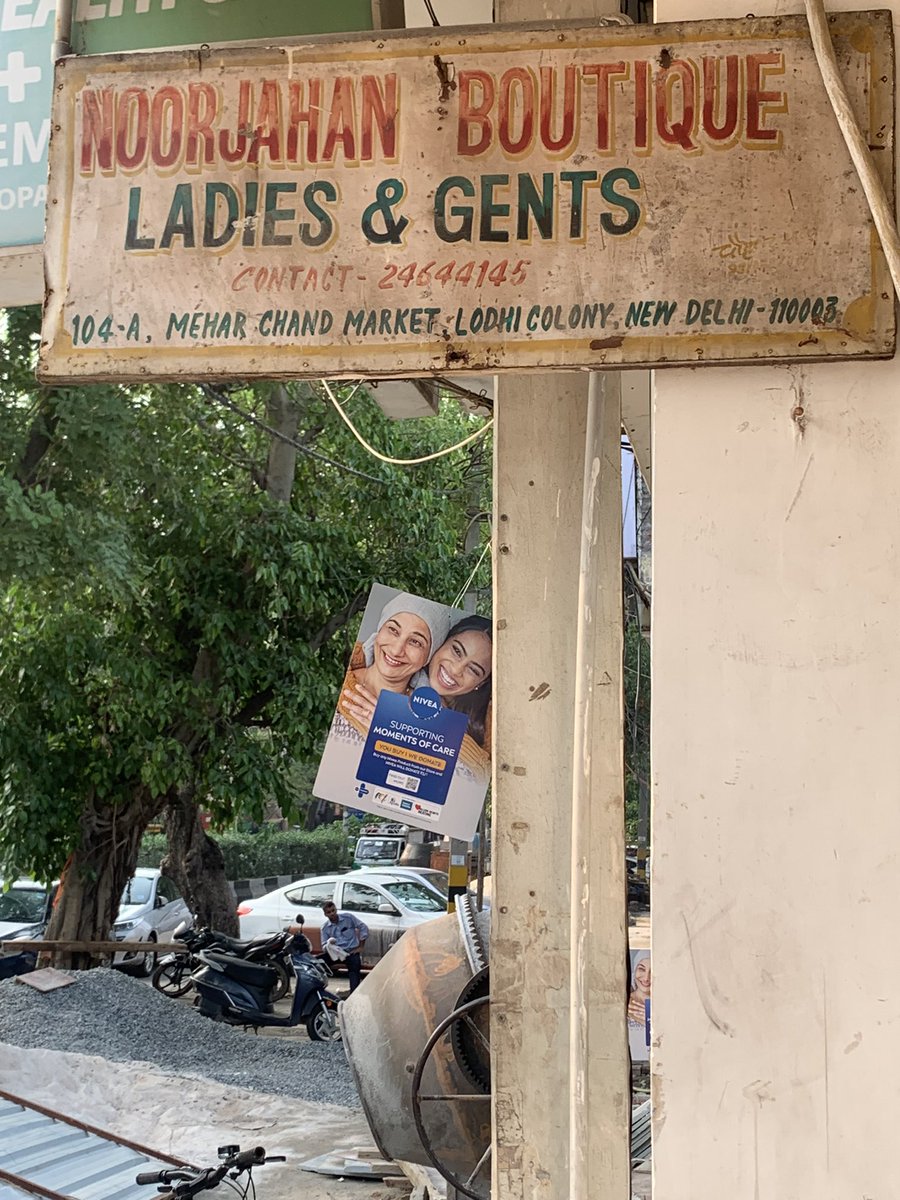
In case you happen to be in need of a tailor, and are in south delhi, I want to recommend the services of Noorjehan Tailors in Meherchand Market. They’re excellent and can make just about anything for ladies and kids.
@nagrajadve Shade giving trees. I have a mango tree in front of my house that gives a deep shade and I see how valuable it is to people who rest, sleep, stop for a while on the road in the summer months. Yesterday a delivery man asked (and did) catch a short rest in my tree shaded balcony.
FRI 19 APR @ 3.45PM, @CPR_India alumna @persistara, now at @BirkbeckLaw, with @zerahmh on impact of smart governance on multiscalar govt. in the #globalsouth Are #SmartCities a new curtailment of municipal democracy or an old trend? Join in person or on https://t.co/M8LcvdRVCA
@rahulatiitd Sometimes I see cold water vendors - who park near the hospital gates - trying to manoeuver their carts across in the morning and its very scary and inconvenient. I’d love to see what surveys and what paperwork the authorities did when they made these plans.