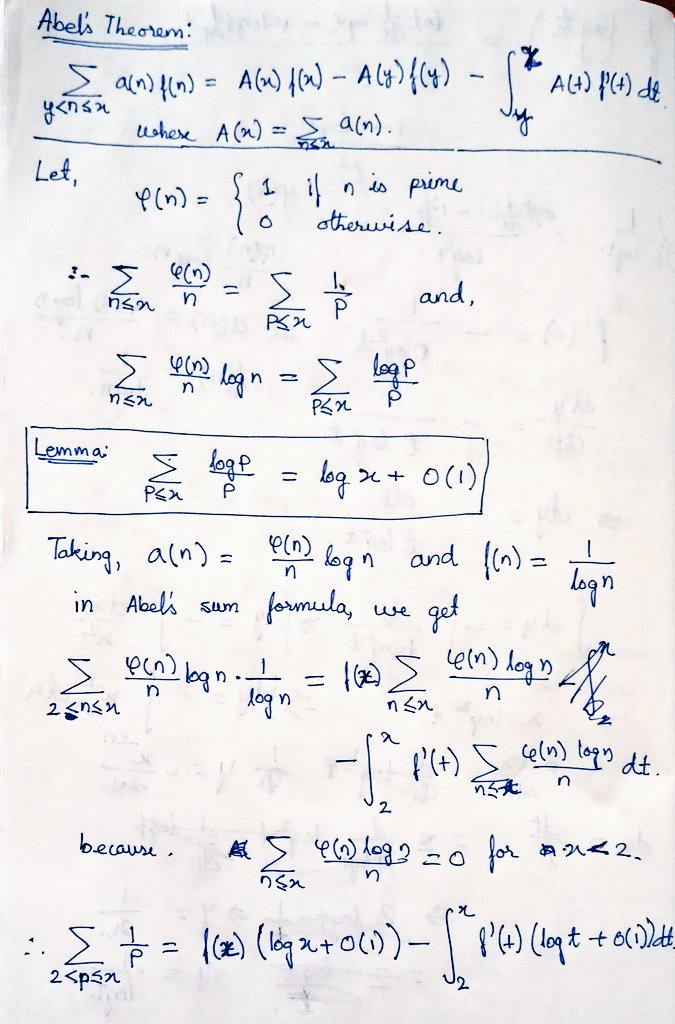
@kaneenikasinha@PraphullaK I did the proof and got a more improved error term O(1/log x). Please check it. 🙂
I came across this identity and it's proof in TM Apostol's "Introduction to Analytic Number Theory".
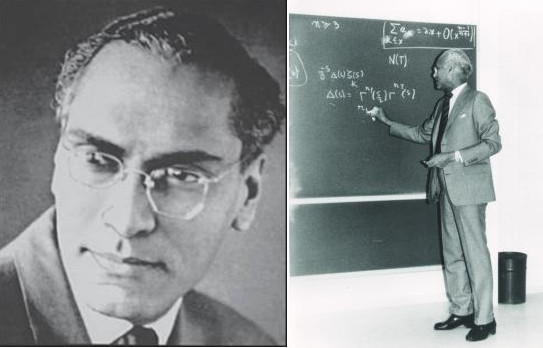
Next in who after the Ramanujan Series? He was the man Homi Bhabha trusted to build the Silo of Indian genius. While Ramanujan was the lightning, Komaravolu Chandrasekharan (1920-2017) was the lightning rod. He spent his life in the absolute backend of Number Theory, solving the mysteries of the Zeta Function: the math that now safeguards every digital secret in the world. He was the President of the world’s mathematicians & a King in the halls of Zurich, yet he lived to 96 as a total Ghost in his own country. He did not just solve eqns; he built the TIFR, the very sanctuary where every other Indian ghost I have discussed found a home. He is the Architect who designed the house of Indian logic, then quietly walked out the back door into the silence of history.
Born in 1920 in Andhra Pradesh, KSC was a protég�� of Ananda Rau. Along with Homi Bhabha, he was the primary architect of the Tata Institute of Fundamental Research (TIFR). While Bhabha was the Face, KSC was the Engine. He was the 1 who personally recruited the ghosts we have been discussing: K. G. Ramanathan, M. S. Narasimhan, C. S. Seshadri, Raghavan Narasimhan, & others.
He spent time at the Institute for Advanced Study (IAS) in Princeton, working directly with Hermann Weyl (Weyl recommended him to Bhabha) .
KSC did not just solve 1 problem; he mastered the distribution of primes & the Riemann Zeta Function. He worked on Exponential Sums & the Geometry of Numbers. His work explains how numbers are distributed across the universe. Why does this matter? Because Modern Cryptography & Quantum Chaos Theory depend on the randomness & spacing of these numbers.
He wrote the definitive textbooks on Number Theory that are still the gold standard at the UChicago & the ETH Zurich. He turned the Intuition of Ramanujan into a Global Rigor that computers could finally use.
In 1965, he moved to Switzerland to become a prof at ETH Zurich (Einstein's alma mater). He lived there for over 50 yrs, becoming a Shadow Giant. He served as the President of the International Mathematical Union (IMU). This is effectively the highest administrative post in world mathematics. Yet, while he was making decisions that shaped the direction of global math, he was almost entirely forgotten in his home country.
He lived to the age of 96. To his neighbors in Switzerland, he was a polite, incredibly intellectual Indian gentleman. To his relatives in India, he was the Granduncle in Zurich who did some high-level math. No one realized he was the man who had essentially curated the survival of Indian mathematics after 1947.
Meet Shreesh Jadhav !
(Man Who Chose Service Over Silicon Valley)
A brilliant mind who became a monk and gave up everything to serve society.
> Secured AIR 2 in IIT-JEE (1985)
> Graduated from IIT Kanpur with exceptional academic record
> Topped GATE (Computer Science) with ~99.92 percentile
> Completed his Masters & PhD in Computer Science from IIT Kanpur
> Specialized in Computational Geometry, Graph Algorithms & Discrete Mathematics
> His research was recognized by top global bodies like ACM
But instead of chasing wealth or global opportunities… he chose a completely different path
> Became a monk associated with Ramakrishna Mission Vivekananda University
> Devoted his life to educating the underprivileged Children
> Later became Dean of Research & CS Coordinator at Ramakrishna Mission Vivekananda University
> In 2009, he was awarded the Distinguished Alumnus Award by IIT Kanpur.
His words say it all: “I left lesser things for something better… you left better things for the mundane”
At a time when success is defined by money & status, he redefined it through purpose and service.
Not widely known to the public.
But one of the most inspiring minds to come out of IIT Kanpur.
I'd watch pretty much any presentation given by the legendary Mikhail ''Misha'' Gromov, bit if I had to choose one, I'd recommend you this gem titled 'What is scalar curvature, really?' which was given at Stony Brooks.
Anyone with an interest in mathematics or physics will want to watch this one carefully. He also gave a longer presentation on the topic, in four parts, at the IHES.
🔗👇👇👇
For decades, mathematicians could check if a number was prime, but only with a small chance of error/by taking a billion years.
In 2002, Prof. Manindra Agrawal (Currently Director of IIT Kanpur & a very very humble guy) & 2 students, Neeraj Kayal & Nitin Saxena, published a 9 page paper called "PRIMES is in P."
This was the 1st time in history anyone proved that determining if a number is prime is easy (polynomial) w/o relying on unproven assumptions.
When the paper was 1st released, it was so short & elegant that world class mathematicians initially thought it was a prank. It settled a problem that had been open since the time of the Greeks.
Neeraj Kayal & Nitin Saxena are now renowned researchers themselves (at Microsoft Research & IIT Kanpur respectively), and their AKS Test is a foundational pillar taught in every advanced cybersecurity course globally today.
Around ten years ago Marijn Heule, Oliver Kullmann and Victor Marek proved that if you 2-colour the positive integers from 1 to 7825, then you must be able to find x, y and z all of the same colour with x^2+y^2=z^2 -- that is, a monochromatic Pythagorean triple. 1/
9. Combinatorics by Narayanan N(IITM)
10. Programming, Data Structures and Algorithms using Python by Madhavan Mukund (CMI)
11. Data Structures and Algorithm Design by Nitin Saxena (this is currently going on and I am enrolled in it. Really good quality content, and quite hard.)
Nptel has been and still is my constant companion throughout my journey with science.
Here are some masterpieces I have watched from NPTEL.
The first five-six is a must watch for every high school student interested in science.
4. Electromagnetic Fields by Harishankar Ramachandran
5. Introductory Organic chemistry by H Chakrapani...(IISERP)
6. Co-ordination Chemistry by D Ray(IIT Kgp)
7. Ordinary Differential Equations Kaushik Bal (IITK)
8. Introduction to Abstract Group Theory by K Hanumanthu (CMI)
I am going to teach graduate classical mechanics next semester. Do you know of fun but instructive examples I could use? Please share if you can. Thanks! Here is one I love, to get you excited! (1/)
Ravi Kumar, an engineer from DU and MBA from IIM Kozhikode, appeared for the 2016 ISRO Administrative Officer exam, which he topped.
ISRO then allegedly applied a normalization rule after the results, lowering his score so he lost the top spot.
Ravi challenged this before the Central Administrative Tribunal (CAT), arguing no such normalisation rule was disclosed earlier and was illegal. Even the Union of India admitted no such rule existed in the recruitment notice.
CAT first adjourned the case (meaning it would be heard later). Ravi claimed this original “adjourn” order was destroyed and replaced with an order dismissing his plea. He then challenged it in Delhi High Court, which also dismissed it.
Ravi openly accused Tribunal members and judges of corruption and forging orders to protect ISRO. CAT found this scandalous and gave him a suspended three-month contempt sentence.
Hurt, Ravi enrolled in law college, became an advocate, and filed a petition in the Supreme Court seeking FIRs against six sitting/former judges for alleged forgery.
Yesterday, he appeared in the Supreme Court. The Court called his plea “scandalous” and even made sarcastic remarks, but still appointed former CJ Dr. S Muralidhar as amicus curiae to advise whether FIRs can be filed against judges for allegedly forging orders. If even prima facie evidence emerges, the SC could order a limited probe or internal inquiry.
Hope Ravi wins this one! It is not love nor wisdom, but the sting of pride that drives man beyond his limits. Absolute cinema.
Prafulla Chandra Ray, aka P.C.Ray. The father of modern Indian Chemistry, the first Indian to set up a pharma company, and a pioneer of modern chemical industries in India.
Thread on his death anniversary today.
1. Introduction to Electrodynamics by Griffiths.
2. Concepts in Thermal Physics by Blundell & Blundell.
3. Feynman Lectures.
Reading these for the past 2 years, immensely enjoyed all the books. They changed my way of understanding the subject.