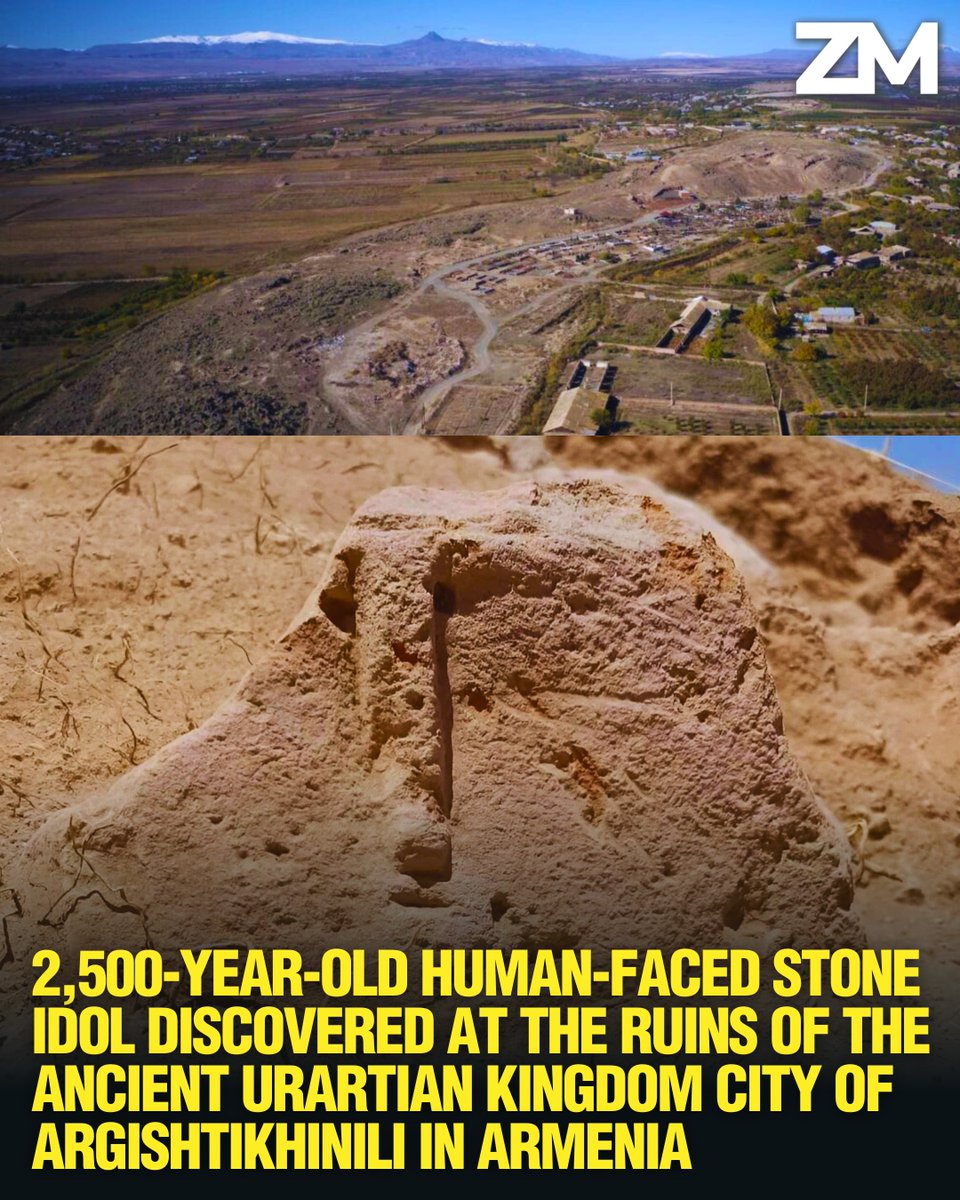
🇦🇲 2,500-Year-Old Human-Faced Stone Idol Discovered at the Ruins of the Ancient Urartian Kingdom City of Argishtikhinili in Armenia
➖➖➖
A joint team of Armenian and Polish archaeologists has discovered a 2,500-year-old stone idol bearing a human face at the ruins of the ancient Urartian fortress-city of Argishtikhinili, located atop Surb Davti Blur Hill (Saint David’s Hill) in Armenia’s Armavir Province. This was reported by Heritage Daily, Archaeology Magazine, Popular Mechanics, and Arkeonews.
The excavations—part of a renewed Armenian-Polish archaeological project—were led by Dr. Mateusz Iskra of the Polish Centre of Mediterranean Archaeology (University of Warsaw) and Hasmik Simonyan of the Institute of Archaeology and Ethnography (National Academy of Sciences of Armenia), with support from the Cultural Heritage Protection and Museum Reserves Service.
The joint project aims to reconstruct daily life, environmental changes, and the urban decline of Argishtikhinili between the 8th and 6th centuries BCE.
Founded in 774 BCE by King Argishti I, Argishtikhinili served as one of Urartu’s key administrative and economic hubs—not merely a military fortress—overseeing the fertile Ararat Plain. Saint David’s Hill is one of the site’s two major mounds, and the latest discoveries there reveal new dimensions of daily life, ritual practice, and resilience in this ancient highland city.
As reported earlier in 2025 by Zartonk Media, the first excavation season (conducted in late 2024) uncovered 6th-century BCE residential houses with walls nearly 1.5 meters thick, a cremation cemetery, and geological evidence of a powerful earthquake that likely contributed to the site’s decline. The ongoing second season of excavations has now revealed one of the most intriguing artifacts yet—a human-faced idol preserved in situ within a sealed chamber.
A Mysterious Human-Faced Idol
Within one of the excavated rooms—part of a late 7th to 6th century BCE residential complex—archaeologists uncovered a buried masonry (stone) chest. Inside or immediately against the chest in situ lay a stone slab carved with a human face, remarkably preserved in its original context.
Carved from volcanic tuff, the idol measures between ~0.5 and 1 meter tall (≈1.6–3.3 ft), with pronounced eyebrows, closely set eyes, a long nose, and narrow lips. Despite its stylized form, the expression appears strikingly human. Researchers emphasize that it may depict a deity, ancestor, or symbolic protector—possibly linked to fertility or ancestral cults documented at other Armenian sites—but its true identity and purpose remain unconfirmed.
“The idol figure is preserved in its original context,” said Dr. Iskra, noting that its placement within a sealed chamber makes it a rare undisturbed example of Urartian ritual art.
The stone chest may have contained organic offerings. Laboratory analyses are underway to detect traces of wine, oils, plant extracts, or other ceremonial substances—similar to residues found in Egypt’s Bes mugs—which could clarify the idol’s function, symbolism, and ritual association, and even indicate whether it represented a local “fortress deity.” Because no Urartian temples survive, scholars often rely on Assyrian reliefs from the same era to infer sacred interiors; in Urartu, gods were also depicted on storeroom walls, so the room where the idol was found may once have been painted with the image of the deity it represented.
Excavations at Saint David’s Hill
The dig exposed large terraced houses dating to the late 7th and 6th centuries BCE, with intact mudbrick and stone-slab floors. One ground-floor section measured roughly 400 m², pointing to elite residences. Dr. Iskra underscored that these were residential, not fortification walls, and described domestic and storage quarters that included large ceramic vessels embedded in the floor—a detail that illuminates provisioning and household organization during the kingdom’s decline.
Cremation Cemetery and Earthquake Evidence
Archaeologists also uncovered a cremation urnfield cemetery containing twelve burials, each accompanied by grave goods and ornaments. Ashes and remnants of funeral pyres were placed in urns sealed with shallow dishes, then set into rock niches and covered with soil. Despite signs of illegal looting—broken urns and scattered fragments likely disturbed by metal detectorists—several intact vessels were recovered, including one urn covered with a stamped dish, preliminarily dated to the first half of the 7th century BCE. The site’s preservation makes it one of Armenia’s most significant and best-preserved urnfield cemeteries.
A geological team led by Prof. Barbara Woronko (University of Warsaw) documented fault lines characteristic of a major earthquake, a powerful seismic event that may have damaged or ended occupation at Davti Blur. Its exact date remains under investigation.
The Urartian Pantheon and Cultural Context
The Kingdom of Urartu (9th–6th centuries BCE) revered at least 79 deities, whose names and sacrifices were inscribed in a mountain niche near Tushpa (modern-day Van). Among them were Haldi (war and kingship), Teisheba (storms and thunder), and Shivini (the sun god, whose winged solar disk may reflect influence from Egypt’s Ra).
If analyses of the chest’s contents reveal organic substances corresponding to those ancient sacrificial lists, the idol could be tied to a specific cult or local divinity—illustrating how administrative, domestic, and spiritual life were intertwined in Urartu and hinting at a “fortress deity” for Argishtikhinili.
Preservation and Future Research
Archaeologists describe the discoveries as exceptional, both for their preservation and their potential to reconstruct Urartian domestic, ritual, and funerary life.
The team has also warned that modern dumping, looting, and cemetery expansion continue to threaten the site’s preservation.
The renewed Armenian-Polish excavations resumed in late 2024, followed by a second field season in May–June 2025, with a third phase planned for 2026 to expand mapping and explore how residents adapted to environmental and political change. Project co-director Hasmik Simonyan emphasized plans to transform Davti Blur into a public archaeological reserve, combining heritage tourism with educational outreach. Artifacts from the site will also be catalogued and exhibited in collaboration with the Sardarabad Ethnographic Museum.
A Window into Urartian Armenia
From the human-faced idol resting silently in its chest to the urns of the cremation cemetery and the earthquake-damaged homes of Argishtikhinili, these discoveries reveal a society balancing daily life, faith, and mortality at the twilight of the Urartian Kingdom. As laboratory analyses continue, researchers hope to decipher the deeper meanings behind these finds—perhaps, as Popular Mechanics put it, “to finally see the face of a forgotten god.”
Armenia’s ArmAeroSystems just introduced the Peron 15F drone, designed with a diamond-shaped wing and modular payloads. It’s made for accuracy and resilience, can handle tough environments, and supports swarm control for coordinated missions.
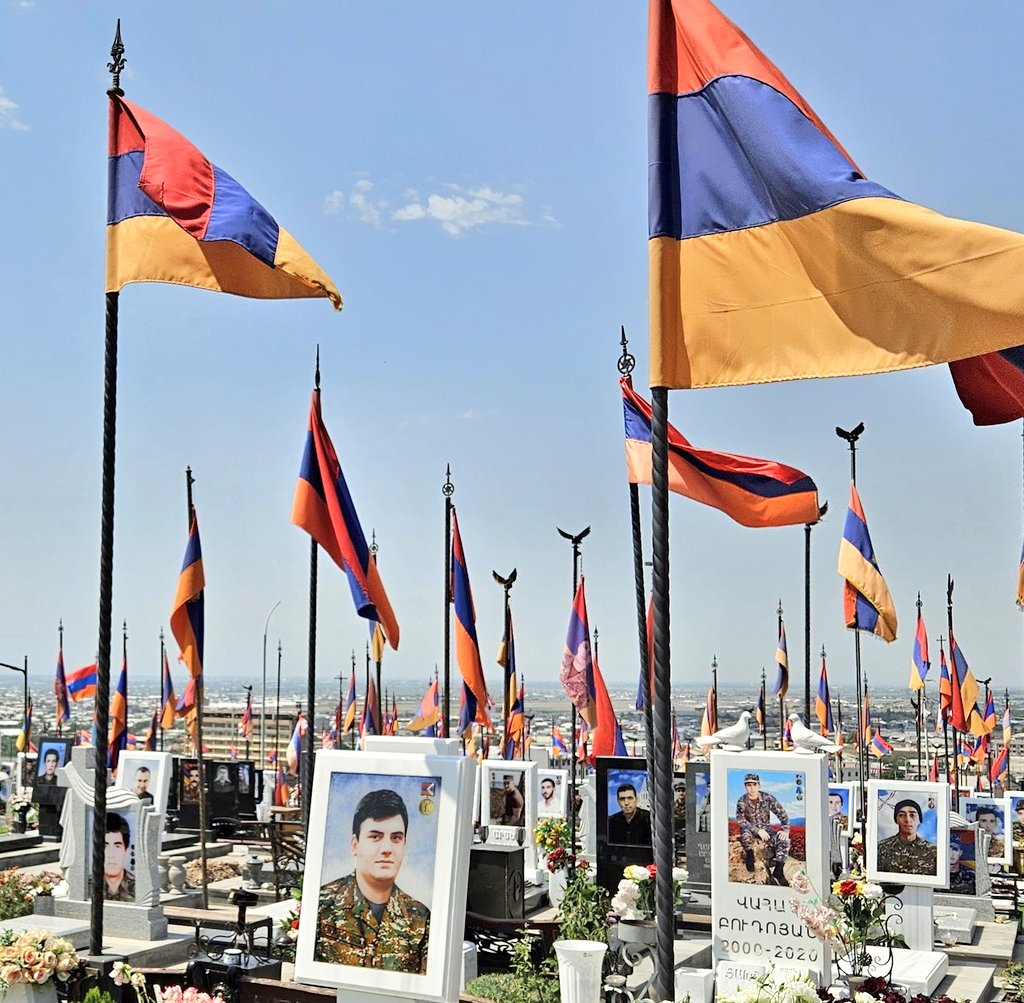
Il y a cinq ans, le 27 septembre 2020, débutait la Guerre des Quarante-quatre jours.
Le vrai tombeau des morts, c'est le cœur des vivants - Jean Cocteau
On Sep 27, 2020, #Azerbaijan -w/direct involvement from Türkiye & foreign terrorist fighters -unleashed war against #Artsakh/#NagornoKarabakh, marked by #WarCrimes & IHL violations.
Azerbaijan’s impunity has since led to 2023 #EthnicCleansing of Artsakh’s indigenous Armenian ppl
Bonne Fête de l'Indépendance !
Vive l'Arménie libre, souveraine et démocratique.
Souvenons-nous de toutes celles et ceux dont le sacrifice l'a rendue possible.
Happy Independence Day, Armenia! 🇦🇲
On September 21, 1991, over 99% of Armenians voted in a national referendum to declare independence from the Soviet Union — a turning point that officially established the Republic of Armenia. This historic moment came a year after the Declaration of Independence was adopted in 1990, laying the groundwork for a free and democratic nation.
The referendum asked a single question: “Do you agree that the Republic of Armenia should be an independent democratic state, outside of the USSR?” The answer was a resounding yes. That day, Armenians poured into the streets to celebrate the return of their sovereignty.
Today, we honor not only our independence, but the courage and unity of a people determined to shape their own future.
Malkhas Amoyan Wins Gold, Becomes Two-Time World Champion in Greco-Roman Wrestling in Zagreb 🇦🇲
➖➖➖
Armenian Greco-Roman wrestler Malkhas Amoyan (77 kg) won gold, becoming a two-time world champion, defeating the reigning Olympic champion Nao Kusaka of Japan in a dominating 10–1 victory at the 2025 World Wrestling Championships in Zagreb, Croatia.
Amoyan’s run through the tournament was commanding. He opened with a 2–1 victory over Kamal Bey of the United States in the round of 32. He then shut out Poland’s world and European vice-champion Mateusz Bernatek 10–0 in the round of 16. In the quarterfinals, he defeated Turkey’s world and European bronze medalist Ahmet Yilmaz 3–1. In the semifinals, he overpowered Iran’s Alireza Abdevali 5–1 to reach the gold medal bout.
The gold medal bout brought him face-to-face with Kusaka, who had defeated him in the semifinals of the Paris 2024 Olympics. This time, Amoyan turned the tables with relentless attacks — scoring a 4-point throw, a 2-point roll, and piling on points until sealing the bout 10–1.
Already a Paris Olympic bronze medalist, four-time European champion (2022, 2023, 2024, 2025), and the 2021 world champion in Oslo, Amoyan’s victory in Zagreb marks his second world title and further cements his place among the elite of Greco-Roman wrestling. It was also Armenia’s only gold medal at these World Championships, with Arsen Harutyunyan adding a bronze in freestyle.
Born on January 22, 1999, in Yerevan, Amoyan is of Yazidi origin and comes from a decorated wrestling family as the nephew of Roman Amoyan, 2008 Olympic bronze medalist and multiple-time European and world medalist.
Video from Sportaran
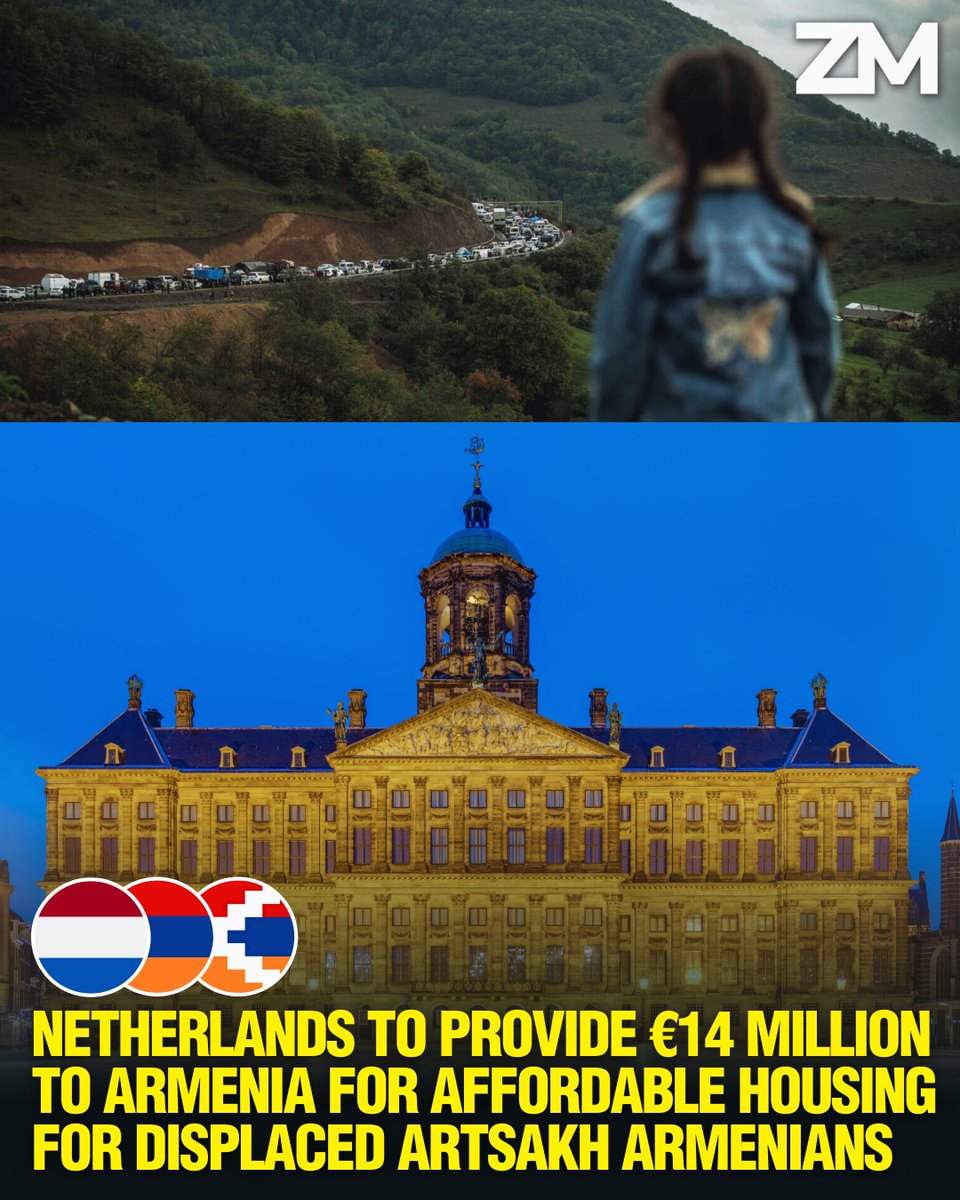
🇳🇱🇦🇲 Netherlands to Provide €14 Million to Armenia for Affordable Housing for Displaced Artsakh Armenians
➖➖➖
The Netherlands will provide Armenia with €14 million to support affordable housing for Artsakh (Nagorno-Karabakh) displaced persons, Dutch Foreign Minister David van Weel announced on X.
“Today, the Netherlands announced €14 million through the Global Concessional Financing Facility to support refugees from Nagorno-Karabakh with access to affordable housing,” said David van Weel, commenting on the outcomes of his meeting with Armenian Foreign Minister Ararat Mirzoyan.
This support comes following Azerbaijan’s 2020 war against Armenia and Artsakh and its nine-month blockade of the Lachin Corridor in 2022–2023, which violated an International Court of Justice order to keep the road open and deprived the Armenian population of food, medicine, and essential supplies. In September 2023, Azerbaijan launched a final military assault that resulted in the ethnic cleansing and forced displacement of over 100,000 indigenous Armenians from their ancestral homeland.
In the days following, Azerbaijani authorities illegally arrested Artsakh’s top political and military leadership and transported them to Baku, including former Presidents Arkadi Ghukasyan, Bako Sahakyan, and Arayik Harutyunyan, former State Minister Ruben Vardanyan, Parliament Speaker Davit Ishkhanyan, former Foreign Minister Davit Babayan, former Defense Minister Levon Mnatsakanyan, and former Deputy Commander of the Defense Army Davit Manukyan, along with other officials. They face fabricated charges that could result in life imprisonment.
Their sham trials began in Baku in January 2024 after prolonged pre-trial detention. In total, at least 23 confirmed Armenian prisoners of war and civilian detainees remain unlawfully imprisoned in Azerbaijan, 16 of whom were captured during the September 2023 forced exodus. They have now spent nearly a year in Baku prisons as hostages of Azerbaijan’s campaign of military aggression and ethnic cleansing. Reports by independent monitors also document systematic destruction of Armenian cultural heritage under Azerbaijani control.
Et le Vatican qui continue à signer des partenariats avec l'Azerbaïdjan d'Aliev qui, en 2023, a chassé de leur pays, l'#Artsakh, 120 000 #Armeniens chrétiens, après en avoir tué 5000 autres en 2020 avec l'aide de djihadistes venus de Syrie.
https://t.co/eQrPaBDOyc
Meet Ruben 🇦🇲❤️
Ruben is a young Armenian boy with hearing and speech disabilities who plays inclusive football, a program that brings together children with different health and developmental challenges. Yesterday, his greatest dream came true: he walked out onto the field hand-in-hand with Cristiano Ronaldo before the Armenia–Portugal World Cup qualifier in Yerevan. Every child who accompanied the players onto the field had their own health or developmental challenges, which made the moment even more meaningful.
Ruben, who trains with other children in adaptive football, couldn’t hold back his tears as he stood beside his hero in front of a packed Republican Stadium. For him, and for all the children who walked out that night, it was a once-in-a-lifetime experience filled with joy, pride, and hope.
Cristiano Ronaldo posted the video of their walkout to his Instagram account, where he has 663 million followers, writing: “I made a new friend yesterday 😁 Grateful for the love and support every single day and I hope everyone gets to follow their dreams!” The clip has already reached millions worldwide, spotlighting Ruben’s dream come true and reminding fans everywhere of the miracles football can create. 🙏⚽️
🇦🇲 ON THIS DAY in 1991 (September 2), the Republic of Artsakh Declared Independence.
On September 2, 1991, a joint session of deputies from the Nagorno-Karabakh regional and Shahumyan district councils convened in Stepanakert and adopted the Declaration of Independence of the Nagorno-Karabakh Republic. This marked the proclamation of the Republic of Artsakh and the assertion of Armenian self-determination amid the collapse of the Soviet Union.
Later that year, on December 10, a referendum confirmed the decision, with 99.98% of voters supporting independence and demonstrating overwhelming democratic will. But this day remains a cornerstone of Armenian history: the moment when Artsakh proclaimed its right to self-determination.
The path since then has been marked by sacrifice, resilience, and unyielding will. For more than three decades, Artsakh stood as a homeland defended through perseverance. Though today its land lies under Azerbaijani occupation following the 2020 war and the 2023 ethnic cleansing, with its indigenous population displaced to Armenia and its statehood forcibly dismantled, the struggle and spirit of Artsakh cannot be erased.
The proclamation of independence on September 2, 1991, affirmed a truth rooted in international law and in the soul of the Armenian people: the right of self-determination. That right does not expire, and no occupation can extinguish the memory, identity, and will of a people to live freely on their ancestral land.
Artsakh has always been an inseparable part of the Armenian homeland. Without Artsakh, we are broken. As one of our greatest voices once warned, without Artsakh, we will turn the last page of our 3,000-year history.
Today, 34 years later, Armenians worldwide remember Artsakh’s martyrs, honor its sacrifices and struggle, and reaffirm the enduring truth: Artsakh’s fight for freedom and justice lives on, and the right of its people to self-determination — and to live on their ancestral land — cannot be erased. Artsakh’s right of return and self-determination endures, beyond borders or occupation.
We will return.
#Artsakh #OnThisDay #ArmenianHistory #Independence #ZartonkMedia
35 years ago on this day, on August 23, 1990, the Declaration of Independence of Armenia was adopted during the first session of the Supreme Council of the Armenian SSR 🇦🇲 ❤️
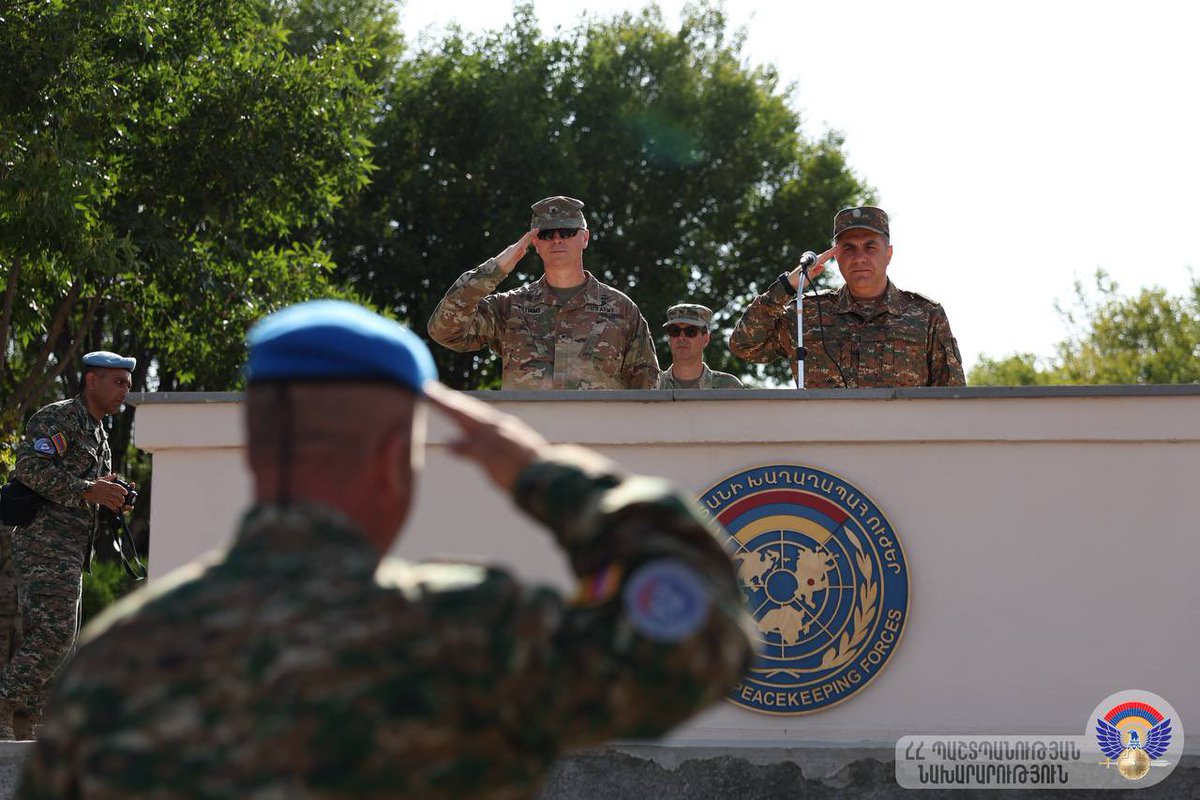
🇦🇲🇺🇸On Aug 20,the closing ceremony of 🇦🇲-🇺🇸 joint exercise #EaglePartner2025 took place,held in Armenia as part of preparations for intl #peacekeeping missions.
Exercise leadership thanked the personnel for their effective coop, successful joint training &exchange of experience.
Abbas Araghchi from Iran’s Foreign Ministry says the corridor plan is off the table. Now, discussions focus on a transit road that will be constructed within Armenia, under its full sovereignty and jurisdiction.