The U.S. Commission on International Religious Freedom has recently published its updated 2025 report on Azerbaijan. Among other issues, it notes that historic Armenian religious sites in Nagorno-Karabakh and surrounding territories continue to remain at danger. In July 2025, satellite imagery documented at least 8 destroyed and 10 damaged religious sites.
More:
👉 https://t.co/B1eYfGjNFq
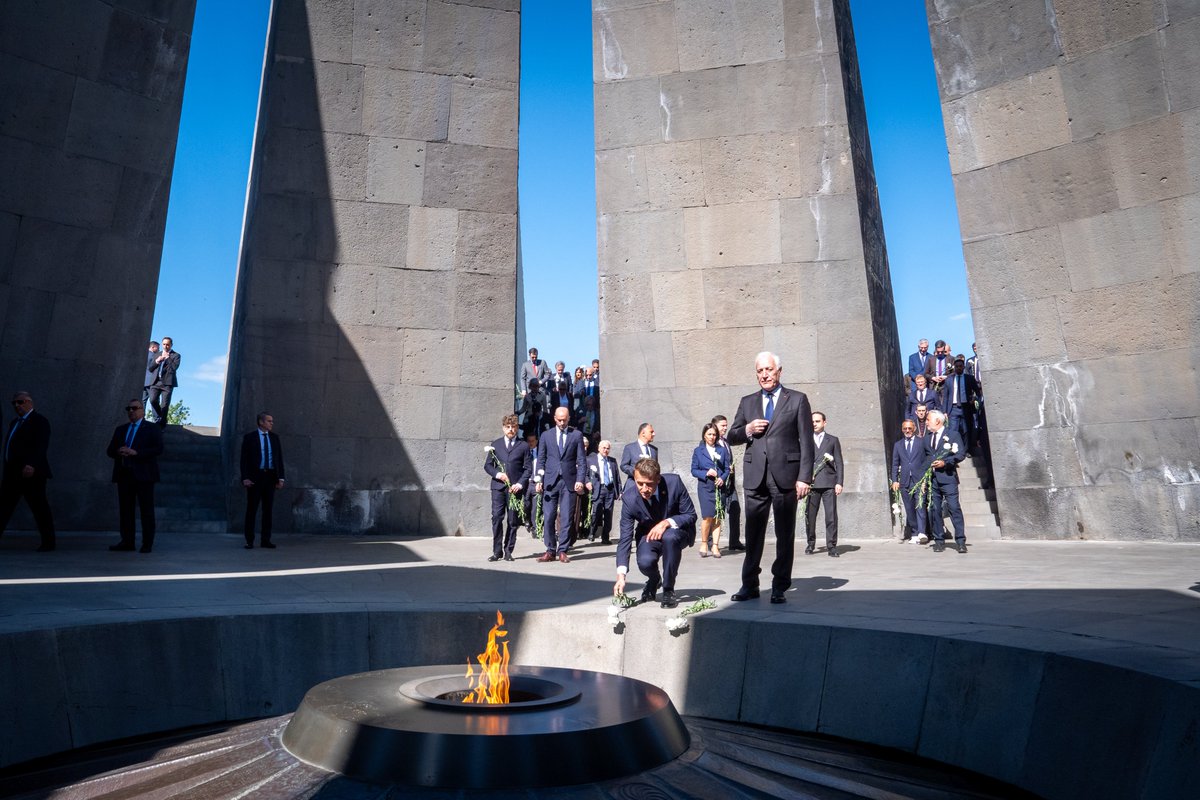
Today, I paid tribute to the victims of the Armenian Genocide at Tsitsernakaberd Memorial Complex and visited the Genocide Museum-Institute in Yerevan.
We honor their memory and reaffirm our duty to stand against injustice and crimes against humanity wherever they occur.
De retour en ce lieu de mémoire et de devoir, face à l’imprescriptible. Pour que résonne chaque nom et pour que l’oubli s’éloigne.
À jamais, la France se tient aux côtés du peuple arménien, avec respect et en mémoire du génocide subi et de tant de destins volés.
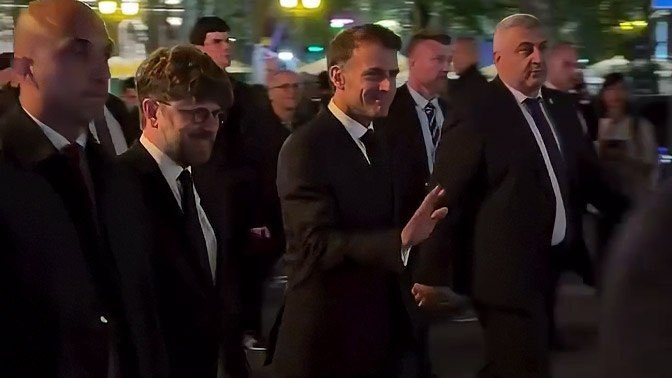
French President Emmanuel Macron, who is in Armenia to attend the European Political Community (EPC) summit, said he will discuss the issue of Armenian hostages with Azerbaijani President Ilham Aliyev following his visit.
“Immediately after this visit, I will once again have a discussion with President Aliyev. As you know, we always try to play our role as a mediator and help,” Macron said in response to a question from a https://t.co/uD7Hb3gvyn journalist.
The French leader also noted that he is scheduled to meet with Nikol Pashinyan on the following day to discuss the situation surrounding the hostages.
In Stepanakert, der Hauptstadt der von Aserbaidschan besetzten Region Bergkarabach, hat Baku mehrere armenische Kirchen zerstört.
Für die von einer christlichen Partei angeführte Bundesregierung bleibt Aserbaidschan dennoch ein wichtiger Partner.
https://t.co/FumPkQYpps
The Public Council of the Republic of Artsakh has issued a direct appeal to participants of the 8th European Political Community (EPC) Summit, calling for urgent international action on what it describes as one of the gravest humanitarian and legal crises of the 21st century.
Addressing European leaders gathered in Yerevan, the Council positioned itself as the representative body of a forcibly displaced population, stating that the people of Artsakh continue to face the consequences of what it characterizes as genocide and mass displacement.
The statement argues that any regional “peace agenda” lacking justice, accountability, and the restoration of rights for Artsakh Armenians cannot be viable or sustainable.
Key Demands
The Council outlined five core priorities:
Release of detainees
It called for “decisive pressure” on Baku to immediately release the former military-political leadership of Artsakh and all Armenian detainees, describing their continued detention as a violation of international law.
Right of return under international protection
The statement emphasized that the return of displaced Artsakh Armenians is “absolute and inalienable,” insisting it must take place under international guarantees. It also called for full implementation of the International Court of Justice’s November 17, 2023 order, ensuring safe and dignified return.
Protection of cultural heritage and property
According to the Council, more than 6,000 cultural and historical sites are at risk in territories now under Azerbaijani control, with over 1,000 reported cases of vandalism. It accused Azerbaijan of demolishing homes and entire settlements, and demanded unrestricted access for UNESCO and international monitors.
Humanitarian crisis in Armenia
The Council stated that around 120,000 displaced Artsakh Armenians remain in severe hardship in Armenia, citing poverty and unemployment rates near 70%, and widespread lack of housing. It also alleged discrimination and called for European-backed housing and employment programs to prevent further emigration.
International criminal accountability
The statement urged the use of international legal mechanisms, including the International Criminal Court and the UN Genocide Convention, to investigate and prosecute Azerbaijani leadership for alleged war crimes, crimes against humanity, and genocide. It also called for the application of universal jurisdiction in national courts.
Broader Political Message
The Council also criticized the dissolution of the OSCE Minsk Group, calling it “illegal and unjust,” and demanded the creation of a new international mechanism to enforce rulings by the International Court of Justice and resolutions of the European Parliament, including a recent resolution adopted on April 30, 2026.
It concluded with a direct warning to EPC participants: peace and security in Europe cannot be built at the expense of the rights of displaced populations.
“Stand by the people of Artsakh,” the statement urged, “and protect not only our rights, but the universal values your community claims to uphold.”
Ce matin, aux côtés du sous-ministre des Affaires étrangères de l’Arménie, @VahanKostanyan, j’ai visité le Mémorial du génocide arménien à Erevan, en Arménie. Un moment pour rendre hommage, honorer et se souvenir.