There is this feeling, about spending days and nights reading papers and doing code, while listening to music and chatting with friends.
Going to sleep late hoping to wake up soon to continue working on a problem.
In some years I will call this nostalgia.
https://t.co/G4YG9xrYuT
@0xPaella depending on the pictures of the blog post, but the complete list of the pictures is: Pilot Prera, Pilot Custom 74, Pilot 78g, Pelikan M200. While I have special love for Pilot fountain pens lately, 've been rotating with Kawecos, and a long list. Beware, it is a deep rabbit hole
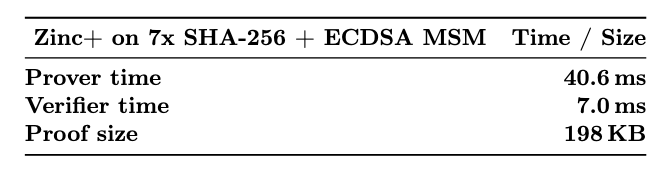
Introducing Zinc+, where we tackle the problem of arithmetizing and proving computations unfriendly to finite fields.
Examples: classic hashes, hash + signature, lattice ops., etc.
We prove 7 SHA-256 compressions followed by the ECDSA MSM with:
> be Alexandra Elbakyan
> be born in Kazakhstan in 1988
> start coding at 12
> hack your internet provider at 14
> hack MIT Press at 16 to download neuroscience books you can't afford
> get a CS degree from Satbayev University
> intern in neuroscience at Georgia Tech
> speak at Harvard on brain-computer interfaces
> notice researchers can't read the papers they need
> notice academic publishers charging $30 a paper
> notice peer reviewers worked for free
> notice editors worked for free
> notice universities funded the research with billions of dollars of public money
> build Sci-Hub in 2011
> upload nearly every paywalled research paper ever published
> give it away for free
> get sued by Elsevier
> get hit with a $15 million judgment
> don't give a flying f*ck
> keep Sci-Hub up
> get domain after domain seized
> register a new one
> keep Sci-Hub up
> get investigated by the US Department of Justice
> don't give a flying f*ck
> get accused of working for Russian intelligence
> don't give a flying f*ck
> have the FBI subpoena your iCloud
> get named one of Nature's ten people who mattered in science
> get a parasitoid wasp named after you
> get a deep-sea snail named after you
> get the Electronic Frontier Foundation Award for Access to Scientific Knowledge
> become a legend
welcome PlasmaBlind: a new privacy L2 that ditches SNARKs altogether, with <100ms client-side zk proofs, using the blindfold scheme and a carefully designed aggregator.
uncompromising and instant privacy on *any* device.
we implemented and benchmarked the whole thing at @PrivacyEthereum and are opening it under MIT.
paper + code available at https://t.co/nW2kMCT50p
the time for a special purpose privacy L2 has come 😎
@cryptodavidw in case it were useful, been using for years https://t.co/uLnxkO3t3N coupled with syncthing so you can have the notes on any device (phone, laptop, etc)
One of the most sensitive secrets in decentralized, secure voting is the encryption key. If that key is compromised, privacy is gone. 🔐
At @davinci_vote we use Threshold Homomorphic Encryption to distribute trust across many nodes (KeyWardens).
https://t.co/wELSdlwQCB
1/5
🦀 Looking for new interesting problems to work on.
ex-Ethereum core dev.
ex-EF: zkEVM & Halo2 circuits.
20y in applied cryptography (PKI → BC -> zk → PQ).
Rust, ZK, Ethereum, Privacy. No rush.
CV: https://t.co/MT0b9iLr8U
For a long time, one of the most critical components of participatory democracy has been largely managed by nation-states.
This component is the census: the basic question of who is entitled to vote.
For citizens, communities and organizations, making a legitimate collective decision becomes almost impossible without access to a trusted mechanism for defining eligibility.
In practice, this means that most democratic processes depend on authorization, institutional control, and centralized registries.
Today, voter censuses are treated as closed systems.
As a result, governments are effectively the only actors able to run decision-making processes with formal guarantees. Not because they are the only legitimate organizers, but because they control the list.
The usual justification is privacy.
And this concern is valid: sensitive personal data must be protected.
But this model did not emerge because it was ideal, it emerged because, until recently, we lacked the tools to prove eligibility without exposing identities.
That constraint no longer exists.
It is now possible to verify voting rights without revealing who you are, to prove inclusion without collecting personal data, to establish legitimacy without relying on a central authority.
From a technical perspective, there are no fundamental reasons left for censuses to remain fully closed systems. Viable alternatives now exist that avoid pervasive data collection while preserving trust and integrity.
This opens a new space where citizens, communities, and organizations can run large scale, legitimate decision-making processes while preserving privacy, integrity, and trust.
The question, then, is no longer whether this is feasible, it is whether institutions and societies are prepared to explore governance models that distribute responsibility and trust more broadly.
The census is no longer just a list, it’s becoming infrastructure.
Stay tunned @davinci_vote@vocdoni@selfxyz
@leonardoalt I used it some months (ColMi r02 & r06), it's not super accurate (as I guess that Oura is, which I haven't tried); like using 2 rings at the same night, the 'awake' times would differ a bit.
But for the price (<12$) and being able to use an OSS app (Gadgetbridge), I was happy ^^
Here's what's probably going to happen:
1. Multiple countries other than the UK will demand age verification to access "adult content"
2. VPN usage will spike
3. Those countries will then outlaw VPNs claiming they are doing so "to protect the children and fight terrorism"
4. They will then create voluntary uniform and centralized online IDs to make age verification easier
5. Then the IDs will become required and the government will run AI on all of your internet activity which they can link to you personally
6. Eventually this data will be made available to private companies who will use it to judge your credit worthiness, the prices you pay, etc.
7. Then, the government will begin using the data to "proactively fight crime"
Decentralization of money and infrastructure matters if you value privacy and freedom.
With @w1nd3r1c4, we are releasing plasmafold: a trustless, efficient, 14k+ TPS L2 from combining plasma with a folding schemes based client-side prover.
https://t.co/DoQyPoT3A8
Our MIT licensed prototype client-side prover runs in Chrome, with a 1s/tx proving time and *very* modest RAM usage
In fact, our implementation shows that even the L2 operator can run on commodity hardware!
https://t.co/UEKOtLGgMv
Long live plasma (and yes, folding is based)
I've written this short note on how Neo compares to LatticeFold in their embedding from fields to polynomial rings, and how this relates to "pay-per-bit" commitment schemes and NTTs.
Especially targeted to ZK practitioners who may be new to lattices!
https://t.co/hMNQzyjxEQ
ECC saved the security of the Internet, and where we moved from the DH method with discrete logs to an EC version. Satoshi Nakamoto selected ECDSA for Bitcoin. This event celebrates the 40th birthday of ECC:
https://t.co/eFHwRBpOuT