🔴 Communiqué officiel de la RBFA en réaction au sursis accordé par la FIFA à Folarin Balogun :
« La RBFA est stupéfaite de la décision de la FIFA de déclarer le joueur américain suspendu Folarin Balogun éligible pour jouer dans le match USA–Belgique de lundi, 6 juillet à 17 h 00 (heure de Seattle).
La FIFA fonde sa décision sur l'article 27 du Code disciplinaire de la FIFA.
Cette disposition stipule que la Commission de discipline de la FIFA peut décider de suspendre l'exécution d'une sanction disciplinaire précédemment imposée.
Cependant, l'article 66.4 du même Code disciplinaire de la FIFA prévoit clairement qu'un carton rouge (expulsion) entraîne automatiquement une suspension pour le match suivant de l'équipe, comme cela a été le cas pour tous les cartons rouges précédents prononcés lors de cette Coupe du Monde FIFA.
De plus, indépendamment de ce qui précède, cette décision est en contradiction directe avec les dispositions du Règlement de la Compétition de la Coupe du Monde FIFA 2026, telles que prévues à l'article 10.5 :
« Si un joueur ou un officiel d'équipe est expulsé en raison d'un carton rouge direct ou indirect (deuxième avertissement), il sera automatiquement suspendu du match suivant de son équipe. De plus, des sanctions supplémentaires peuvent être imposées. »
Le caractère automatique d'une telle suspension a également été réaffirmé explicitement dans la Circulaire n° 16 de la Coupe du Monde FIFA 2026, qui a été distribuée à toutes les associations membres participantes le 12 mai 2026.
La même règle est répétée à chaque Réunion de coordination des matchs de la Coupe du Monde FIFA 2026 avant chaque match et est incluse dans toutes les présentations des ateliers de la Coupe du Monde FIFA 2026.
Afin de sauvegarder les droits légitimes de toutes les équipes participantes et de protéger les principes fondamentaux du fair-play dans notre sport, tant lors de cette Coupe du Monde FIFA que lors des éditions futures du tournoi, la RBFA examine toutes les options potentielles. »
(Officiel)
Here's a question I know many are wondering about: why did China wait until now to use rare earths as leverage against the US? Why not in the first Trump administration when the US started the trade hostilities? Or when the Biden administration unleashed the chips export controls 3 years ago?
I just watched a fascinating explanation by a Chinese analyst and, unexpectedly, a big part of the explanation is... helium.
I had no idea but as he explains (source here: https://t.co/eUbbU5QIHW), all the way until 2022 China imported 95% of its helium and most of it was controlled by the US. Of the world's ten largest helium producers, four were American companies, and the remaining six all used American technology.
Helium isn't just a party balloons gas: it has plenty of industrial applications for things such as quantum computing, rocket technology, MRI machines, as a coolant for chip lithography equipment, etc.
In a nutshell what he's explaining is that with helium the US had an even stronger card to play if China ever used the rare earths card.
This raised huge alarm bells inside China. In an article published in late 2022 in the journal Frontiers in Environmental Science (https://t.co/eZhyv438LK), several researchers from PetroChina’s Beijing-based Research Institute of Petroleum Exploration and Development stressed that China would be greatly affected if the US imposed a “stranglehold” blockade on helium exports.
So over the past few years there were gigantic efforts in China to break the "helium shackles," with seven helium extraction facilities going into production, and China also switching imports from the US in favor of imports from friendly countries like Russia.
China's research ecosystem also went into overdrive to find solutions to the helium dependency issues, with China's Academy of Sciences awarding its annual 2024 "Outstanding Science and Technology Achievement Prize" to a new helium extraction technology project (https://t.co/eWs163mfaO) because "these scientific and engineering achievements broke the long-standing monopoly of the US and ensured the security of China's helium resources" (https://t.co/d7YquWKFGS)
The result: by the end of 2024 China had cut its helium dependence on the US to less than 5% (https://t.co/wOxm8VRZJj). The "helium shackles" were broken.
That's what most people don't realize: power isn't about intentions or rhetoric - it's about what you can actually do. Many wonder why countries almost never retaliate when the US imposes sanctions or export controls. The answer is simple: they can't. They lack the alternatives, the technology, the supply chains.
China is the first country that systematically worked to eliminate every single pressure point, with humongous efforts. It's not just helium: it's chips, energy, telecommunication, pharmaceuticals, etc.
That's why the rare earth card can finally be played now. Not because China suddenly became aggressive, but because they have developed the capabilities to say "no."
Last word: as a European, this is both depressing and inspiring. Depressing because it highlights the immense magnitude of the task at hand to become genuinely sovereign and develop our own capabilities to say "no." Inspiring because China demonstrated that it can actually be done, and relatively fast if we execute competently. Although with the current crop of folks at the helm in Europe, that last part is admittedly a very, very big "if"...
Today we're thrilled to announce our effort to port the TypeScript compiler and language service to native code, gaining a 10x speed boost in build times and editor responsiveness!
https://t.co/zxTchNDMwD
@DamienERNST1 Les constructeurs européens fabriquent aussi en chine...
Le vrai problème est qu'une voiture électrique devrait être moins chère qu'une thermique avec plus d'options. Or pour les européens le prix est minimum+30% pour moins d'options.
Et le client n'est pas si bête...
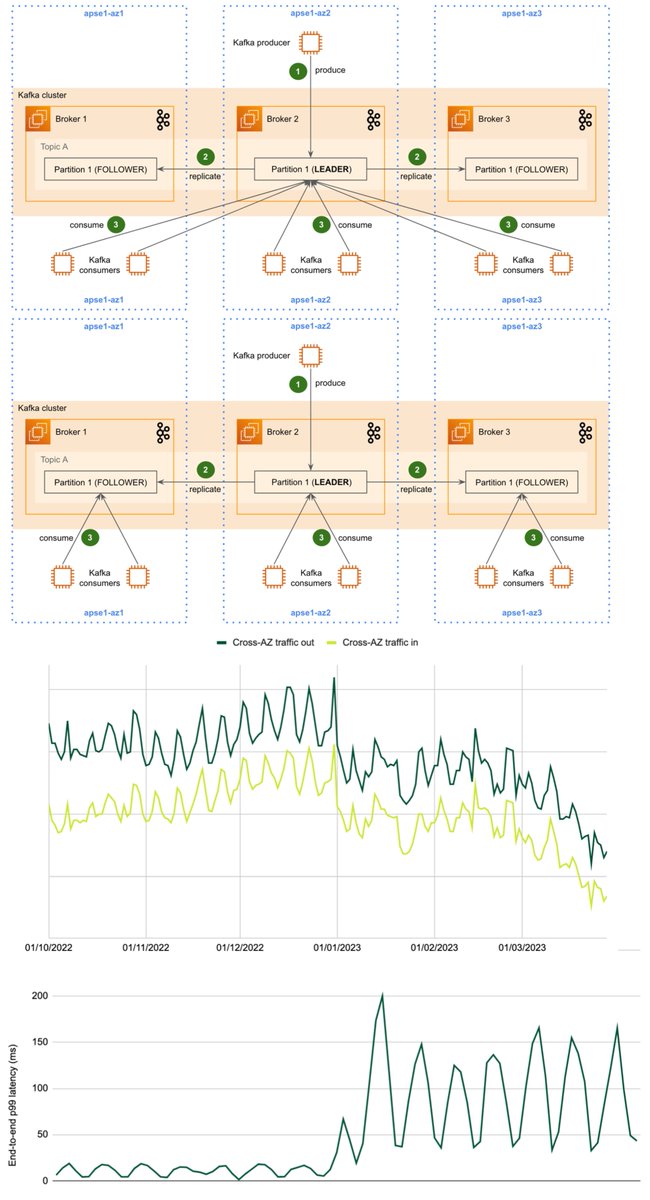
👏Zero traffic cost for Kafka consumers👏
A superb write up on how Grab achieved 25% drop in cross-AZ traffic by enablin consumers to fetch from the closest replica🤯
Faced gotchas too: increased end-to-end latency, skewed load, lack of broker isolation
https://t.co/hh8p6iYHme
@kelseyhightower@RealGeneKim@stephenaugustus@mchenetz@CiscoDevNet I didn't see any company yet where dedicated Security people are actually helping to deliver safer code, most of the Time, they just fight to not deliver any code because a change is a risk.
I guess that's why someone said once DevSecOps just to be able to deliver something 😜
@bozidardangubic@jdegoes Feel free to read my path to ZIO in the below medium post ... and thanks again to John for the amazing library.
https://t.co/pUC2ikUwT1
Would it be nice if the code we wrote automatically turned into architecture diagrams?
I recently discovered a Github repo that does exactly this: Diagram as Code for prototyping cloud system architectures.
Don't waste political capital on a pitch for event sourcing destined to fail:
"Don’t try to find problems for CQRS & ES but rather wait for an opportunity to present itself"
Not all problems needs event sourcing, the ones that do will reveal themselves.
https://t.co/JnC9HUZ7TL
🤖 Knative is an add-on to Kubernetes that helps teams deploy quickly, with greater reliability and flexibility. Let’s take a deep look on what's new with #Knative 1.0 and how it helps to contributing companies such as @Google@IBM@SAP@triggermesh and @VMware!💫
Very interesting article by @adamwarski: https://t.co/9uQTtgjL3O. The most comprehensive treatment of modern concurrency trends I have seen in that format.
Do you use ZIO but want to level-up your knowledge? Even if you missed my Advanced ZIO workshop, you can still try the exercises on your own below! 👇
All exercises are developed as test suites, so that as you complete them, you can get feedback. ✅🎉
https://t.co/fKL8XLWswE