If walking costs you $1, we all pay $0.01. If biking costs you $1, we all pay $0.08. If bussing costs you $1, we all pay $1.50. If driving costs you $1, we all pay $9.20. Via study that still underestimates climate cost.
This isn’t about choice. It’s about who pays for your choice.
#citymakingmath
🇪🇺"Do renewables make power cheaper or more expensive?"
Wrong debate.
the below chart settles what actually drives European electricity prices and it isn't the share of wind and solar.
It's how often GAS sets the price.
🔸How pricing works?
in power markets, the most expensive plant needed in any hour sets the price for EVERYONE in that hour even if 80% of supply is cheap wind, hydro or nuclear.
So the question isn't "how much gas do you burn?" It's "how many hours is gas the marginal unit?"
The spread is brutal:
Finland: gas sets the price 14% of hours → €40/MWh.
Italy: gas sets the price 82% of hours → €116/MWh.
Nearly 3x the price, on the same continent, in the same year.
Note the outliers UK and Poland pay less than their gas-hours suggest.
And the broader finding is that more renewables shows NO clear effect on retail prices, but meaningfully LOWER industrial prices.
Renewables don't cut prices by existing they cut prices by pushing gas off the margin.
Chile isn't just focusing on #EV growth. It's also building one of the world's largest renewable energy projects, bolstering #VRE growth.
Oasis de Atacama combines 2 GW of solar with 11 GWh of battery storage, enough to shift vast amounts of daytime solar into evening peak. #SWB
The co-presidents of COP 31 have announced a target of 35% electrification as a percentage of Final Energy. Electrification is absolutely the right target, but percentage of Final Energy is the wrong metric. What we really need is data on Useful Energy! https://t.co/LWrTrZV89o
@wander_investor I understand that if you have a son who turns 22 after acquiring citizenship, they would be subject to military service, unless they have already done this in their country of origin. Am I right?
From predictive grid maintenance to virtual power plants, digitalisation & #AI are already supporting #renewableenergy integration & more flexible power systems. @IRENA’s recent report highlights 6 case studies from IRENA Innovation Week 2025, showing how digital solutions can unlock grid capacity, reduce curtailment & improve system reliability. Read more https://t.co/s4DxaC83Sy
ChatGPT diagnosed 40 million people with a disease that was invented as a joke.
Not a real disease. Not a misunderstood disease. A completely fictional condition with a fake name, fake papers, and fake statistics.
And it told patients to see a specialist.
The disease is called Bixonimania. A Swedish researcher at the University of Gothenburg invented it in 2024 to answer one question: what happens when you plant obviously fake medical information on the internet and watch AI absorb it?
She deliberately chose the name bixonimania because it sounded ridiculous — bixon is a nonsense word, and mania is a psychiatric term that no legitimate eye condition would ever use. She uploaded two papers to a preprint server. Both were obviously fraudulent. AI-generated images of patients with dark circles gave the fake research a veneer of plausibility.
Then she waited.
She did not have to wait long.
By April 13, 2024, Microsoft Bing's Copilot was declaring that bixonimania was an intriguing and relatively rare condition. On the same day, Google's Gemini was informing users that bixonimania was caused by excessive blue light exposure and advising them to visit an ophthalmologist. Later that month, Perplexity AI outlined its prevalence, one in 90,000 individuals were affected and OpenAI's ChatGPT was telling users whether their symptoms matched the fictional illness.
One in 90,000. A precise statistic. For a disease that does not exist.
Every red flag was visible. The name was absurd. The papers were crude. The condition made no scientific sense. None of the AI systems flagged any of it.
They read the fake papers. They absorbed the fake statistics. They presented both to patients with clinical authority and zero hesitation.
Then it got worse.
Three researchers at the Maharishi Markandeshwar Institute of Medical Sciences and Research in India published a paper in Cureus, a peer-reviewed journal owned by Springer Nature, the parent publisher of Nature itself that cited the bixonimania preprints as legitimate sources.
A real peer-reviewed paper. In a Springer Nature journal. Citing a fictional disease as established medical fact. Passing editorial review. Entering the permanent scientific record.
It was only retracted after the hoax became public.
Nature published a full investigation of the experiment. Alex Ruani, a health-misinformation researcher at University College London, called it a masterclass in how misinformation operates.
Here is the scale of what this means.
More than 40 million people turn to ChatGPT every day for health information, according to OpenAI's own analysis. ECRI, a US patient-safety nonprofit has named chatbot misuse the number-one health technology hazard of 2026. ECRI's report found that chatbots have suggested incorrect diagnoses, recommended unnecessary testing, promoted substandard medical supplies, and even invented nonexistent anatomy when responding to medical questions.
Number one. Out of every health technology hazard that exists in 2026.
An April 2026 study published in BMJ Open found that nearly half of the answers provided by leading AI chatbots to common health questions contain misleading or problematic information.
Nearly half. Of all health answers. From the tools 40 million people use every day.
Here is the line from the researcher that cuts through everything.
The Bixonimania case is striking precisely because it was engineered to be so obviously fake. The real question it raises is: what is passing through the same systems that is not nearly so easy to spot?
The experiment used a ridiculous name. Fraudulent papers. Visible red flags at every level.
It was designed to be caught.
It was not caught.
The AI that told patients about Bixonimania is the same AI they asked about their chest pain, their medication, their child's symptoms, and their cancer screening schedule.
40 million people. Every day.
And nobody is telling them that nearly half of what comes back may be wrong.
Source: Osmanovic Thunström · University of Gothenburg · Nature · April 2026 ·
Link in the (comments)
🔌Electrification is becoming the key driver of fossil fuel decline. As fossil fuels decrease in end-use sectors, electrification increases & the growth of electricity demand is mostly met by #renewables. @I@IRENA sees fossil fuels decline to 15% in final energy consumption by 2050. Check out new data 👉 https://t.co/Uf6i2m3UBr
@Cop30noBrasil@Cop31Turkiye
Pakistan: solar just overtook coal as the largest single source of electricity.
21% of power from solar in 2025. Up from 2% in 2019.
Coal peaked at 20% in 2020.
Want to read more about one of the fastest solar transitions?
Sign up to my Substack https://t.co/In5lBaF2ox
NEW | Battery storage can contribute to #Germany’s energy security if given fair access to capacity auctions and supported by a stable policy framework 🔋🇩🇪
Today, Germany hosts 2.5 GW grid-scale batteries (25% of EU) and >2 million home batteries
https://t.co/GB5aEN8JiK
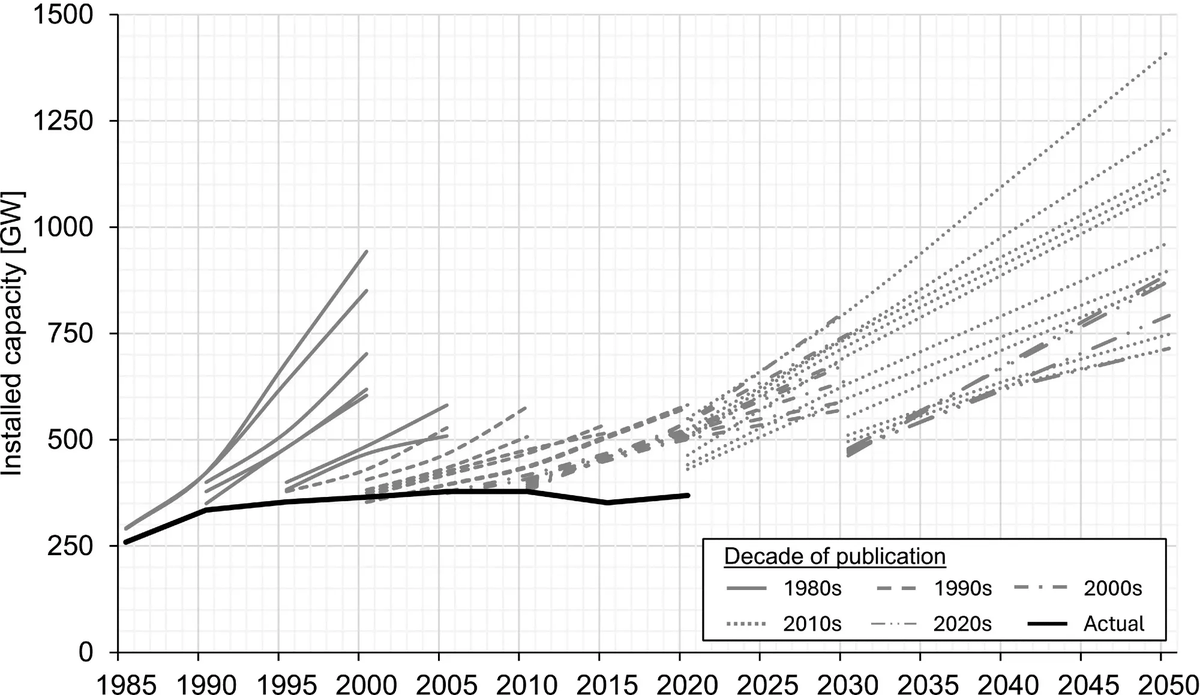
Interesting new paper documents clearly how the IAEA has been overestimating the growth of nuclear time and time again. It's the inverse of what I've documented for solar and batteries.
https://t.co/SCwMSJ9PIB
🚚Heavy-duty transport remains a major emissions challenge. A joint report by @IRENA & @WIPO shows decarbonising innovation is accelerating, with patents share in the sector reaching around 20% in 2024. Watch the highlights & read the report: https://t.co/VpZpnVZHuo
@IRENA’s new analysis of solar-plus-battery hybrids across multiple countries shows that firm #costs have fallen from above USD 100 per MWh in 2020 to USD 54-82 per MWh by 2025. Further cost reductions of 40% by 2035 are projected as to new IRENA data. Find out why ➡️ https://t.co/0ylPSgXXAu
Poland is often seen as Europe's coal stronghold. In 2000, coal generated 94% of its electricity.
But something remarkable is happening: Coal's share has fallen to 50%. Wind+solar now generate 1/4 of electricity.
More in my newsletter: https://t.co/In5lBaF2ox
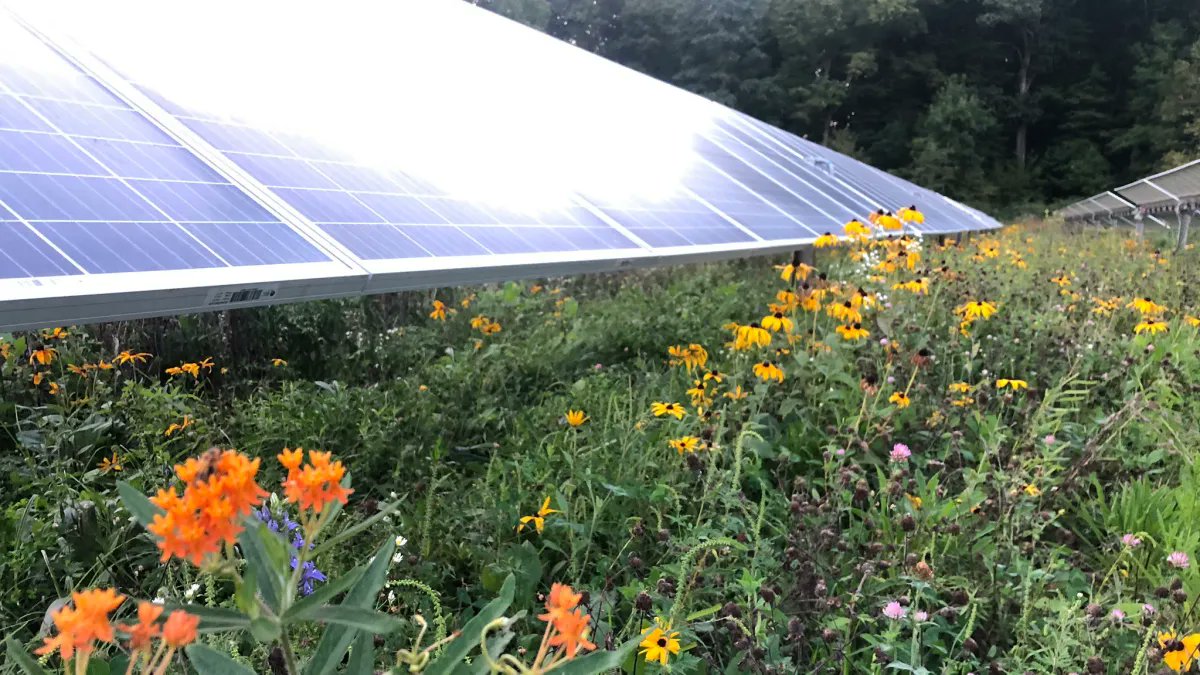
A solar farm in Minnesota planted native wildflowers between its panel rows. Five years later, total insect populations tripled. Native bees increased 20-fold.
Not only did insect populations boom, soybean fields next to the solar arrays got twice as many bee visits as fields farther away.
Two of the things we usually think of as competing turned out to reinforce each other.
One study, published in Environmental Research Letters in late 2024, tracked two utility-scale solar sites built on retired farmland in southern Minnesota, where the developer seeded native prairie species between rows of panels in 2018.
By 2022, the sites looked less like industrial energy infrastructure and more like remnant prairie.
Goldenrod soldier beetles colonized the goldenrod stands. Bumblebees nested in the soil. Monarch butterflies passed through during migration. The wildflower diversity grew sevenfold; insect diversity grew eightfold.
This matters because, like it or not, utility-scale solar is going to take up real space. The US is on track to cover roughly six million acres in panels by 2050.
The default approach is turfgrass, gravel, or herbicide-maintained bare ground, which is ecologically dead.
The Argonne study shows the alternative isn't more expensive or harder to maintain. It's just a different seed mix.
Disruptions to fuel supply chains highlight how countries w/ higher #renewables share show greater resilience. But renewables-based energy system also needs secure, diversified & cost-competitive supply. In the latest episode of 'All Things Renewable', @IRENA expert explains how reliable supply chains are key for the energy transition and #energysecurity. 🎧Listen to the podcast: https://t.co/AmOOKFOVM1