Everyone in Embodied AI is talking about Vision-Language-Action (VLA) models. Almost no one is talking about the physical nightmare of collecting the data to train them. You can't scrape a kitchen table or a warehouse shelf from a web browser.
To get to millions of hours of diverse, real-world manipulation data, you need hundreds of rigs. But you can't buy them. If you build them out of off-the-shelf developer kits, they weigh 15 pounds, overheat in an hour, require bulky cabling, and break the first time an operator wears them on a job site.
At the Instawork Robotics Lab (IRL), we had to build our own. Meet the Instacore: a rugged, 4lb wearable egocentric data-capture engine designed specifically to survive a full shift on a standard power pack.
We didn't build a flashy humanoid. We did hard, blue-collar systems engineering:
💾 THE COMPUTE — A custom MediaTek Genio carrier board that runs completely fanless, routing 5 camera streams directly to on-board storage.
⚡ THE I/O PIPELINE — We ditched USB for industrial GMSL. Thin, ultra-flexible coaxial lines route high-speed data down to the backpack and Power-over-Coax (PoC) back up, completely eliminating batteries on the wrist.
⏱️ UNIFIED SENSOR CLOCK — The MediaTek Genio SoC drives a shared master clock straight to the ISPs driving our 5 global shutter sensors, stamping metadata at the microsecond of capture to ensure zero-drift temporal alignment.
👁️ OPTIMIZED OPTICS — 95 DFOV lenses on flexible PCB ribbon modules keep the wrist cams flat to prevent snags. A 145-degree chest camera captures the macro workspace, while a 50mm baseline rectilinear stereo head pair preserves close-up 3D mapping.
To build hundreds of these, we took over a warehouse in Mountain View in April, called it the Instalab, and brought in talented Pros with assembly backgrounds from Tesla, Apple, and Meta.
To test the systems, we had our Pros wear active rigs while assembling more rigs. The video below shows the raw, time-synchronized Foxglove playback of that exact loop.
Now, we’re shipping these units globally to scale data collection for real Pros on the job.
Today, we're opening @Instawork Robotics Lab (IRL), connecting the robotics industry with > 10 million skilled workers. IRL is offering the first certified workforce program for the physical AI economy ... with 20,000 @Instawork Pros already certified! 👷
Read more from @alistairmbarr@BusinessInsider
https://t.co/57Jwyabf2P
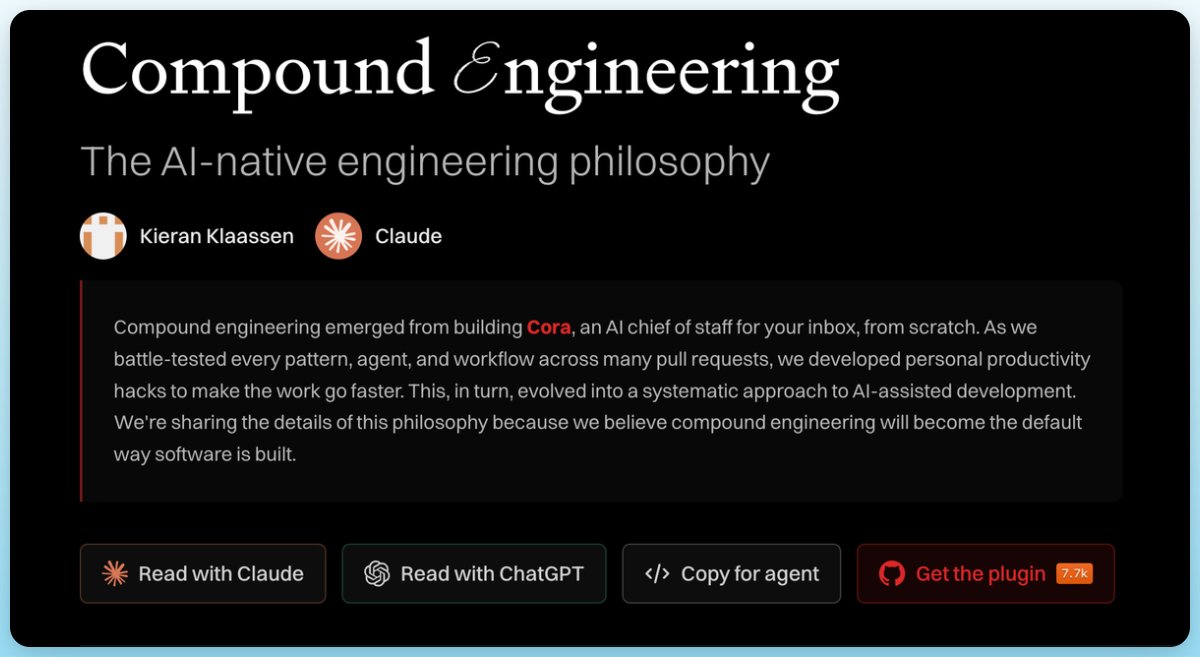
We just published the complete guide to compound engineering— @kieranklaassen's approach to AI-native development that has over 7,000 GitHub stars.
Drop it straight into Claude or ChatGPT and start using it:
https://t.co/zF5ErPfVZD
I have to say that over the last 24 hours I've found @X to be warm and welcoming.
The diversity of responses in both tone and content has been heart warming.
I did have to block one account with a large number of followers.
But beyond that, I appreciate all the engagement !
After the Russian Revolution, Lenin eased up a bit.
He allowed some capitalism with the New Economic Policy.
This took the fight out of the remaining Russian anti-communists and gave the Bolsheviks breathing room to consolidate power.
Then they resumed.
https://t.co/3HXYGOBkgX
This particular example is not super important, but it made me realize something important about journalists. The percentage who are engaged in a disinterested search for the truth is close to zero. They nearly all write as controversialists.
Finishing things is more than just an exercise in tidiness or self-discipline. In many projects, a surprising amount of the best work is done in what was meant to be the final stage.
If you're using a non-standard font, compare its x-height to SF Pro before you lock in all of your font sizes. This will help you create more legible interfaces.
Why? Thought you'd never ask...