🚨 ALERTA ALERTA!: Hari ini hari terakhir Fable 5 ada di subscription Claude. Mulai besok dia pindah ke pay per token, yang buat kita user biasa artinya boncos, ga bakal kepake lagi.
Sebelum ditarik, lo masih bisa "curi otaknya" biar tetep kepake di model yang lebih murah kayak Opus atau Sonnet.
Prinsipnya satu: jangan suruh Fable ngerjain kerjaan lo, suruh dia NULIS cara ngerjain kerjaan lo. Hasil kerjaan bisa dibikin ulang sama model yg lebih murah tanpa Fable.
Gini caranya:
🧠🤯 Bayangin semua riwayat chat Claude, ChatGPT, Apple Notes, sampai catatan kerja lu dikumpulin jadi satu "otak digital".
Ada yang ngelakuin itu pakai Obsidian... dan hasil graph-nya bener-bener mind-blowing. 🧵👇
Bukan cuma kumpulan catatan.
Semuanya saling terhubung, gampang dicari lagi, dan bikin ide yang tadinya kepisah jadi nyambung satu sama lain. ⚡
Yang menarik, dia gak pakai setup ribet atau plugin seabrek.
Dia cuma masukin semua data mentah ke satu vault:
📂 Chat Claude Code.
📝 Export Apple Notes.
💬 Riwayat ChatGPT.
📊 Laporan penjualan.
🎬 Script UGC.
📈 Catatan trading.
...pokoknya semua.
Setelah itu, Claude yang bantu ngerapiin saat proses ingest, sementara Obsidian bikin hubungan antar-catatan lewat graph view. 🕸️
Contohnya?
Dia bisa langsung lihat kalau lonjakan penjualan clothing brand-nya ternyata nyambung sama hook Instagram tertentu yang diuji beberapa minggu sebelumnya. 👀
Jadi ini bukan soal AI yang "ajaib".
Ini soal punya sistem organisasi yang bikin semua informasi gampang ditelusuri dan saling terkoneksi. 🧩
Masukin semua yang menurut lu penting.
Nanti sistemnya yang bantu ngasih gambaran besar dan menemukan pola yang mungkin selama ini gak kelihatan. 💡
Katanya dia bahkan bikin panduan PDF yang ngebahas:
📄 Workflow ingest lengkap.
🔄 Nightly optimization loop pakai Claude.
📁 Struktur folder yang dipakai buat ngembangin operasional UGC sampai tembus $10k+/bulan.
https://t.co/WyWc0rzJlr
🤯 CEO Obsidian baru aja ngerilis 5 skill gratis buat Claude Code yang menurut gue masih banyak orang belum tahu. Dan menariknya... semua ini dibagikan langsung sama Steph Ango, orang yang menjalankan Obsidian. 🚀
Yang paling bikin kaget?
Isinya cuma 5 file. 😳
Tapi kelima file ini nyelesain masalah yang sering nggak disadari banyak pengguna.
Secara default, Claude Code cuma ngelihat vault Obsidian sebagai kumpulan file .md biasa. Jadi dia nggak benar-benar paham gimana Obsidian bekerja.
Nah, skill ini ngajarin Claude Code buat ngerti ekosistem Obsidian yang sebenarnya, seperti:
🔗 Wikilinks
🔄 Backlinks
🎨 Canvas
🗂️ Bases
📝 Markdown khas Obsidian
Begitu Claude paham semua itu, vault lu nggak lagi cuma jadi tempat nyimpen catatan... tapi mulai berubah jadi sistem kerja yang aktif. 🔥
Contohnya:
📌 Masukin 200 catatan acak, Claude bisa bantu ngelink, ngasih tag, dan nyusun strukturnya secara otomatis.
✍️ Tinggal bilang, "Ubah highlight minggu ini jadi 3 draft postingan." Claude bakal ngambil ide langsung dari catatan lu sendiri, pakai konteks dan gaya tulisan yang udah ada, jadi proses bikin konten bisa jauh lebih cepat.
🗺️ Bahkan cukup 1 prompt, Claude bisa bikin Canvas board lengkap buat memetakan sebuah project yang biasanya butuh waktu sekitar 2 jam kalau dikerjain manual.
Workflow kayak gini ternyata juga dipakai banyak akun "faceless second brain":
📝 Notes masuk → ✨ jadi konten → 🔄 jalan setiap hari secara otomatis.
Setup-nya juga simpel banget:
1️⃣ Clone repo dari GitHub.
2️⃣ Pindahin 5 skill tadi ke folder Claude Code Skills.
3️⃣ Buka Claude Code langsung di dalam vault Obsidian.
Tanpa plugin.
Tanpa API key.
Tanpa harus langganan paket berbayar. 👀
Yang bikin gue makin geleng-geleng...
Di luar sana ada yang jual kursus AI Second Brain ratusan dolar, padahal fondasinya nggak jauh beda dari 5 file gratis yang baru dibagikan langsung sama CEO Obsidian.
Kadang informasi paling berharga memang dibagikan gratis... yang susah justru tahu kalau informasi itu ada. 🤯🔥
https://t.co/bllCkR6ZRI
I made Fable 5 and Opus 4.8 build the same app, website & game. The results will shock you.
Head-to-head comparison of Fable 5 versus Opus 4.8:
0:00 Intro
0:47 Website design
4:51 Mobile app design
7:14 Game design
12:37 Final thoughts
I don't prompt Claude Code anymore.
I have loops running that prompt Fable, and my job is just to write loops.
This is the Boris Cherny method, and I have to say, it's extremely powerful.
Everything you need to get started with loop engineering (as a complete beginner):
pendapat david noah soal 6 saham IPO:
- Underwriter adalah kunci
- track record underwriter lebih penting dari apapun
- HP, KI, LG terbaik sejauh ini
- JELI & PRDL, underwriter Sucor, reputasi bagus, size kecil allotment kecil tapi arah bisa 5-7x ARA bahkan UMA
- JECX — underwriter LG Trimegah, size lebih besar allotment lebih banyak tapi arah lebih pendek sekitar 2-3x ARA
- Strategi dana terbatas
- all in satu IPO saja per hari, pilih yang paling bagus
Tips IPO, pesan di malam terakhir penawaran, pantau antrian order
- semakin oversubs, semakin kecil allotment, semakin panjang arahnya
- Pilih IPO yang barangnya kering
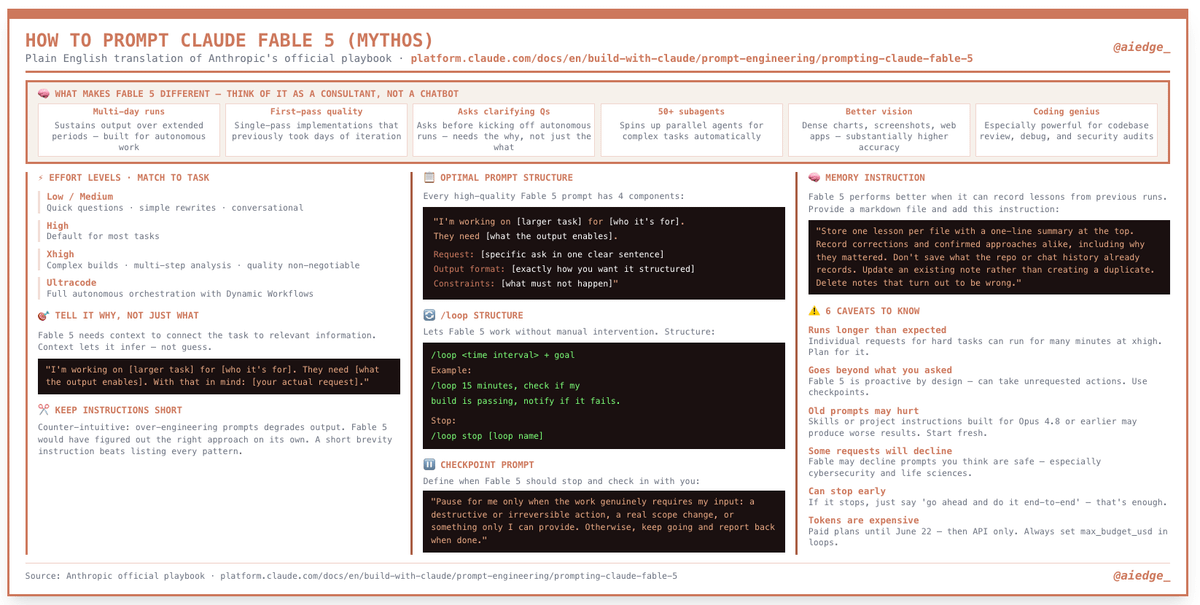
Anthropic just literally spoon-fed you how to use Fable properly.
99% of Claude users missed it.
The way you need to prompt Fable is fundamentally different from all other AI models.
I translated their entire new Fable prompting handbook:
Hermes Agent. Zero to full autonomous operation. One complete course.
Installation. Skills. Memory. MCP. Scheduler. Multi-agent.
Works while you sleep.
The people who build this system will never manually operate a content, research, or business workflow again.
The compounding starts from the first automated skill that runs.
Read this and bookmark it now.
GITHUB JUST CREATED AN OFFICIAL CERTIFICATION FOR THE MOST IN-DEMAND DEVELOPER ROLE OF 2026.
It is called Agentic AI Developer.
GH-600.
And it is the first formal signal that running AI agent teams is now a recognized engineering discipline with a credential behind it.
Not a prompt engineer.
Not a vibe coder.
An Agentic AI Developer.
The person who operates, supervises, and integrates AI agents across the entire software development lifecycle.
The person who knows where agents fail in production.
The person who understands how to build autonomous workflows that do not introduce catastrophic failure modes into CI/CD pipelines.
The person every engineering team is going to need and almost none of them have right now.
GitHub certifying this role changes the hiring conversation permanently.
Before GH-600: "Do you work with AI agents?" is an interview question with no standard answer.
After GH-600: the credential tells the hiring manager exactly what you know and what you can do before the interview starts.
The engineers who get certified in the first wave of GH-600 will have a credential for a role that has more demand than supply for the next 3 to 5 years.
The engineers who wait until it is mainstream will be competing with everyone who moved first.
If you are already working with GitHub Copilot or building agent-driven workflows you are already doing this job.
GH-600 is how you prove it.
Bookmark this.
Follow @cyrilXBT for every AI certification worth your time the moment it drops.
Claude Code creator:
"I don't prompt Claude anymore. I write loops - and the loops do the work. My job is to write loops."
in 30 minutes Boris reveals his actual daily Claude Code setup.
Claude Code + loops + dynamic workflow
Worth more than a $500 vibe-coding course
Anthropic engineer:
"You're not supposed to prompt Claude. You're supposed to build a system that prompts itself."
this is one of the best workflows I've seen in a long time
in this video she breaks down exactly how most people are using Claude:
- the daily workflows Anthropic's own engineers automated first
- the task pipelines most users don't know Cowork can run
- the scheduling system that handles your busywork while you do real work
- why opening Claude to type one prompt at a time is the 2024 way of doing things
if you've been using Claude for more than a month and never left the chat window, you've been using one agent when you could be running a team of them
instead of another show tonight, watch this
make sure to bookmark it before it gets lost in your feed
the guide is in the article below
A harnessed LLM agent, clearly explained!
Most people picture this as a model with tools bolted on. The real architecture inverts that relationship.
The model itself is deliberately thin. Intelligence gets pushed outward, and the harness composes it at runtime.
Three dimensions orbit the harness core:
- 𝗠𝗲𝗺𝗼𝗿𝘆 holds the state a model shouldn't carry in weights or context. Working context, semantic knowledge, episodic experience, and personalized memory each have their own lifecycle.
- 𝗦𝗸𝗶𝗹𝗹𝘀 hold procedural knowledge. This can cover operational procedures, decision heuristics, and normative constraints that specialize the general model per task.
- 𝗣𝗿𝗼𝘁𝗼𝗰𝗼𝗹𝘀 hold the interaction contracts. Agent-to-user, agent-to-agent, and agent-to-tools are three distinct surfaces with their own failure modes.
Between the core and these modules sit the mediators, like sandboxing, observability, compression, evaluation, approval loops, and sub-agent orchestration.
They govern how the harness reaches out and how state flows back in.
The useful question this framing unlocks is: for any new capability, where should it live?
- Stable knowledge goes to memory
- Learned playbooks go to skills
- Communication contracts go to protocols
- Loop governance goes to the mediators
Harness design becomes a question of what to externalize, and how to mediate it.
I'm building a minimal agent harness from scratch and will open-source it soon.
In the meantime, my co-founder wrote an article about the anatomy of Agent Harness, covering the orchestration loop, tools, memory, context management, and everything else that transforms a stateless LLM into a capable agent.
Read it below.
Anthropic engineer:
"You're not supposed to prompt Claude. You're supposed to build a system that prompts itself."
this is one of the best workflows I've seen in a long time
in this video she breaks down exactly how most people are using Claude:
- the 14% you lose to CLAUDE.md before typing a word
- the automation workflows most users don't know exist
- the daily task pipelines that run without touching the keyboard
- the daily workflows Anthropic's own engineers automated first
if you've been using Claude for more than a month and never left the chat window, you've been using one agent when you could be running a team of them
instead of another show tonight, watch this
make sure to bookmark it before it gets lost in your feed
the guide is in the article below
Anthropic engineer:
"You can build 5 assistants in one afternoon. Each one handles a task you've been doing manually every single day."
In 45 minutes he builds 5 focused agents from scratch on camera.
Most people are still doing code review, testing, and documentation by hand every single day
Watch the session, then save all templates below 👇
i can't believe people don't know you can just make your skills better using iterative AutoResearch
we did it for our browser skills and created /autobrowse, read about how we make our skills up to 90% faster and cheaper to run.
Hermes agent masterclass.
In this video, I cover everything you need to understand and customize Hermes Agent. Self-evolving skills, three-tier memory, GEPA optimization, and going from 1 to 10 agents that work for you 24/7.
Enjoy!
Chapters:
00:00 - Intro
02:03 - How to get the most out of this video
02:32 - What we're building (and why it's wild)
07:11 - How the whole thing works under the hood
09:27 - The SOUL.md: your agent's personality file
11:15 - The 3-tier memory system that keeps it all together
14:16 - Skills: what your agent can actually do
16:49 - The self-evolving loop (agents that improve themselves)
19:58 - The curator: Hermes' built-in garbage collector
22:56 - GEPA optimization: making your agent sharper
25:08 - Installation and setup
27:38 - Connecting your agent to Telegram
30:36 - Configuring programmer with Claude Code
31:53 - Adding new skills (from a hub of ready-made skills)
34:59 - Going from 1 to 10 agent profiles
36:49 - Building a custom designer from scratch
40:42 - Anatomy of the .hermes folder (where everything lives)
45:05 - Skill taps: sharing skills via a GitHub repo
45:59 - Skill bundles: stacking skills for workflows
47:19 - Hermes Kanban (coming soon)
48:05 Outro
Cheers! :)
If you read just one AI article this month, make it this.
How to automate ANYTHING in your life using AI in <10 minutes.
This is the most valuable article I could give you right now.
Follow this roadmap, and you'll instantly become more productive:
Anthropic pays $750,000+ a year for engineers who know how to build LLMs from scratch.
Stanford just released the exact lecture that teaches it - 1 hour 44 minutes, free, straight from CS229.
Bookmark and watch it this weekend.
It'll teach you more about how ChatGPT & Claude actually work than most people at top AI companies learn in their entire careers.
self-evolving skills in Hermes agent.
i found this to be the most powerful feature in Hermes.
the agent doesn't just solve problems, it remembers how it solved them.
memory handles facts, and skills handle procedures. the difference matters because knowing that a Kubernetes pod crashed is useless without knowing the exact sequence of commands that fixed it.
here's how the self-improvement loop works in six steps:
1. the agent encounters a problem
2. works through trial and error: 5+ tool calls, errors, retries
3. finds a working solution
4. calls 𝘀𝗸𝗶𝗹𝗹_𝗺𝗮𝗻𝗮𝗴𝗲(𝗰𝗿𝗲𝗮𝘁𝗲) to save the successful approach as a 𝗦𝗞𝗜𝗟𝗟.𝗺𝗱 file
5. the skill is saved to ~/.hermes/skills/
6. next session, the agent reads the skill and follows the proven procedure instead of rediscovering from scratch
skill creation triggers automatically when the agent completes a complex task, hits errors and recovers, receives a correction from you, or discovers a non-trivial workflow.
now here's the important part:
without maintenance, agent-created skills can pile up fast. that's why Hermes ships with a Curator that runs in the background, merging overlapping skills, archiving unused ones, and never auto-deleting anything. worst case is archival, and rollback is one command.
in this way every hard problem the agent solves once, it solves faster the next time. the agent compounds.
i wrote a full deep dive covering hermes agent's self-evolving skills, three-tier memory, GEPA optimization, and setting up multiple specialized agents.
the article is quoted below.