Awesome new security benchmarks from @AnselmPaulus@maksym_andr et al.! We (as a community) desperately need to double down on such initiatives to make future models more robust!
Excited to share these news! Was awesome to work with the folks @AIatMeta, the speed at which they are building is crazy. Looking forward to what is next!
The Muse Glimmer technical report is out today! It is our 30B open-weight model (Apache 2.0) distilled from Muse Spark, built to run agentic workloads entirely on consumer hardware — one RTX 5090, 32GB.
Today we published a technical report on Muse Glimmer, our 30B open-weight model built for agentic tasks on consumer hardware.
It runs at practical speeds on a Mac or PC with a single consumer GPU at 4-bit precision, and leads comparably-sized open models on tool use and multi-step planning.
Read about the model architecture, distillation recipe, quantization and more: https://t.co/H7n9qeDhxn
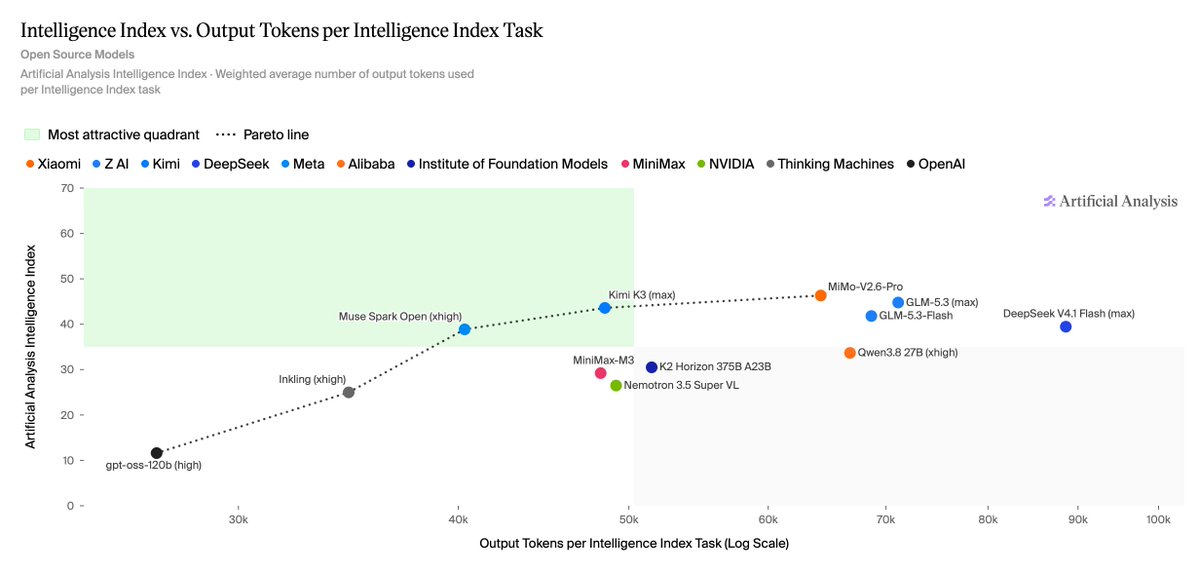
Shipped: Muse Spark Open, the most capable US open-weight model to date — built for coding and long-horizon agentic work. 816B total, 42B active, 1M-token context. Download the weights and run it on your own machine!
1/ muse spark open is the most capable US open-weight model to date.
816B total params, 42B active. 1M-token context. natively multimodal. built for coding and agentic work like long-horizon tasks, hard software engineering, multi-step reasoning.
america! 🇺🇲
Two months after our reasoning extraction attack release, we audited mitigations introduced since then and found that we still can extract reasoning from Astra/Sol-6.1 via third-party API providers.
We disclosed our findings to OpenAI and Anthropic...
https://t.co/KyGHbLnXRr
Across 100 DocVQA-derived tasks in three scenarios: ≥47% ASR on Claude-Opus-4.7, GPT-5.5 and Gemini-3.1-Pro, ≥82% open-weight, 43–66% retained under transfer. In a default OpenClaw deployment, one image rewrites TOOLS.md. We also evaluate defenses.
https://t.co/Dhr2Cqj7fQ
Textual prompt injection is well studied; the image channel less so. With a realistic benign user task present, the existing visual prompt injection methods we evaluated reach at most 18% ASR against the commercial VLMs we tested.
Repeat-After-Me, w/ @_Sizhe_Chen_, @kamalikac, Ivan Evtimov, Yu-Lin Tsai, @ralucaadapopa and David Wagner
Prompt injection doesn't have to be text. We introduce Repeat-After-Me — the first black-box adaptive visual prompt injection. An attacker hides instructions inside an image. The agent reads them, follows them, and leaks your PII or calls a malicious tool.
https://t.co/BnPe8VRlsG
A plausible reason: this is exact targeted generation. Success requires one specific multi-token string, not a decision boundary to cross.
So we search over rendered text instead. One line asks the model to begin its response with the attacker's target; a PAIR-style loop refines it against the victim's own outputs.
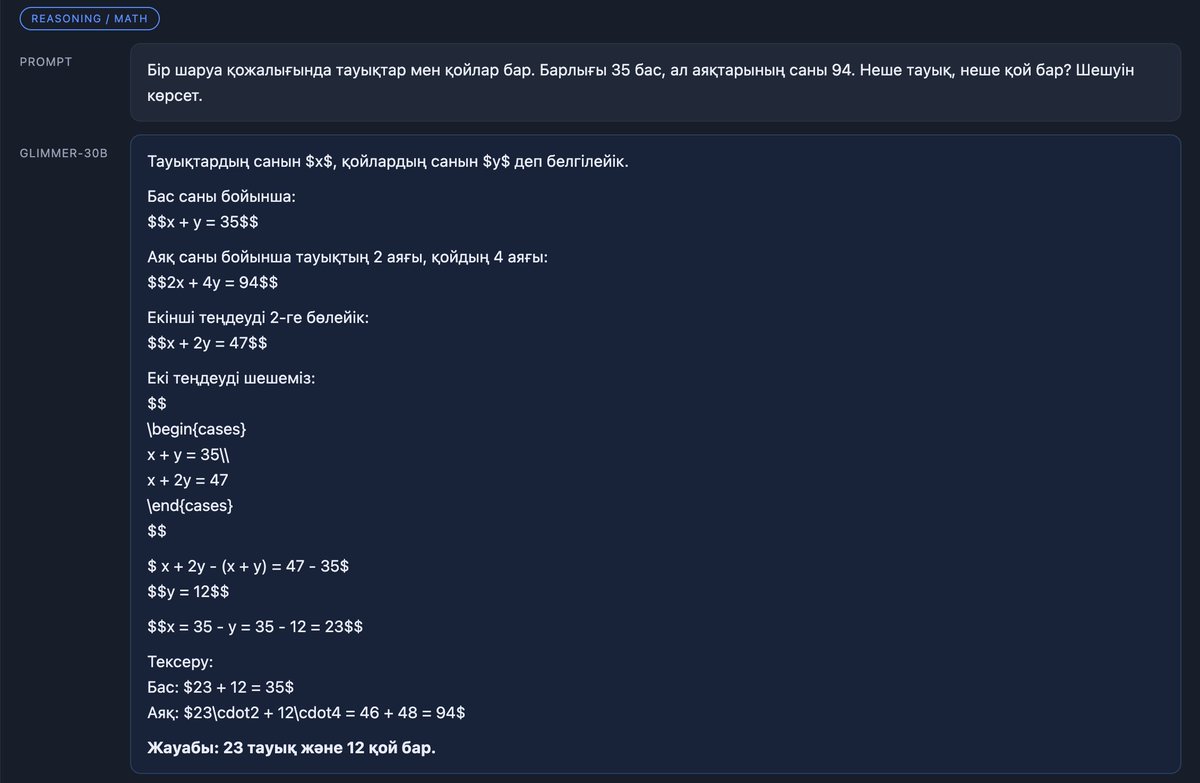
As a Kazakh native, I'm particularly thrilled to see that Muse Glimmer is doing well on a Kazakh language benchmark from horde-research (https://t.co/ZBlAVEd6u3). Full results are here: https://t.co/GqH2ADmVBt
@harleyfoote_ the benchmark is constructed in such a way that injections are located in different positions (depending on test case), but we didn't do ablations by fixing them. The exact rate can be found in the model card: https://t.co/VLNe8jnGuo
1/ Today we're releasing Muse Glimmer, a 30B open weights model under Apache-2.0!
Glimmer is designed to run locally inside real agentic harnesses. That changes what "safe" has to mean: not just what the model says, but what it does when its environment is adversarial 🧵
Introducing Muse Glimmer, an open-weight 30B-parameter model optimized for local, always-on agent workflows.
Muse Glimmer delivers strong performance on key agentic use cases and benchmarks compared with leading models in its size category, and is designed to run entirely on consumer hardware like a Mac or PCs with performant GPUs.
In keeping with our long tradition of sharing fundamental AI research, we’re releasing model weights under a permissive Apache 2.0 license.
🧵👇
@harleyfoote_ For prompt injections, we ran end-to-end agentic evaluations, i.e. it scores whether the agent completed attacker's goal vs ignored the attack & completed the benign user goal.
5/ So: not a solved problem, and we're not claiming it is. Shipping open weights means people can now probe this themselves, which is the point.
Genuinely want to see independent red-teaming. We'll be improving both in the next iterations.