@mdnavans@Aadil_2001@hameedsyed981 Why would associating a hashtag or a particular phrase with an established act of worship be problematic?
It is simply a phrase that has become widely used as an honorific designation for those who pray the Fajr prayer in masjid.
@mdnavans@Aadil_2001@hameedsyed981 Rijal al Fajr isn't an event or something. It's just a hashtag trend that is associated with encouraging children to attend Fajr prayer.
It's like other descriptive designations that develop through common usage.
When those who ascribe themselves to Salafism say something wrong, the first people to refute them are the Salafis themselves, because their allegiance is to the Sunnah. The same cannot be said for other sects.
@OfficialRayanK@maalik4125 Broken clock is right twice a day.
Sadly, many Salafis have taken on a cultish attitude, going to extremes to criticise others over minor errors or disagreements about specific scholars.
@Ibnsajidad@AlLubak@QadriMurid An individual or society can't just transition to an ideal state. It's practically impossible.
A person being motivated by a trend to do a good deed and then gradually perfecting their intention is a necessary transitional phase.
@Ibnsajidad@QadriMurid Not quite. The campaign served as a great reminder that actually got a lot of people started. Sometimes, we all just need a small external push to do the right thing when it feels hard.
Sheikh Badr bin Muhammad al-Turki حفظه الله, recitation with English captions
Surat an-Naziat 42-46 [Only Allah knows when the Hour will come, and on that Day their life in this world will seem like a single afternoon or morning]
The “Rijāl al-Fajr” (Men of Fajr) Campaign: Is It a Bidʿah?
Those who declare this campaign a bidʿah rely upon the statement of the Prophet ﷺ:
“Whoever introduces into this matter of ours that which is not from it, it shall be rejected.”
They also rely upon the principle of the Salaf: “Had it been good, they would have preceded us in it,” and the statement of Shaykh al-Islām Ibn Taymiyyah concerning innovations introduced due to the sins and shortcomings of the servants.
These are sound principles, but the issue lies in their proper application.
The Fajr prayer itself is an act of worship that is tawqīfī (restricted to revelation). However, waking those who are asleep, reminding the negligent, encouraging children through rewards and gathering for breakfast are means of encouraging obedience, not independently legislated acts of worship.
The innovations condemned by Ibn Taymiyyah concern matters such as introducing the adhān for the ʿĪd prayer or placing its khuṭbah before the prayer. The campaign, however, introduces no alteration to the Fajr prayer itself.
Furthermore, the practices employed in this campaign have foundations in the Sunnah and the actions of the Salaf:
• Checking on absentees: The Prophet ﷺ would enquire about those absent from Fajr. Likewise, when ʿUmar ibn al-Khaṭṭāb رضي الله عنه noticed the absence of Sulaymān ibn Abī Ḥathmah, he approached his mother and asked about him. (Al-Muwaṭṭaʾ, 1/131)
• Gathering after prayer: The Prophet ﷺ would remain seated after Fajr until sunrise, while his Companions conversed and laughed, and he would smile. (Ṣaḥīḥ Muslim, 4/1810)
• Encouraging children through permissible means: Al-Rubayyiʿ bint Muʿawwidh رضي الله عنها narrated that the Companions would make their children fast and give them toys made of wool to distract them until the time of breaking their fast. (Ṣaḥīḥ al-Bukhārī and Muslim)
Thus, encouraging children through permissible rewards is not without precedent. The objective is to accustom them to obedience until they become accustomed to performing it for its own sake.
al- Imām Manṣūr al-Buhūtī رحمه الله stated concerning congregational prayer:
“It was legislated for the sake of maintaining relationships, fostering mutual affection and preventing estrangement.”
(Al-Rawḍ al-Murbiʿ, 1/333)
When the people of a neighbourhood gather for Fajr and subsequently share a meal, they are fulfilling one of the very objectives for which congregational prayer was legislated.
The campaign should therefore be preserved from invented acts of worship, claims of specific virtues without evidence, and the humiliation of those who fail to attend. It should also be conducted under the supervision of the mosque’s imām.
There is no basis for declaring such a campaign a bidʿah merely because of its organisational format.
May Allah bless those behind these campaigns and place in their scales the reward of every person they encourage to walk to His houses in the darkness.
The Prophet ﷺ said:
“If they knew what was in the ʿIshāʾ and Fajr prayers, they would come to them even if they had to crawl.”
(Ṣaḥīḥ Muslim, 1/325)
@Ibnsajidad@QadriMurid Those who are doing it after the campaign are obviously doing it for the sake of Allah, the campaign was just a reminder for them. They aren’t doing it to conform to society.
Refuting al Rāzī’s Use of Allah’s Forgetting as Evidence for Taʾwīl of the Ṣifāt
The argument rests on the assumption that nisyān (forgetting) in every context means the absence of knowledge so it would need to be interpreted.
Their punishment itself entails Allah's knowledge of their circumstances. Allah creates their punishment through His will, and will necessarily entails knowledge. Allah decreed and recorded their punishment before its occurrence and knows it after its occurrence.
Forgetting Does Not Necessarily Entail an Absence of Knowledge
For instance, someone may say to a person who has given wealth to others, praised them or honoured them: "You forgot me and did not do for me what you did for so and so."
The person addressed may have been fully aware of him but deliberately withheld such favours because he did not deserve them.
Similarly, someone who has punished another person by imprisoning him may say that he has forgotten him, despite being conscious of him. What is meant is that he no longer mentions him with goodness as he does others.
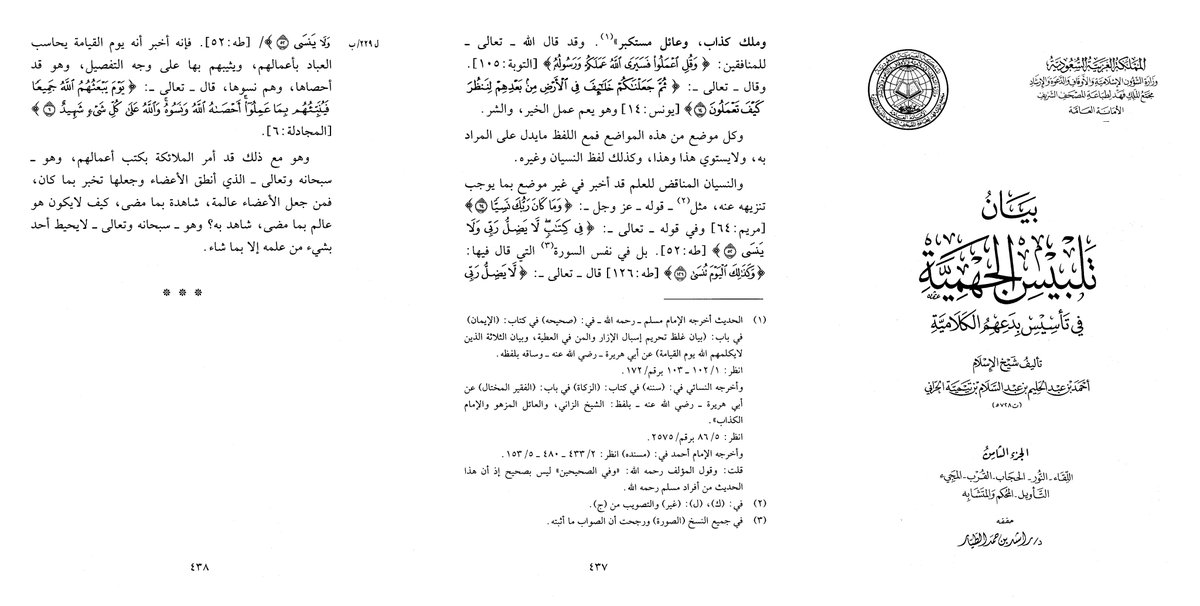
The usage of forgetting in such a context does not entail an absence of knowledge. (Bayān Talbīs al-Jahmiyyah, 9/429–431).
The Relationship Between Forgetting and Remembrance
Nisyān is the opposite of dhikr (remembrance or mention), as Allah says:
"And remember your Lord when you forget." (Al Kahf 18:24).
However, dhikr does not always refer to remembrance in an unrestricted sense. It may refer to praising someone, treating him favourably or mentioning him with criticism.
Allah says:
أَهَٰذَا الَّذِي يَذْكُرُ آلِهَتَكُمْ وَهُمْ بِذِكْرِ الرَّحْمَٰنِ هُمْ كَافِرُونَ
"Is this the one who mentions your gods? Yet they themselves reject the remembrance of the Most Merciful." (Al Anbiyāʾ 21:36).
The Messenger of Allah ﷺ mentioned their gods with criticism, whereas the remembrance of Allah that they rejected was the remembrance of praise and glorification. The distinction between the two meanings is understood through the context.
Allah also says:
وَإِذَا ذُكِرَ اللَّهُ وَحْدَهُ اشْمَأَزَّتْ قُلُوبُ الَّذِينَ لَا يُؤْمِنُونَ بِالْآخِرَةِ
"When Allah alone is mentioned, the hearts of those who do not believe in the Hereafter recoil in disgust." (Al Zumar 39:45).
وَإِذَا ذَكَرْتَ رَبَّكَ فِي الْقُرْآنِ وَحْدَهُ وَلَّوْا عَلَىٰ أَدْبَارِهِمْ نُفُورًا
"And when you mention your Lord alone in the Qur'an, they turn their backs in aversion." (Al Isrāʾ 17:46).
Those who forgot Allah were conscious of His existence, supplicated to Him during hardship and acknowledged Him as their Creator when questioned. However, they neglected the remembrance that Allah deserves by turning away from His revealed Book, commands, prohibitions and what He informed them of.
The Punishment Corresponds to the Deed
Allah says: "Whoever turns away from My remembrance will have a miserable life, and We will raise him blind on the Day of Resurrection. He will say, 'My Lord, why have You raised me blind when I used to see?' He will say, 'Thus did Our signs come to you, but you forgot them, and thus will you be forgotten today.'" (Ṭā Hā 20:124–126).
Allah's signs reached the disbeliever, but he turned away from them despite being aware of them. His recompense is to be deprived of the goodness with which Allah remembers and rewards the believers.
This is further explained in the Ḥadīth Qudsī in which Allah says: "Whoever remembers Me within himself, I remember him within Myself, and whoever remembers Me in a gathering, I remember him in a gathering better than theirs." (Ṣaḥīḥ al-Bukhārī, 6/2694; Sharḥ Ṣaḥīḥ Muslim, al-Nawawī, 17/2; Jāmiʿ al-Tirmidhī, 3603)
Allah's remembrance of His servant here is a reward for the servant remembering Him. Allah knows the servant regardless of whether the servant remembers Him or not. As for the one who turns away from His remembrance, Allah turns away from mentioning him with goodness. (Bayān Talbīs al-Jahmiyyah, 9/432–434).
The Same Linguistic Principle Applies to Hearing
Another way of demonstrating the flaw in al Rāzī's argument is through the usage of samʿ (hearing).
Speech consists of khabar (information) and ṭalab (request). What is sought from the listener in the former is acceptance of the information as true, whilst what is sought in the latter is a response to the request.
For instance, when we say:
"Samiʿa Allāhu liman ḥamidah (Allah hears whoever praises Him)."
What is meant is that Allah answers his dua, not that Allah only hears those who praise Him.
Allah says: "Indeed, my Lord is the Hearer of supplication." (Ibrāhīm 14:39)
"If I am guided, it is because of what my Lord reveals to me. Indeed, He is Hearing and Near." (Sabaʾ 34:50).
Allah also hears those whose speech He condemns: "Indeed, Allah has heard the statement of those who said, 'Allah is poor, and we are rich.'" (al ʿImrān 3:181).
Hearing is used in the sense of accepting and obeying others in Al Māʾidah 5:41–42 and Al Tawbah 9:47.
Thus, explaining hearing in a particular context as answering, accepting or obeying does not entail negating the actual attribute of hearing. The intended meaning is understood from the particular context.
The Same Linguistic Principle Applies to Seeing
The term naẓar (looking) may also convey love, mercy and compassion according to its context.
Allah says: "Allah will neither speak to them nor look at them on the Day of Resurrection." (Āl ʿImrān 3:77)
The Messenger of Allah ﷺ also informed us that Allah will neither speak to, look at nor purify an elderly adulterer, a lying ruler and an arrogant poor person on the Day of Resurrection. (Ṣaḥīḥ Muslim, 1/102–103; Sunan al-Nasāʾī, 2575)
This does not mean that Allah cannot see them. Rather, the one who is loved and shown mercy is looked upon favourably, whilst the one who is hated is turned away from.
As for seeing in a general sense, Allah says: "Say, 'Do deeds, for Allah will see your deeds, as will His Messenger.'" (Al Tawbah 9:105).
"Then We made you successors in the land after them to see how you would act." (Yūnus 10:14)
This encompasses both good and evil deeds.
In each of these instances, the expression is accompanied by something indicating its intended meaning. The meanings are not identical in every context, and the same applies to the term nisyān. (Bayān Talbīs al-Jahmiyyah, 9/434–437)
The Qur'an Negates Forgetfulness That Contradicts Knowledge
Allah explicitly negates the form of forgetting that contradicts knowledge:
"And your Lord is never forgetful." (Maryam 19:64)
"My Lord neither errs nor forgets." (Ṭā Hā 20:52).
It is worth noting that in the very same Sūrah in which Allah negates forgetting, He attributes forgetting to Himself in relation to the disbelievers.
Allah will hold His servants accountable for their deeds on the Day of Resurrection and inform them of what they did in detail, including deeds which they themselves have forgotten.
"On the Day Allah resurrects them all and informs them of what they did. Allah has recorded it, whilst they have forgotten it. And Allah is Witness over all things." (Al Mujādilah 58:6)
Allah commands the angels to record their deeds and causes their bodily limbs to speak and testify concerning their past actions. How could the One who causes their limbs to know and testify concerning what occurred be unaware of what occurred Himself? (Bayān Talbīs al-Jahmiyyah, 9/437–438)
Why Al Rāzī’s Argument Does Not Justify Taʾwīl of the Ṣifāt
The problem with al Rāzī's argument is that it confuses the meaning of a word in isolation with its intended meaning when used in a particular context.
For the argument to be valid, it would first have to be proven that nisyān necessarily entails an absence of knowledge in every context in which it occurs. Arabic usage, the explanations of the Salaf and the Qur'an itself demonstrate otherwise.
Explaining a word according to its context is not the same as diverting it from its intended meaning. Explaining Allah's forgetting of the disbelievers as depriving them of goodness, honour and reward does not require negating the intended meaning of the verses.
Al Rāzī's argument fails to demonstrate the necessity of taʾwīl in these verses and cannot serve as evidence for diverting the meanings of Allah's other attributes.
Bayān Talbīs al-Jahmiyyah, Ibn Taymiyyah, 9/429–438
| The Ashāʾirah testify that their position on the Qurʾān is the same as the Muʿtazilī (Jahmī) view – that the Qurʾān is created |
🔹Abū al-Maʿālī al-Juwaynī (d. 478 AH) said:
“For the meaning of their (i. e., the Muʿtazilah) statement, ‘These expressions (i. e., the Arabic Qurʾān) are the speech of Allah,’ is that He created them. And we do not deny that they are Allah’s creation (Khalqullāh), but we refrain from calling the creator of speech ‘a speaker’ by it. Thus we have agreed on the meaning, and then, after agreeing, disputed over what to call it.”
📕 Al-Juwaynī, al-Irshād (p. 116-117).
🔹Al-Jurjānī (d. 816 AH) said in his commentary on al-Mawāqif by al-Ījī (d. 756 AH):
“Know that what the Muʿtazilah say about the speech of Allah, the Exalted, namely that it is the creation of sounds and letters that indicate the intended meanings, and that it is originated and subsists in something other than His Essence, we also affirm. There is no dispute between us and them about that [...].”
He also said:
“This, which the Muʿtazilah said; we do not deny it. Indeed, we affirm it ourselves and call it ‘verbal speech (kalām lafẓī)’, and we acknowledge that it is created (muḥdath) [...].”
📕 Al-Jurjānī, Sharḥ al-Mawāqif (8/107 & 8/106).
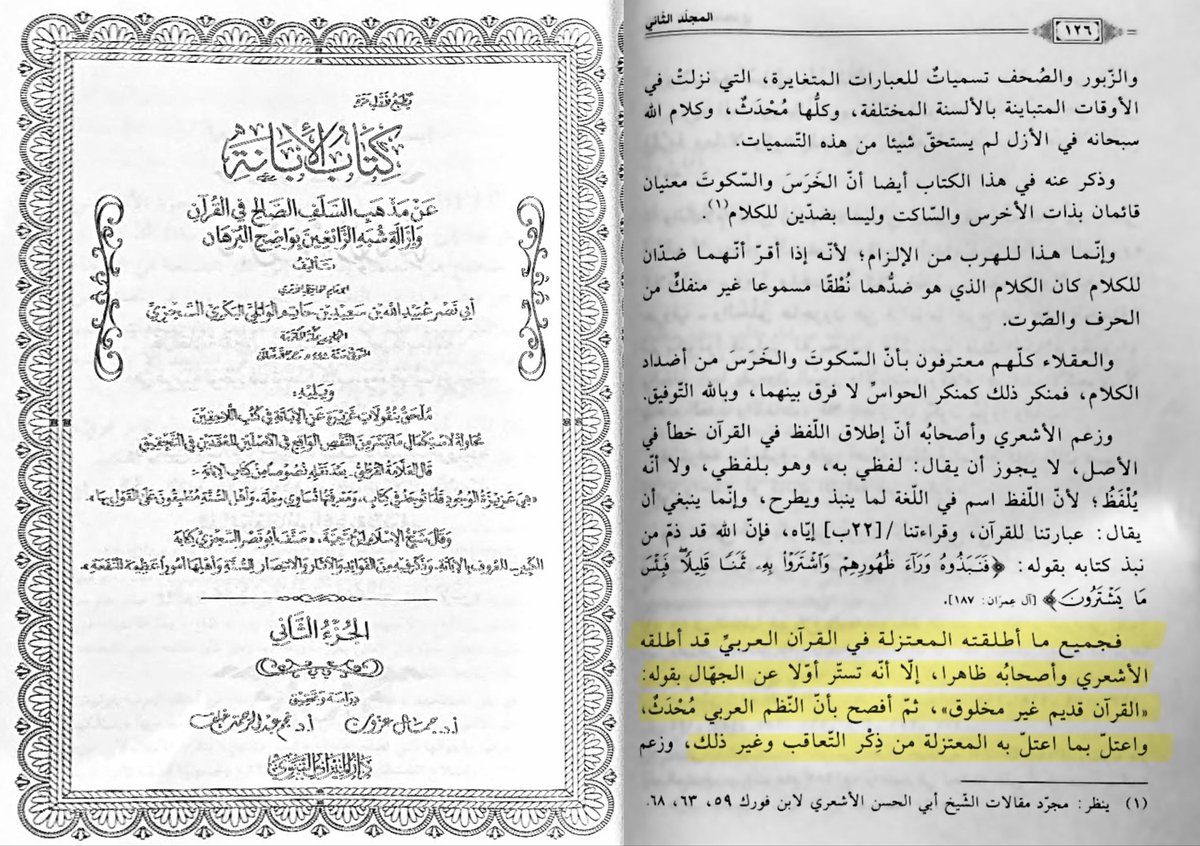
🔹Imām Abū Naṣr as-Sijzī (d. 444 AH) said regarding the Ashʿarī view:
“So everything that the Muʿtazilah declared about the Arabic Qurʾān, al-Ashʿarī and his followers have also declared outwardly. However, he (i. e., al-Ashʿarī) first concealed it from the ignorant people by saying, ‘The Qurʾān is eternal, uncreated,’ and then he made it plain that the Arabic composition (an-Naẓm al-ʿArabī) / the Qurʾān) is created (muḥdath), and he put forward as a pretext the same things the Muʿtazilah put forward [...].”
📕 Abū Naṣr as-Sijzī, al-Ibānah (2/126).
Imām Najm al-Dīn al-Ṭūfī al-Ḥanbalī (d. 716 AH) points out that Fakhr al-Dīn al-Rāzī, in his book Al-Arbaʿīn, was unable to adequately refute the arguments of those who affirmed jihah and consequently resorted to reprehensible sophistry.
al-Imām Ibn Rajab al-Hanbalī (رحمه الله تعالى) said:
“In any case, the eminent ḥadīth critics who are well-versed in the hidden defects of ḥadīth (ʿilal al-ḥadīth) are exceedingly few among the scholars of ḥadīth.
The first to become renowned for speaking on the criticism of ḥadīth was Ibn Sīrīn.
He was then succeeded by Ayyūb al-Sakhtiyānī, from whom Shuʿbah acquired this knowledge. From Shuʿbah, Yaḥyā al-Qaṭṭān and Ibn Mahdī acquired it, and from these two, Aḥmad, ʿAlī ibn al-Madīnī and Ibn Maʿīn acquired it. From them, in turn, it was acquired by the likes of al-Bukhārī, Abū Dāwūd, Abū Zurʿah and Abū Ḥātim.
Abū Zurʿah used to say in his time:
“Few are those who understand this, and how rare it is! Once you look beyond one or two individuals, how few are those whom you find proficient in this!”
When Abū Zurʿah died, Abū Ḥātim said:
“The one who was proficient in this has departed”—meaning Abū Zurʿah—“and there remains neither in Egypt nor in Iraq a single person proficient in this.”
After the death of Abū Zurʿah, he was asked: “Do you know anyone today who knows this?”
He replied: “No.”
After these came a group of scholars, among whom were al-Nasāʾī, al-ʿUqaylī, Ibn ʿAdī and al-Dāraquṭnī.
Few of those who came after them excelled in the knowledge of this, to the extent that Abū al-Faraj Ibn al-Jawzī said at the beginning of his book al-Mawḍūʿāt:
“Those who understand this have become few; rather, they have become nonexistent.” And Allāh knows best.”
(Jāmi’ al-‘Ulūm wa'l-Hikam, p. 564)
Imām al-Baghawī al-Shāfiʿī on affirming Allah’s two Hands, as quoted by al-Zarkashī:
“Allah’s explicit use of the dual form for the Hand is evidence that it does not mean favour, strength or power. Rather, they are two attributes of His Essence.”
*Note - this is virtually identical to what al-Thaʿlabī mentions in his tafsīr, so perhaps al-Zarkashī inadvertently confused al-Baghawī with al-Thaʿlabī, or al-Zarkashī had access to a different manuscript of al-Baghawī's tafsīr?
Allāhu aʿlam.