TLDR: We brought (Auto)LFADS to PyTorch, now available on GitHub and NeuroCAAS! 🔥
@chethan and I are excited to announce lfads-torch, a new impl. of (Auto)LFADS, designed to be easier to understand, configure, and extend! ⚡️
https://t.co/XSOY06uk85
https://t.co/KLzygarpk2
Modern neuroscientists routinely record the complex, goal-oriented, and time-varying activity of thousands of neurons. Can we find representations of neural activity that 1) are human-interpretable and 2) enable the generation of neural activity for unrecorded behavioral conditions? We present our recent work on Generating Neural Observations Conditioned on Codes with High Information (GNOCCHI) 🥔🍝 !!
By leveraging unsupervised, information-based diffusion models, GNOCCHI can discover interpretable latent spaces from neural data and generate high-quality neural activity for specific conditions outside of the set of available neural recordings!
I started my company originally to build maximally agency-increasing BCI without profit motive, and that's worked decently well so far
BUT AGI timelines are shortening, so we are pivoting to work on neglected approaches to alignment
So fortunate to lead an amazingly talented lab. These folks are 𝒄𝒓𝒂𝒏𝒌𝒊𝒏𝒈 𝒐𝒖𝒕 great science.
🧵 of must-see posters, which span NeuroML / AI, clinical BCI (+@BrainGateTeam), population dynamics, 2P Ca imaging, spinal pattern generation, EMG… 🧠🔬👩🔬👨🔬📈 #SfN23
⬇️
Is a universal brain decoder possible? Can we train a decoding system that easily transfers to new individuals/tasks?
Check out our #NeurIPS2023 paper where we show that it’s possible to transfer from a large pretrained model to achieve SOTA 🧠!
Link: https://t.co/0Iebjpt4TM 🧵
Neural Data Transformer 2 (NDT2), preprint + accepted to NeurIPS 23! A study on Transformer pretraining neuronal spiking activity across multiple sessions, subjects, and experimental tasks! With @jenpgh, Leila Wehbe, and @robert_gaunt1! 1/7
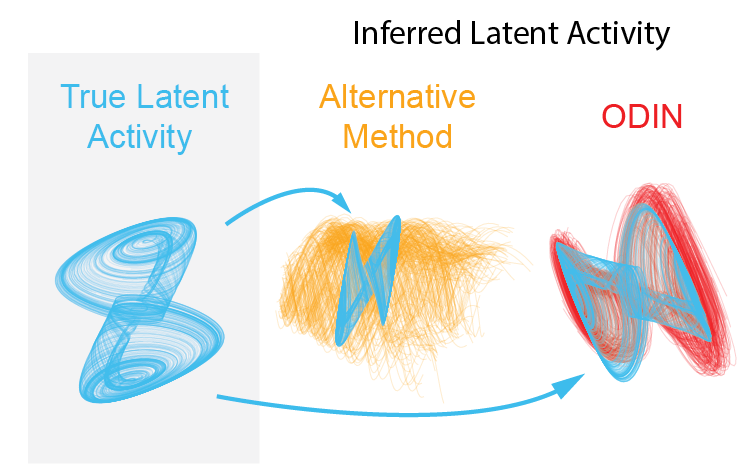
Ever wondered whether the dynamics learned by LFADS-like models could help us understand neural computation? @chethan,@arsedle, @JonathanDMcCart, and I developed ODIN to robustly recover latent dynamical features through the power of injectivity! 📜 1/ https://t.co/dovP0LxVNt
@ConsciousMeat@chethan Yes! We’d recommend chopping the continuous session up into fixed-length, overlapping segments and then linearly merging the segments back together after modeling. We used this technique for the MC RTT dataset in the NM paper so there’s more detail there!
TLDR: We brought (Auto)LFADS to PyTorch, now available on GitHub and NeuroCAAS! 🔥
@chethan and I are excited to announce lfads-torch, a new impl. of (Auto)LFADS, designed to be easier to understand, configure, and extend! ⚡️
https://t.co/XSOY06uk85
https://t.co/KLzygarpk2
@NinelK1@chethan Thanks, we hope so! Great question-- we haven't done a rigorous comparison but anecdotally training steps seem comparable to if not faster than TF2. May have something to do with async GPU operations?
https://t.co/Uuz37omGhH
This project is the result of a significant engineering effort to make (Auto)LFADS more accessible to the community and we are excited to see how it’s used. Please reach out and let us know what you think!
lfads-torch also includes recent extensions of LFADS to EMG and 2-photon calcium imaging, and provides a modular interface for experimenting with new reconstruction costs, input priors, and data augmentations.
https://t.co/S1khDzgGp4
https://t.co/QPnQ8q2DG6
A wise mentor once helped me understand that this job “is all about the people.”
I am so proud that these two amazing people are the first PhD graduates from my lab.
Congratulations, Feng Zhu and Andrew Sedler!
Excited about this new line of work in my lab, led by @arsedle w/ @chris_versteeg, to probe the relationship between expressivity and interpretability in models of neural population dynamics.
https://t.co/UrhnrEBjSF