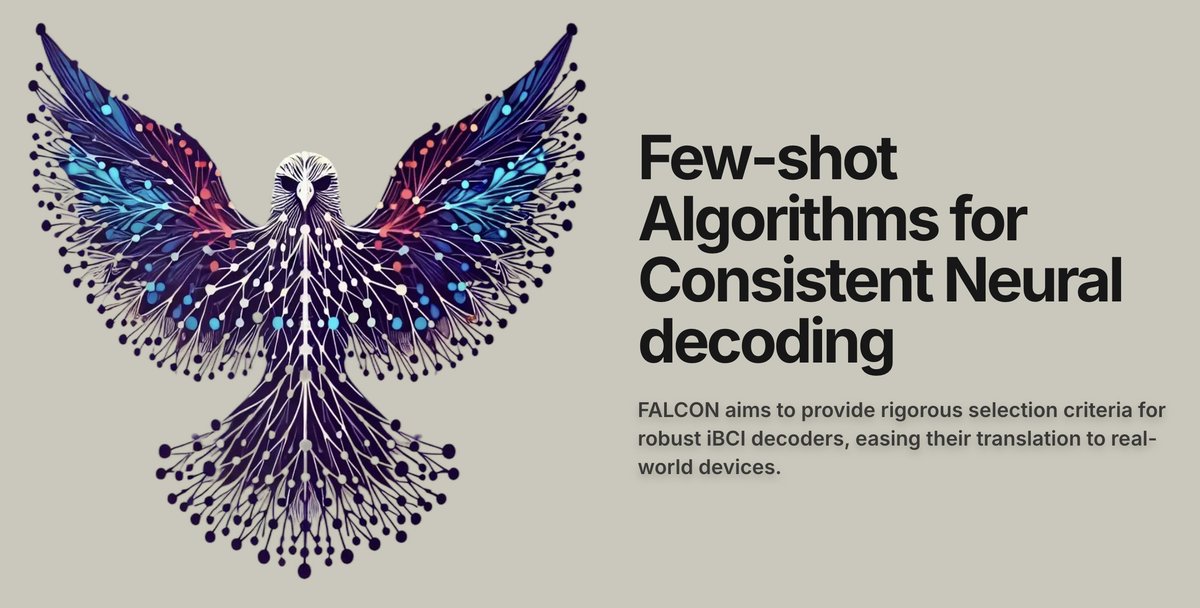
How can we build BCIs that operate robustly in the face of nonstationarities?
Our @NeurIPSConf Datasets and Benchmarks paper introduces the Few-shot Algorithms for Consistent Neural Decoding (FALCON) Benchmark!
Work led by @bkarpowicz_ and @_JoelYe
Pranav Iyengar Deevi et al.: Restoring conversational communication in pontine stroke-induced dysarthria using an intracortical brain-computer interface - https://t.co/pI7CsAc0qF
Chris Versteeg et al.: Dynisys: inferring low-dimensional dynamics and inter-area communication signals from multi-area neural datasets - https://t.co/ckQYEDEaP9
Holy Shift!! This new podcast from Emory/GT @CoulterBME highlights biomedical research breakthroughs and their impacts on our lives. Check out the first episode on stem cell therapies for congenital heart defects! https://t.co/0M7eun29vP
I'm very excited to share the workshop "𝐈𝐦𝐩𝐥𝐚𝐧𝐭𝐞𝐝 𝐁𝐂𝐈𝐬: 𝐓𝐞𝐜𝐡𝐧𝐨𝐥𝐨𝐠𝐢𝐞𝐬, 𝐀𝐩𝐩𝐥𝐢𝐜𝐚𝐭𝐢𝐨𝐧𝐬, 𝐚𝐧𝐝 𝐅𝐮𝐭𝐮𝐫𝐞 𝐃𝐢𝐫𝐞𝐜𝐭𝐢𝐨𝐧𝐬" which will be on November 11 at the IEEE/EMBS International Conference on Neural Engineering in San Diego!
We believe shared autonomy will play an important role in future BCIs (both invasive and non-invasive)! We're hiring postdocs, particularly in robotics + AI. If you're interested in joining our team, please visit: https://t.co/jEbDO7mJN5.
Check out our study in @NatMachIntell, where we use AI copilots for brain-computer interfaces (BCIs): https://t.co/IWhprtemFR. We enable a paralyzed participant to neurally control a computer cursor and a robotic arm (non-invasive, no surgery). Video here: https://t.co/dZG8h6xb9C
Coming March 17, 2026!
Just got my advance copy of Emergence — a memoir about growing up in group homes and somehow ending up in neuroscience and AI. It’s personal, it’s scientific, and it’s been a wild thing to write. Grateful and excited to share it soon.
Excited to announce the Foundation Models for the Brain and Body workshop at #NeurIPS2025!🧠
We invite short papers or interactive demos on AI for neural, physiological or behavioral data.
Submit by Aug 22 👉 https://t.co/t77lrS2by5
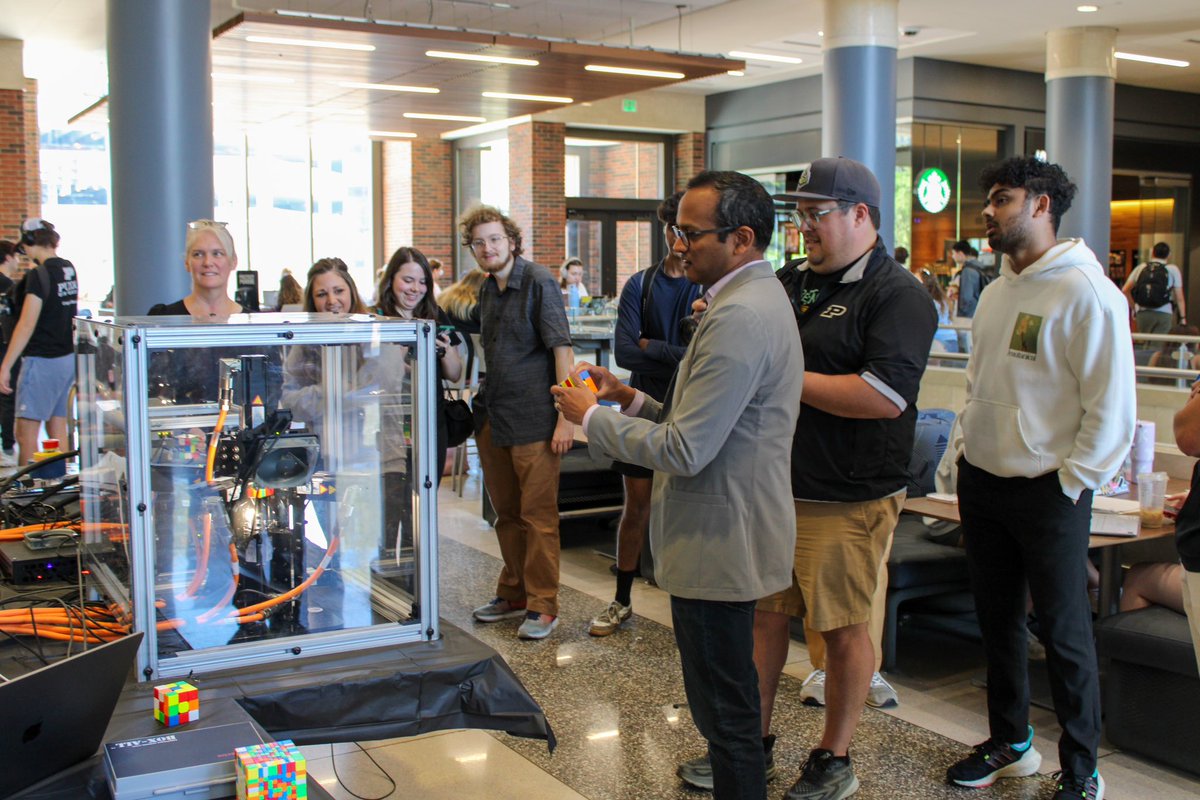
A team of #PurdueECE students has built a record-breaking machine that solves a RUBIK’S Cube faster than the blink of an eye 👁️!
Congrats to Brock Berta, Aden Hurd, Junpei Ota, & Matthew Patrohay on this remarkable achievement!
Come see the machine today (Fri) until 3 in MSEE!
I am the 3rd person in the world to receive the @Neuralink brain implant.
1st with ALS. 1st Nonverbal.
I am typing this with my brain. It is my primary communication.
Ask me anything! I will answer at least all verified users!
Thank you @elonmusk!
Exciting news from @NiaTherapeutics! We’re thrilled to announce that Prof. Michael Kahana (@KahanaMichael) has joined the company full-time as CEO.
A world leader in the science of human memory, Prof. Kahana built a distinguished career at the University of Pennsylvania (@Penn), where he and members of his Computational Memory Lab pioneered the study of how patterns of neural activity, recorded directly from the brains of neurosurgical patients, predict fluctuations in #memory encoding and retrieval. This foundational research provided the scientific basis for Nia’s groundbreaking therapy.
Kahana is the author of over 230 peer-reviewed publications and the landmark textbook, Foundations of Human Memory. His scientific contributions include the retrieved-context theory of episodic memory and the discovery of theta oscillations, place cells, grid cells, goal cells, and time cells in the human brain. He has received major honors including the Troland Award from the National Academy of Sciences and the Howard Crosby Warren Medal from the Society of Experimental Psychologists.
Together with Nia co-founder @DanRizzutoPhD and @yezzyat, Kahana authored the seminal publications demonstrating that closed-loop #neurostimulation can reliably enhance human memory performance. These studies, conducted under DARPA’s Restoring Active Memory (RAM) program, produced the largest dataset ever collected on AI-based memory decoding and brain stimulation.
“I’m excited to join Dan Rizzuto and the Nia team in accelerating our mission to deliver transformative #BCI therapies for patients living with memory loss due to traumatic brain injury #TBI and other neurological conditions,” said Kahana.
Welcome aboard, Mike — we’re just getting started.
🔗 Learn more about Prof. Kahana’s work: https://t.co/NCX6HcP0pA
4 yrs ago, I jumped from AI into Brain-Computer Interface (BCI) research—with almost zero neuroscience experience.
Today, I'm at NPTL, one of the world's leading BCI labs, contributing to breakthroughs like restoring speech for people with ALS and developing a robust handwriting BCI.
There's never been a more exciting time to enter the BCI field!
I'm writing a blog about my journey and advice for newcomers.
What questions do YOU need answered?
Ask below 👇