Excited to see this out! This project includes some of my earliest PhD experiments and findings with participant T12. Huge congrats to @BenyaminAK_BCI and the rest of the team for building on it and getting it across the finish line!
🧠🗣️ Ever stumbled over your words, realizing only after speaking them outloud? Your brain might not have followed the plan. New preprint on the neural ensemble organization of speech motor plans and what it means for speech BCIs https://t.co/f7zpqNDKSc 1/10
Excited to share our new work on cross-brain transfer of speech and handwriting BCIs! Some studies have required 10+ days of training data for peak BCI performance. Can pooling neural data from other users speed things up? 1/6
https://t.co/1Yjr5tNk7j
Our findings show that inner speech could be a powerful new modality for BCIs—but also highlight the importance of privacy & agency. By decoding imagined sentences and creating safeguards, we aim to move toward communication neuroprosthetics that are empowering in all aspects.
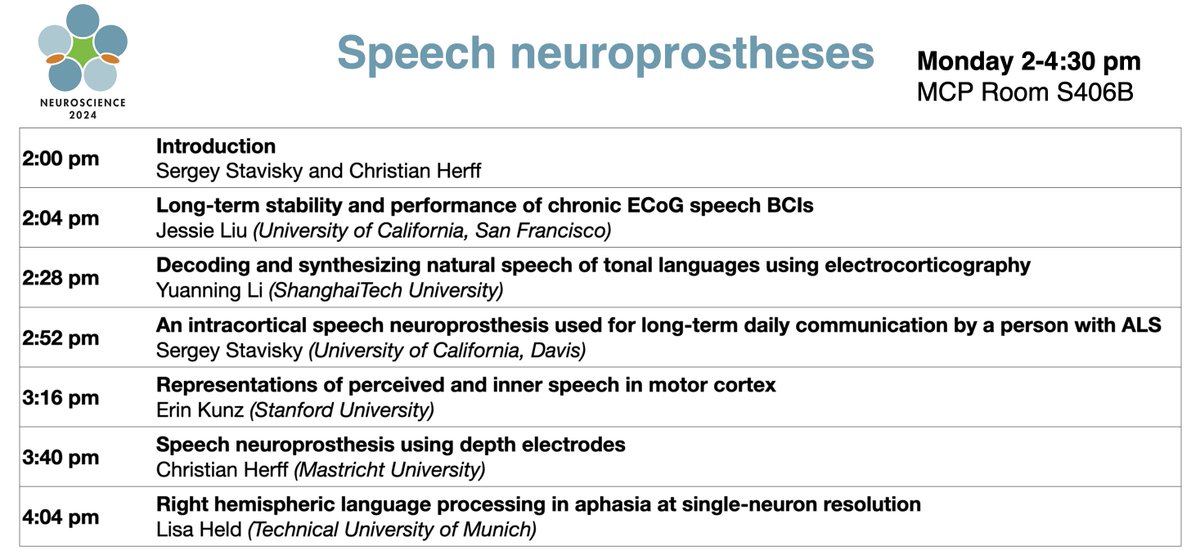
Interested in speech neuroprostheses? Come to the #SfN24 minisymposium organized by @HerffC and I. We have a fantastic lineup chosen to survey the many directions this field can go in: different recording modalities, languages, and behaviors (e.g. attempted vs. imagined speech).
It’s been a fun journey putting this together with our participants and our collaborators. Thanks to all contributors including my co-lead author @benyameister and mentors @WillettNeuro@ShaulDr and @JaimieHenderson !
Can a speech BCI really read your private thoughts? Inspired by a 2023 @Bcisociety workshop, our preprint tackles this question! We find that verbal thought is well represented in motor cortex, but accidental decoding can be prevented with proper training. https://t.co/JYnDplQMpp
We’re also presenting this work at #sfn2024 today (poster H19) and at a Minisymposium organized by @SergeyStavisky Monday Oct 7 2-4:30pm. Come talk to us to learn more!