Honoring his roots. 🇷🇼
Nate Ament shows love for Rwanda carrying his heritage with him on draft night 🤩🌍🇷🇼
📹: @nbafuturestartsnow
📺 NBA League Pass
⏰ 2:00AM CAT
This evening, President Kagame and First Lady Jeannette Kagame joined a full BK Arena for the Basketball Africa League (@theBAL) Season 6 Final game between Rwanda’s RSSB Tigers and Angola’s Petro de Luanda.
RSSB Tigers were crowned champions after a hard-fought 90–88 victory, becoming the first Rwandan team to win the BAL title since the league was launched in 2021.
THE FIRST RWANDAN TEAM TO REACH THE BAL FINAL! 🇷🇼✅
RSSB Tigers get the job done in front of their home crowd and advance to the BAL Finals in their very first BAL season! 🤯
What’s holding Africans back? President Kagame asked.
Prof. Murigande told Kagame that the main reason is that African leaders don’t care about their people. They seek to enrich themselves — to eat, and to eat alone. The president agreed with him, but he pressed further, asking why this problem seems peculiar to Africa.
Kagame doesn’t ask rhetorical questions. He has identified a problem and is involving Rwandans in finding a solution.
Here’s my take:
To overcome challenges like those faced by postcolonial societies, a people must rediscover a sense of collective self-worth. Usually, this comes from the memory of their past achievements— who they were as a people informs who they are and who they aspire to be.
While Africa was not the only region to experience colonization, it is one of the few where colonialism either erased the memory of past greatness or created new countries with no shared memory of such greatness.
Colonisation captured African minds. In that sense, although Africa was colonised last, it was colonised the worst.
Colonial education deepened this alienation, distorting African aspirations, turning them from collective to individual.
In the 1950s, the small group of “educated” African elites aspired to join the white world : the colonial administration. Today, with colonial education still intact and keeping African minds in chains, the elites it creates do not aspire to uplift their people; they aspire to join the global elite. They don’t seek to improve their own societies; they seek to escape from them.
Accordingly, these elites measure their self-worth by:
•how fluently they speak foreign languages,
•which foreign schools they send their children to,
•which foreign hospitals they can afford,
•how many houses they build, and how much money they invest abroad.
At the heart of this lies a quiet acceptance that Africans are somehow defective as a people, and that the only way to succeed is individually. Even those who once believed they could change things often abandon the quest for collective improvement once they grasp the scale of the effort it demands.
The kind of heavy lifting required for real transformation breeds a sense of hopelessness, one that pushes people from collective ambition toward individual greed.
So, the individual’s aspiration becomes to join the global bourgeoisie. But these are strategies of self-evacuation. They are attempts to flee backwardness by moving from the rural village to the capital, then on to the enlightened colonial metropolis, and ultimately to disappear into cosmopolitan anonymity - a form of self erasure rather than a search for self restoration.
This journey became the measure of progress. Those who remain in Africa do so with one foot already out (through dual citizenship or close connections to the representatives of their desired metropoles) for themselves, and especially for their children.
Although Kagame brings up this topic, it has been a theme he turns to whenever he notices that some ethic is creeping in amongst the leaders, only that this time he is more specific.
For example, while he has been teaching agaciro as a form of mental decolonization, most people over the years understood agaciro merely as a material pursuit.
Yet agaciro is, at its core, about retracing and reclaiming the memory of self-worth and therefore the basis for collective pursuit.
now, more than ever, we are seeing the importance of telling our own stories. over the past week, we have seen the international media being wildly selective, erasing and rewriting history and testimony, and being wildly complicit in genocide denial. we must tell our own stories.
ADMA had grads at KCC this week involved in video production for the FIA General Assemblies.
Here's behind the scenes in the auditorium with one of those grads, Jean Luc, in his role as video and content manager.
This is big red flag and needs clarification from @RDBrwanda and @RwandaYouthArts .
The #creative250 scene can’t thrive like this, a step backwards from all the great progress that’s been achieved so far.
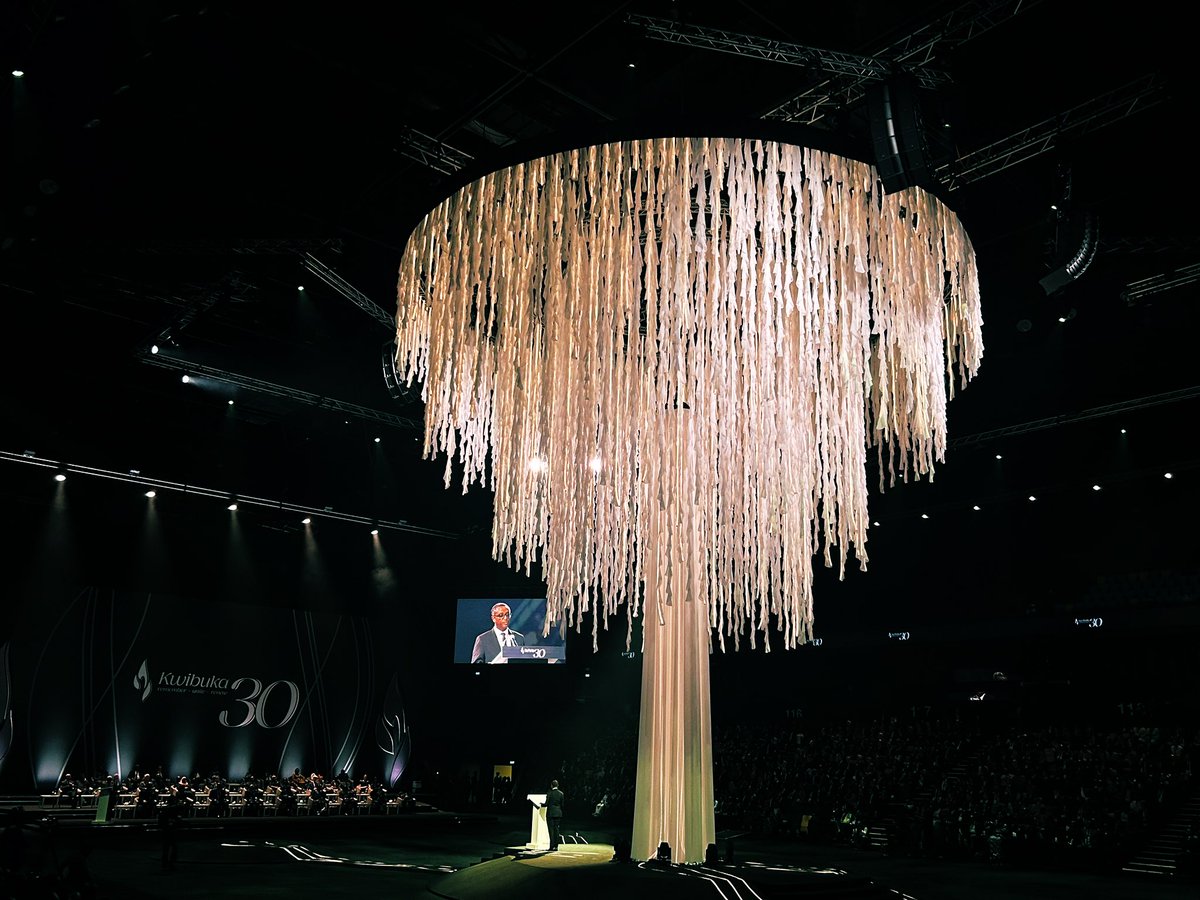
This tree was selected for its profound evocative qualities:
* Its foliage embodies the protection that was absent during the Genocide.
* The vertical strength of its trunk resonates with the aspirations of the young generation, accentuated by the inner glow akin to flowing sap.
* Its roots symbolize the memory of our history, vital for forging a resilient and brighter tomorrow.
* The radiant roots between the main stage and lateral ones will echo the theme of Unity at the core of both Ceremonies.
#Kwibuka30