I rest my case, the 2025 DHS contains some very interesting data & yesterday’s Cabinet resolutions included several significant directives. Yet neither seems to have generated much public debate or engagement. It appears that as a society, we are often more drawn to drama than to substantive issues. #RwOX
FERWABA, with the Kabano Family, will host a U18 3x3 tournament on June 26 at Zaria Court to honor the memory of Kenrik Kabano & his mother Rosine.A celebration of sport, family, and legacy.
The Silent Billionaire: Is Chris Kayoboke Uganda’s Smartest Tycoon?
Kayoboke started life from the gritty trenches of the 1970s transport sector, navigating the volatile Idi Amin regime before ultimately fleeing into Kenyan exile. It was in Nairobi that he crossed paths with fellow exiles Amos Nzeyi and Engineer Dan Kigozi, forging a powerful alliance that would change Uganda's corporate landscape forever. Upon their return, the trio capitalized on the government's 1993 privatization rollout to buy the state-owned Lake Victoria Bottling Company. They aggressively injected fresh capital and rebranded it into Crown Beverages Limited, the mega-franchise behind Pepsi, Mirinda, and Sting. Yet, while his flamboyant partners captured the public spotlight, Kayoboke chose to remain a reclusive ghost, hand-holding the company through its rocky early days by providing critical transport on credit and infusing his own cold hard cash.
According to exclusive financial evaluations, Kayoboke's massive 41% stake in the booming Pepsi franchise places his conservative net worth at over UGX 204.4 billion (around $56.7 million) from this single asset alone. Driven by aggressive market maneuvers against rival Coca-Cola, the company shattered records with annual turnovers climbing past UGX 513.6 billion. What truly sets the silent billionaire apart, however, is his unconventional family dynamic. Instead of shoehorning his children into inheriting the family soda empire, his brilliant sons, Julius and Paul Kayoboke, forged their own elite paths globally as international telecom CEOs, heavyweight private equity partners, and top-tier diplomats in Singapore and China without relying on their father's corporate shadow.
Naturally, this ultra-reclusive empire building sparks a fiery debate that is bound to get commenters arguing in the section below. In a modern Uganda where loud, flamboyant tycoons constantly flaunt their assets on social media to buy public influence, Kayoboke proves that supreme silence is the ultimate power move. But it raises a massive question: is it better for a billionaire to be transparent and public-facing, or is it safer to pull the strings of a multi-billion shilling national supply chain entirely from the dark? Who is actually winning the wealth game: the loud billionaires chasing fame, or the silent ghosts hoarding generational fortunes? Drop your raw thoughts below.
When entertainment outpaces policy.
This morning i was reading the recent Rwanda Media Barometers published by the Rwanda Governance Board, and one trend continues to stand out: a large share of our media space is still dominated by sports, entertainment, and leisure-oriented content. Even broader studies on Rwanda’s media landscape point to the growing influence of social media-driven and personality-centered engagement.
What caught my attention even more is what has happened in just these first weeks of May this year
Parliament approved the Budget Framework Paper through a Parliament X Space discussion. This is one of the most important policy conversations for any country because it shapes national priorities and public spending. Yet the engagement remained modest: about 1.6K views, 17 likes, and 7 reposts.
A few days later, on 8 May, Parliament approved the electoral law. Again, considering the importance of elections in shaping democratic participation and governance, one would expect intense public debate and engagement. But the post generated roughly 1.4K views, 18 likes, and 11 reposts.
Then came a completely different conversation last Saturday the 16th May: the exchange involving Hon. Olivier and Ms. Scovia. Their posts attracted significantly more attention, averaging hundreds of thousands of views, over 1.2K likes, and more than 220 reposts.
As I reflected on this contrast, one question stayed in my mind: are modern societies naturally becoming more attracted to emotional debates, personalities, and entertainment than to issue-based discussions and public policy conversations?
How does a public exchange between a media personality and a government official generate far more engagement than debates about the national budget or electoral reforms? Is this simply how digital platforms work today, where emotion travels faster than policy? Or are we slowly reaching a point where governance and political questions are increasingly viewed as matters for government officials and elites, rather than issues requiring active citizen attention?
The Rwanda Media Barometer 2024 actually raises related concerns about the future of professional, issue-based journalism, especially at a time when social media is becoming one of the dominant spaces for public engagement.
Perhaps political scientists, media scholars and communication experts can help us better understand this phenomenon. Because beyond likes, reposts, and trends, there is a deeper question here about civic culture, democratic participation, and what kind of public discourse we are building as a society. #CitizenEngagement #ActiveCitizenary
Who is Accountable for the RDB Building temporary closure ?
The recent public notice regarding the "temporary closure" of the RDB Building is a masterclass in administrative obfuscation. By using terms like "planned renovation" and "upgrade works," the authorities are attempting to minimize a massive failure in due diligence as a minor logistical hurdle. Let us be clear: forced relocation of an entire government hub is not a "small mistake." It is a waste of public resources and a slap in the face to every citizen held to the "Kigali Standard."
The timeline is damning. These institutions, including RDB, RHA, RMB, REMA, RLMUA, and RCB, moved into this building in late October 2023. We are now being told that less than three years later, the structure requires "upgrades" so significant that everyone must move out.
This raises a fundamental question that the public notice conveniently ignores: How did the government acquire a building that is already unfit for purpose?
The irony is not just deep; it is systemic.
First of all, The Rwanda Housing Authority (RHA), under MININFRA, sets the codes that everyone else must follow. Secondly, The City of Kigali (CoK) enforces those codes with zero "flexibility," often demolishing the property of citizens who fail to meet strict standards.
Why was this same rigor absent when the state purchased this property from a private owner? If a technical audit was conducted, it was clearly incompetent. If no audit was conducted, it was gross negligence.
This is exactly the "mediocrity" and "carelessness" that President Kagame has famously condemned. He has repeatedly warned leaders that "doing things twice" because they weren't done right the first time is a betrayal of the Rwandan people. When the very agencies in charge of land, environment, and housing standards cannot even secure a headquarters that meets their own rules, it erodes the public trust. It is unacceptable for a "Convenience Standard" for the institutions they run while the ordinary citizen faces the "Full Force of the Law" for a minor structural deviation.
Taxpayers are now paying for the initial purchase, the relocation costs, and now the massive "renovations" that should have been identified before a single Franc was spent on the acquisition. We deserve more than a vague notice; we deserve an explanation of who authorized this purchase and a clear path of accountability for this waste of national resources. True leadership requires leading by example, and right now, this situation only reflects a failure to protect public resources.
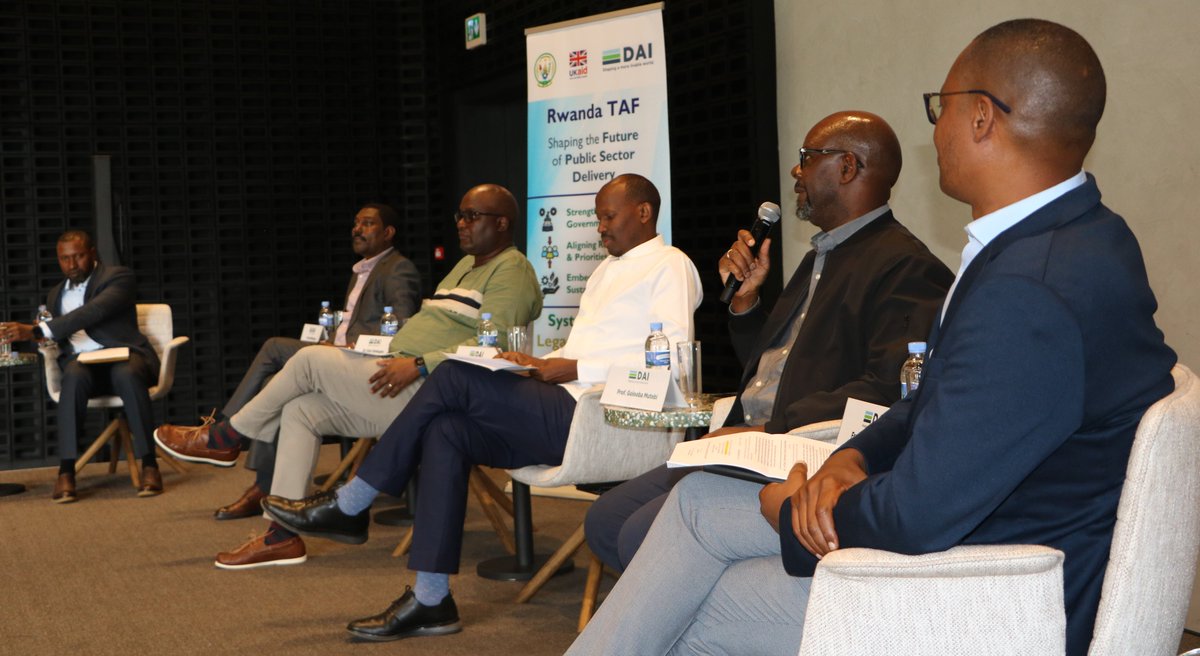
Through our 🇬🇧‑funded programme with DAI, we’ve supported Rwanda🇷🇼 to strengthen property tax systems enabling better delivery of education, health and infrastructure.
We’ve also helped enhance the #Imihigo performance system for real impact and better services for citizens.
When feedback becomes uncomfortable
Last week, i attended a Knowledge Café organized by the @GreenFundRw where we were discussing climate financing and the real experiences of entrepreneurs on the ground. One entrepreneur in the gas sector shared something that stayed with me. He explained how he had approached @BRDbank for financing, but found the process too bureaucratic and slow, and eventually chose to work with @imbankrw instead.
What surprised me was not his story, but the reaction it sparked. A government official seated next to me leaned over and quietly asked why he was bringing that up. I found that question more concerning than the complaint itself. I asked her, why shouldn’t he speak about his frustration? Is it because it’s a government agency? If an institution exists to serve people, then people should be free to talk about their experiences, both good and bad.
From what i have seen, both in Rwanda and elsewhere, real progress comes when people speak honestly about what is not working. That is how systems improve. Listening to challenges is not a weakness, it is actually the starting point of better solutions.
In Rwanda, where we have strong ambitions around development, green growth, and service delivery, we need to create more space for honest feedback. When public servants become uncomfortable with criticism, it risks creating a culture where only positive stories are told, while real issues remain hidden.
Over time, that silence can have consequences. Some of the challenges we continue to face, including human development issues like child stunting, require open and honest conversations. If we truly want progress, we must be willing to listen, even when the message is uncomfortable.
Enjoy the Edi-Al-Fitr and the weekend that is in the corner!
Why many businesses in Kigali open with promise but close too soon, the working capital problem!
There is an increasing a pattern in the business environment in Rwanda that deserves serious reflection. It is not uncommon to visit a restaurant in Kigali today and then return a few months later only to discover that it no longer exists. The same experience happens in other sectors. One may visit a shop at Kigali Heights, find it operating well at first, but after some time the business has closed or been replaced by another tenant. The same situation can also be seen in places like the Car Free Zone in Kisementi, where businesses open with excitement and promise but disappear after a relatively short period of time.
One of the biggest underlying challenges behind this pattern is the misunderstanding between investment capital and working capital. Many entrepreneurs succeed in mobilizing significant resources to start a business, but very little attention is given to the capital required to sustain operations during the first months or even years.
It is not uncommon to find someone who has saved or mobilized Rwf100 million to start a business but fails to reserve even Rwf50 million to run it. Most of the available funds are spent on renovations, furniture, branding, equipment, and creating an attractive appearance for the business. By the time the doors open, a large portion of the capital has already been consumed. What remains is very little liquidity to sustain daily operations.
Yet working capital is what keeps a business alive. A business needs continuous cash flow to pay salaries, replenish stock, cover rent, settle electricity and water bills, manage logistics, and deal with unforeseen operational expenses. Without this financial buffer, even a promising business can begin to struggle within a few months.
Take the example of someone opening a restaurant in Kigali. A large portion of the capital may go into interior decoration, kitchen equipment, furniture, and branding to create an appealing environment for customers. It is possible for Rwf70–80 million to be spent on the physical setup alone. However, if at least Rwf20–30 million is not reserved for working capital, challenges quickly emerge. The business begins struggling to purchase fresh ingredients, pay employees at the end of the month, maintain marketing activities, or handle routine operational costs.
This situation partly explains a pattern that has become common in the hospitality sector. Many restaurants, bars, and hotels request 30 days or even longer to pay their suppliers. In many cases, this arrangement is not part of a structured financial strategy but rather a reflection of limited working capital. As a result, suppliers end up indirectly financing the operations of these businesses.
Let look at this example, a supplier delivering meat, vegetables, beverages, or imported products may supply goods today but only receive payment after a month. If the restaurant itself is struggling with cash flow, payments can be delayed even further. Over time this creates a chain reaction where suppliers also begin facing financial pressure because their own cash cycles become disrupted. Eventually the entire business ecosystem becomes strained.
Retail businesses face similar challenges. An entrepreneur may invest heavily in setting up a beautiful shop in a prime commercial location. The shop may look impressive on opening day, with well-designed shelves, lighting, and branding. However, after the first round of sales, the business may lack the cash required to replenish stock. Shelves begin to empty, product variety declines, and customers gradually stop coming because they cannot find what they need.
Agriculture also presents similar situations. A young agripreneur may invest significant resources in acquiring land, irrigation equipment, and farm tools but forget to reserve funds for seeds, fertilizers, labor, transportation, and post-harvest handling. The farm may appear well prepared, yet it struggles to operate efficiently because operational cash is missing.
In simple terms, investment capital builds the business, but working capital sustains it. Without adequate working capital, a business may look impressive on opening day but begin collapsing quietly behind the scenes due to operational pressures.
Another challenge observed among entrepreneurs is the difficulty of pooling resources and building equity partnerships. Many individuals prefer to operate alone, even when the scale of the project requires stronger financial backing. There is often a preference to start and own a business individually rather than bringing together partners and investors.
In many other economies, entrepreneurs combine resources. Three or four partners may pool their savings to create a stronger capital base and build a business that is better financed and more resilient. In the local context, however, the culture of equity collaboration remains limited. Each person attempts to start a small venture individually, which often results in undercapitalized businesses struggling from the beginning.
Another issue that deserves attention is the lack of specialization and focus among many entrepreneurs. It is common to find someone running several small ventures simultaneously using the same limited capital. A person may operate a small shop, start a printing business, and at the same time attempt to invest in farming or transportation. Instead of strengthening one business until it becomes stable and profitable, the limited capital becomes fragmented across several ventures. This fragmentation weakens all the businesses involved.
Closely related to this challenge is the limited level of innovation in the entrepreneurial ecosystem. Many businesses tend to copy what others are already doing rather than identifying new opportunities or developing differentiated services. As a result, clusters of identical businesses emerge in the same neighborhoods. One street may suddenly have numerous cafés, several pharmacies, multiple liquor stores, restaurants, bars, or nursery schools all attempting to serve the same market.
This copy and paste approach to entrepreneurship creates oversupply and intense competition for the same customers. Instead of expanding the market, businesses end up dividing an already limited customer base. When revenues fall below expectations, many of these businesses struggle to survive.
When some of these ventures eventually collapse, the immediate reaction is often to blame the government. However, the government is not a parent to entrepreneurs. While it has a responsibility to create an enabling environment for business, the discipline of planning, managing capital properly, and making sound business decisions ultimately rests with business owners themselves.
What may be needed more within the business community is openness and a willingness to share experiences. Many entrepreneurs face similar challenges, yet very few openly discuss their failures or the lessons learned from them. The culture of silence and secrecy prevents others from learning from those experiences.
Greater openness about what works and what does not work in business could help avoid repeating the same mistakes. Societies progress not only through success stories but also through honest reflection about failures.
Improving financial literacy, encouraging partnerships, promoting specialization, and nurturing innovation could significantly strengthen the survival and growth of businesses across Rwanda. In many cases, success comes not from doing many things at once or copying what others are doing, but from focusing on one idea, managing capital with discipline, collaborating with others, and continuously learning from both successes and failures.
https://t.co/QunRPM87Tf
Thank you for sharing this, it is an important contribution to the discussion.
If i may add, the role of the media goes beyond highlighting issues, it is also to bring clarity and context so that both the public and duty bearers can clearly understand what is happening & respond in time. When information is shared in bits, it can sometimes make it difficult to pinpoint where the real challenge lies.
Considering that many of these projects are funded through public resources, either directly from taxpayers or through loans acquired by the gov’t that citizens will eventually repay, there is value in presenting the full picture. It would be helpful to outline what was planned, what has been done so far, the challenges encountered, and what needs to happen next. Such an approach strengthens accountability and ensures journalism plays its full role in informing and guiding constructive action. Thank you and have a great evening!
Why civilians admire Rwanda Defense Forces
Both evenings of Friday and Saturday this week, i attended the vigil of an old schoolmate who passed away the week before after suffering a stroke . As often happens at such gatherings, grief brought together people who had not seen each other in many years. Beyond the sadness, these moments become quiet spaces of reconnection, where old friends and relatives sit together, remember shared histories, and slowly drift into deeper conversations about life and society.
After the vigil, we stayed on at the homestead. In between moments of silence and laughter, our discussions naturally shifted to broader issues. We talked about education, food insecurity, leadership, and how things seem to be working or not working around us. One former classmate had travelled all the way from the Eastern Province and came with his daughter. I greeted her and casually asked what class she was in. She told me she had just completed high school.
Out of curiosity, i asked which subject combination she had studied. She answered HEG, History, Economics, and Geography. I followed up with a few simple questions, touching briefly on European history, the Ottoman Empire, and then African history. To my surprise, she struggled to express herself. It was not just about content. She could not clearly articulate her thoughts in either English or French. Her father looked at me, slightly amused and slightly shocked, and said, “No wonder you are a son of a headmaster, you still remember these things.”
That comment stayed with me. Not because of pride or nostalgia, but because of what it quietly exposed. If a student who has just completed secondary school cannot confidently express basic ideas or communicate clearly in any of the official languages, then the problem is not the child. It is the system that produced her. Education, at its core, should equip young people with the ability to think, reason, and express themselves. When that is missing, something fundamental has gone wrong.
The conversation soon shifted to food insecurity. The same classmate from the Eastern Province is a businessman involved in buying cash crops. One friend among us asked a question many people ask quietly but rarely unpack deeply. Why is food insecurity still a problem in the Eastern Province, a region blessed with fertile land and favorable conditions?
His answer was direct. The problem, he said, is not land, rainfall, or farmer effort. The issue lies in “weak innovation and poor strategic leadership at the local level.” He explained that vast stretches of land in the East are still fertile and underutilized. Whatever you plant grows, he said. During harvest seasons, farmers often produce more than they can consume.
Yet despite this abundance, hunger persists. There are no proper post-harvest storage facilities. Farmers lack guidance on preservation, aggregation, and value addition. When harvests are plentiful, prices collapse and farmers sell cheaply. A few months later, when supplies run low, the same communities struggle to access food. Do we have agricultural extension officers at the sector level if yes, are they doing the right job?
He gave an example that hit everyone in the group. How can people in places like Ndengo experience hunger when they live near water? Why can’t farming in such areas not supported to engage in irrigation farming? His frustration was not aimed at farmers. It was directed at local leaders that fail to turn natural advantages into sustainable livelihoods.
As the discussion deepened, one of the former schoolboys made a statement that caught everyone’s attention. He said that if the Rwanda Defense Force were given the education sector and the local government, we would see very different results. There were about ten of us seated together. No one objected, the silence that followed was telling.
I asked a simple question. Why?
The answers came quickly, they said the RDF is effective. It is not corrupt. It values work. It is disciplined. Its members are continuously trained. They are smart and professional. Most importantly, people do not hear stories of them mistreating citizens. These were not political statements. They were observations drawn from everyday experience and from civilians.
That night, when i returned home and later sat at my reading table as usual, the conversation kept replaying in my mind. I found myself asking a deeper question. Why is the Rwanda Defence Force so admired by civilians? Why do ordinary citizens instinctively trust it more than many civilian institutions?
The answer, i realized, is not complicated. It lies in leadership that is clear and purposeful, in accountability that is real, in continuous learning, and in a culture where merit matters more than titles.
In the RDF, leadership is clear. Every officer and soldier understands not just what they are doing, but why they are doing it. There is a shared sense of mission. Whether in security operations, disaster response, or national emergencies like the COVID-19 period, the institution acts with clarity and discipline. Its presence is firm but humane, structured but respectful. That consistency builds trust.
Accountability is also unmistakable. Responsibility is defined and personal. When things go wrong, they are analysed and corrected rather than explained away. In many civilian institutions, policies are well written but poorly implemented. Accountability is often diluted across committees such as technical working groups, sector working groups, task force committee and procedures. In the RDF, outcomes matter.
Training does not end at recruitment. Continuous professional development is part of the culture. Skills are sharpened, leadership is strengthened, and standards are enforced. Ironically, this culture of learning is often stronger in the army than in institutions that exist solely to manage education.
Perhaps the most important reason civilians admire the RDF is its commitment to merit. Promotion is not ceremonial. Rank is earned through performance, discipline, leadership, and results. Titles are functional, not decorative.
This stands in sharp contrast to what we increasingly see in other sectors today. Academic and professional titles have multiplied. We encounter many people calling themselves professors or doctors with PhDs, yet their work has produced little in terms of solutions to real societal problems. Research remains locked in journals. Ideas never translate into policy or practice. Communities see no tangible benefit.
A doctorate is supposed to represent original contribution to knowledge and relevance to society. When titles exist without impact, they lose credibility. You do not find this culture in the Rwandan army. No one rises by self-designation. No authority exists without responsibility. Performance is visible, and standards are predictable.
Rwanda is not alone in this experience. In other countries that rebuilt quickly after crisis, disciplined and merit-driven institutions played a central role in restoring education, infrastructure, and public administration. Even beyond Rwanda’s borders, RDF peacekeeping missions are often praised not just for maintaining security, but for engaging communities, building basic infrastructure, and earning trust through action.
This reflection is not a call to militarize civilian governance. It is a mirror held up to civilian institutions. The real question is not whether the army should run education or local government. The real question is why civilian institutions struggle to adopt the same culture of merit, accountability, and continuous learning.?
If education were managed with the seriousness of national defence, students would graduate able to think and express themselves. If local governance combined discipline with innovation and citizens at heart, fertile regions would not face hunger.
That weekend conversation began in mourning and ended in reflection. It reminded me that citizens do not admire uniforms. They admire competence, integrity, and results. The trust the RDF enjoys has been earned through performance, not slogans. Until other institutions internalize the same values, citizens will continue to ask uncomfortable but necessary questions, not out of rebellion, but out of hope for institution
https://t.co/10ujXyFOi2
President Paul Kagame is the most inspiring leader I have met.
After ending the Genocide against the Tutsi in 1994, he did not seek revenge. Instead, he built an inclusive and peaceful #Rwanda, prioritizing reconciliation - a concept easy to write and theorize about but extraordinarily difficult to achieve, especially in the wake of such unspeakable evil.
Under @PaulKagame's leadership, Rwanda has not only healed but thrived. His governance is rooted in zero tolerance for corruption, a strong work ethic, and education for all - just to name a few of the values that have driven the country’s unprecedented (economic) success.
Success, however, often breeds envy.
In the complex landscape of the Great Lakes region of East Africa, it is all too easy to vilify the one leader who has delivered real progress for his people and who truly believes in the potential of Rwanda and entire Africa. If even a fraction of Kagame’s leadership qualities were present in some of his counterparts, the entire region would be far more peaceful and prosperous.
A single post cannot do justice to his remarkable journey or the complexities of the region. For deeper insight, I highly recommend this full interview with @MarioNawfal.
"Technology isn’t just infrastructure; it is a tool for empowerment," highlighted Emmanuella, our Head of Tech &Cybersecurity.
AI, blockchain, & digital finance create opportunities, for women but true impact needs inclusivity, education, & more women at the decision-making table
According to press release from the @RSSB_Rwanda the pension reform will double contributions from 6% to 12% by January 2025. This sharp increase, implemented without gradual transition, will immediately impact workers' take-home pay by 3%. Why wasn't a progressive approach considered?
We've seen this pattern of insufficient public consultation before. Remember the NGO law? While civil society eventually managed to advocate for some changes in Parliament, many problematic articles remained unchanged - all because stakeholders weren't consulted during drafting.
Even when policies have transition periods, implementation can be abrupt. Take the church regulations: Despite a 5-year window for meeting requirements, the sudden enforcement led to widespread closures, affecting communities across Rwanda.
The pension increase is particularly concerning because it affects every working Rwandan. A 3% reduction in take-home pay is significant. A progressive approach - perhaps a 1% increase over three years - would have allowed families to adjust their budgets gradually.
When policies directly impact citizens' livelihoods, shouldn't those same citizens have a voice in shaping them? Public consultation isn't just about being heard - it's about creating better, more implementable policies.
The NGO law experience showed us that post-facto advocacy, while sometimes partially successful, is far less effective than early stakeholder engagement. Why repeat this pattern with the pension reform?
We need a standardized approach to policy development that includes mandatory public consultation periods. Major changes to people's financial obligations shouldn't be announced and implemented with such short notice.
Let's advocate for better policy-making processes. Progressive implementation, meaningful stakeholder engagement, and proper transition periods aren't luxuries - they're necessities for good governance. Our collective future shouldn't be decided in isolation. We need transparent, inclusive policy-making that considers the real-world impact on citizens. @RSSB_Rwanda@RwandaFinance@primaturerwanda@rwandaparliamnt