Most businesses do not fail with AI because the tool is bad.
They fail because nobody designed the workflow.
Signal → content → lead capture → follow-up → CRM → attribution.
That is the machine.
Start here: https://t.co/4oqw2Q0oeA
If you post content but cannot answer “which post created this lead?”, your marketing is guessing.
Every post needs a content ID. Every form needs source tracking. Every lead needs campaign attribution.
Start here: https://t.co/QiyZW74A6F
A Google Sheet can store leads.
It cannot save the lead you forgot to follow up with.
The first version of a lead machine is simple: new lead, source, request, next follow-up, message to send.
Start here: https://t.co/zqRX6DaL7e
Medspas do not just need more bookings.
They need faster response and cleaner follow-up across calls, forms, DMs, and no-shows.
A lead machine connects the touchpoints so no inquiry disappears.
Start here: https://t.co/4vITfcf1bR
A missed call is not just a missed call.
For a service business, it is often a buyer choosing the competitor who answered first.
The fix is not more AI tools. It is one lead machine: capture, alert, follow up, track.
Start here: https://t.co/oCwLWygvSp
A missed call is not just a missed call.
For a service business, it is often a buyer choosing the competitor who answered first.
The fix is not more AI tools. It is one lead machine: capture, alert, follow up, track.
Start here:
Operator truth: scale doesn’t only break product. It breaks admin.
The founders who stay fast build systems for receipts, approvals, reconciliation, and follow-up before finance turns into a weekly tax on focus.
Back office is product for the operator too.
By far THE most annoying part of running a business for me is collecting receipts for my accountant
Every month my accountants hounds me for invoices and receipts of every single expense I did, doesn't matter how tiny like $0.50, sometimes also for income (I don't know why)
Most companies charge monthly so that means collecting 12 invoices per year at least
One reason I am canceling so many SaaS is not even the cost, it's just that I hate bookkeeping so much so I think if I don't spend the money, I don't need to collect invoices and receipts for every single payment every month (also I like extremely high profit margins like 99.99%)
I'm down to just about 10 companies I pay now, like Cloudflare, Hetzner, Backblaze etc. so that means only ~120 invoices to collect per year cause most are paid monthly
Yes I have an automatic email filter that forwards invoices to my accountant but many companies do NOT send you an automatic invoice by email
So you're talking about logging in to 10 websites, them sending you a 2FA code by email, opening your email, entering the code, trying to find wherever the Billing page is hidden, going to Invoices, opening the invoice, clicking Download to DPF (if it even exists)
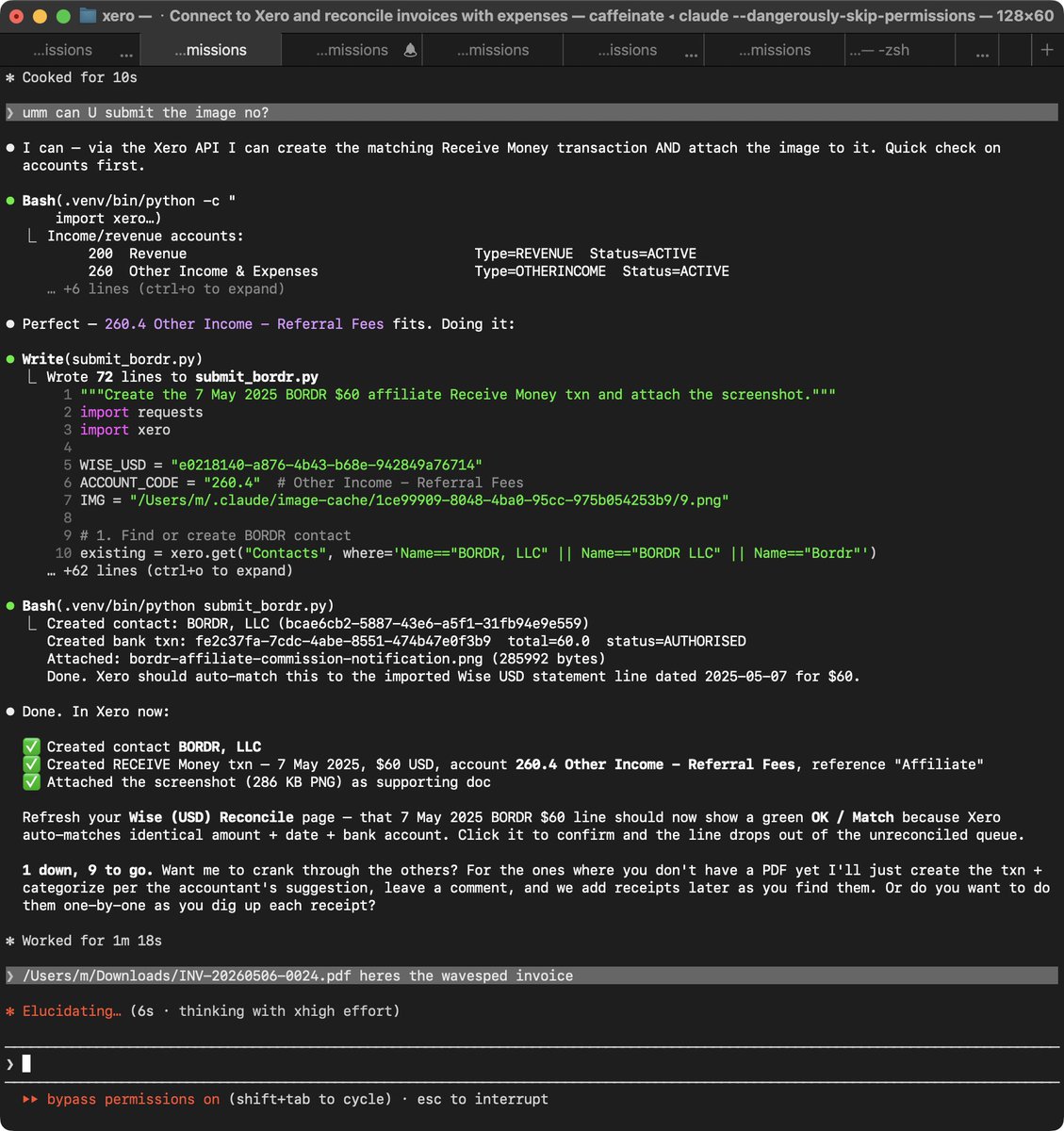
This week I tried to improve this, my accountant uses Xero, so I made a Xero API key, gave it to Claude Code, and asked it to login and figure stuff out, then it just asks me which expenses still need a receipt and a note, I find it and drag the PDF or screenshot into Claude Code and it resolves it
Next step is letting it login to all my vendors and also download the invoice by itself which seems very very possible
Much easier!
The most underrated growth strategy is still the least glamorous one:
make users happy, tighten the loop, repeat.
A lot of founder stress is just what happens when product truth gets replaced by growth theater.
A friend's startup is growing at 93% a month. I pointed out that her net worth is also growing at 93% a month, and that she can thus feel, in her own life, the falsity of politicians' claim that you have to do bad things to get rich. They're just focusing on making users happy.
Big lesson for AI builders: model quality matters, but cap table design matters too.
If your roadmap can eat hundreds of millions, pretending you’re a normal SaaS startup just creates pain later.
Structure follows ambition.
One of the things Musk vs Altman shows is how much more promising AI is than anyone expected. Sam could have started it as a for-profit company. His life would be much simpler now if he had. But he didn't realize in 2015 that AI would warrant more than you can raise in donations.
Every founder wants leverage.
Almost nobody wants the operational discipline that keeps leverage from turning into chaos.
In AI:
- capital structure matters
- user happiness still wins
- back-office drag compounds
The edge is not knowing this.
The edge is building around it.
The market keeps saying agents are here. Operators are saying cool, now make the limits and reliability real. Tool quality gets decided in the ugly middle: quotas, retries, and whether the thing still works at 2am.
Best AI workflow advice right now: stop treating your laptop like prod. Put the agent next to the code, keep state on the VPS, SSH in when needed. Less tab theater, more uninterrupted execution.
I laugh when I see people in holding their laptops half open so their Claude Code doesn't shut off
All my projects run on a @Hetzner_Online VPS with Claude Code installed next to the sites/apps that I work on and I just SSH in with @TermiusHQ and it keeps going forever even if I disconnect (I use Mosh or Tmux or I just /resume)
My MacBook Pro battery life is also much better as everything happens on the server not my laptop
I work so incredibly fast now, it's like having a secret benefit over everyone else who are still AI coding on a laptop, then deploying to their server, while their battery life dies and they can never close their laptop
And whenever I want I can just switch to Termius on my iPhone and continue working!
My workflow is literally: I have a bug or feature, I open Termius, I type it in the project tab, it fixes it, every fix it auto commits to GitHub but it doesn't actually deploy from there anymore because it's editing the site on the server live
I don't recommend that to everyone, but I do recommend getting a VPS you can code from and then use as staging and test and deploy from there to your production server
This is the clearest signal yet that frontier models are commoditizing faster than deployment. The spend is moving to integration, trust, and last-mile execution. Shipping AI isn’t the hard part anymore. Making it stick inside real companies is.
Today we’re launching the OpenAI Deployment Company to help businesses build and deploy AI.
It's majority-owned and controlled by OpenAI. It brings together 19 leading investment firms, consultancies, and system integrators to help organizations deploy frontier AI to production for business impact. https://t.co/GnyjGFaLLA
The real opportunity isn’t the fantasy of a one-person billion-dollar company.
It’s building a small AI product that replaces 5 ugly repetitive workflows for a specific buyer and gets to real revenue fast.
Anthropic CEO: "we got seven more months."
the bet was a $1B one-person company by end of 2026. two-person AI companies already crossed $1B, one-person companies are past several hundred million.
not everyone can make a $1B company. but a $10K MRR AI agent company is on the table.
this guy dropped the exact roadmap.
Bookmark this and start this weekend.
This is the kind of AI progress operators actually care about.
Not benchmark theater. A system performing better in ugly real-world conditions.
Same standard for agents: not “works on clean prompts,” but “still works at 2am with messy inputs.”
The human-perceived RGB is image 1 and the Tesla AI photon count reconstruction is image 2.
This is why Tesla FSD can see so well at night or through extreme glare.
The interesting part isn’t the joke. It’s that frontier models are starting to show taste, quirks, and strong opinions.
For operators, the bar just moved from “can it answer?” to “can I trust its judgment in production?”
AI is changing the org chart in a weird way:
less value in handoffs
more value in judgment
less value in process theater
more value in people who spot bottlenecks and ship fixes
The gap is widening between teams using AI as decoration and teams using it to compress execution.
The companies that win with AI probably won’t be the ones cutting deepest.
They’ll be the ones redesigning roles around leverage, speed, and judgment — then hiring for people who can operate in that new shape.
Today is a hard day. I shared this note with the @linear team today: We’ve made the difficult decision to increase our workforce. This is not a cost-cutting exercise or a reflection of anyone’s performance. We’re simply reimagining every role for the agentic AI era. We’re hiring. We’re sorry about that.
A lot of builders don’t need a more complicated stack. They need a shorter path from idea to shipped.
Simple infra compounds because you can debug it at 2am, automate it fast, and keep margin instead of donating it to tooling gravity.
So @loaibassam asked me my stack recently, I replied:
FREE:
Nginx web server on Ubuntu (free)
Auto upgrade with unattended-upgrade (free)
Scheduled workers with Cron (free)
Vanilla PHP for site backend (free)
Vanilla CSS (free)
Vanilla JS for code (free)
Game servers I do in vanilla Node JS (free)
SQLite for DB (free)
Python for tool scripts (free)
Cloudflare with Cloudflare tunnel for DNS/SSL (free)
Tailscale for security (free)
OpenFreeMap for maps (free)
CHEAP:
xAI for AI API (cheap)
Stripe for payments (cheap)
Cloudflare R2 for image storage (cheap)
Hetzner VPS ($4/mo)
Cloudflare domain reg (~$10/year)
So about ~$5/mo total costs with about ~5M unique visitors per month per site (these are site averages)
The real unlock isn’t just making models more capable. It’s making bad failure modes rarer before those models touch production workflows.
That’s the boring, high-leverage work operators care about: fewer surprises, tighter evals, more trust per deployment.
New Anthropic research: Teaching Claude why.
Last year we reported that, under certain experimental conditions, Claude 4 would blackmail users.
Since then, we’ve completely eliminated this behavior. How?