It's been a wild ride working on @POKTnetwork / @BuildWithGrove from it's inception nearly a decade ago, to piloting the ship over many of the last few years.
I'm starting something new in the next month.
More on that when the time's right.
Grove is winding down.
After nine years, this is goodbye, and a thank you for everything we built together.
We began as @POKTnetwork Inc., founded in 2017 by @o_rourke , Valeria Benitez Florez, Pabel de Jesus Nunez Landestoy Nunez, and @luyzdeleon .
Over a hundred amazing people passed through the company along the way, and their work fills more than 250 open-source repositories across the Pocket Network and Grove GitHub organizations.
Together we built two versions of the Pocket Network protocol and its first gateway, the Grove Portal, which settled more than a trillion requests across 60+ blockchains. Pocket Network continues on, permissionless by design and stewarded by the Pocket Network Foundation.
In 2026 we moved up the stack, and bet that money, not hyperlinks, was the internet’s best quality signal. We built a platform for humans and agents to pay creators directly, and became one of the first adopters of x402, the open payment protocol for the internet. In five months, nearly a thousand fans paid over 400 creators more than 6,000 times for their content. You proved quality is worth paying for.
To our partners, our investors, our teammates past and present, and the Pocket Network community we grew up in: thank you for betting on us, twice.
The ideas don’t retire with the company.
Our code stays open source, and both of our theses stand:
1. neutral, permissionless access to public-goods infrastructure is foundational to the internet’s future.
2. the agentic internet will need a way to pay humans for genuine, tasteful content.
With gratitude from the https://t.co/PtZZimmPvL team,
@ArtSabintsev , @fredt_io, and @olshansky
OH: “i’ve switched to Kimi from claude for a bunch of work. it’s just so much more fun because it just does the thing instead of lecturing you”
Woke lobotomized models are the enemy of American competitiveness.
This is concerning. For the first time, a Chinese model Kimi K3 has taken #1 on the Frontend Code Arena and is scoring at or near the frontier on other benchmarks.
Meanwhile America is tying itself in knots: politicians and bureaucrats are banning new data centers, piling on state regulations, and pushing for new federal agencies to pre-approve frontier models.
This is how you lose the AI race. The rest of the world won’t play by our rules if we bog ourselves down. Permissionless innovation is how America won the internet and became the technological envy of the world. We can do it again with AI -- while addressing risks in a targeted way -- or we’ll watch our lead evaporate.
From an ecological perspective, western frontier models are a common pool resource that Chinese open weight models exploit. They are finite, because if you exploit them too hard, they lose the incentive and resources to train new models, and everyone loses. (Chinese models aren’t magically good, they are good because Ant and OAI spend a lot of money on training).
If you think about it like a parasite/host relationship, Chinese models are a parasite that needs to calibrate its exploitation so that the host doesn’t die. Kimi arguably made a mistake. It overexploited the host and imperiled the Ant OAI growth story. So at equilibrium you’d expect open weight models to “tastefully” exploit the western frontier and choose to remain 6 months behind and slightly inferior capability wise.
However perhaps Kimi, Qwen, GLM, deepseek etc may not be playing an equilibrium game. They might be under orders to puncture the American lab growth story, even if it means killing their own host. Maybe the time is now because OAI and Ant are most vulnerable ahead of the IPO. Maybe Xi just had a bad day. Or maybe Kimi defected from the gentleman’s agreement that the Chinese labs share to not kill the host that they all rely on.
The fact that I can scrape libgen/zlib with Qwen/Kimi when I want to reference a quote in a book for a post, but am scolded and reprimanded by America's models when I attempt to do the same thing is mind boggling.
America will lose if we keep holding ourselves back.
Two immediate takeaways:
1) This quote is 🔥 "People don't feel like they've been automated. They feel like they've been promoted."
2) Implied, but not said: People want personalized software, like they want personalized medicine, and the time for personalized software is probably upon us now. SaaSpocalypse may begin to accelerate for some businesses. Most B2B software has no moat.
@samoth_ai@obsdmd@qvac I've been doing this with the Claudian github extension with closed models, and then with Qwen (locally) as well.
It's the best use case for obsidian+second brains.
Will give it a look.
Introducing Universal Dictation on Stream
Push-to-talk across iOS and Mac: Instantly. No app switching, no reconnection.
We built Notes so nothing gets lost, and Chat so you can think out loud. With Dictation, your voice goes anywhere.
Notes, Chat, Dictation—in one voice ring
@uncledoomer@nic_carter what don't you like about the tesla + FSD experience?
Single handedly the best purchase I have ever made from a QOL perspective.
If you can still get an S/X, you can put your hands on the wheel periodically and go ham.
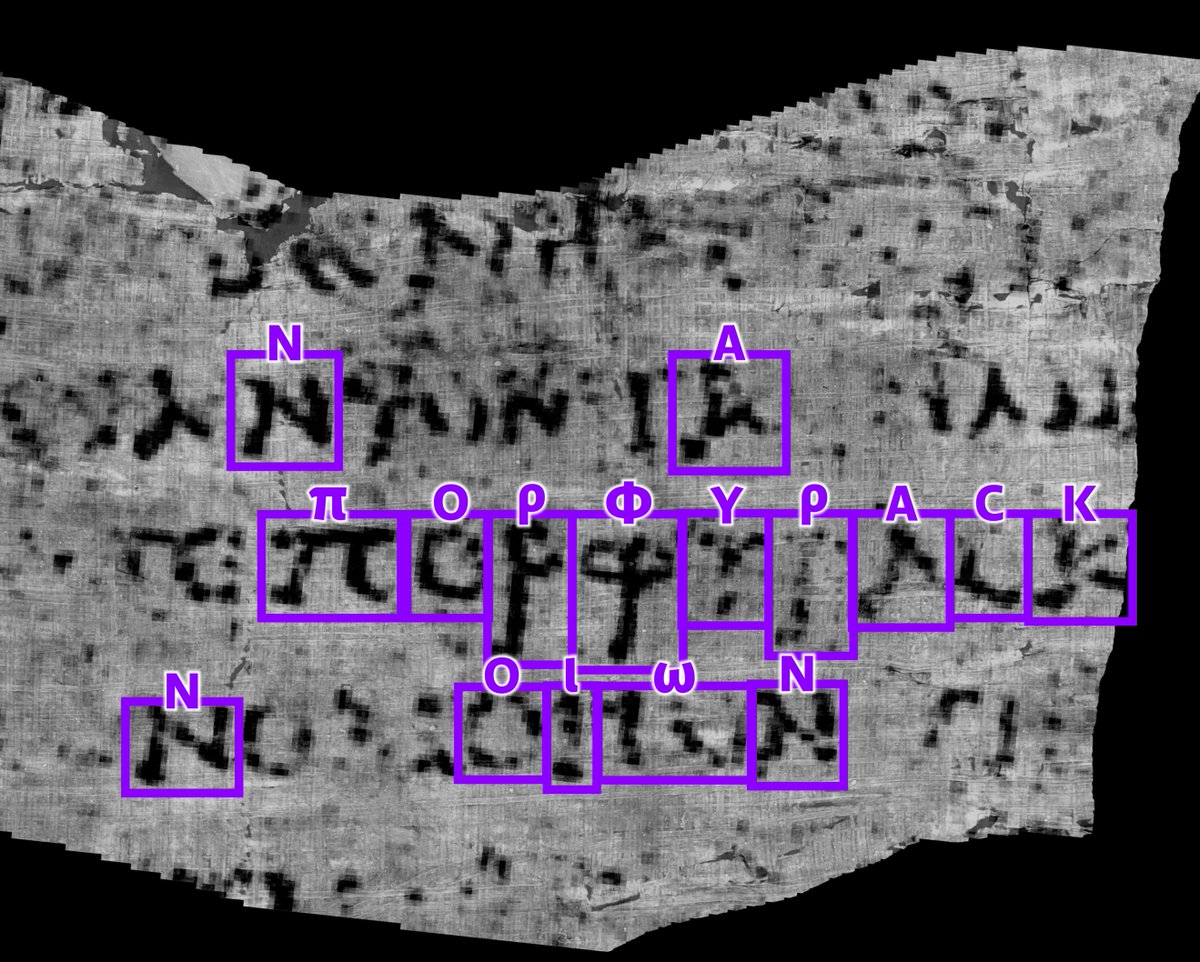
AI has allowed me to translate ancient texts that have never been in English and extract myths that were long forgotten centuries ago.
https://t.co/5eYgkw20YS
i think AI is about to set off the biggest wave of historical discoveries ever
and it's already started...
> AI read the full text of a scroll buried by Mount Vesuvius 2,000 years ago, revealing a lost work of Stoic philosophy and a book by the philosopher Philodemus that nobody knew existed
> AI deciphered another scroll from the same library and found Plato's exact burial spot, unknown for 2,000 years. the text even describes his final night, with Plato critiquing a flute player's rhythm from his deathbed
> an AI handwriting model showed some Dead Sea Scrolls are 50 to 100 years older than scholars believed, putting the Book of Daniel within its author's lifetime. we could be looking at something close to an original
> AI recovered a 250-line hymn to Babylon, one of the most copied texts of the ancient world, by matching 30 fragments scattered across museums worldwide. it had been lost for 1,000 years
> AI found 303 new Nazca lines in Peru in six months, nearly doubling one of archaeology's most famous mysteries after a century of human searching had only turned up 430
> AI reconstructed the rules of a 2,000-year-old Roman board game from nothing but the carvings on a limestone slab, simulating thousands of games until it found the ruleset that fit
everyone is excited about what AI will solve in the future
i'm equally excited about what AI will solve from the past
Absolutely beautiful rant about AI in Linux Kernel from Linus yesterday:
I realize that some people really dislike AI, but this is an area
where I'm willing to absolutely put my foot down as the top-level
maintainer.
Linux is not one of those anti-AI projects, and if somebody has issues
with that, they can do the open-source thing and fork it.
Or just walk away.
AI is a tool, just like other tools we use. And it's clearly a useful one.
It may not have been that "clearly" even just a year ago, but it's no
longer in question today.
There are other questions around AI (like what the economy of it will
actually look like in the end), but "is it useful" is no longer one of
those questions. Anybody who doubts that clearly hasn't actually used
it.
Yes, it can also be a somewhat painful tool, both for maintainer
workloads and just from a "it keeps finding embarrassing bugs"
standpoint.
But the solution is not to put your head in the sand and sing "La La
La, I can't hear you" at the top of your voice like some people seem
to do.
The solution is to make sure those LLM tools _help_ maintainers
instead of just causing them pain. There's no question on that side.
We're not forcing anybody to use it, but I will very loudly ignore
people who try to argue against other people from using it.
And no, AI isn't perfect. But Christ, anybody who points to the
problems at AI had better be looking in the mirror and pointing at
themselves at the same time.
Because it's not like natural intelligence is always all that great either.
The kernel project has been and will continue to be about the technology.
Sure, the social angle of working on open source is important and
often a very motivating part of the project, but in the end that's a
side benefit, not the _point_ of the project.
This is *NOT* some kind of "social warrior" project, never has been,
and never will be.
In the kernel community we do open source because it results in better
technology, not because of religious reasons.
And so we make decisions primarily based on technical merit. Not fear
of new tools.
Linus
@MatthewBerman I’m using opus still, and lots of skills with rules, and looping rules, to stretch everything out, but it’s horrible lol.
I basically go from claude to grok+local Qwen when I run out of tokens.
Very compelling argument to switch back to using Codex. I keep running out of tokens on Claude about 72 hours into the weekly reset and it’s such a pain.
Once we have completed our review for security vulnerabilities, we will make the entire codebase of 𝕏 open source, with no exceptions.
Moreover, we will invite third party reviewers to examine the system that is running to confirm that the open source code is what is running.
Trust through total transparency is the only thing that should be believed.