When Henry Ford arrived in England, he asked for the cheapest room in town.
The clerk at the counter was confused.
Standing in front of him was one of the richest and most famous men in the world the founder of Ford Motor Company.
Yet his coat looked old.
His suitcase was plain.
And instead of luxury, he simply asked:
“Where’s the most economical place to stay?”
The clerk stared at him for a moment before asking carefully:
“Excuse me… are you Henry Ford?”
Ford nodded.
Still shocked, the clerk said:
“Your son stays in the finest hotels and wears expensive suits.
But you’re asking for the cheapest room… wearing an old coat.
Why?”
Ford smiled and replied:
“All I need is a place to sleep.
Wherever I go, I’m still Henry Ford.”
Then he touched his coat and added:
“This belonged to my father. It keeps me warm. That’s enough.”
And then came the line that stayed with people:
“My son still worries too much about what others think.
I learned long ago that you don’t pay for approval.
I didn’t become rich by spending money.
I became rich by understanding what matters and what doesn’t.”
That’s the difference between looking wealthy and understanding wealth.
Real confidence doesn’t need luxury to prove itself.
Because your value isn’t your hotel room.
Or your clothes.
Or the opinions of strangers.
You are who you are wherever you are.
Robert Downey Jr. nailed that magical feeling we all chase on JRE:
“70% of it is just staying out of your own way.”
The rest? That super thin, invisible thread you can feel tugging. You pause when agitated, move when it pulls, and suddenly the right wall has the map behind it.
He calls it synchronicity. Intuition. That quiet inner smile when you just know, this is it. Love, friendship, career, path… it all clicks.
True mastery isn’t about forcing the current, it’s learning to recognize the subtle pull of the river and surrender to its flow. The moments we stop pushing are often the ones where life begins to arrange itself.
In a world obsessed with hustle and control, this is a powerful reminder that alignment and real success often come from presence and trust, not endless grinding.
When was the last time you felt that inner smile of “this is it”, and what were you doing (or not doing) right before it happened?
You don’t have to rush your journey. 🤍
Some days, even the smallest step forward is enough.
Little by little, healing happens, dreams grow, and life starts changing in beautiful ways.
Keep going at your own pace.
Your destination is closer than you think. ✨
Comedian Pete Holmes shares the simplest mental health tool he's ever used: "Yes, thank you."
Pete was sent advance copies of his own book to send out to reviewers.
When he looked through it, he realised it was three versions old filled with notes to himself, a placeholder word ("flappy") scattered throughout, and entire chapters he'd cut.
"It was just my first book deeply disappointing."
"You feel this like black cloud. You're just sad. Then you're embarrassed. To me it's the feeling and then it's the embarrassment that you have the feeling. It's worse than the feeling."
But instead of spiralling, Pete applied the exact tool he'd written about in that very book.
He said: "Yes, thank you."
And it lifted.
Pete explains why this works and it's simpler than any therapy framework or spiritual practice:
"It just short-circuits your brain if you say yes, thank you to it. And I mean almost instantly in my experience."
Flight delayed? Yes, thank you.
Embarrassed about your own book? Yes, thank you.
He breaks down the psychology behind it:
"Everything [is] attraction and aversion. Aversion is just charging it with all of this push. Like a basketball underwater. So you're giving it all the energy."
When you resist a bad feeling, you compress it. You give it power. "Yes, thank you" does the opposite, it stops the fight.
And you don't need to make it profound:
"It can just be a clean breath and a recognition that you're alive. And maybe you see the sun coming through the window."
Most of our suffering is the layer of resistance we pile on top of it. The embarrassment about the embarrassment. The frustration about the frustration.
"Yes, thank you" collapses that second layer instantly by simply not fighting it.
"Really not debating with the bad feeling. Just saying yes, thank you to it. That's been one of the most powerful things in my life for sure."
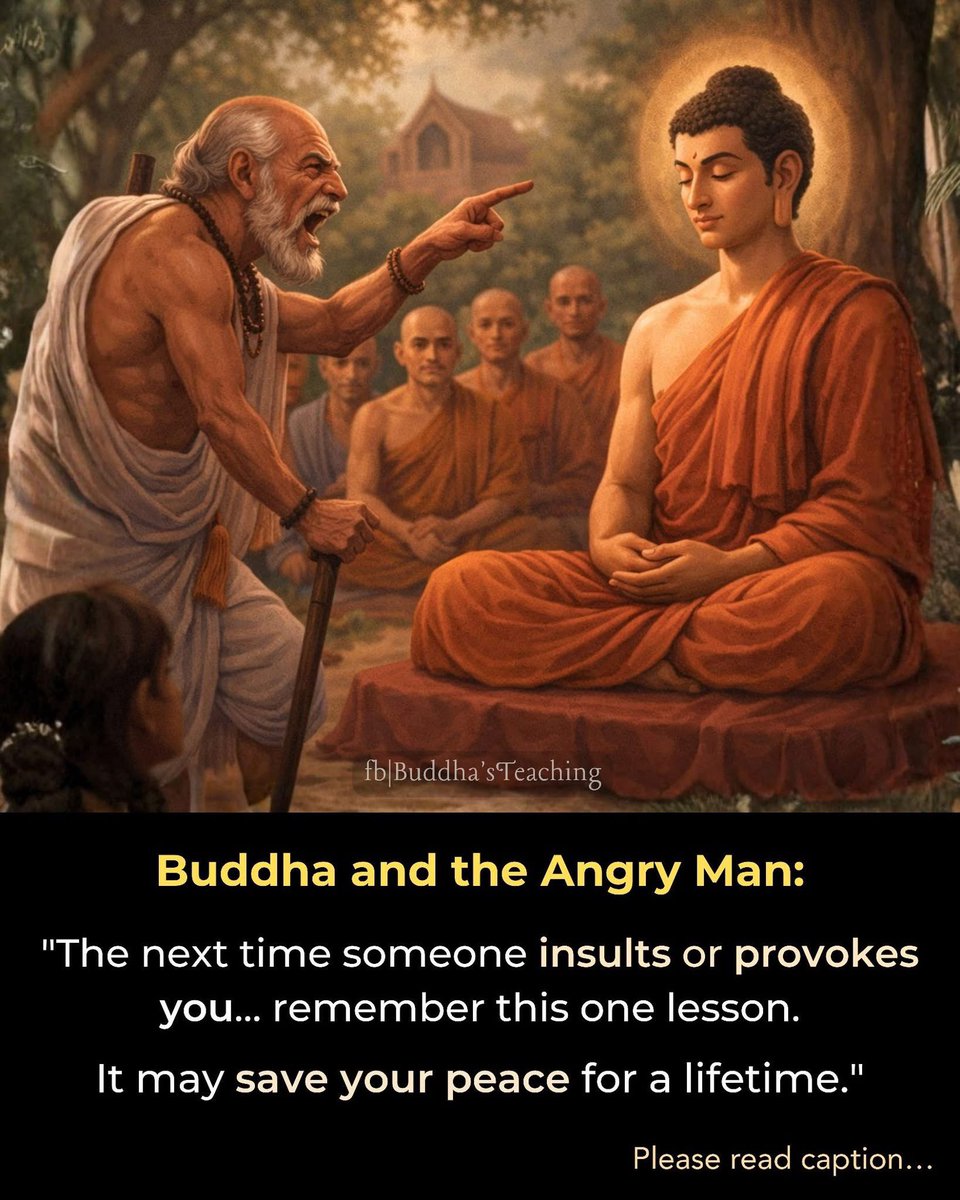
The Buddha and the Angry Man
One day, while the Buddha was walking with his disciples, a furious man rushed toward him.
His face was burning with anger.
His words were harsh and full of bitterness.
He shouted, insulted, and tried again and again to provoke him.
The disciples became upset.
Some stepped forward and asked Buddha for permission to send the man away.
But the Buddha remained calm…
silent…
unmoved — like a deep lake that stays still even when the wind blows across its surface.
The man kept shouting until he had no strength left.
And when silence finally fell, the Buddha gently asked him:
“My friend, if someone offers you a gift, and you do not accept it… who does the gift belong to?”
The man, surprised by the question, replied,
“It belongs to the one who offered it.”
The Buddha smiled and said:
“In the same way, you came here to offer me anger, insults, and hatred.
But I do not accept them.
So they remain with you… not with me.”
The man stood speechless.
For the first time, he saw the truth clearly:
Anger has no power…
unless someone chooses to receive it.
Takeaway
Not every insult deserves a response.
Not every argument deserves your energy.
Sometimes the strongest thing you can do
is remain calm… and walk away with your peace.
Let others keep their anger.
You keep your peace.
✨🙌🏾💫
Your walk is physically growing your brain. That’s not a metaphor.
Every year after 50, your brain’s memory region shrinks by about 1-2%. Researchers at the University of Pittsburgh put 120 older adults into two groups. One walked 40 minutes a day, three days a week, for a full year. The other just stretched. Brain scans showed the walkers’ memory region grew by 2%, undoing one to two years of shrinkage. The stretching group shrank by another 1.4%.
It changes how you think too. Stanford tested 176 people on creative tasks while sitting and then while walking. Creative output jumped 60%. Even on a treadmill facing a blank wall.
Every single person who walked outside produced at least one strong original idea, while only half the seated group managed it. The boost stuck around even after they sat back down.
A 2024 review in the British Medical Journal looked at 218 studies and found that walking and jogging worked about as well as antidepressants for depression. For people already dealing with clinical depression, a separate analysis of 75 studies found the benefit was about 4x what it was for everyone else.
You don’t even need 10,000 steps. That number came from a 1960s Japanese marketing campaign for a pedometer, not from any medical study. When researchers tracked over 226,000 people, every extra 1,000 steps per day lowered the risk of early death. Around 9,000 steps a day is enough to cut that risk by 39%.
A pair of shoes and a door. No prescription needed.
“You can get addicted to peace and you can also get addicted to chaos”. - Denzel Washington on creating healthier habits and your improving lifestyle.
“Anything you practice, you get good at. Positively or negatively. Spend a half an hour every morning in quiet time first. Don't go *sighs and grabs your phone*, we're all guilty of it. It's very hard to do. You do it. Start with five minutes. Don't turn on any lights. Put your feet on the floor. Take some deep breaths and say thank you. And then just be quiet. You'll find it very hard to do. When you get quiet, you start to hear things. Don't even worry about a half hour. Try 10 minutes. Whether you pray, whether you meditate, no music, no nothing, just sound. Just try to be quiet first because what you're reacting to is peace. Once you get up and grab the things or whatever, what you're reacting to is chaos. You can get addicted to peace and you can also get addicted to chaos”.
🔗 https://t.co/8Su9h3dFlz
Great story from Coach K on running into a former camper and the lesson this man carried with him.
Coach K asked all the kids at the camp...
"Who do you talk to the most?"
“Yourself… so when you talk to yourself, why not be yourself's best friend?”
A lot of performers are entertaining an internal voice that’s critical, impatient, and unforgiving.
We say things to ourselves we’d never say to a teammate and then we expect confidence, consistency, and composure to follow.
You're in a lifelong conversation with yourself. Make it one worth having.
📹: Sons and Daughters Podcast
You come home exhausted after a long day at your desk… so you collapse on the couch to “relax.”
Big mistake.
Guy Winch:
“Relaxation is only 50% of the story. Your brain confuses physical and mental exhaustion. Most of us are mentally drained, not physically. Relaxation won’t recharge you — it just won’t drain you further.
What actually fills the battery? Active recharging — painting if you’re creative, organizing if you’re structured, socializing if you’re an extrovert. Force yourself to do the thing that energizes you, even when you feel wiped out. You’ll sleep better and wake up less drained.”
The biggest burnout trap: “I’m tired, so I’ll just relax.”
Mental fatigue requires mental replenishment. Passive scrolling or zoning out doesn’t restore cognitive resources the way purposeful, engaging activity does.
Do you default to passive relaxation when burned out — or do you force an active recharge?
What actually leaves you feeling more energized afterward?
Your experience 👇
Jordan Peterson: "You're underestimating how much you can improve"
"If the gap between you and your ideal is so great that it paralyzes you, you've created a dragon you don't have the tools to master. So you have to scale the dragon down to size. You want to scale it down until it's a size you're willing to move toward, however small that is."
Jordan explains the math behind growth:
"There's a gospel principle called the Matthew Principle: to those who have everything, more will be given. It implies that reality works like this: when you're moving up, it's exponential. When you're going down, it's downhill, then cliff. So it doesn't matter how small your first steps are, even if they're shameful in their size. Because if you're disciplined, you'll speed up extraordinarily rapidly. The ball doesn't roll in a linear fashion. It rolls in a geometric fashion."
He shares his own story:
"When I first started going to the gym, I was 23. I weighed 135 pounds at 6'1". Very thin. I smoked like mad, drank too much. I wasn't in good shape. I went to this swim class, it was me, a really overweight young guy, and seven women over 70. They could outswim me. It was pretty damn humiliating."
Jordan continues:
"Then I started lifting weights. I'd be underneath the bench press trying to lift 75 pounds, and some muscle-headed bastard would come over and tell me how to do it. It's embarrassing. Lots of people won't go to the gym because they're embarrassed about how they look. But you start at the bottom where you're weak. If you want to rectify what's weak, you have to accept that the first steps are going to be painful."
The result:
"It took me about 3 years, but I stopped smoking, stopped drinking, and gained 40 pounds of muscle. I got a lot more physically confident. A lot more coordinated. Then I could dance, so that was better when I was going out in graduate school."
He explains why self-reflection matters:
"If your plans didn't work out, sit down and say: 'Even if the world was conspiring against me and my failure was 95% the fault of external circumstances, what did I do that wasn't as good as it could have been? Where did I fail to look?' To ask that question, you have to want the answer. That's what it means to knock, to ask, to seek. You have to want to know."
Jordan concludes:
"One of the reasons you confess your sins is because you want to discover where you're insufficient. It's painful, but the advantage is you can rectify the error. And then as you move forward, you're stronger."