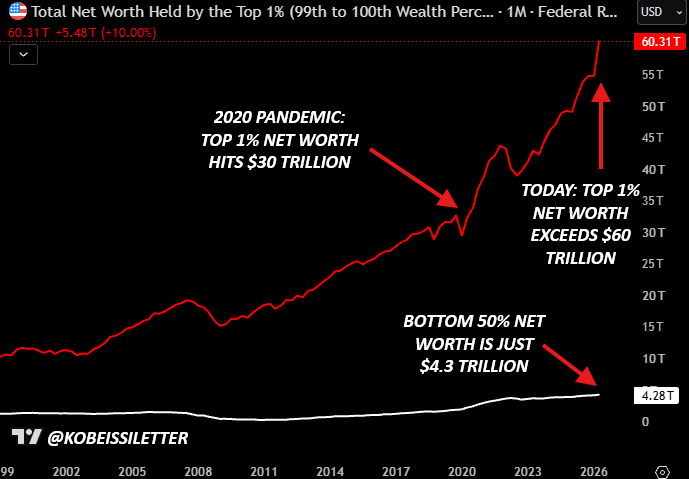
The middle class is gone.
According to Fed data, the top 1% of Americans now control ONE-THIRD of all US net worth.
Since 2020, the top 1% have gained +$30 TRILLION in net worth, while the bottom 50% are worth just $4.3 trillion.
What is happening? Let us explain.
(a thread)
What would the world have to look like for $60K $ETH to be rational?
> Ethereum settles trillions in tokenized assets.
> Stablecoins become global digital money.
> L2s serve billions of users.
> AI agents transact autonomously.
> DeFi becomes financial infrastructure.
Ethereum becomes the neutral settlement layer underneath the digital economy and the average person doesn’t even know they’re using Ethereum.
The roadmap is already moving toward this future.
Pectra > smarter accounts
Fusaka > more L2 data
Glamsterdam > more execution capacity
Hegotá > stronger censorship resistance
Beyond > scaling, privacy and security
Making Ethereum become infrastructure for a global, programmable economy.
At $60K, ETH would be worth roughly $7T.
For that valuation to make sense, Ethereum wouldn’t just need more users.
It would need to become one of the world’s most important financial settlement networks.
$60K ETH isn’t really a price target.
It’s a statement about what Ethereum could become.
Ethereum Is Following Institutional Demand, Not Trends
SharpLink CEO Joseph Chalom says institutions want security, trust, and liquidity, "and Ethereum is dominating on all three.”
That makes sense when the trade size moves from millions to billions.
Institutions care less about saving a few cents on fees and more about:
• Can the network stay secure?
• Can a risk committee trust the infrastructure?
• Can billions enter and exit without destroying liquidity?
Ethereum already has the strongest combination of these three.
• Security: Ethereum has operated continuously for more than a decade, with a large economic security base and a broad validator ecosystem.
• Trust: Major institutions are already building on Ethereum, from tokenized funds to stablecoins and ETFs. That creates a powerful network effect: each new institution sees less execution risk when the infrastructure is already proven.
• Liquidity: Ethereum remains deeply connected to stablecoins, RWAs, DeFi and L2s. For large players, deep liquidity matters because entering and exiting large positions can matter more than saving a few basis points on transaction fees.
And the most compelling part is the flywheel:
More institutional capital → deeper liquidity → more trust → more capital.
Other chains can compete on speed.
Ethereum is competing to become the financial infrastructure institutions are comfortable building on.
That is a much bigger game.
Never pick a side. Never join a team. Not the US vs China, not republican vs democrat, not men vs women, not black vs white.
The greatest enemy to tyranny is individualism, that is to say, informed people making informed decisions on a case by case basis.
Loyalty to a side is the end of objectivity and death of logic.
That’s why they push these fake binaries on people. They want to shut down your ability to reason.
We tend to treat these as separate stories. Bitcoin. Stablecoins. Tokenization. AI. AI agents.
Look at them together and a different picture appears.
The dollar is already onchain. More than $300 billion of stablecoins moved $11 trillion last year, and stocks, bonds and funds are starting to follow.
At the same time, AI agents are learning to do work on their own. They will need to pay for things at any hour, often in amounts too small for a card. Money that moves like software is built for exactly that.
Seventeen years of building the pieces without the picture on the box. I think they are starting to fit.
Link:https://t.co/wYCogBS0la
#AI #AIagents #Blockchain #Tokenization #Stablecoins #RWA #USD #Banking #Payments #Bitcoin
ELI5: FCR - Fast Confirmation Rule ✍️
@chainlink CCIP 2.0 is the first major FCR integration.
Ethereum finality takes ~13 minutes. Thanks to FCR, Chainlink CCIP can confirm Ethereum transactions in ~12-24 seconds.
Ethereum market infrastructure, ~30x faster.
🌎‼️ Hotel de Tulum cierra sin previo aviso y deja a 35 trabajadores en la calle.
La nueva administración de Our Habitas tomó una decisión inhumana: sin previo aviso, dejó a sus 35 empleados en la calle. Dos días antes de terminar la quincena simplemente cerró sus puertas, negando sus derechos laborales como su última quincena, liquidación y demás prestaciones.
Our Habitas era famoso por ser uno de los pocos hoteles con la mayoría de sus trabajadores originarios de la zona maya. Por tal motivo, su trato era siempre servicial principalmente con los mexicanos.
Pero desde que la transnacional All Accor Group compró el hotel las cosas cambiaron. Los empleados aseguran que aún mantenían una buena ocupación gracias a su calidad de servicio, por lo que es impensable que el cierre se haya dado por cuestiones económicas, sino que más bien obedece a políticas de la gerencia extranjera.
Los trabajadores exigen una liquidación justa. El canal TulumFM elaboró un reportaje amplio sobre esta situación que recomendamos ver, y así conozcan a estas personas que ahora no solo se quedaron sin empleo, sino sin su último pago sin previo aviso, afectando la economía de sus familias.