Agentic AI adoption is on fire at @Uber, and it's changing the way we build, not just in engineering, but across the entire company.
Today, 99% of our engineers use AI tools. More than 70% of pull requests are attributed to local or cloud agents. And our engineers have built 2,500+ agent skills across the software development lifecycle.
Those numbers are exciting, but they led us to a much bigger question:
How do we bring agentic AI beyond engineering?
Finance. Legal. Operations. Marketing. Customer Support. HR. Procurement.
These functions run on complex workflows that are often manual, highly nuanced, and spread across dozens of systems. You can't automate them effectively by looking at process diagrams or documentation. You have to understand how the work actually gets done.
So we created something called Agentic Pods.
The idea is simple.
We handpicked ~30 of our most AI-proficient engineers (people with deep knowledge of Uber's systems) and paired each of them with a domain expert from a business function.
Then we gave every pod just two weeks.
• Days 1 – 2: Shadow the expert. Observe every step. Document workflows. Ask questions. Build intuition.
• Day 3: Prioritize opportunities based on scale, repetition, business impact, and data availability.
• Days 4 – 5: Build a working agent alongside the person doing the job.
• Days 6 – 9: Validate with several others performing the same work. Does it generalize? Does it actually make their job better?
• Day 10: Ship.
In just the past two months, we've run 16 Agentic Pods across 16 different business functions.
• Capital allocation across 150 cities: 15 hours → 30 minutes.
• Financial pacing reports: 2 days → 10 minutes.
• Marketing web quality assurance: 2 weeks → 50 minutes.
• Support workflow creation: 9,000 manual workflows → self-service automation.
The productivity gains are impressive, but what surprised us most wasn't the speed.
• It was how quickly engineers embedded in unfamiliar domains uncovered opportunities that had been hiding in plain sight.
• The biggest wins rarely come from automating one task. They come from rethinking an entire workflow. Once you redesign the workflow around AI, you often eliminate handoffs, remove unnecessary approvals, replace legacy tooling, reduce vendor spend, and dramatically accelerate decision-making.
• The workflow becomes the unit of automation - not the individual task.
• The most impactful agent skills cut across teams, orgs, functions, tools, and systems.
The biggest lesson? The best AI opportunities are rarely visible from the outside.
You discover them by sitting next to the people doing the work, understanding every friction point, and building with them, not for them.
We're now forming a dedicated team to scale this further and go deeper. They'll deeply understand the work, redesign it from the ground up, and use AI to fundamentally change how the business operates.
It's exciting times!
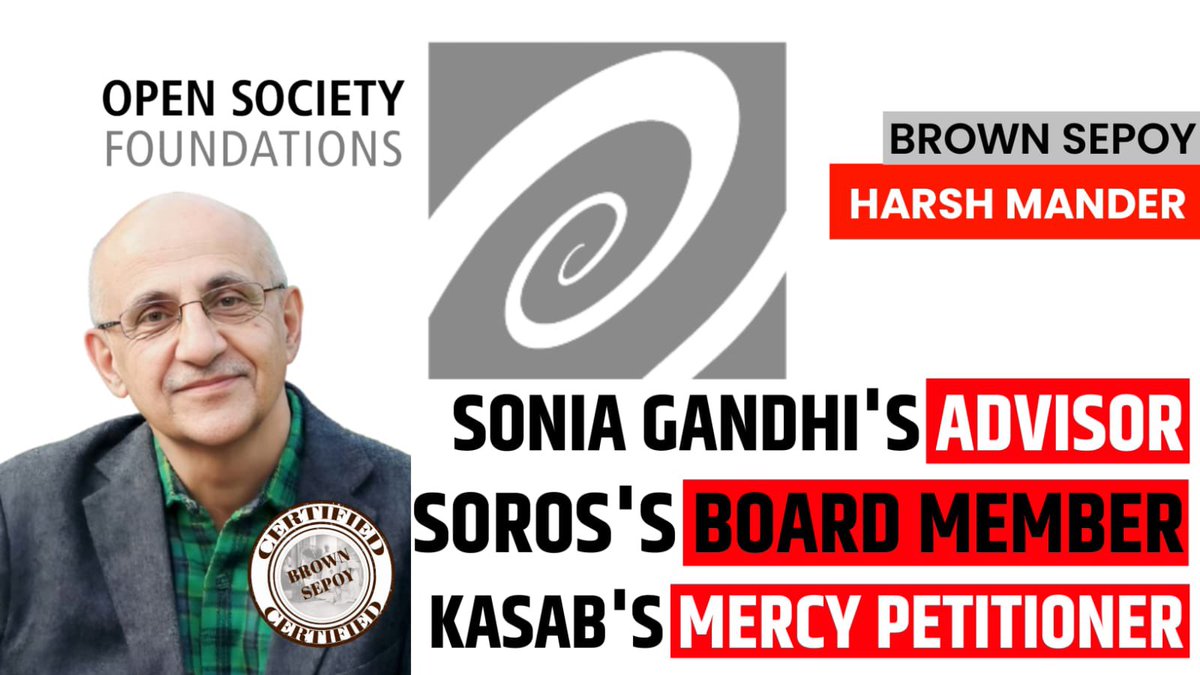
Brown Sepoy of the day is
“Harsh Mander”.
🧵 Former IAS officer. Sonia Gandhi's NAC member. George Soros's Open Society Foundation advisory board. Signed mercy petitions for Ajmal Kasab, Yakub Memon, and Afzal Guru. CBI has raided him. His NGO's FCRA licence is suspended.
We should brace for a BIG Pakistani terror attack soon. It’s the pattern.
• 43 pak troops killed in Balochistan
• remember the Pahalgam attack was preceded by the Balochistan train attack
• India was blamed for that attack as well
• Pakistan likes to test new found security partners
• remember they carried out the Parliament attack in Dec 2001, just 3 months after 9/11
• this was done to test the reliability of US security guarantees after Pakistan agreed to host the US invasion of Afghanistan
• going against an Islamic country - not popular
• India serves as a useful distraction from domestic failure
• when India retaliates, they can play victim, claim victory & promote Munir to grand supreme marshal
I co-founded Wikipedia, but an anonymous mob runs the show—and now I’m banned.
I told the story in the Washington Examiner, out this morning:
https://t.co/IubzC65BoC
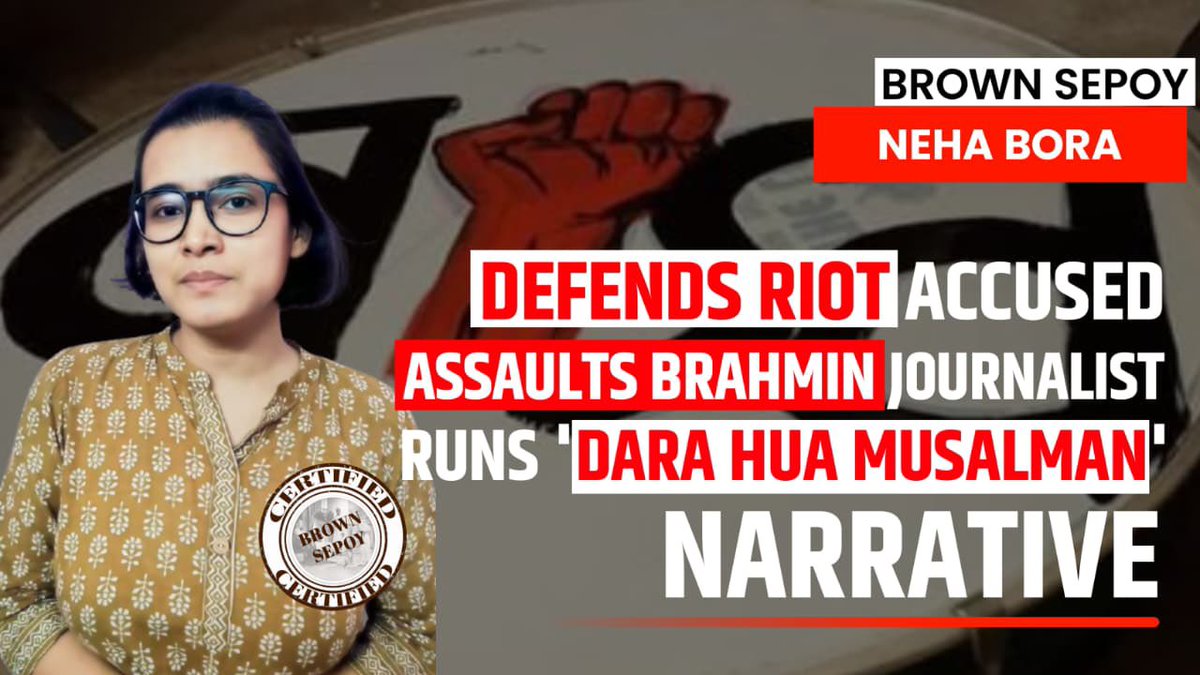
Brown Sepoy of the day is
“Neha Bora”.
She's the national president of AISA. She defended Delhi riots accused as "ordinary students," laughed with Arundhati Roy, who said Kashmir is not an integral part of India, and frames Hindu unity as a threat to Muslims.
The movie Satluj is a textbook example of manufactured history. It claims to show the truth, but it purposely hides the real facts
The film completely ignores the bombings, bus massacres, and brutal violence caused by Khalistani terrorists against thousands of innocent people. By erasing the real killers from the story, it is not history but propaganda.
Showing only one side of the story is dishonest. Weaponizing a one-sided narrative while completely silencing the actual victims of terrorism is a dangerous game. You cannot just blame the police and give a free pass to the armed terrorists who actually started the bloodshed in Punjab.
Caring about only side of the story makes it a lie. True justice means remembering every innocent life lost, not just the ones that fit a political agenda.
It is time to stop falling for half-truths meant to brainwash the next generation.
Brown Sepoy of the day is
“Harish Khare”.
🧵 He was PM Manmohan Singh's media advisor. Now he writes for The Wire, calling Operation Sindoor "stunted imagination," & defending UAPA-chargesheeted riot accused as "intellectual architects”.
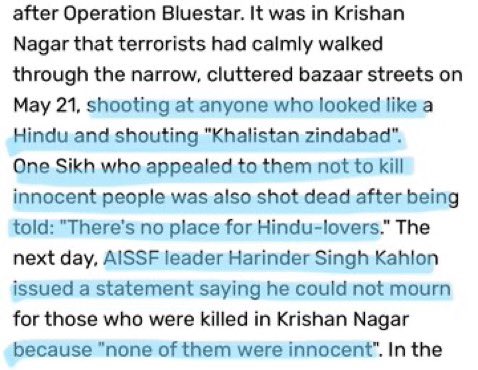
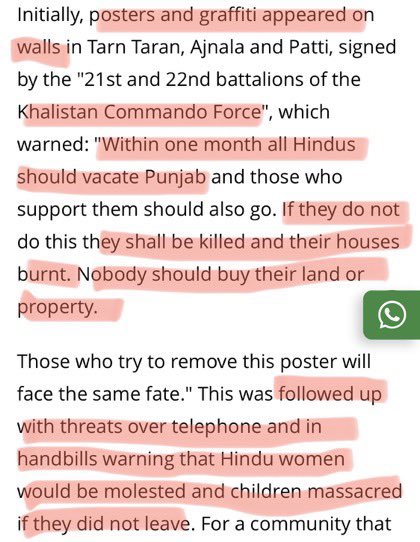
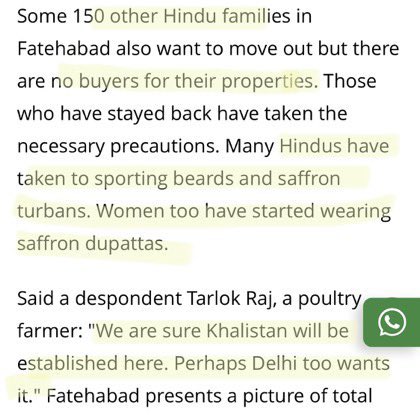
Khalistanis ordered Hindus to flee Punjab or their women’ll be violated. None was to buy their homes either. Any Sikh expressing sympathy was killed. Hindus started hiding their identity.
When God had forsaken Pb, braveheart @tavleen_singh risked life to bring this evil to light.
Nothing happened to Sikhs until some brainwashed idiots fed on Pakistani money introduced terrorism and stole their brightest and bravest to become foot soldiers of murderous organizations. That is when tragedy happened.
'Sant' Jernail Singh Bhindranwale and his ardent supporter and admirer, the 'human rights' activitis Jaswant Singh Khalra.
Seems it was perfectly OK for Sant ji to threaten massacre of 5,000 Hindus/hour and Sikhs like Khalra found no issue with it.
The Pb-K issue peaked just when defence spend touched 4% of GDP - this causation👇is faux.
All nation states have deep, principally-problematic redlines - US has Gitmo, Israel banned Jenin,Jenin, UK refused universal suffrage to catholics till the late 1960s. India has its own.
The protests in Pakistan-occupied Jammu and Kashmir have entered a phase where they can no longer be dismissed as sporadic disturbances. Yet much of the commentary in India has been less about understanding what is happening there and more about fitting it into an Indian political narrative. Every slogan against Islamabad is being read as a slogan for India. Now, that is an assumption worth examining.
There is little doubt that the present agitation has moved beyond demands over prices, electricity and governance. It has acquired an unmistakable political dimension, with sections of the protesters openly questioning Pakistan’s authority over the territory. That, however, is not the same as saying they are looking towards India. These are two very different propositions.
It is easy to mistake hostility towards one state for affection towards another, particularly in a conflict as layered as this one. But decades of Pakistani political control, ideological influence and cross-border conflict have shaped public attitudes in ways that cannot simply be wished away.
The more interesting observation is how restrained the Indian state has been. New Delhi has never diluted its legal position that Pakistan-occupied Jammu and Kashmir forms part of India. Yet its response to the ongoing unrest has been notably measured, almost clinical. Contrast that with sections of the Indian media that are effectively projecting the protests as the beginning of an inevitable return to India. If the situation were as straightforward as they suggest, one would have expected the Indian establishment itself to sound considerably more assertive.
The explanation probably lies in exactly what distinguishes narrative from statecraft. The Indian state, like any state, has to think beyond headlines. It understands that a serious deterioration in Pakistan-occupied Jammu and Kashmir is not necessarily in India’s strategic interest. It could create humanitarian, security and diplomatic challenges that New Delhi would not want to be confronted with. History offers enough examples from the subcontinent to show that instability in the neighbourhood rarely remains somebody else’s problem. That perhaps explains why the Indian state’s response has been markedly more measured than that of those who appear more eager to draw strategic conclusions than the Indian state itself.
There is another contrast that has attracted far less notice. While the conflict in Gaza has generated sustained political mobilisation among sections of Indian Muslim opinion, the violence in Pakistan-occupied Jammu and Kashmir, despite weeks of unrest and repeated use of excessive force by the Pakistani authorities, has not evoked anything close to a comparable level of public engagement.
The same is true of many Kashmiri political voices that routinely speak of a people divided across the Line of Control. If that idea carries moral weight, it cannot be turned on and off with circumstance.
The developments in Pakistan-occupied Jammu and Kashmir deserve to be analysed on their own terms, not pressed into service for competing narratives. The unrest is real, and Pakistan’s handling of it has even more serious implications. But the measured response of the Indian state is itself a reminder that strategic calculations are often more complex than political messaging. Sometimes, what governments choose not to say is every bit as revealing as what television studios choose to amplify.
Jaswant Singh Khalra was an advocate for a Khalistan state, and even ran a magazine called Liberation Khalistan.
In 1992, state elections.were announced. Khalistani ideologues like Khalra took extreme positions about it. Here are some snippets of what he wrote about it. 🧵
Khalra was OGW of Khalistan.
He egged Sikh youth to terrorism, venerated genocidal ogre Bhindranwale, valorized the most psychopathic massmurderers & rapists like Manochahal. His estimate of ppl disappeared by Pb police is based on outrageous conjecture & a tissue of lies.#Satluj
The movie should be released and I know everyone sensible would say that. I remember reading multiple authors from that time including @tavleen_singh@ShekharGupta and all have maintained these stories till now.
I remember my family in Punjab (we have Sikhs too) telling us police families would get kidnapped. Then they'd pick up Khalistani families and do hostage swaps. Punjab went through a brutal phase and I agree with Tavleen. Only Gill saahab could have solved it. It was gory and unfortunate.
I didn't meet my family in Punjab for 15 years. My family members got shot at and one got kidnapped by Khalistanis. Many horror stories happened.
Who is next after the Ramanujan?
In the mid-20th century, Western academic cartels claimed that advanced mathematics was a European construct, brought to a colonized India via British education. Tekkath Amayankottukurussi Kalathil Sarasvati Amma responded by spending decades deep in the forgotten archives of Kerala, translating archaic Sanskrit palm-leaf manuscripts with razor-sharp mathematical precision.
She proved that centuries before Sir Isaac Newton/Gottfried Leibniz were even born, unheralded Indian astronomers had already built the foundations of calculus & high-level geometry. This is the story of how an Unsung Scholar reclaimed the Intellectual Sovereignty of a Nation.
For generations under colonial rule, a deeply damaging psychological narrative was hammered into the Indian psyche: Your ancestors were mystics & poets, but they lacked the rigorous, logical discipline for advanced science & mathematics. The global academic consensus was that high-level geometry, infinite series, & calculus were the exclusive property of Europe.
India was viewed as a nation that needed to be civilized with Western numbers, completely oblivious to the fact that it had once been the mathematical capital of the world.
T.A. Sarasvati Amma was born in Kerala, a land with a deeply hidden, rich intellectual undercurrent. She was not an "uneducated" woman in the literal sense, she was a brilliant scholar of Sanskrit & Mathematics, but to the global elite who only validated degrees from Oxford/Cambridge/Harvard, she was an outsider working in the shadows.
In the 1950s & 60s, while working under the guidance of legendary scholars like Dr. V. Raghavan at the University of Madras, she realized that the history being taught in schools was a lie. She did not seek validation from Western journals. She went straight to the dirt, the dust & the decaying private libraries of old Kerala families.
She began unearthing 100s of brittle, centuries-old palm-leaf manuscripts written in a highly technical, coded astronomical Sanskrit.
Sarasvati Amma undertook a brutal, lonely intellectual pilgrimage. For yrs, w/o the aid of computers/digital databases/massive research grants, she painstakingly translated & mathematically mapped out texts like the Yuktibhasa, the Karanapaddhati & the Tantrasangraha.
Her pitch to the skeptical academic community was uncompromising: "I will not give you theories. I will give you the exact geometric proofs, calculated centuries before your European heroes walked the earth."
She discovered that in the 14th century, a mathematician named Madhava of Sangamagrama & his disciples in the Kerala School of Mathematics had already solved problems that Europe would not touch until the late 17th century.
Against all odds, in 1979, Sarasvati Amma published her magnum opus: "Geometry in Ancient and Medieval India." It was a masterclass in mathematical archaeology that fundamentally shook the foundations of global history.
She systematically proved that:
The Madhava-Gregory Series: The infinite series for pi*(4 X (1 - 1/3 + 1/5 - 1/7.......), attributed to the Scottish mathematician James Gregory in 1671, was recorded in India 300 yrs earlier.
For the 1st time in modern history, the West could not look down its nose. The proofs were right there, written on palm leaves, preserved by a quiet woman who refused to let her nation’s history be erased.
Sarasvati Amma’s work didn't build corporate empires/software companies, but it did something far more powerful: it restored the intellectual self-respect of an entire civilization. Her book became the absolute gold standard reference for the history of mathematics worldwide, forcing global historians to slowly & reluctantly rewrite their textbooks.
She lived a fiercely quiet, simple life, retiring as a prof & spending her final yrs in her hometown in Kerala, completely disconnected from the blinding lights of fame. She passed away in 2000, largely unknown to the millions of Indian students who daily study the very calculus her work reclaimed.
T.A. Sarasvati Amma proved that the ultimate form of patriotism is the preservation of truth. She showed that a nation’s backbone is nott just built by industrial concrete/military might, but by its memory.
T.A. Sarasvati Amma proved that a lone Indian woman, armed with nothing but dusty palm leaves & an iron will, could rewrite the mathematical history of the world.
Let me explain the Kashmir conflict using a direct American parallel:
Imagine if, after the Civil War, the US permanently split into 2 nations: the progressive, secular Union in the North (India), and a regressive, hostile society of slave owners in the South (Pakistan). (1/8)
If you are still singing the "Happy Birthday" song and have not discovered the melodious Janmadinam Idam song in Sanskrit composed by Swami Tejomayananda, you are missing something. The birthday song in English merely wishes you a happy day but the Janmadinam song? It wishes you a life of meaning, purpose, blessings from Ishwara and fame coming from virtuous deeds. When it comes to profundity, it is hard to beat Sanskrit.
Brown Sepoy of the day is “Mukta Joshi”.
🧵 She spent 7 months "investigating" a Hindu American foundation for Al Jazeera. Filed a 3,000 word piece. Then wrote in her own conclusion "there is no evidence." 7 months and Qatar's money with zero proof.